Finding Auto Glass Repair Near Me Made Simple
Searching for auto glass repair near me? Discover how mobile service, insurance help, and safety recalibration make getting your windshield fixed fast and easy.
Oct 11, 2025
generated
auto glass repair near me, mobile windshield repair, ADAS recalibration, windshield replacement, car glass repair
When you type "auto glass repair near me" into a search bar, what you’re really looking for is a quick, painless fix that doesn't completely derail your day. The solution, more often than not, is mobile auto glass repair. This is a service where a certified professional comes directly to you—at home, at the office, pretty much anywhere your car is parked. It's all about saving you time and getting your car safely back on the road, fast.
Get Help Wherever You Are With Mobile Auto Glass Repair
Let's be real: nobody has time for a cracked windshield. Picture this: you get a rock chip on your morning commute. The old way meant calling a shop, trying to find an appointment that fits your schedule, driving across town, and then sitting in a waiting room. That whole ordeal can easily eat up half your day.
Mobile auto glass repair turns that entire process inside out.
Instead of you going to the shop, the shop comes to you. A trained technician pulls up in a fully-stocked service van with everything they need to do the job right. This means your windshield can be fixed in the company parking lot while you're in a meeting or in your own driveway while you're getting things done at home. It takes a major headache and turns it into a minor inconvenience.
This visual perfectly captures the convenience of on-site service—a technician taking care of a windshield repair right where the car is parked.
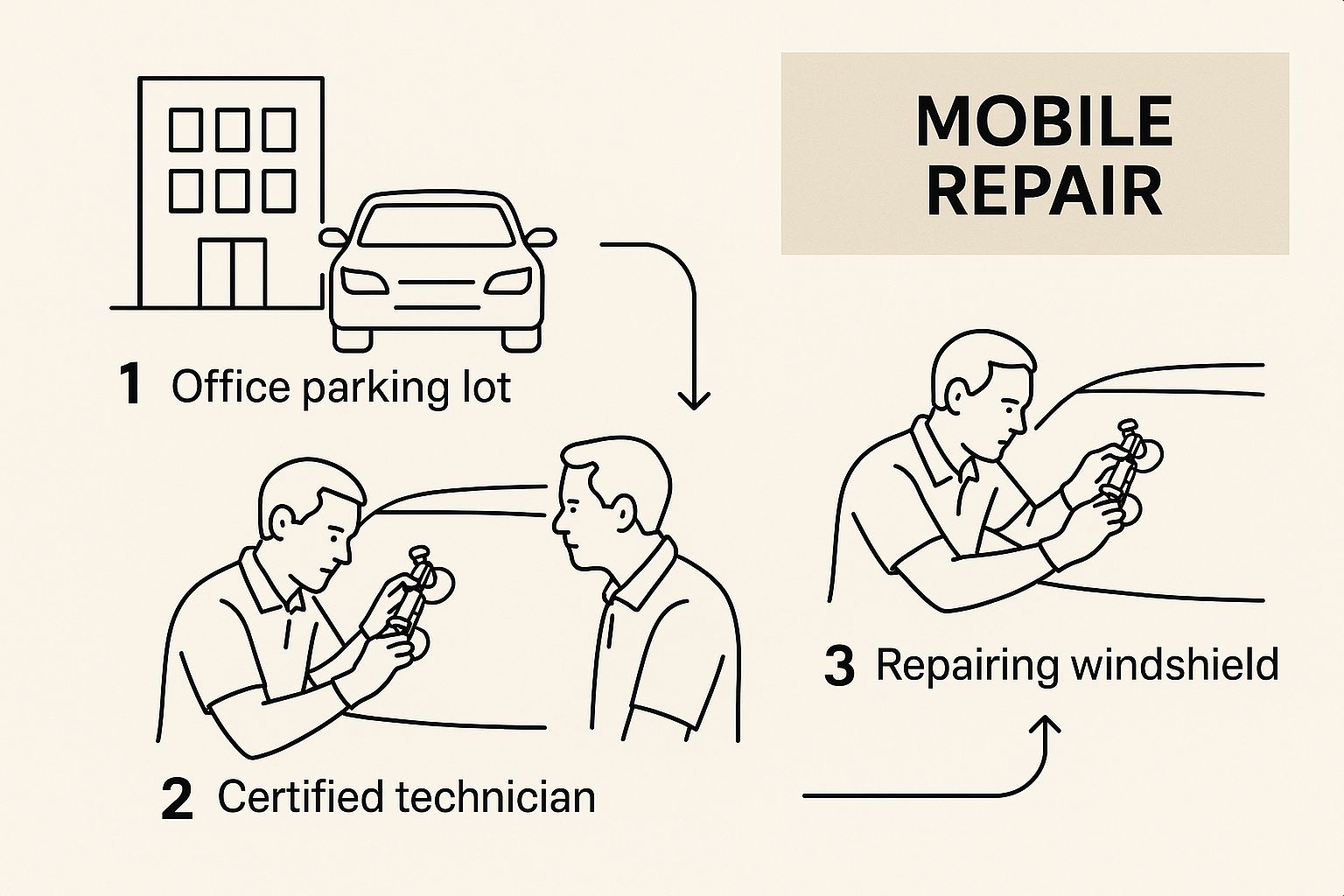
The real takeaway here is that your day keeps moving forward while your car gets the critical safety attention it needs.
The Growing Demand for On-Demand Service
It's no surprise that this "come-to-you" service model is becoming the new standard. The global glass repair market is on track to grow from an estimated USD 15 billion in 2025 at a compound annual growth rate of 6% through 2033. This isn't just a fad; it's a direct response to more cars being on the road and drivers needing solutions that fit their busy lives.
The real win with mobile repair isn't just skipping a trip to the shop. It's about immediately restoring your vehicle's safety and stopping a tiny chip from spreading into a massive crack that obstructs your vision and demands a full, expensive replacement.
Mobile Repair vs In-Shop Repair at a Glance
So, how does the mobile experience really stack up against a traditional shop visit? This quick comparison breaks it down.
Feature | Mobile Auto Glass Repair | Traditional In-Shop Repair |
|---|---|---|
Convenience | Technician comes to your location (home, work) | You must drive your vehicle to the shop |
Time Saved | Minimal disruption; service is done while you wait | Requires travel time and waiting at the facility |
Scheduling | Highly flexible to fit into your daily routine | Limited by shop hours and appointment availability |
Cost | Often comparable, with no extra travel expenses for you | May have overhead costs reflected in the price |
While both methods can get the job done, mobile service is clearly built around your schedule, not the other way around.
Ultimately, opting for a mobile service is a smart move that prioritizes your safety, time, and sanity. By having the experts come to you, you can get damage fixed right away without giving up a whole afternoon. Finding a reliable pro is easy, as many top providers offer service across various Bay Area locations.
What to Expect During Your Repair or Replacement
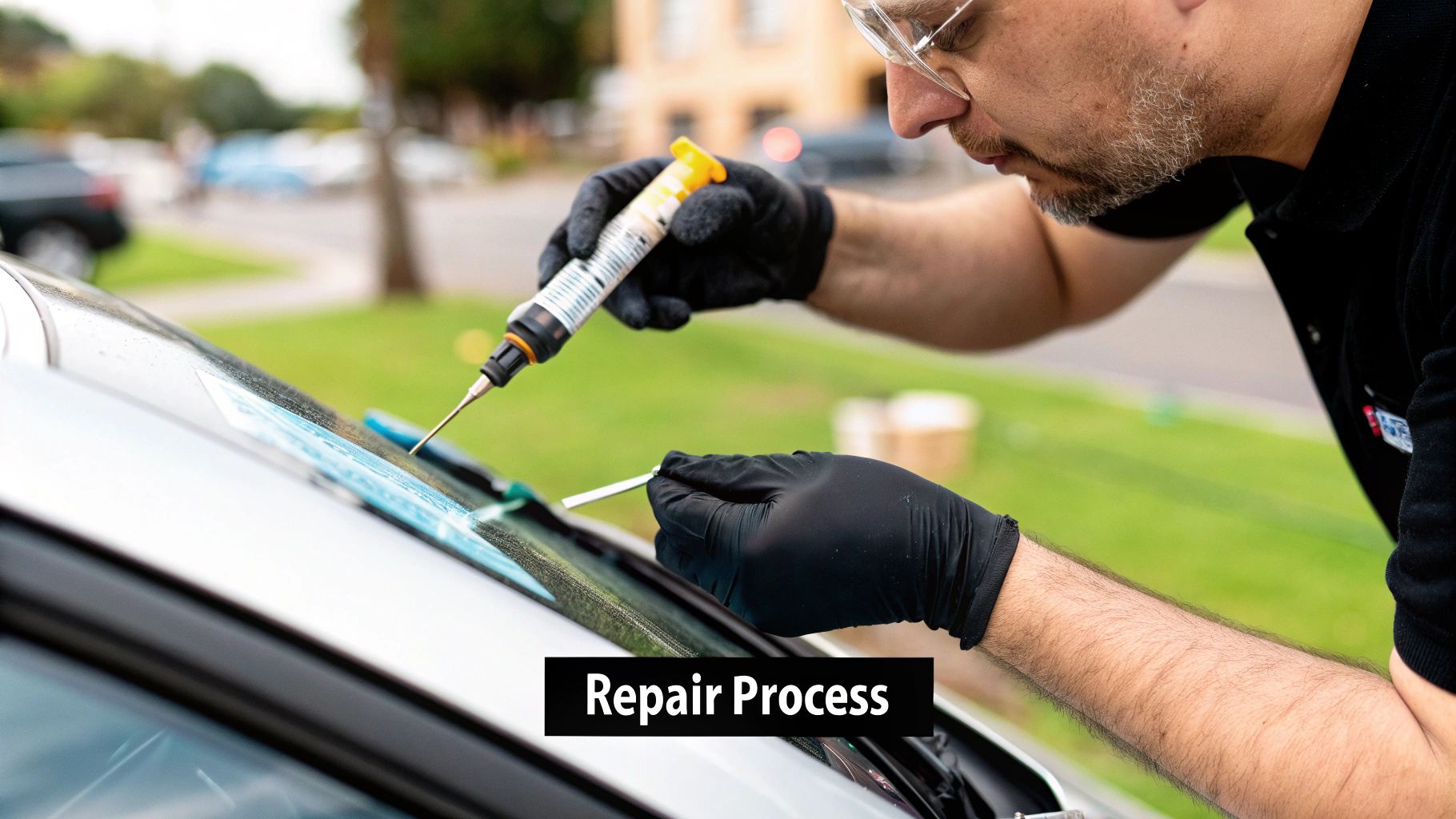
Knowing what’s going to happen when a technician shows up can take a lot of the stress out of getting your auto glass fixed. Whether you're dealing with a tiny rock chip or a crack that spans the entire windshield, the end goal is always the same: getting your vehicle back to its original state of safety and strength. From the moment we arrive to the final quality check, it's a carefully handled process.
The first thing our technician will do is give the damage a thorough once-over. This isn't just a quick glance; this inspection tells us exactly what needs to be done. We’re looking at more than just the size of the chip—its location, depth, and type are all critical. Damage that’s right in your line of sight, for instance, or too close to the edge of the windshield almost always means a full replacement is the only safe option.
The Windshield Chip Repair Process
If the damage is minor, a repair is usually the best and most cost-effective solution. You can think of it a lot like a dentist filling a cavity. We’re not replacing the whole tooth, just treating the problem area to stop it from getting worse and to restore its original strength.
The process itself is pretty slick and uses some very specific tools:
Prep Work: First, we meticulously clean the impact point, clearing out any tiny bits of glass or dirt. A clean surface is absolutely essential for the repair resin to create a strong, permanent bond.
Vacuum and Inject: A special device is placed directly over the chip. It first sucks all the air out of the crack—a crucial step—before injecting a high-quality, clear resin deep into the damaged layers of glass.
Curing: To finish the job, we use an ultraviolet (UV) light to cure and harden the resin. This solidifies the material, effectively bonding the glass back together and making it incredibly strong again. The entire repair usually takes less than 30 minutes.
Once the resin is cured, the spot is virtually invisible, and your windshield’s structural integrity is completely back to normal. It’s a quick and simple fix, which is why it pays to search for "auto glass repair near me" as soon as you notice a chip. A small repair now can easily prevent a big replacement bill later.
The Full Windshield Replacement Process
When a chip is too large or a crack is too long, a full replacement becomes necessary. This is a much more involved job where every detail matters. After all, your windshield is a key safety feature, providing up to 60% of your vehicle's structural strength in a rollover crash.
A professional replacement is a masterclass in precision and follows a strict protocol:
Protecting Your Vehicle: Before we do anything else, we cover your dashboard, hood, and seats to make sure they stay clean and protected from any adhesives.
Removing the Old Windshield: The damaged glass is carefully cut away from the vehicle's frame. We also remove any attached components like wipers, trim, and mounted sensors.
Preparing the Frame: This is one of the most important steps. We clean the frame where the new glass will sit, right down to the metal. Then, a special primer is applied to prevent any future rust and to help the new adhesive create a perfect, watertight seal.
Installing the New Glass: A bead of powerful urethane adhesive is applied to the frame, and the new windshield is carefully guided into place with professional-grade suction cups for a perfect fit.
Curing and Final Touches: The adhesive needs time to cure and form a solid bond. Our technician will provide you with a specific Safe Drive-Away Time (SDAT), which is the minimum amount of time you need to wait before getting back on the road.
Following the Safe Drive-Away Time isn’t just a suggestion—it's a critical safety instruction. Driving too soon can weaken the adhesive's bond, leading to leaks or, in a worst-case scenario, causing the windshield to fail during an accident.
Why ADAS Recalibration Is a Non-Negotiable Safety Step
https://www.youtube.com/embed/JCW3NBprtkA
If your car has features like lane-keeping assist, adaptive cruise control, or automatic emergency braking, your windshield is doing a lot more than just blocking the wind. It's a high-tech hub for your car's safety brain, the Advanced Driver-Assistance Systems (ADAS). These systems depend on cameras and sensors mounted right on the glass to "see" the world around you.
When a new windshield goes in, the camera's position can shift by just a millimeter. That might sound insignificant, but for your car's safety systems, it's a massive problem.
Here’s a good analogy: replacing a windshield without recalibrating the ADAS is like putting a new scope on a rifle and not sighting it in. Your aim will be off. For your car, this means its safety features might be looking in the wrong direction, misjudging distances, or failing to kick in when you need them most. This isn't just an inconvenience—it's a serious safety hazard.
Static vs. Dynamic Recalibration Explained
Recalibration isn't a one-size-fits-all job. The right method depends entirely on what your car's manufacturer specifies. The technician handling your "auto glass repair near me" will use one of two main approaches to get it done right.
Static Recalibration: This process happens in a controlled shop setting. The technician sets up special targets and patterns at very precise distances in front of your vehicle. Then, they connect to the car's computer to reset the system, essentially teaching it to recognize the new "straight ahead" position.
Dynamic Recalibration: This one involves actually driving the car. A technician takes it out on well-marked roads at specific speeds, allowing the ADAS camera to read lane markings and other road cues to re-align itself on the fly.
Some vehicles actually need a combination of both static and dynamic methods to get everything working perfectly again. For a deeper dive, check out our guide on what ADAS windshield calibration involves.
A Critical Step in a Growing Market
As this technology becomes standard, the need for proper ADAS recalibration is only getting more critical. The entire automotive glass replacement market is projected to hit USD 58.5 billion by 2029, a huge leap from USD 40.7 billion in 2025.
A big reason for this growth is how complex windshields have become. With ADAS integration, precise installation and electronic calibration are more crucial than ever before. You can read the full research on this market trend to see the numbers for yourself.
Skipping recalibration essentially turns off the very safety features you paid for when you bought your car. To ensure these life-saving systems work as intended after a windshield replacement, this precise electronic tuning is absolutely mandatory.
Making Insurance Claims for Glass Repair Painless
Let's be honest, the moment you see that chip or crack, your first thought is probably about the damage. The second is almost always, "Ugh, what a pain this is going to be with my insurance."
It’s a common dread, but I’ve got good news for you: it’s usually far simpler than you imagine. Most comprehensive insurance policies actually cover windshield repair and replacement, and you might not have to pay a dime out of pocket.
Insurers see it this way: a clear, structurally sound windshield is a critical safety component. They'd much rather pay for a quick repair now than deal with a massive claim from an accident caused by impaired vision or a compromised windshield later. In fact, for small chip repairs, many insurance companies will waive your deductible entirely. That means the fix is completely free for you.
Letting the Professionals Handle the Paperwork
You've got enough on your plate without adding "play phone tag with my insurance agent" to the list. This is where a great mobile auto glass company really shines—they become your advocate. You don't have to navigate the claim process alone.
Instead of you getting stuck in a maze of paperwork and hold music, a skilled team can take care of everything.
They’ll kick off the claim for you.
They will handle and submit all the necessary photos and documentation.
They bill your insurance company directly, so you aren't paying upfront and waiting weeks for a check in the mail.
This turns a potential headache into a simple, hands-off experience. You just schedule the repair, and we handle the rest in the background.
Will a Glass Claim Increase My Insurance Rates?
This is the big one, right? It's the number one question we get, and it’s a perfectly valid concern. Thankfully, the answer is almost always no.
Auto glass claims fall under your policy's comprehensive coverage, not collision.
Comprehensive coverage is for "no-fault" incidents—things completely out of your control, like a rock flying up from the highway, a tree branch falling, or vandalism. Since you didn’t cause the damage, insurers generally don't penalize you by raising your rates.
This system is in place for a reason. Insurers want you to get safety issues fixed right away, without worrying about a financial hit later. By letting a pro manage the claim, you get your vehicle back to being safe quickly and correctly, often with no cost and no effect on your premiums. It really is the path of least resistance.
How to Choose the Right Local Auto Glass Service
When you type "auto glass repair near me" into a search bar, you're often flooded with options. But how do you know who you can really trust with your vehicle? The truth is, not all auto glass shops are created equal.
Making the right choice goes way beyond just finding the cheapest quote. It’s about ensuring the work is done safely and correctly by true professionals. Your windshield is a critical safety component, so let’s talk about what really matters.
Verify Technician Certifications
First things first, check the credentials of the people who will actually be working on your car. You wouldn't hire an unlicensed electrician, right? The same logic applies here. Look for technicians who are certified by a respected organization like the Auto Glass Safety Council (AGSC).
That certification is more than just a piece of paper. It’s your assurance that the technician follows strict, industry-recognized safety standards for every single installation. It means they’re trained on the proper techniques and materials for your specific vehicle, which is absolutely crucial with today's complex car technology.
Prioritize Quality Materials and Warranty
The glass and adhesives used for your repair or replacement are non-negotiable. Reputable shops will insist on using Original Equipment Manufacturer (OEM) or Original Equipment Equivalent (OEE) glass. This is your guarantee that the new glass will fit perfectly and uphold the same safety standards as the one installed in the factory.
Beyond the materials, a great company will always stand behind its work.
A solid warranty should cover both the materials and the installation itself. If a shop is hesitant to offer a warranty, that’s a huge red flag. It usually means they aren't confident in the quality of their own service.
Evaluate Reputation and Spot Red Flags
Before you commit, do a little homework. A company's reputation is built one job at a time, and a quick online search can tell you a lot. Checking what previous customers have to say is one of the best ways to gauge what your experience will be like. For example, you can read reviews from our clients to see what a professional and seamless service looks like.
Always be wary of a price that seems too good to be true. A suspiciously low quote often means corners are being cut somewhere—whether it's with cheap glass, weak adhesives, or an inexperienced technician. Think of it as an investment in your safety. The global automotive glass market, valued at about USD 21.0 billion in 2025, is projected to hit USD 36.5 billion by 2035, driven by innovations like ADAS and smart glass. This trend underscores just how complex and important quality auto glass work has become. You can find more data on these advancements in automotive glass technology on FutureMarketInsights.com.
To help you sort through the options, we've put together a quick checklist.
Vetting Your Local Auto Glass Repair Provider
Criteria to Check | Why It's Important | What to Look For |
|---|---|---|
Technician Certification | Ensures the installer is trained in the latest safety standards and techniques. | Look for AGSC (Auto Glass Safety Council) certification. |
Material Quality | Guarantees a perfect fit and meets federal safety standards. | Ask if they use OEM (Original Equipment Manufacturer) or OEE (Original Equipment Equivalent) glass. |
Comprehensive Warranty | Protects you against defects in materials or workmanship after the job is done. | A lifetime warranty on workmanship is the industry standard for quality service. |
Insurance Assistance | A knowledgeable team can make the claims process smooth and hassle-free. | Ask if they work directly with your insurance provider. |
Online Reviews | Provides real-world insight into their customer service and quality of work. | Check Google, Yelp, and their company website for recent, detailed reviews. |
ADAS Recalibration | Critical for ensuring your vehicle's safety systems function correctly after a replacement. | Confirm they offer in-house or mobile ADAS recalibration services. |
Using this checklist can give you the confidence that you're not just getting a quick fix, but a safe, reliable repair that will last for years to come.
Got Questions? We’ve Got Answers.
Even with everything laid out, you probably still have a few things on your mind. It’s one thing to understand the process, but it's another to know how it fits into your real life. Let's tackle some of the most common questions we get from drivers just like you.
Think of this as the practical, no-nonsense part of the conversation. We'll cover timing, safety, and what happens when the Bay Area weather decides not to cooperate.
How Long Am I Sidelined? Breaking Down Repair Times
This is usually the first thing people ask, and for good reason—you have places to be. One of the best parts of our mobile service is how quickly we can get you back on the road.
A simple rock chip repair is incredibly fast. Most of the time, our technicians can have it fully sealed and finished in under 30 minutes. You can get it done on your lunch break, while you're on a conference call, or before you have to run out to pick up the kids. It’s designed for minimal disruption.
A full windshield replacement is a more involved job, of course. You can expect that to take between 60 to 90 minutes. After that, there’s a short but critical waiting period for the adhesive to set.
So, Can I Drive Off Immediately After a Replacement?
Hold on a second. This is a big one for safety. After a chip repair, yes, you can drive away instantly. But after a full windshield replacement, you absolutely need to wait.
The special urethane adhesive that holds your new windshield in place needs time to cure and create a rock-solid bond with your car’s frame. This is what we call the Safe Drive-Away Time (SDAT).
Your technician will give you a specific SDAT, usually somewhere between 30 and 60 minutes after they’ve finished the installation. This isn't just a suggestion—it's essential for your safety. Driving too early could weaken the seal, leading to leaks or, in the worst-case scenario, a complete failure of the windshield in an accident.
What if It’s Raining? Can the Repair Still Happen?
We’re a mobile service, but we can't control the weather. Since the quality of the installation is our top priority, certain conditions can put a temporary pause on things.
Here’s how weather plays a role:
Rain: We can't work in the rain. Water and urethane adhesive are a bad mix, as moisture can compromise the seal. If you have a garage, carport, or any covered area where we can work, we’re good to go.
Extreme Cold: When temperatures drop (usually below 40°F or 4°C), it can mess with how the adhesive cures. Pros get around this by using special fast-curing adhesives designed to work in the cold, ensuring a safe bond no matter what.
High Humidity: That thick, foggy air can also slow down the curing process. Our technicians are trained to assess the conditions on-site to make sure we can get a perfect, lasting seal.
If the weather just isn't cooperating, we'll be upfront about it. A good company will always call you to reschedule for the next clear day rather than risk a shoddy job.
OEM vs. OEE Glass: What’s the Real Difference?
You’ll hear these acronyms thrown around, and it's important to know what you’re choosing for your car.
OEM (Original Equipment Manufacturer) glass is the real deal—it's the exact same glass that was in your car when it rolled off the assembly line. It’s made by the same company, has the same branding, and is a perfect match for fit, tint, and thickness.
OEE (Original Equipment Equivalent) glass is what’s often called aftermarket glass. It's made by a different company but is legally required to meet the same strict federal safety and quality standards as OEM glass. Think of it like a top-tier generic brand—it does the exact same job and is just as safe, but without the automaker's logo. For most drivers, high-quality OEE glass is a fantastic, cost-effective choice that provides the same safety and performance.
Ready to get that chip or crack fixed without the hassle? The expert team at Auto Renu Auto Glass LLC is here to help with fast, reliable mobile service throughout the Bay Area. Schedule your repair online or get a free quote today!