Your Guide to Car Window Repair Cost
What's the real car window repair cost? Our guide breaks down pricing factors, insurance coverage, and smart ways to save on your next auto glass repair.
Oct 20, 2025
generated
car window repair cost, auto glass repair, windshield replacement, car repair cost, vehicle maintenance
When you get a quote for a car window repair, the numbers can feel all over the map. For a simple chip, you might pay somewhere between $70 and $150. But if you need a full windshield replacement, that figure can jump from $250 to over $1,000.
Think of these as ballpark figures. The final price tag really comes down to the specifics of your car and the damage.
Breaking Down the Average Car Window Repair Cost
It helps to know what you're walking into before you even call a repair shop. A small chip fix is a relatively straightforward and affordable job. On the other hand, replacing an entire pane of glass, especially a modern windshield loaded with tech, is a much bigger deal. The price gap simply reflects the time, materials, and skill needed for each service.
It’s a bit like home repair. Patching a small hole in the drywall is a quick, inexpensive task. Tearing out and replacing an entire wall? That's a different story. Injecting resin into a tiny rock chip takes minutes, but a full windshield replacement involves carefully removing the old glass, prepping the frame, and perfectly setting the new one.
To give you a clearer idea of what to expect, let's look at some typical price ranges for the most common auto glass jobs. Remember, these are just industry averages—your final cost will depend on your car, where you live, and the shop you go with.
Estimated Car Window Repair Costs at a Glance
This table gives you a quick summary of what you can generally expect to pay for different auto glass services.
Type of Service | Average Cost Range |
|---|---|
Windshield Chip Repair | $70 - $150 |
Windshield Crack Repair (up to 6 inches) | $100 - $200 |
Side Window Replacement | $200 - $450 |
Rear Window (Back Glass) Replacement | $300 - $800 |
Windshield Replacement (Standard) | $250 - $500 |
Windshield Replacement (with ADAS) | $500 - $1,500+ |
These numbers are a great starting point for budgeting. Now, let’s dig into the specific factors that can make these prices swing from one end of the spectrum to the other.
Why Your Car Window Repair Cost Varies
Ever wondered why you get quoted one price for a window repair, and your friend gets a completely different one for their car? It’s a lot like ordering a meal at a restaurant. A simple coffee has a set price, but a complex, multi-course dinner with high-end ingredients is in a completely different ballpark. Your final auto glass invoice is built the same way, with several key factors determining the bottom line.
What Kind of Damage Are We Talking About?
The most immediate factor is the type of damage to the glass. Think of a small, contained rock chip as that simple cup of coffee. It's often a quick fix, with a technician injecting a special resin to seal it up in less than 30 minutes. This is by far your most affordable option.
But if that chip turns into a crack and starts to spread, the problem gets more complicated. A running crack requires more time, more advanced techniques, and more material to fix, which naturally drives up the price.
It's Not Just Any Piece of Glass
Next up is which window is actually broken. A standard, stationary side window is a relatively straightforward replacement. A modern windshield, on the other hand, is a whole different story. These aren't just simple panes of glass anymore; they often house a whole suite of technology, like sensors for your wipers, automatic headlights, and even advanced driver-assistance safety systems (ADAS). All that built-in tech adds to the replacement cost.
The make and model of your car also play a major role. A luxury brand like a Mercedes-Benz or a high-tech car like a Tesla doesn't use off-the-shelf glass. They often feature specialized, acoustically treated, or uniquely shaped glass that costs more to produce and install.
A standard side window on a common sedan might run you $250 to replace. But a specially coated, sensor-packed windshield on a luxury SUV? That could easily top $1,000. The huge difference comes down to the complexity of the materials and the skilled labor needed for the job.
Sometimes It’s What’s Inside That Counts
Finally, the problem isn't always with the glass itself. If your window is stuck, the culprit might be the power window motor or regulator—the mechanism that actually moves the glass. When these components fail, it's a completely different type of repair that involves taking apart the door panel.
You can learn more about what goes into fixing these mechanisms by reading about power window repair costs at https://www.autorenu911.com/powerwindowrepair.
Each of these variables comes together to determine your final quote. Getting a handle on these factors helps you understand why one repair bill can look so different from another. For a closer look at the materials and processes used across the industry, you can find great information from the specialized glass repair sector.
How Modern Car Tech Impacts Your Repair Bill

If you've noticed the car window repair cost creeping up over the years, you're not imagining things. The biggest reason isn't the glass itself, but the incredible amount of technology now packed into it. Your windshield has evolved from a simple piece of laminated glass into the command center for your car's most important safety systems.
Many new vehicles come standard with Advanced Driver-Assistance Systems (ADAS). Think of these as your car’s digital co-pilot, using an array of cameras and sensors—often mounted right on the windshield—to run features like lane-keeping assist, adaptive cruise control, and automatic emergency braking.
This tech integration is a huge deal. The global automotive windshield market was valued at around $29.74 billion in 2023 and is on track to hit an estimated $59.04 billion by 2032. That explosive growth is almost entirely due to the increasing sophistication of ADAS technology. You can read more about these market trends on fortunebusinessinsights.com.
Why Recalibration Is a Non-Negotiable Step
Here’s the thing: when you replace a windshield on a car with ADAS, simply swapping the glass is only half the battle. Those cameras and sensors have to be perfectly realigned, or recalibrated, to the manufacturer's exact specifications.
Being off by even a single millimeter can throw the whole system out of whack. A misaligned camera might not see lane markers correctly or could misjudge the distance to the car ahead, creating a massive safety hazard.
This recalibration process isn't an optional add-on; it's a critical safety procedure. It ensures your car's life-saving features are seeing the world as they should be, protecting you, your passengers, and everyone else on the road.
This is a high-tech job that requires specialized tools and technicians who know what they're doing. That extra expertise and equipment are what turn a straightforward glass replacement into a more complex—and more expensive—procedure. To get a better sense of what's involved, you can learn more about this crucial service in our guide on ADAS windshield calibration.
Using Insurance to Cover Your Repair Costs
When you're staring at a cracked window, your mind probably jumps straight to your auto insurance policy. The good news is that glass damage is usually covered, but it falls under a specific part of your plan: comprehensive coverage.
Think of comprehensive as your safety net for all the weird, non-collision stuff that can happen to your car. It’s for things like theft, vandalism, or a stray rock getting kicked up on the highway and chipping your windshield. If you have this coverage, it will help foot the bill for the repair or replacement.
The big question, though, always comes down to your deductible.
Understanding Your Deductible
Your deductible is simply the amount you have to pay out of your own pocket before your insurance company steps in. Let's say your deductible is $500, but a full side window replacement is quoted at $450. In that scenario, filing a claim doesn't make any sense—you'd end up paying the entire bill yourself anyway.
This is especially true for small chip repairs, which often cost less than $150. It's almost always cheaper to just pay the shop directly.
Deciding whether to file a claim is a simple math problem. Compare the repair quote to your deductible. If the repair costs significantly more than your deductible, a claim is likely your best option.
Now, there's a fantastic perk for drivers in certain states. Places like Florida, Kentucky, and South Carolina have laws on the books that require insurers to offer zero-deductible options for windshields, often called "full glass coverage." If you have this, that repair might not cost you a single penny.
But what about your rates? A single glass claim is unlikely to make your premium spike. Insurers usually see it as a no-fault incident. However, a pattern of claims is a different story. Insurance industry trends reveal that drivers who file two or more glass claims within three years often see their rates go up by an average of 15%.
Deciding Between a Repair or a Full Replacement
So, you've got a chip in your windshield. Is it a quick, easy fix or the beginning of a much bigger, more expensive problem? Knowing whether you need a simple repair or a full-blown replacement isn't just guesswork; experienced auto glass technicians follow clear safety standards to make that call.
The decision really boils down to three things: the size, location, and type of the damage. A tiny, clean chip? That's usually the ideal candidate for a resin repair, which is fast and keeps your original factory seal intact. But once that chip turns into a crack and starts to spread, the situation changes dramatically.
Key Decision Factors
There's a handy rule of thumb many technicians use: if the chip is smaller than a quarter, it can probably be repaired. But the location of that chip is just as critical as its size.
Size: As a general rule, small chips and dings under an inch in diameter are good candidates for repair.
Location: Any damage that sits in the driver's direct line of sight is a major red flag. Even a flawless repair can leave a slight distortion, which is a safety hazard. Because of this, most shops will insist on a replacement.
Depth: Your windshield is made of two layers of glass with a plastic layer in between. If the damage has gone all the way through both layers, it’s too deep to be safely repaired.
This infographic lays it all out visually, helping you see when a repair is possible and when a replacement is the only safe option.
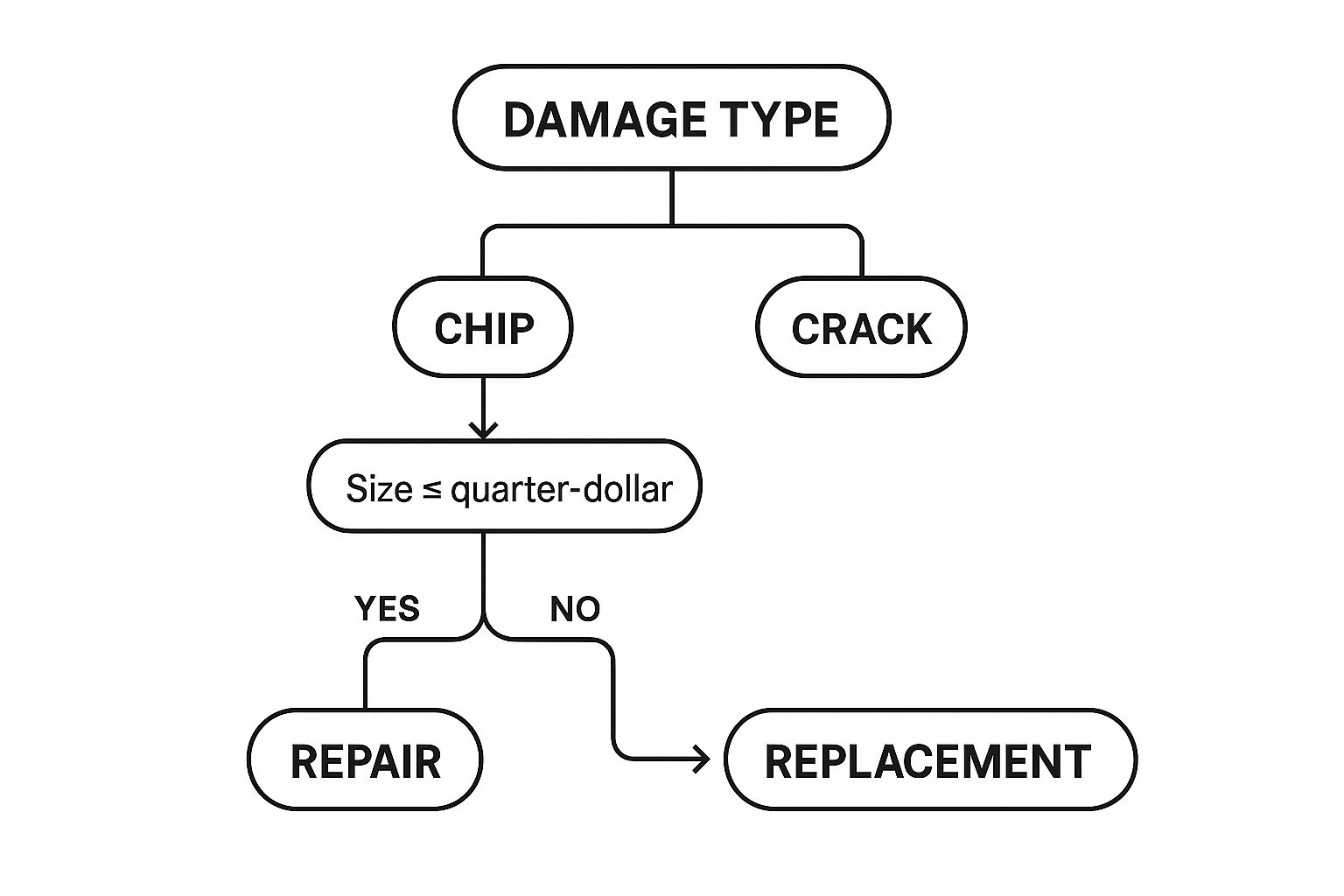
As you can see, a crack of almost any significant length usually means you're looking at a replacement. This is about restoring your car's structural integrity, not just fixing a cosmetic flaw.
To make it even clearer, here’s a quick breakdown of the main differences between the two options.
Repair vs. Replacement: A Quick Comparison
Factor | Repair | Replacement |
|---|---|---|
Best For | Small chips (under 1 inch), minor dings | Long cracks, large chips, damage in driver's view |
Cost | $50 - $150 on average | $200 - $1,000+ depending on the vehicle |
Time | Usually under 30 minutes | 1-2 hours, plus adhesive curing time |
Safety | Restores strength to the damaged spot | Fully restores the windshield's structural integrity |
Original Seal | Preserves the factory-installed windshield seal | Requires a new seal to be installed |
Ultimately, a small chip is a relatively inexpensive fix. But once a crack starts to run, or if the initial damage is in a critical spot, a full windshield replacement is the only way to ensure your vehicle is safe to drive.
Your windshield isn't just for looking through—it provides up to 30% of your vehicle's structural strength in a rollover. A crack seriously weakens this support, making a full replacement a non-negotiable safety requirement.
Smart Ways to Save Money on Window Repairs

While a surprise repair bill is never welcome, you have more control over your car window repair cost than you might realize. Making a few smart moves can be the difference between a minor inconvenience and a major expense.
The single biggest money-saver? Act fast on small chips. A tiny chip is a quick fix, often costing under $100. But leave it alone, and that little ding can turn into a massive crack seemingly overnight, thanks to road vibrations or a sudden temperature change. That's when you're looking at a much pricier full replacement.
Be a Savvy Shopper
Never take the first quote you get. A little bit of shopping around is your best tool for getting a fair price.
Get Multiple Quotes: Call at least three different auto glass shops. Be sure to check with both well-known national chains and smaller local businesses to get a feel for the market rate.
Ask About Glass Types: Always ask about the price difference between OEM (Original Equipment Manufacturer) glass and quality aftermarket options. For many cars, especially those without advanced safety systems, aftermarket glass is a perfectly safe and more affordable choice.
Consider Mobile Repair: Mobile services can be a game-changer. They come to your home or office, which not only saves you time but can also save you money since they often have lower overhead than a physical shop.
It's also worth noting that well-run repair shops often pass their efficiency savings on to you. You can learn how efficient job and cost tracking can streamline service operations and see how it helps keep prices competitive.
A Note on DIY Kits: Those DIY windshield repair kits you see for under $20 can be tempting, but they're a real gamble. A botched repair can actually make the damage worse or prevent a professional from being able to fix it properly down the road. When it comes to the integrity of your windshield, sticking with a professional is always the safest bet.
Your Top Car Window Repair Questions, Answered
When you're dealing with a busted car window, a lot of questions pop into your head. Let's walk through some of the most common ones so you know exactly what to expect.
How Long Will the Repair Take?
This really boils down to whether you need a quick fix or a full replacement.
A small chip repair is surprisingly fast—most technicians can have it done in less than 30 minutes. A complete window or windshield replacement is a bigger job, usually taking about 60 to 90 minutes from start to finish.
The most important step, however, is letting the adhesive cure. After a new window is installed, your car needs to sit for at least an hour. This gives the powerful sealant time to set, creating a solid, waterproof bond that keeps you safe.
Is It Okay to Drive With a Damaged Window?
If you have a tiny chip that’s way outside your line of sight, you can probably drive for a little while without issue. But don't put it off for long. Any damage, no matter how small, can spread without warning, compromising the strength of the glass.
A long crack is a whole different story—it's a serious safety risk. Your windshield is a key part of your car's structural support, especially in a rollover, and it's also designed to help your airbags deploy correctly.
The smartest move is always to get any glass damage, big or small, checked out by a pro right away. A minor repair today can save you from a major—and much more expensive—replacement tomorrow.
What's the Difference Between OEM and Aftermarket Glass?
Knowing your glass options is a big part of controlling your car window repair cost. There are two main types you'll hear about.
OEM (Original Equipment Manufacturer) Glass: This is the real deal, made by the same company that supplied the original glass for your car. It’s a guaranteed perfect match for fit, quality, and even tint.
Aftermarket Glass: This glass is made by a third-party company to fit your vehicle's specifications. While it’s often a more budget-friendly option, the quality can sometimes be a mixed bag.
The materials themselves are also changing. You're seeing more cars with laminated side windows instead of the old-school tempered glass, a shift driven by new global safety standards aimed at preventing ejections and injuries. You can find more detail on this trend in the automotive glass market.
When you need fast, professional auto glass service you can trust, Auto Renu Auto Glass LLC is ready to help. We offer mobile service, coming right to your location for expert chip repairs, full replacements, and ADAS recalibration to get you safely back on the road. Head over to our site to get your free, no-obligation estimate today at https://www.autorenu911.com.