
Rock Chip in Windshield? Expert Tips to Repair & Save
Dealing with a rock chip in windshield? Discover repair options, costs, insurance advice, and when to replace — all in our easy guide to protect your vehicle.
Oct 21, 2025
generated
rock chip in windshield, windshield repair cost, diy windshield repair, auto glass repair, car maintenance
It’s a sound every driver instantly recognizes and hates: that sharp thwack of a rock against the windshield. What's left behind might look like a minor blemish, but a rock chip is far more than a simple cosmetic issue. It's a breach in one of your car's most important safety features, and leaving it alone is a gamble that rarely pays off.
Why You Can't Ignore That Tiny Chip
Think of that little chip as a crack in a dam. At first, it's just a tiny flaw. But with the constant pressure of daily driving—road vibrations, bumps, and especially drastic temperature shifts—that small point of weakness is almost guaranteed to spread.
Suddenly, that insignificant chip has grown into a long, spiderwebbing crack right in your line of sight. Now you're dealing with more than just an eyesore. You're facing a compromised view of the road and a weakened windshield, which is critical to your car's structural strength. Acting fast to repair the chip is always the wiser, safer, and ultimately cheaper path.
This infographic breaks down exactly how that initial small impact can lead to a much bigger, more expensive problem.
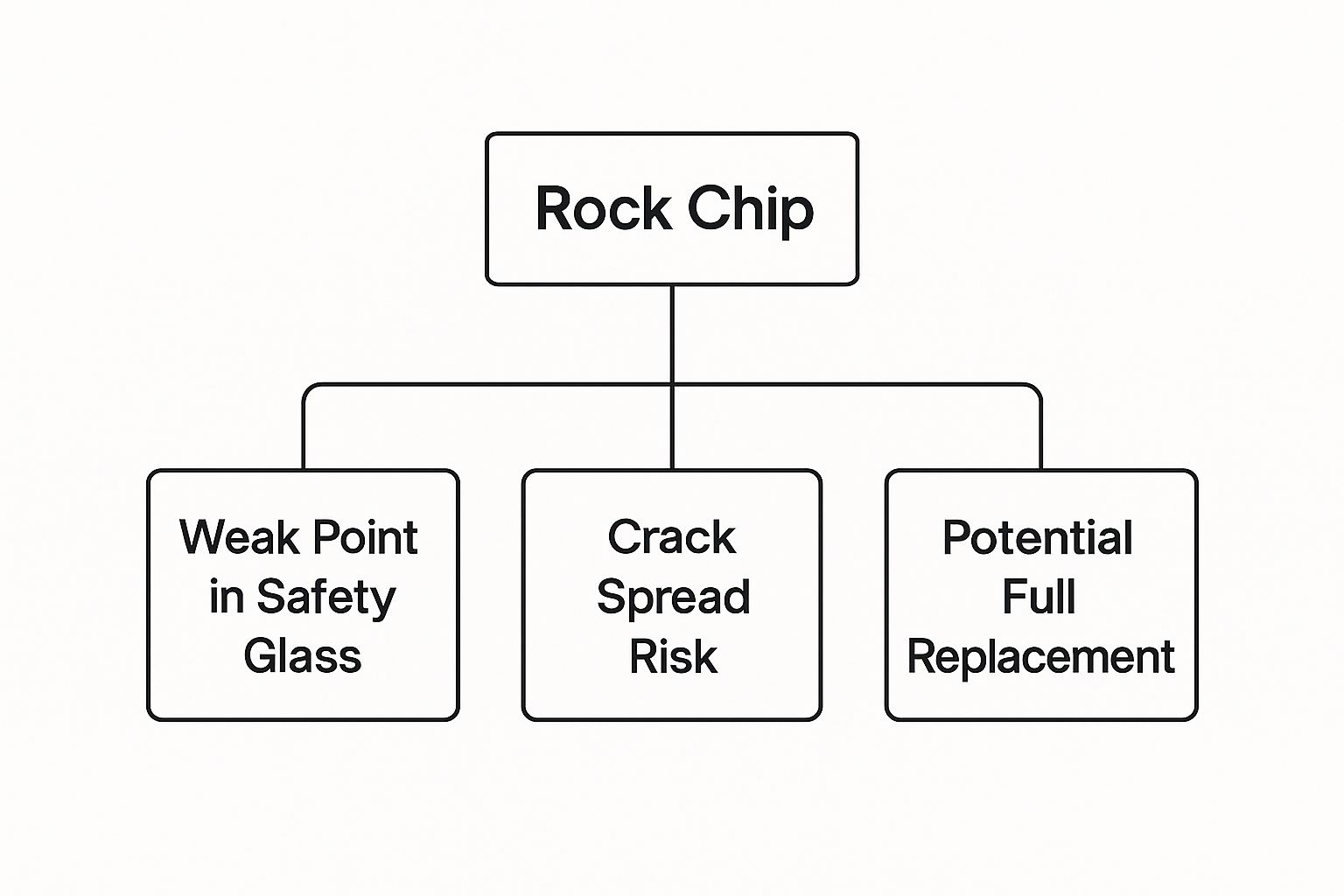
As you can see, the moment that rock hits, the integrity of the safety glass is weakened. From there, it's a high-risk situation where cracks can easily spread, eventually leaving no option but a full, costly windshield replacement.
What Kind of Rock Chip Do You Have? Decoding the Damage
Ever noticed that not all rock chips look the same? That little ding on your windshield isn't just a random blemish; it's a specific type of fracture. Understanding what you're looking at is the first step in figuring out how serious it is and what to do next.
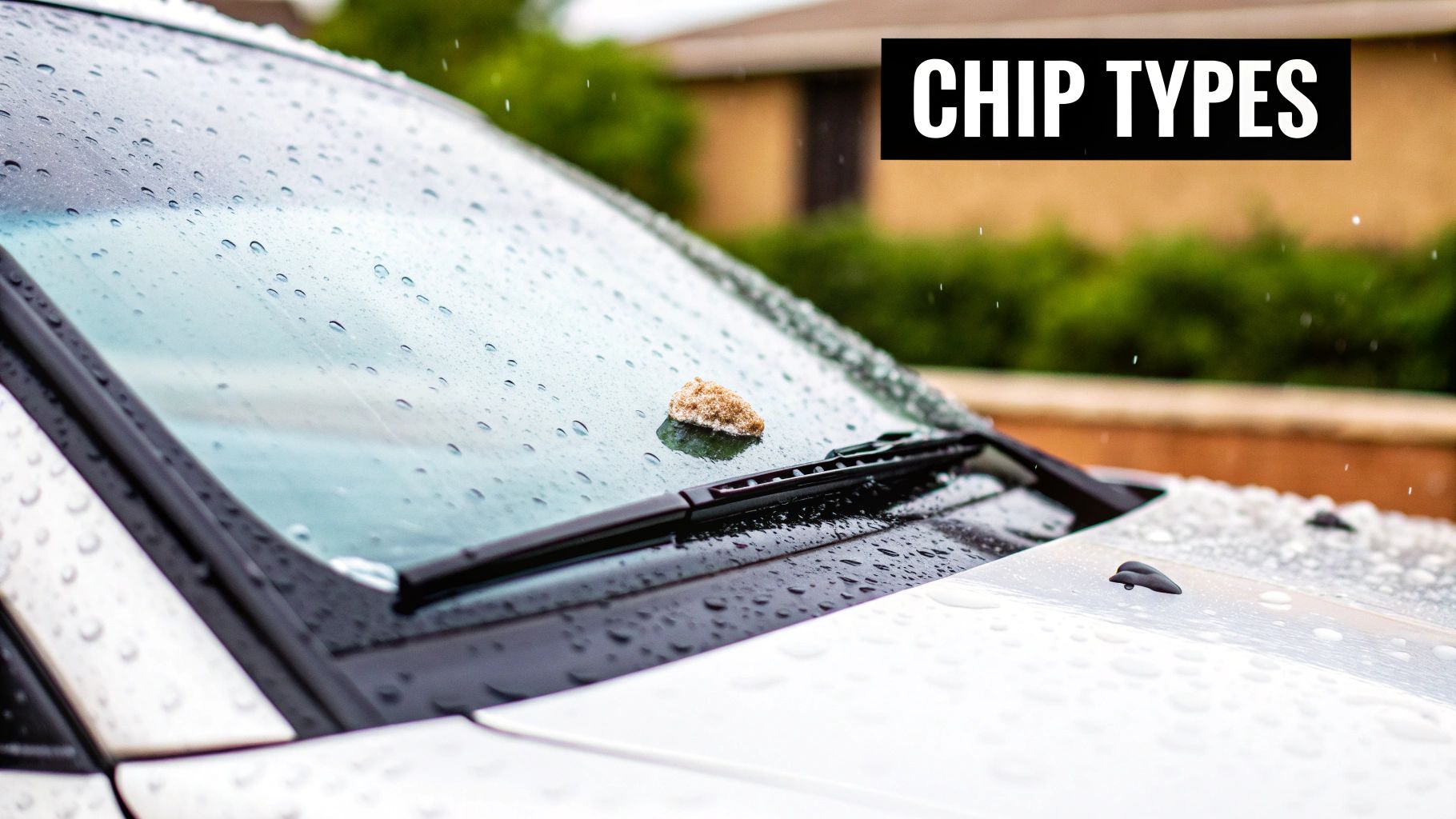
Think of it like being a detective at the scene of a tiny crime. A circular, cone-shaped mark is typically a Bull's-Eye, while a chip with tiny cracks branching out from the center is a classic Star Break. Each type has its own personality—and its own likelihood of spreading across your windshield.
This isn't just trivia for car nerds. Knowing the difference matters because it dictates how urgently you need a repair. A small, stable chip might be an easy fix, but an untreated crack can quickly spiderweb, turning a simple repair job into a full replacement.
In fact, many of the 3.8 million windshields replaced back in 2022 likely started as small, fixable chips. Getting it sorted out early can save you a ton of hassle and money down the road. You can find more insights on auto glass industry statistics to see just how common this issue is.
A Field Guide to Common Rock Chips
To help you identify the damage on your own windshield, think of this table as your field guide. Each type of chip has a distinct look and carries a different level of risk.
Common Types of Windshield Rock Chips
Chip Type | Visual Description | Risk of Spreading | Repairability |
|---|---|---|---|
Bull's-Eye | A clean, circular break, often with a cone-shaped pit in the center. Resembles a target. | Low | High |
Star Break | Features a central impact point with short cracks radiating outwards, like a starburst. | High | Medium to High |
Combination Break | A mix of a Bull's-Eye and a Star Break, with a central circle and radiating cracks. | High | Medium |
Half-Moon (Partial Bull's-Eye) | A semi-circular break that looks like half of a Bull's-Eye. | Medium | High |
Crack Chip | A single crack, usually smaller than a credit card, originating from an impact point. | Very High | Low to Medium |
By figuring out which type of chip you're dealing with, you'll have a much better idea of whether you're looking at a quick fix or a more urgent problem that needs immediate professional attention.
Repair or Replace? Making the Right Call for Your Windshield
So, you've got a rock chip. The first big question you need to answer is whether you're looking at a simple repair or a full-blown replacement. This decision isn't arbitrary—it really boils down to three critical factors: the chip's size, location, and depth.
A good rule of thumb I always tell people is the "dollar bill test." If the entire damaged area can be covered by a dollar bill, there's a very good chance it can be repaired. It’s a simple but surprisingly effective way to gauge the situation.
But size isn't everything. Where the chip is located is just as important. Any damage directly in the driver’s line of sight is a major problem. Even the best repair can leave a slight distortion, and you just can't have that in your primary field of view. For safety's sake, a replacement is often the only option here.
Chips or cracks near the edge of the windshield are also a red flag. This area is crucial for the structural integrity of the glass, and damage there can compromise the entire windshield's strength, making a replacement necessary.
It's not just about the glass anymore. Modern cars have added a whole new layer of complexity with Advanced Driver-Assistance Systems (ADAS), which use cameras mounted right on the windshield.
If you have to replace the glass, that ADAS system must be professionally recalibrated. If it isn't, features like lane-keep assist and automatic emergency braking could fail when you need them most. With ADAS technology expected in over 80% of new cars by 2025, finding a shop that understands this process is non-negotiable.
For a deeper dive into what a full replacement involves, especially with ADAS, check out our guide on windshield replacement. As technology continues to advance, the ADAS calibration market is booming, a trend you can learn more about by looking at auto glass industry statistics.
Choosing Your Repair Path: DIY Kits vs. Professional Service
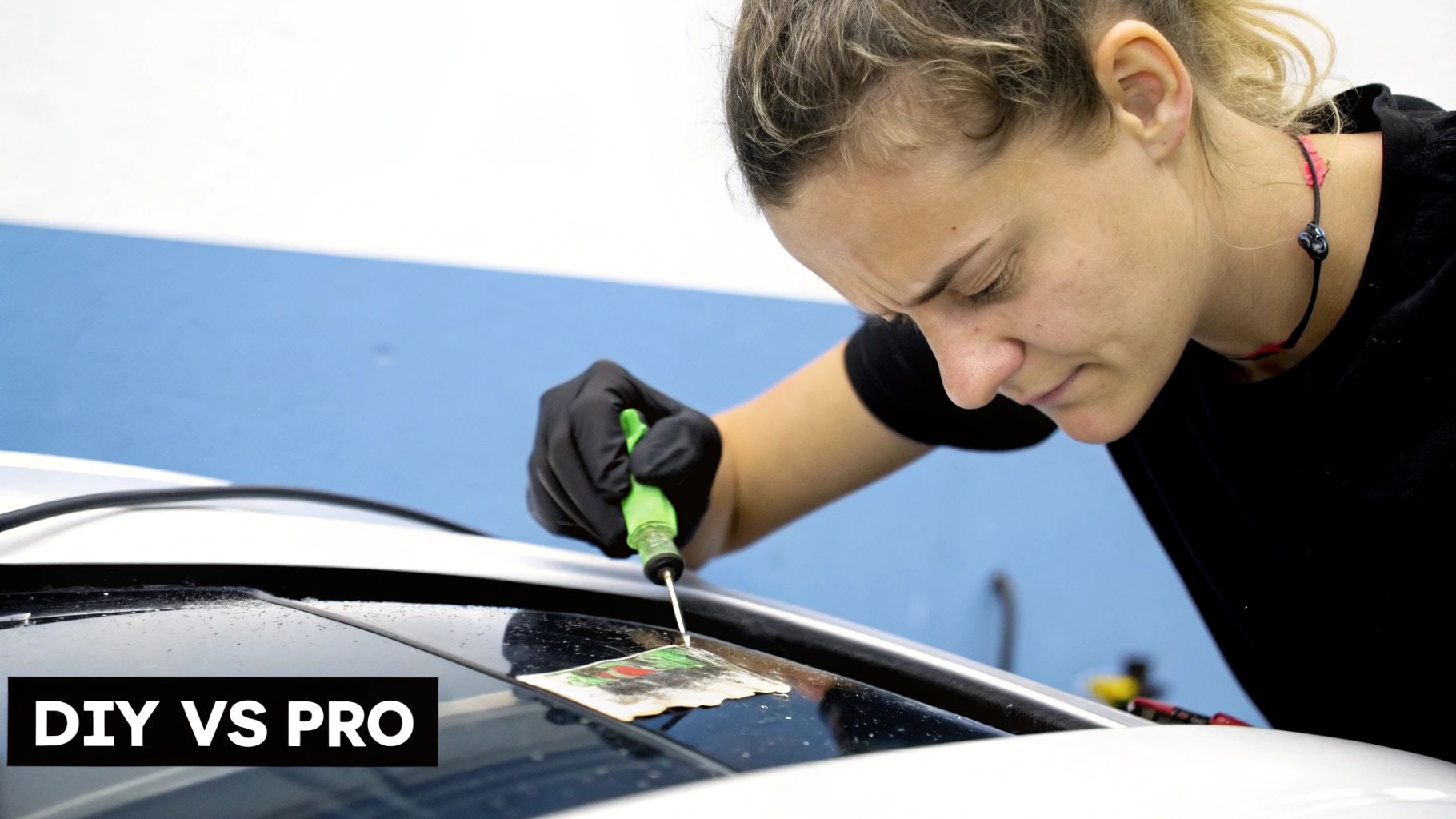
So, you’ve decided to fix that rock chip. Now what? You've basically got two options: grab a DIY kit from the auto parts store or call in a professional.
A DIY kit can seem tempting. It's cheap, and for a very small, simple chip, it might feel like a quick win. The catch is that there's a real risk of doing it wrong. A bad application can easily trap air bubbles or moisture, leaving you with a cloudy, weak repair that could actually make the damage worse over time.
Think of it this way: a DIY kit is like putting a bandage on a deep cut. It might cover the problem, but it doesn't truly fix it.
A professional repair, on the other hand, is like getting proper stitches. Technicians come equipped with specialized vacuum tools to pull every bit of air and moisture out of the chip before injecting a high-strength, optically clear resin. This process doesn't just fill the hole—it restores the structural integrity of the glass, resulting in a repair that's stronger, clearer, and practically invisible.
When you do decide to go with a pro, it pays to find a shop with proven credentials. Technicians who are ASE and RepairPal certified professionals are trained to meet rigorous industry standards. Ultimately, a quality mobile windshield repair is almost always the best bet for a lasting, reliable fix.
Let's Talk Money: The Cost of Repair and Using Your Insurance
So, what’s this little chip going to cost you? The good news is, probably nothing out of pocket. Getting a rock chip fixed by a professional is surprisingly affordable, and most comprehensive auto insurance policies cover 100% of the cost.
That’s right—no deductible. Your insurance company would much rather pay for a quick, inexpensive repair now than foot the bill for a full, costly windshield replacement down the road. It's a classic win-win.
This practical approach is a huge reason why the global market for windshield chip repairs hit a staggering USD 1.38 billion in 2024. Insurers and drivers alike are realizing it just makes sense. You can dive deeper into the windshield repair market growth trends here.
The first thing you should do is pull out your policy or hop online to check your coverage details. If you need a refresher on how it all works, a great resource for understanding your personal auto insurance policy can clear things up. Once you've confirmed your coverage, just file a claim and find a reputable shop to get it fixed.
Protecting Your Windshield After the Fix

So, you've had that annoying rock chip taken care of. Great! But the job isn't quite done yet. A little aftercare is crucial to make sure the repair holds up for the long haul.
Think of the freshly injected resin like setting glue. For the first 24-48 hours, you'll want to be gentle with it. That means holding off on any high-pressure car washes and avoiding sudden temperature shocks—like cranking the defroster on high on a frosty morning. This brief waiting period gives the repair the time it needs to fully cure and harden without any extra stress.
Now for the long term. Your best defense against new chips is smart driving. Keep a safe distance from other vehicles, especially big rigs and construction trucks that are notorious for kicking up rocks and gravel. If you can, take the paved route instead of cutting through a gravel road. These simple habits can make a huge difference in keeping your glass pristine.
It's also worth noting that if you have a newer vehicle with advanced safety features, a full windshield replacement is a more complex job. The cameras tied to your safety systems need to be perfectly aligned, which is why it's so important to understand the process of ADAS windshield calibration.
Your Windshield Chip Questions, Answered
Got questions about that new chip in your windshield? You're not alone. Let's tackle some of the most common ones right here.
We'll clear up the confusion so you know exactly what you're dealing with, what the real risks are, and how to make the best call for your car.