Your Guide to At Home Windshield Replacement
Is at home windshield replacement right for you? This guide covers the process, costs, insurance, and critical ADAS recalibration to ensure a safe repair.
Oct 22, 2025
generated
at home windshield replacement, mobile auto glass, windshield service, adas recalibration, auto glass insurance
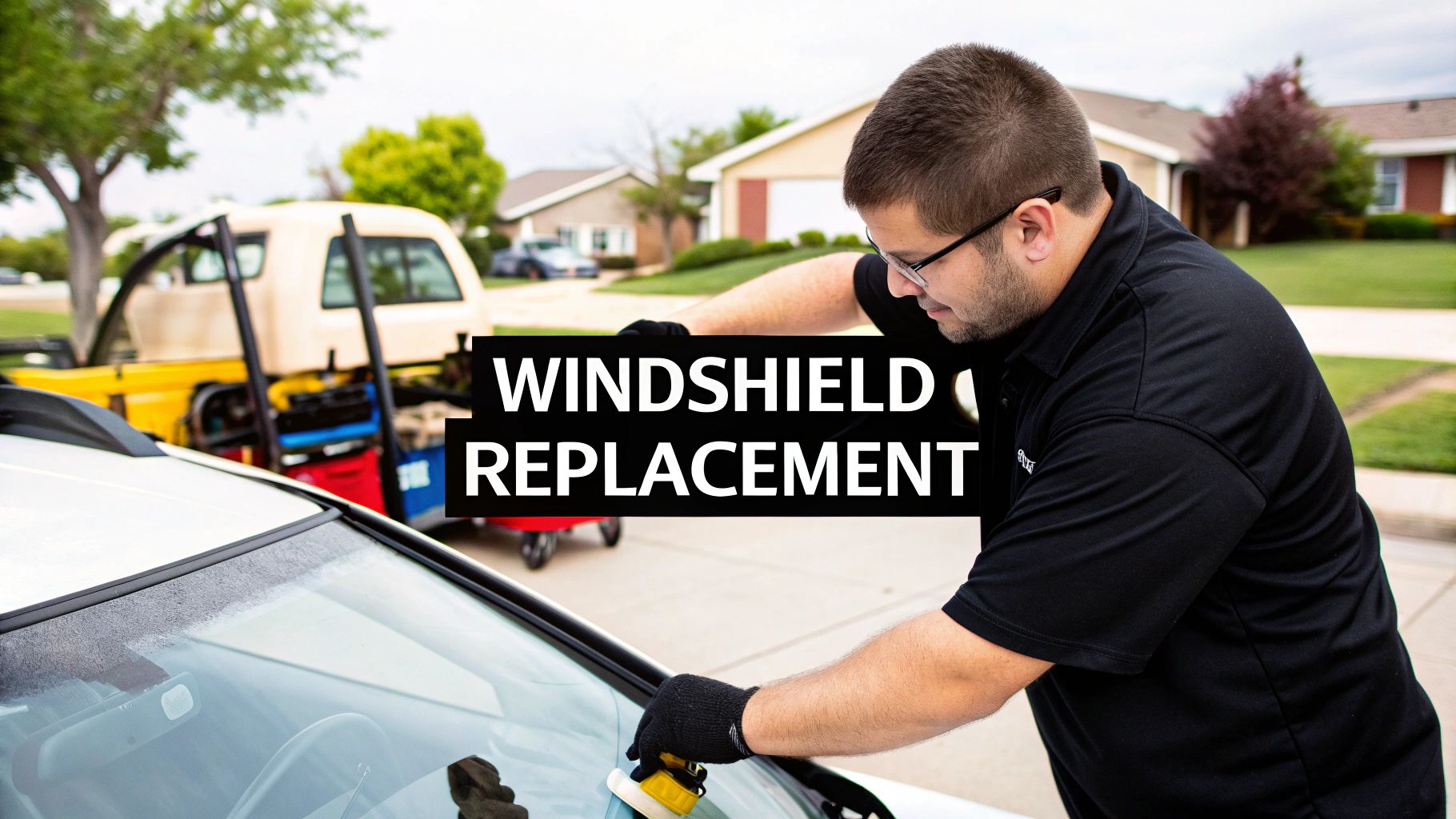
Picture this: a fully-equipped auto glass shop rolls right up to your curb. That’s the simple idea behind at home windshield replacement, a service that brings the expertise of a certified technician, along with all their tools, directly to your doorstep. What used to be a day-killing errand is now something that fits seamlessly into your life.
The Convenience of Windshield Replacement at Home
Let's face it, a cracked windshield is a major headache. It's not just ugly; it's a serious safety risk that throws your whole day off track. The old way of dealing with it meant booking time at a shop, dropping off your car, and then just… waiting. Mobile windshield replacement completely changes the game by putting your time first, without ever compromising on a quality job.
You can think of it as a "repair shop on wheels." A technician arrives in a specialized van at whatever location works for you—your home, your office, wherever—with everything needed to do the job right. All the hassle of finding a ride or burning a vacation day is just gone.
Why Choose a Mobile Service?
The biggest win here is pure, simple efficiency. Instead of carving out half a day for the repair, the work gets done in your driveway while you get on with your life. It’s a solution built for how people actually live and work today.
Here are a few of the standout advantages:
Time Savings: No more driving to the shop or killing time in a waiting room. The technician comes to you.
Enhanced Safety: You won't have to drive with a compromised windshield, which is crucial for both visibility and the structural integrity of your vehicle.
Flexibility: Schedule the appointment for wherever is most convenient, whether that's at home while you work or at the office during a meeting.
Professional Quality: Mobile technicians are certified pros who use the exact same high-quality glass and industrial-strength adhesives you'd find in a traditional shop.
At its heart, at home windshield replacement is about getting professional, top-tier service on your schedule, not someone else's. It's about restoring your vehicle to its highest safety standard without making you bend over backward to do it.
This guide will break down the entire process for you—from how it works and what to expect cost-wise, to dealing with insurance and understanding the critical post-replacement step of ADAS recalibration. By the end, you'll see why it's become such a safe, reliable, and popular option for so many drivers.
For a deeper dive into the specific services we offer, our guide on auto glass replacement is a great resource. The ultimate goal is always the same: to get you back on the road safely, with as little disruption as possible.
How the Mobile Replacement Process Works
So, what actually happens when the technician’s van pulls up to your house? An at-home windshield replacement is far more than just swapping out a piece of glass. It’s a meticulous, step-by-step process that restores your vehicle's structural integrity and safety features, all while you’re at home or work. Knowing what’s involved can really help you appreciate the skill that goes into it.
This infographic breaks down the entire mobile service journey, from the moment you book the appointment to the final installation.
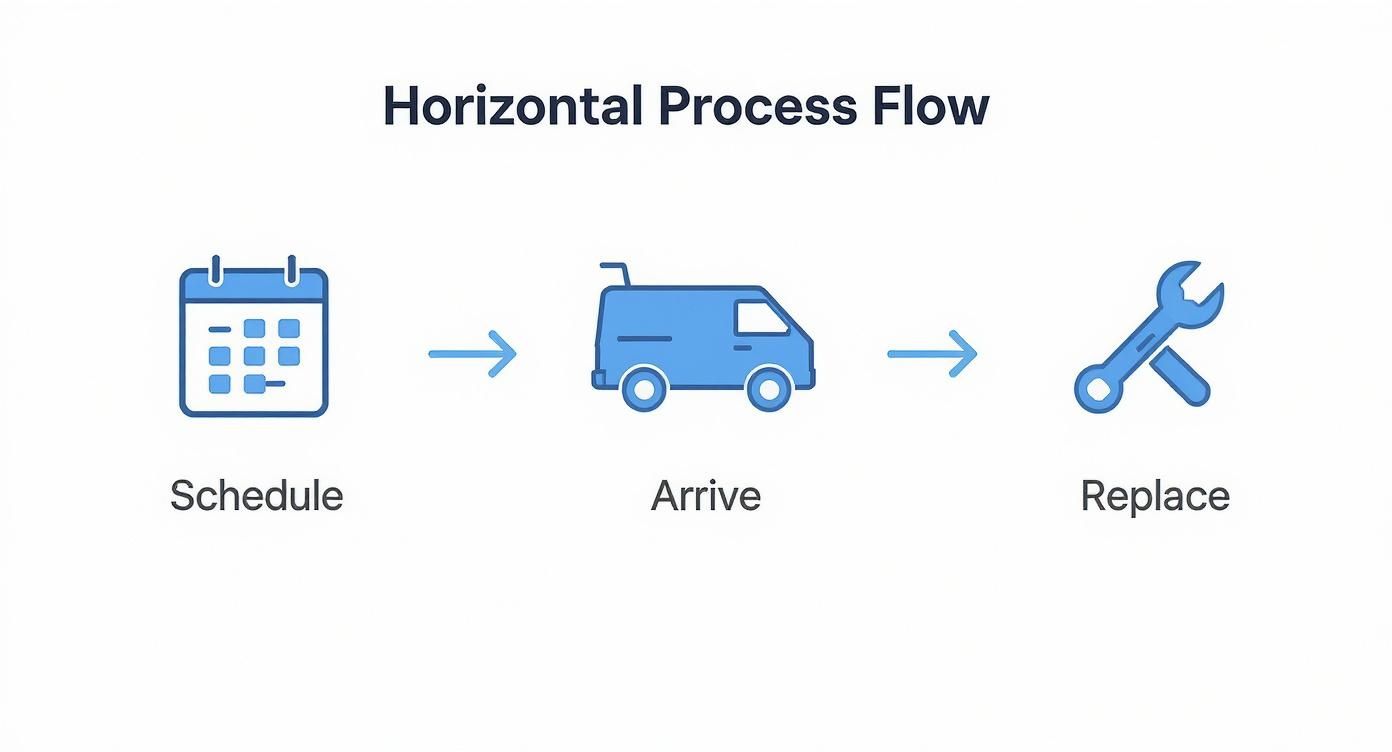
As you can see, it’s designed to be a seamless experience that fits right into your schedule, saving you a trip to a repair shop.
The Initial Vehicle Inspection
First things first, a good technician never just jumps right in. They start with a thorough inspection of your vehicle. This isn't a quick once-over; they're carefully assessing the damage, noting any pre-existing issues inside or out, and double-checking that they have the exact right piece of glass for your car’s make and model. This simple step prevents surprises and protects both you and the tech.
During this stage, they'll also prep the work area by laying down protective covers over your dashboard, hood, and seats. This keeps your car clean and safe from any stray adhesive or accidental scratches.
Removing the Damaged Windshield
Next up is getting the old, damaged windshield out. This is a delicate operation that requires real precision. Technicians use specialized tools, like a cold knife or a wire-out tool, to slice through the thick urethane adhesive that seals the glass to the vehicle's frame.
The main goal here is to remove the glass without damaging the surrounding paint or, most importantly, the pinch weld—that’s the metal channel the new windshield sits in. A clean, straight pinch weld is absolutely critical for a secure, leak-proof fit.
It's easy to forget, but a properly installed windshield is a key safety feature. In a rollover accident, the windshield can provide up to 60% of the structural strength in the cabin, helping to keep the roof from caving in.
The demand for this kind of convenient, high-quality service is massive. In fact, the auto windshield repair service market in the U.S. alone is projected to be worth around $8.3 billion by 2025. It just goes to show how many people are choosing mobile solutions for their vehicle repairs.
Preparing for the New Glass
Once the old glass is out, the real prep work begins. The technician will meticulously clean the vehicle's frame, removing every last bit of the old urethane. After cleaning, they apply a special primer to the pinch weld. This primer does two crucial things: it prevents rust from forming on the exposed metal and helps the new adhesive form an incredibly strong bond.
Think of it like painting a wall. If you don't clean and prime the surface first, the paint will peel and chip. The same principle applies here—without perfect prep, you can't get a perfect, lasting seal.
Installing and Curing
Now for the main event. A fresh, even bead of high-quality urethane adhesive is applied directly to the frame. Using heavy-duty suction cups, the technician carefully lifts the new windshield and sets it perfectly into place. A little gentle pressure ensures it makes solid contact with the adhesive, creating a watertight seal all around.
The final, and arguably most important, step is waiting. The adhesive needs time to cure. The technician will give you a safe drive-away time (SDAT), which is the minimum time you need to wait before driving the vehicle. This can be anywhere from 30 minutes to a couple of hours, depending on the adhesive and weather conditions. Sticking to this timeline is non-negotiable—it ensures the bond is strong enough to meet federal safety standards and protect you on the road.
To get a deeper dive into the materials and techniques involved, take a look at our complete guide on professional windshield replacement.
Understanding Your Replacement Costs

When you get a quote for an at-home windshield replacement, you’re paying for a lot more than just a piece of glass. The final price tag is a blend of several key factors, and understanding them helps you see exactly where your money is going and why costs can swing so wildly from one car to the next.
The most straightforward factor is your vehicle's make, model, and year. A windshield for a common sedan is usually much cheaper than one for a new luxury SUV, simply because of availability and how complex it is to manufacture.
The Glass Itself: OEM vs. Aftermarket
One of the first decisions you'll make is what kind of glass to use. This choice has a direct impact on the cost and quality of your new windshield.
OEM (Original Equipment Manufacturer): This is the exact same glass that was installed at the factory, made by the same company. It's a perfect match in every way—shape, size, thickness, and tint. While it’s the priciest option, it guarantees factory quality.
Aftermarket (OEE): This glass is made by a different company but is engineered to meet or exceed OEM specs. High-quality aftermarket glass, often called OEE (Original Equipment Equivalent), can save you a good chunk of change without sacrificing safety or fit.
For most drivers, a top-tier aftermarket windshield strikes the perfect balance between quality and value. Just be sure to check if your vehicle lease or warranty has any specific requirements—some insist on OEM glass.
Built-In Features Drive Up Complexity
Today's windshields are tech hubs. What looks like simple glass is often embedded with a network of sensors and features that are crucial to how your car operates. Every bell and whistle adds to the manufacturing complexity and, you guessed it, the replacement cost.
The table below breaks down some of these common features and how they influence the price.
Windshield Replacement Cost Factors
Cost Factor | Description | Impact on Price |
|---|---|---|
Rain Sensor | A sensor that detects moisture and automatically turns on the wipers. | Moderate Increase |
Heated Wiper Park Area | A heating element at the base of the glass to melt ice around the wipers. | Moderate Increase |
Heads-Up Display (HUD) | Special glass that allows information to be projected onto the windshield. | Significant Increase |
Acoustic Interlayer | A layer of sound-dampening vinyl inside the glass to reduce road noise. | Moderate Increase |
Solar Tint | A coating or tint that reduces heat and blocks harmful UV rays. | Minor Increase |
Think of your windshield as your car’s transparent command center. The more technology it holds, the more specialized and expensive the replacement part becomes.
The reality of modern vehicles is that the windshield is a core technological component. Features like rain sensors, heating elements, and heads-up displays are not just add-ons; they are integrated systems that require a specific, and often more expensive, type of glass to function correctly.
The Non-Negotiable Cost: ADAS Recalibration
If your car has Advanced Driver-Assistance Systems (ADAS), recalibration is an absolutely essential part of the replacement. These systems, which include features like lane-keeping assist and automatic emergency braking, depend on a forward-facing camera mounted on the windshield.
After a replacement, even a one-millimeter shift in the camera's alignment can cause these critical safety systems to malfunction. Recalibration realigns the camera precisely to the manufacturer's specs, ensuring it "sees" the road correctly. This is a non-negotiable step that requires specialized tools and trained technicians, adding a significant amount to the final bill.
How Insurance Impacts Your Bottom Line
Finally, your auto insurance policy can dramatically lower what you pay out of pocket. Most comprehensive insurance plans cover glass damage, which means you might only have to pay your deductible.
In some states, there are even laws that mandate "zero deductible" windshield replacements, meaning you could pay nothing at all. It's always a good idea to call your insurance provider to clarify your coverage before you schedule the service. For a deeper dive into estimating project expenses, you can explore tools like microestimates for cost analysis. By understanding each of these moving parts, you can go into your windshield replacement with a clear picture of the final cost.
Why ADAS Recalibration Is Not Optional
Your car's windshield isn't just a piece of glass anymore. In most new vehicles, it's the high-tech hub that houses the cameras for your Advanced Driver-Assistance Systems (ADAS).
These are the features that make driving safer than ever—think lane-keeping assist, forward collision warnings, and automatic emergency braking. They all depend on a forward-facing camera that’s mounted directly onto the windshield to see and interpret the world around your car. In a very real sense, the glass is now part of your car’s brain.
Think of that camera as the "eyes" of your car's safety system. At the factory, its position and angle are calibrated down to the millimeter to perfectly see lane markings, other cars, and pedestrians. So, when you schedule an at home windshield replacement, you're not just swapping out glass—you're performing a transplant on your car's eyes.
The Millimeter That Makes All the Difference
Even with a perfect, factory-grade replacement windshield, the installation will always cause a tiny, microscopic shift in the camera's position. A change of just one millimeter or a single degree might sound insignificant, but for a system that has to make split-second safety decisions, it’s a huge deal.
This tiny misalignment can throw everything off. Suddenly, your ADAS features might:
Fail to spot hazards: The system could completely miss a car stopping ahead or a person stepping into the road, making automatic braking useless.
Misread the road: A slightly off-kilter camera might cause your lane-keeping assist to hug the shoulder or, even worse, drift into oncoming traffic.
Trigger false alarms: The system could start "seeing" threats that aren't really there, leading to distracting warning lights or even sudden, dangerous braking events.
Recalibration isn't an upsell or an optional extra. It is a mandatory safety procedure. Skipping it is like wearing someone else's glasses—you simply can't trust what you see, and the consequences could be serious.
This tight integration of technology is transforming the auto glass industry. The global automotive windshield market is on track to hit $20.4 billion in 2025 and is projected to skyrocket to $46.2 billion by 2034. This boom is fueled by demand for smart glass with features like UV protection and, most importantly, ADAS integration. You can learn more about the innovation in smart windshield technologies that are making our cars smarter and safer.
Static vs. Dynamic Recalibration Explained
Recalibrating these systems isn't a one-size-fits-all job. Technicians use two main methods, and the right one for your vehicle is determined by the manufacturer's specifications.
Static Recalibration: This is done while your car is parked in a controlled shop environment. A technician uses specific targets and patterns placed at precise distances, which allows them to reset the camera's software to its exact factory settings. It's basically an eye exam for your car.
Dynamic Recalibration: This method involves actually driving the vehicle. The technician takes the car on well-marked roads at certain speeds for a set amount of time, allowing the onboard computer to use real-world lane markings to recalibrate itself on the move.
Some vehicles need both static and dynamic methods to get the calibration just right. This is a critical process that only trained, professional technicians can handle correctly. For a deeper dive, check out our guide on the importance of ADAS windshield calibration.
Can Recalibration Be Done at Home?
Sometimes, yes—but it depends. Dynamic recalibration can often be done as part of a mobile appointment, as long as there are suitable roads nearby for the technician to use.
Static recalibration, however, is trickier. It requires a perfectly level floor and a large, clear space without any obstructions. Most driveways and parking lots just don't meet these strict requirements. Because of this, an at home windshield replacement may need a quick follow-up visit to a shop to complete the static calibration.
Any trustworthy service will be upfront about this from the very beginning. Your safety should never be compromised for convenience.
Using Insurance for Your Windshield Claim
Let's be honest, dealing with insurance can feel like a headache. But when it comes to getting an at home windshield replacement, your policy can be a huge help, often covering the entire cost. Most of the time, this falls under your comprehensive coverage.
Think of comprehensive as the part of your policy that handles damage from things other than a collision. It's for the unexpected stuff—theft, a falling tree branch, and, you guessed it, a rock flying up and cracking your glass. Using this coverage gets a critical piece of safety equipment fixed without you having to foot a massive bill.
Understanding Your Deductible
The big word you'll hear is "deductible." This is simply the amount you agree to pay yourself before your insurance company starts paying. For instance, if the total replacement is $800 and your deductible is $250, you'd pay the $250 and your insurer handles the remaining $550.
But here’s the good news: windshields are often treated as a special case. Because a clear view is so non-negotiable for safe driving, many states and insurance companies have special rules for glass damage that can drastically reduce or even get rid of what you have to pay.
The Possibility of Zero Deductible States
In some states, known as "zero deductible" or "full glass" states, laws actually require insurers to waive the comprehensive deductible for windshield repair or replacement. If you live in one of these states, you can get a brand new windshield for a $0 out-of-pocket cost.
The whole point of these laws is to encourage drivers to fix dangerous cracks right away instead of delaying the repair because they're worried about the cost. It’s always a good idea to check your local state laws or just ask your insurance agent if this applies to you.
The big takeaway here is this: Your policy might have a totally separate, much lower deductible just for glass damage—or it might be zero. Don't just assume you're on the hook for the full amount. A quick phone call can clear things up and potentially save you hundreds.
The Claims Process Step-by-Step
Filing a claim for an at home windshield replacement is usually pretty painless. Good mobile glass companies have this process down to a science and will often handle the insurance paperwork for you.
Here’s how it typically unfolds:
Contact Your Insurer First: Before you book anything, give your insurance provider a call to open a claim. They'll confirm your coverage and give you a claim number.
Choose Your Service Provider: Let your insurance company know you want a mobile service. They might suggest a "preferred" shop, but you almost always have the right to pick a company you feel good about.
Coordinate with the Glass Company: Give that claim number to your chosen auto glass shop. From there, they’ll talk directly to the insurer to verify everything, send the bill, and manage the red tape.
Schedule Your Mobile Appointment: Once the insurance side is sorted out, you're free to schedule the technician to come out to your home or work.
It's smart to know a bit about the claims process, including why things sometimes go wrong. For example, understanding the common reasons an insurance claim might be refused can help you navigate the system and avoid any bumps in the road.
How to Choose a Reputable Mobile Service
It’s tempting to think all mobile services are the same, but that’s a risky assumption. You’re trusting a technician with a critical piece of your car's safety equipment, so doing a little homework upfront is essential. Think of this as your consumer protection guide for finding the right company for your at home windshield replacement.
The convenience of someone coming to you should never mean cutting corners on quality. From your very first phone call, a professional outfit will be upfront about their technicians, the materials they use, and their entire process.
The auto glass market is huge—valued at around $32 billion globally in 2025 and it’s only growing. With that many players in the game, it pays to know what separates the pros from the amateurs. You can get a better sense of the industry by checking out this report on the growth of the auto glass market.
Your Vetting Checklist
Before you hand over your keys, run through these quick questions. They’ll help you weed out the questionable operators and find a service you can trust.
Technician Certifications: First things first, are their techs certified? You want to hear that they’re certified by a group like the Auto Glass Safety Council (AGSC). This isn't just a piece of paper; it means they’re up-to-date on the latest safety protocols and installation techniques.
Glass Quality: Ask what kind of glass they install. They should be using either OEM (Original Equipment Manufacturer) glass or a high-quality OEE (Original Equipment Equivalent) alternative. Anything less can lead to a poor fit, which compromises your vehicle’s structural integrity.
Adhesive Standards: This one is crucial. What adhesive do they use? The answer should be an industry-grade urethane that meets Federal Motor Vehicle Safety Standards (FMVSS). Also, be sure to ask for the safe drive-away time—that’s how long you need to wait before the adhesive is strong enough for you to drive safely.
A great mobile service won’t just replace your glass; they’ll restore your vehicle’s entire safety system. They should be able to walk you through their process, materials, and warranties without any hesitation.
Don't Forget ADAS and Warranties
For any modern car, there are two final questions you absolutely have to ask.
First, find out their exact process for ADAS recalibration. A professional service will either have the equipment to do it right there in your driveway or will arrange for you to bring the car to their shop for the final step. If they brush it off as unimportant, that’s a major red flag.
Second, what's their warranty look like? A company that stands by its work will offer a solid warranty covering the windshield against defects and their workmanship against things like leaks. This is your peace of mind long after they’ve packed up and left.
Got Questions? We’ve Got Answers.
Even after you've decided on mobile windshield replacement, a few questions might still be bouncing around in your head. That's perfectly normal. Let's tackle some of the most common ones we hear from drivers every day, so you can feel totally comfortable with the process.
What About Bad Weather?
This is a big one. Weather plays a huge role in a successful installation. We simply can't replace a windshield in the rain, snow, or extreme heat or cold.
Why? It all comes down to the powerful adhesive, called urethane, that bonds the glass to your vehicle's frame. For that seal to be watertight and, more importantly, structurally sound, it needs to cure under the right conditions. If the weather looks iffy on your appointment day, any good company will call you ahead of time to find a better slot.
How Much Time Should I Set Aside for This?
The hands-on work itself is pretty quick, usually taking a technician about 60 to 90 minutes. That covers everything from carefully removing the damaged glass to setting the new one perfectly.
But there’s a crucial waiting period afterward known as the safe drive-away time. This is the time it takes for the adhesive to harden enough to meet federal safety standards. Depending on the specific adhesive and the day's temperature and humidity, this could be anywhere from 30 minutes to a few hours. Your technician will give you the exact time before they leave.
Seriously, don't rush the safe drive-away time. Driving too soon can wreck the seal, causing leaks or, in a worst-case scenario, preventing the windshield from protecting you properly in an accident.
Is a Mobile Replacement as Good as Going to a Shop?
Absolutely. There's zero difference in quality. A certified mobile technician uses the same top-tier materials you'd find in a shop—that means OEM or OEE glass and the same professional-grade adhesives. The safety procedures and installation standards are identical.
The only thing that changes is the address. As long as we have a dry spot with enough room to work, you're getting the same safe, high-quality job you'd get at any top-notch auto glass center.
Can You Deal With My Insurance Company?
You bet. Most reputable mobile auto glass services are pros at handling the insurance side of things. We'll take care of the phone calls, verify your coverage, and submit the invoice directly to your provider.
Typically, all you need to give us is your policy number. We manage the paperwork and the back-and-forth so you don't have to. It makes the whole process completely stress-free.
For a hassle-free experience with certified technicians who come directly to you, trust Auto Renu Auto Glass LLC. We handle the insurance, use the best materials, and ensure your vehicle is safe for the road. Schedule your service today by visiting us at https://www.autorenu911.com.