car window tinting laws california: what you need to know
car window tinting laws california explained: discover current tint limits, exemptions, and penalties to tint confidently and stay compliant.
Oct 23, 2025
generated
car window tinting laws california, california tint laws, legal window tint ca, vlt percentage, vehicle code
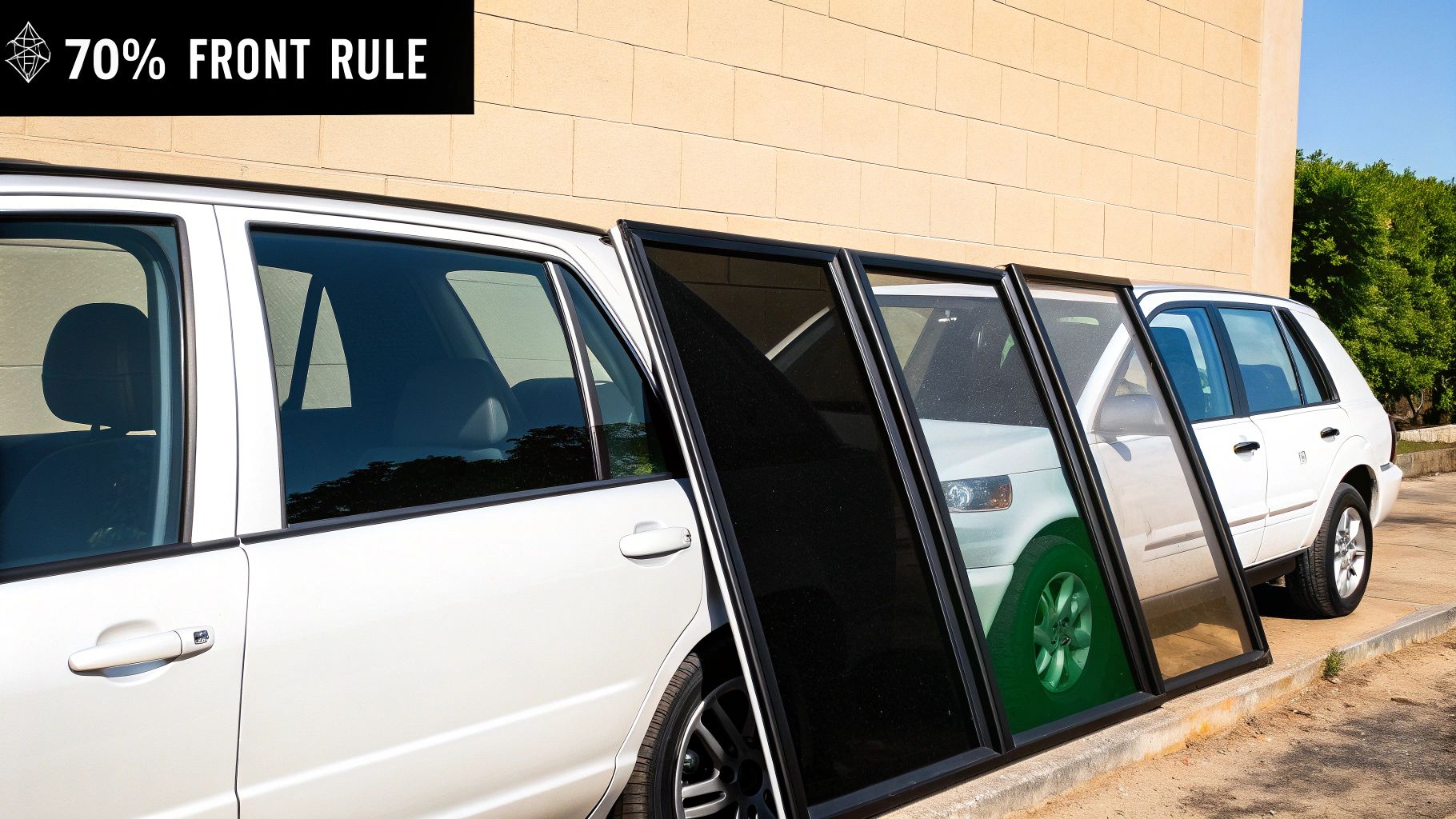
Navigating California's car window tinting laws can feel tricky, but it boils down to a few key rules. Your front side windows must let in more than 70% of light, and your windshield is limited to a non-reflective tint on the top 4 inches only. The good news? Your back side windows and rear window can be as dark as you like, as long as you have side mirrors on both the driver and passenger sides.
Your Quick Guide to California Tint Rules
Let's break down the rules for window tinting in California without getting bogged down in legal jargon. At the heart of these regulations is a simple goal: balancing your comfort and privacy with the non-negotiable need for clear visibility on the road. The one term you absolutely need to know is Visible Light Transmission (VLT).
Think of VLT like the lens on a pair of sunglasses. A high VLT percentage—say, 88%—is like a very faint lens that lets almost all the light stream through. A low VLT, like 5%, is what you'd find on super-dark shades that block nearly everything. California's laws use these VLT percentages to set the legal limit for each window on your car.
Key VLT Limits by Window
The state’s current window tint laws, which have been in place since 1999, are all about making sure drivers can clearly spot pedestrians, cyclists, and other cars. That’s why the rules are strictest for the windows you rely on most.
The law is clear: your windshield and front side windows must have a VLT of at least 70%. For the back half of your car, however, you have a lot more freedom. You can go as dark as you want on the rear side windows and back windshield, but only if your vehicle has working side mirrors on both sides. This requirement ensures you can still see what’s behind you, even with a dark tint. If you want to dive deeper into the history and specifics, this detailed guide on California tint laws is a great resource.
This infographic gives you a great visual summary of the rules for each window.
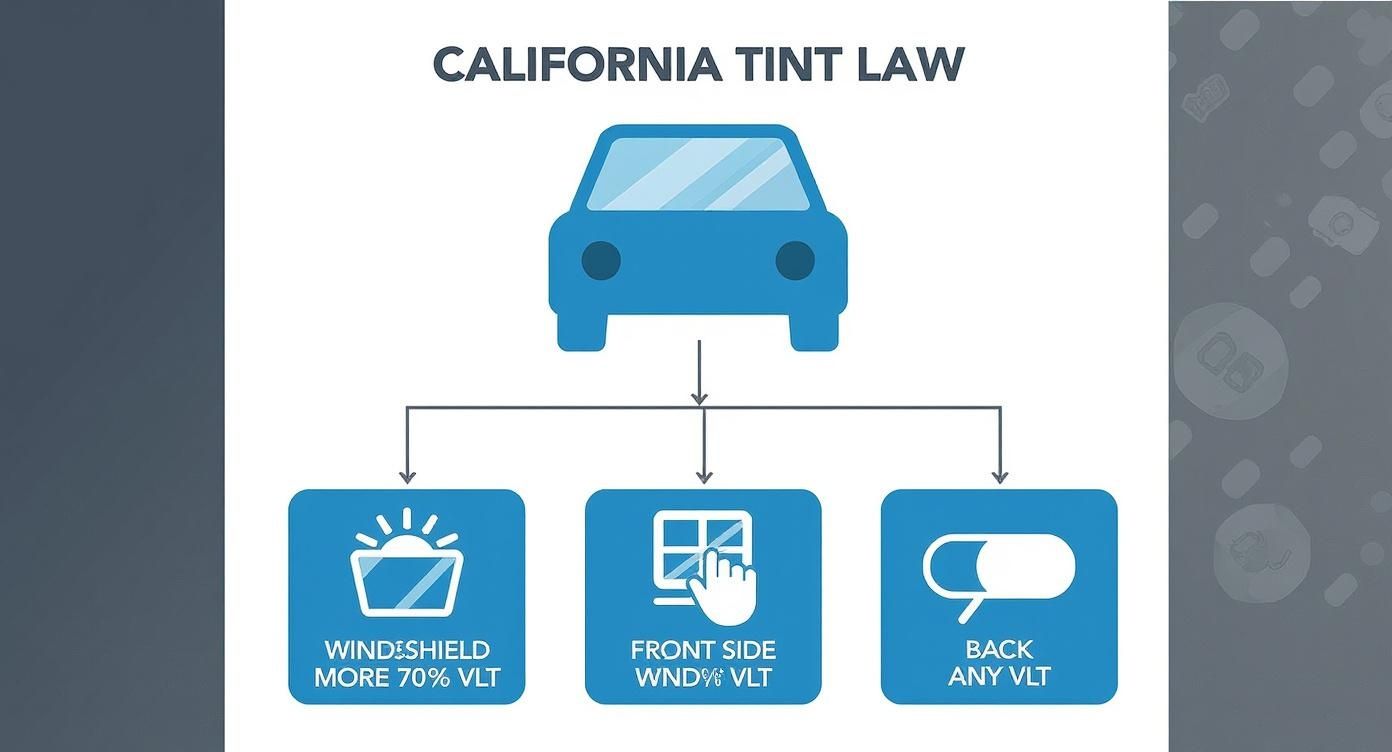
As you can see, the regulations are most stringent for the windows that are most critical to a driver's immediate line of sight.
To make things even clearer, here's a simple table that lays out the core requirements at a glance.
California Window Tint Law VLT Limits at a Glance
Window Location | Maximum Tint Darkness (VLT%) | Specific Rules and Conditions |
|---|---|---|
Front Windshield | 70% VLT | A non-reflective tint is allowed only on the top 4-inch strip. |
Front Side Windows | 70% VLT | The tint film combined with the factory glass must allow over 70% of light in. |
Rear Side Windows | Any Darkness | Legal for any tint level, provided the vehicle has dual side mirrors. |
Rear Window | Any Darkness | Legal for any tint level, but requires functional side mirrors on both sides of the vehicle. |
This table should help you quickly check if your current or desired tint setup is compliant with California law.
The Story Behind California's Tint Regulations
To really get a handle on today's tint laws, it helps to rewind the clock. The story of car window tinting laws in California didn’t start with the high-tech films we use now. It began with something much simpler and, frankly, a bit crude: spray-on tint. Back in the day, this was a brand-new way for drivers to cut down on sun glare and give their cars a custom look.
Before the 1960s, there were no rules at all. But as spray-on tinting caught on, California lawmakers started to worry. How did these darker windows affect a driver's ability to see the road clearly? It sparked a debate that we're still having today—the classic tug-of-war between personal style and public safety.
The turning point came in 1961. Before this, tinting was a free-for-all, mostly because modern films hadn't even been invented yet. Drivers were literally spraying color onto their glass. As the trend exploded, the state stepped in. That year, the first law hit the books, banning any material that obstructed a driver's clear view through the windshield. You can learn more about how these early trends shaped today’s rules in this deep dive into California's tinting history.
The Evolution Toward Stricter Controls
That 1961 law was just the first step. It represented a major change in how the state thought about vehicle modifications, especially those that could mess with a driver's perception. It was a direct reaction to a popular technology that, if taken too far, could clearly become a safety hazard.
It didn't take long for legislators to realize the rule needed more teeth. In 1967, the law was updated and expanded. This new version banned any material on the windshield and the front side windows—the ones right next to the driver. The amount of light it blocked didn't matter; if it was there, it was illegal.
This much stricter approach laid the groundwork for the detailed regulations we follow now. The evolution of these laws points to one consistent idea that’s still central to car window tinting laws in California: a driver's line of sight must be as clear as possible.
The journey from unregulated spray-on tints to specific VLT percentages illustrates a long-standing commitment. Lawmakers have consistently prioritized the safety of everyone on the road, adapting rules as technology and vehicle designs have changed over the decades.
Understanding this history isn't just for trivia night. It gives you the "why" behind the rules. These regulations weren't just created out of thin air; they're the product of decades of experience, adjustments, and a real effort to prevent accidents by protecting driver visibility. When you know where the laws came from, it’s much easier to see why following them matters.
Cracking the Code: VLT Percentages and Other Key Rules
Getting a handle on California's car window tinting laws is the first step to staying on the right side of the law. The rules aren't just about what looks too dark; they're based on specific, measurable standards every driver should know. Let's walk through the most important regulations one by one.
The most critical number you need to burn into your memory is 70% VLT. This is the magic number for your front driver and passenger side windows. It simply means that the window—your factory glass plus any tint film—has to let at least 70% of visible light shine through. Think of it like a test score: your front windows need a 70 or higher to pass.
This rule exists for a pretty good reason. It ensures you can clearly see what’s happening around you, from checking your side mirrors to spotting a car in the next lane. It also allows law enforcement to see inside your vehicle during a traffic stop, which is a major safety factor for them.
Windshields and Side Mirrors
Your front windshield plays by a different, very specific rule. You're allowed to add a non-reflective tint strip, but only on the top 4 inches of the glass. This is your "sun visor" strip, designed to cut down on glare without blocking your view of the road ahead. Go even a fraction of an inch lower, and you're asking for a ticket.
Now, for the back half of your car, the rules get much more relaxed. You can go as dark as you want on the rear side windows and the back windshield. Limo-dark? No problem. But this freedom comes with one very important catch: your vehicle must have dual side mirrors. If your rear view is blacked out, those mirrors become your lifeline for seeing what’s behind you.
Color and Reflectivity Restrictions
It's not all about the darkness level. The color and how shiny your tint is are just as important in California. The state has outlawed certain colors to prevent confusion and keep other drivers safe.
Forbidden Colors: Steer clear of red, amber, or blue tints on your front windshield or front side windows. These colors are reserved for emergency vehicles, and using them can create some seriously dangerous mix-ups on the road.
Reflectivity Limits: Super reflective, mirror-like tints are a definite no-go. The law is clear: your tint can't be more reflective than a standard car window. This is all about preventing your car from shooting blinding glare into the eyes of other drivers, especially during sunrise or sunset.
Key Takeaway: Staying legal goes beyond just VLT. California's rules are a complete safety package, covering tint color, reflectivity, and placement to protect everyone on the road.
Finally, every legal tint job needs to come with the right paperwork. California requires a certificate or sticker from the film's manufacturer to be installed on your car. This little sticker, tucked between the film and the glass, is your proof of compliance, confirming the tint meets state VLT and reflectivity standards. Any reputable shop offering quality window tint services will make sure this is installed correctly. It’s your instant proof that you’ve done everything by the book.
What About Medical Exemptions for Window Tint?
For many drivers, window tint is a style choice. But for some, it’s a medical necessity. California law recognizes that people with certain health conditions need extra protection from the sun.
If you have a condition that causes severe sensitivity to sunlight—like lupus, xeroderma pigmentosum, or another photosensitive disorder—driving in bright daylight can be painful or even dangerous. That’s why the state has a clear process for getting a medical exemption from the standard tint rules.
This isn't just a loophole to get darker windows. It's a specific, health-based accommodation. And thanks to a recent change in the law, that accommodation is better than ever. In 2023, California passed Assembly Bill 1303, a game-changer for those with UV sensitivity. Before this bill, tinting a windshield was a big no-no. Now, AB 1303 allows people with a documented medical need to legally tint their windshields. You can get more details on this important legal update over at Devina Douglas Law’s blog.
The Official Process for Getting an Exemption
Getting a medical exemption is a straightforward process, but you have to follow the official steps. A simple note from your doctor scribbled on a prescription pad won't cut it. You need proper documentation ready to go if an officer ever asks for it.
Here’s what you need to do:
Talk to Your Doctor: Start by consulting a licensed physician, dermatologist, or optometrist. They need to officially certify that your medical condition requires extra UV protection beyond what standard windows offer.
Get a Signed Letter: Your doctor must provide a signed letter on their official letterhead. It needs to clearly state that you require darker window tint for a specific, valid medical reason.
Keep it in Your Car: This letter is your golden ticket. It's the proof of your exemption, and you must have it with you at all times when you're driving the vehicle. Don't just toss it in the glove box and forget about it.
What to Expect on the Road
Even with a legitimate exemption and all the right paperwork, you might still get pulled over. From the outside, a police officer has no way of knowing your dark tint is for medical reasons. They just see a car that appears to violate the state's VLT limits.
Keep in Mind: Your exemption letter allows you to have darker tint, but it doesn't prevent a traffic stop. An officer is well within their rights to pull you over and verify your documentation. The key is to stay calm, be cooperative, and present your doctor's letter.
At the end of the day, this provision in the car window tinting laws California is all about protecting drivers with real health concerns. It ensures you can make your daily drive safer and more comfortable without having to worry about the sun’s harmful effects.
What Happens If You Get a Ticket for Illegal Tint?
So, you’ve been pulled over, and the officer’s tint meter says your windows are too dark. What’s next? The good news is, you’re not usually facing a massive penalty right out of the gate. For a first-time offense, California's window tinting laws are pretty reasonable.
In most situations, you’ll be issued what’s commonly known as a “fix-it ticket.” This isn't a typical fine; it’s a notice that gives you a chance to solve the problem. Officially, it's called a correctable violation, and it means you have a deadline to remove the illegal tint and prove you’ve made your car compliant.
The Fix-It Ticket: A Step-by-Step Guide
Navigating a fix-it ticket is fairly straightforward, but you absolutely have to follow through. The whole point is to show the authorities you've corrected the issue by the date on the citation.
Here’s how it usually plays out:
Remove the Tint: This is the most critical step. You need to get the illegal film taken off the windows that were cited by the officer.
Get It Signed Off: Once the tint is gone, you have to get proof. Take your car and the ticket to any police station, sheriff’s office, or CHP office, and an officer will inspect your windows and sign the ticket, verifying the correction.
File with the Court: With the signed-off ticket in hand, you’ll submit it to the court and pay a small dismissal fee. This fee is typically around $25.
Pro-tip: Don't put this off. Ignoring a fix-it ticket is a surefire way to turn a small problem into a big one. It can escalate to hefty fines, a potential warrant, and even prevent you from renewing your driver's license.
Fines, Points, and Other Headaches
While the fix-it ticket is designed to be a simple warning, things can get expensive if you don't comply. A standard tint violation starts with a base fine of just $25. But once the state and county tack on their various fees and assessments, that small number can easily swell to over $190.
Now for the question on every driver’s mind: will this put points on my license? Thankfully, no. A tint violation is considered a non-moving violation, so it does not add any points to your driving record.
The biggest consequence, however, is the unwanted attention. Having illegally dark tint gives any law enforcement officer probable cause to pull you over anytime, anywhere. That stop for tint could easily lead to other citations if they spot something else. The best way to drive worry-free is to simply stay compliant with the law.
Choosing a Tint Shop and Ensuring Compliance
Knowing California's window tinting laws is one thing, but finding a shop that actually follows them is the real challenge. The truth is, not all tint installers are created equal. Your mission is to find one with a rock-solid reputation for legal, high-quality work.
Start by doing some homework on local shops. A truly professional installer will openly advertise their deep understanding of California's specific regulations. They act as your guide, making sure the film they put on your car is perfectly legal and won't cause you problems later. Don't ever hesitate to ask pointed questions before they even touch your vehicle.
Vetting Your Installer
Think of it like a job interview for your car. A top-notch shop will be happy to answer your questions and will sound confident doing it. Taking a few minutes to do this upfront can save you from the major hassle of a "fix-it ticket" down the road.
Here are a few must-ask questions for any potential tint shop:
"Are you up-to-date on the 70% VLT law for front side windows in California?" The only acceptable answer is a quick and confident "yes."
"What film brands do you use, and do they have a manufacturer's warranty?" Look for well-known, quality brands like 3M, Llumar, or XPEL.
"Will I get a Certificate of Compliance sticker when you're done?" This is required by California law, and any legitimate shop will provide one without you even having to push for it.
A great installer does more than just stick film on glass. Their job is to make sure your car rolls out of their bay 100% compliant with state law, protecting you from any legal headaches.
After the installation, the shop must give you a certificate of compliance. This is a small sticker, usually placed on the driver’s side door jamb, that serves as official proof of a legal tint job. An officer will look for this sticker if they pull you over, so make sure it's there.
If you’re ready to find a professional who knows these rules inside and out, you can request a quote for compliant window tinting to connect with a trusted local expert.
Common Questions About California Tint Laws

Even when you think you have a handle on the rules, real-world situations can bring up some tricky questions about car window tinting laws in California. Let’s clear the air and walk through some of the most common things drivers worry about.
One of the biggest questions we get is about cars from other states. If you've just moved here, welcome to California! Just know that your car has to play by local rules. The state gives you 20 days to register your vehicle after you become a resident. Once you do, your car must meet every single California Vehicle Code standard.
That means the 70% VLT rule for your front side windows is non-negotiable. A tint that was perfectly legal in your old state might now be a problem, requiring you to have it professionally removed to stay compliant.
Factory Tint and Compliance Certificates
There’s also a lot of confusion around factory-installed tint versus aftermarket films. It's a great question. The strict 70% VLT requirement is really targeting films that are applied after a car is sold. That darker "privacy glass" you see on the back windows of brand-new SUVs and minivans? That's installed by the manufacturer and is completely legal in California.
A Certificate of Compliance is a small sticker or document provided by the installer. It’s your official proof that the tint film on your windows meets all of California's legal standards. California law actually requires you to have this in your vehicle if you have aftermarket tint.
Any professional, reputable shop will give you this certificate without you even having to ask. It's your immediate proof for law enforcement that your tint job is by the book.
On a related note, any work done on your front windshield—whether it’s tint removal or a full replacement—can interfere with your car’s advanced safety systems. That’s why it’s so important to understand how ADAS windshield calibration works to ensure your vehicle's safety features function correctly after any glass service.
At Auto Renu Auto Glass LLC, we make sure every tint installation is 100% compliant with California law. We handle all the details, giving you the necessary paperwork and total peace of mind. For a professional, legal tint job, visit us at https://www.autorenu911.com.