How much windshield replacement cost: A Complete Breakdown
Learn how much windshield replacement cost with a clear breakdown of factors, averages, and ways to save.
Feb 11, 2026
generated
how much windshield replacement cost, windshield replacement cost, auto glass replacement, adas recalibration, mobile auto glass
So, you've got a cracked windshield. The first question that probably pops into your head is, "How much is this going to set me back?" The honest answer? It really depends.
On average, you can expect a windshield replacement to cost anywhere from $250 to over $1,200. It's a huge range, I know. A basic sedan will land you on the lower end of that scale, but if you're driving a luxury SUV packed with modern safety sensors, you'll be looking at the higher end.
What Is The Average Windshield Replacement Cost
Trying to nail down a precise cost for a windshield replacement can feel a bit like trying to catch smoke. There’s no single price tag because every vehicle is unique. Think about it like buying a new set of tires—the ones for a simple Honda Civic are a world apart in price from a set for a high-end Porsche. Windshields are no different.
For a standard car without all the bells and whistles, you’re likely in the $250 to $450 ballpark. But the moment you add in features like rain sensors, heated wiper areas, or advanced driver-assistance systems (ADAS), that price starts to climb—and fast.
Breaking Down The Cost Scenarios
Let's get a clearer picture of what you might expect to pay out-of-pocket. The table below gives you a general idea of the cost breakdown for different types of vehicles and services.
Estimated Windshield Replacement Cost At A Glance
This table provides a quick overview of typical cost ranges for different types of vehicles and service requirements.
Vehicle Type / Service | Average Cost Range (Without Insurance) |
|---|---|
Standard Sedan (Basic Glass) | $250 – $450 |
SUV or Truck (Basic Glass) | $350 – $600 |
Vehicle with ADAS (Needs Recalibration) | $500 – $1,000+ |
Luxury Vehicle (OEM Glass & ADAS) | $800 – $1,200+ |
As you can see, what starts as a straightforward glass swap can quickly become a more complex and costly job once today's vehicle technology gets involved.
Why Prices Vary So Much
This isn't just anecdotal; industry data backs up this wide cost spectrum. Most auto glass jobs fall somewhere between $250 and $1,200, but it's the details that drive the final price.
If you own a luxury car like a Mercedes-Benz or a Tesla, you're almost guaranteed to be on the higher side. These vehicles require specialized laminated glass and, crucially, a mandatory recalibration of their safety systems. That recalibration process alone can tack on an extra $200 to $400 to your final bill. For a deeper dive into these industry trends, you can explore the full report on windshield replacement services.
For drivers here in the Bay Area, we at Auto Renu Auto Glass LLC aim to make this process as transparent as possible. Because we operate as a mobile service, we don't have the high overhead of a traditional brick-and-mortar shop. This often allows us to offer more competitive pricing while bringing expert service right to your driveway or office parking lot, whether you need a simple glass replacement or a complex ADAS recalibration.
Key Factors That Influence Your Final Bill
Ever wonder why one quote for a windshield replacement comes in at $300 while another soars past $1,500? It can feel a bit like a mystery, but the price isn't just pulled out of thin air. It’s built from a handful of specific factors, all tied directly to your car.
Think of it like ordering a pizza. The base cheese pizza has a set price, but every topping you add—pepperoni, mushrooms, extra cheese—adds to the final bill. The same logic applies here. The type of car you drive, the kind of glass you choose, and the technology built into it all work together to determine the total cost.
This infographic gives you a quick visual breakdown of the main cost tiers you’ll likely see. It shows just how different a standard replacement is from one for a luxury vehicle or a car loaded with modern safety systems.
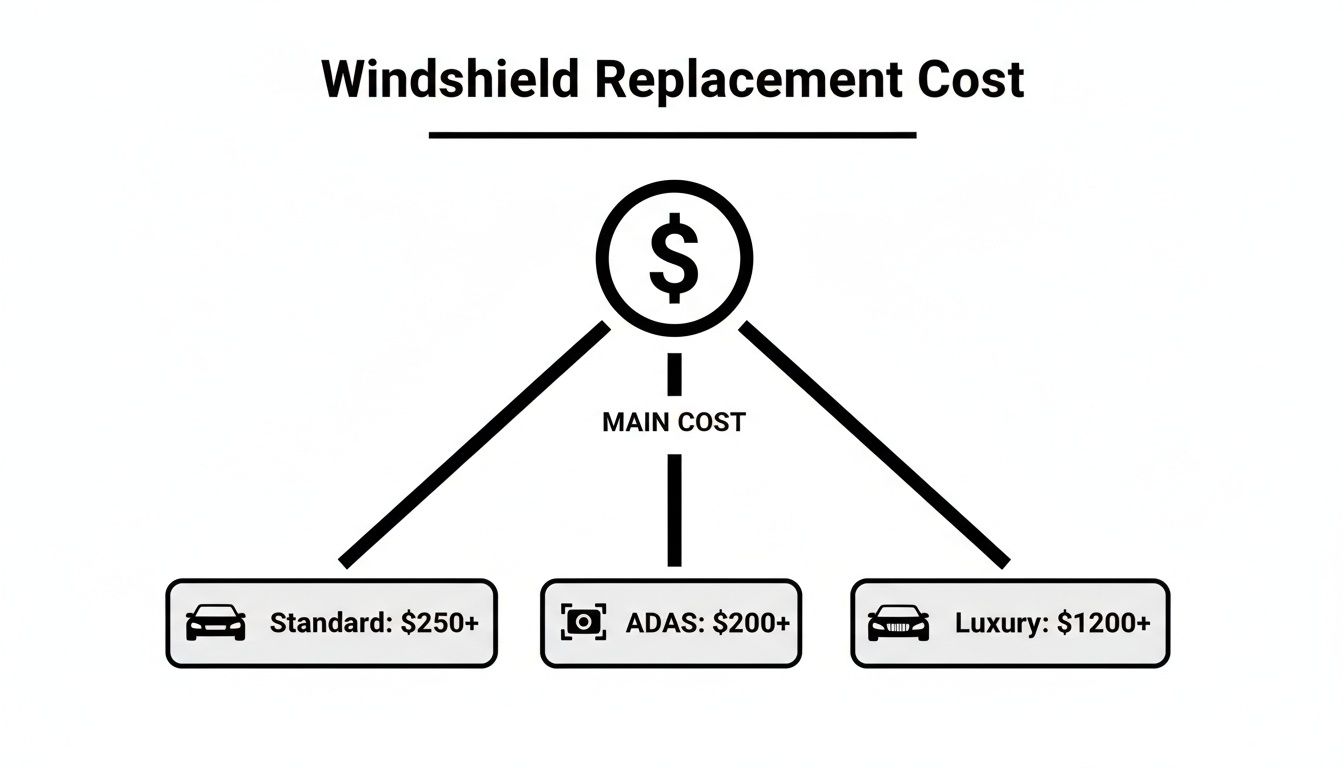
As you can see, a basic job might start around $250, but once you factor in luxury-grade glass or the critical need for ADAS recalibration, that number can climb quickly. Let’s unpack what’s really driving these costs.
Your Vehicle Make and Model
The biggest piece of the puzzle, by far, is the car you drive. A windshield for a super common car like a Honda Civic is produced in huge numbers by lots of different manufacturers. That competition keeps the price down, often landing under $300.
On the other hand, if you drive a luxury import like a BMW or a specialty vehicle like a Tesla, you're dealing with a different beast. These cars often have larger, more uniquely curved windshields, sometimes with special acoustic layers to keep the cabin quiet. That level of engineering means the glass itself is more expensive, easily pushing the cost over $800.
The Type of Glass You Choose
Once we know the shape of the glass your car needs, you generally have two options to choose from, and they come with very different price tags.
OEM (Original Equipment Manufacturer) Glass: This is the exact same windshield your car had when it left the factory, right down to the little automaker logo printed on it. It’s a guaranteed perfect match, but that guarantee comes at a premium—it usually costs 30-50% more than other options.
Aftermarket (OEE) Glass: This glass is made by reputable third-party companies. It's designed to meet or exceed all federal safety standards and performs just like the original. For most people, high-quality aftermarket glass is a fantastic way to get a safe, reliable replacement without breaking the bank.
A professional technician from a shop like Auto Renu Auto Glass LLC can walk you through the pros and cons of each, helping you find the right balance of quality and cost for your car and budget.
Special Features Embedded in the Glass
These days, a windshield is so much more than a simple piece of glass. It’s an integrated part of your car’s technology. Many of them house sensors and other features that add layers of complexity—and cost—to a replacement.
Your windshield is no longer a passive component. It's an active part of your vehicle's safety and comfort systems, housing everything from rain sensors that automatically activate wipers to heating elements that de-ice the glass in winter.
Some of the common features that will bump up the price include:
Rain sensors
Heated wiper zones or fully heated glass
Heads-Up Displays (HUD) that project info onto the glass
Acoustic interlayers for a quieter ride
Each of these features requires a very specific, and more expensive, piece of glass and a much more careful installation process.
ADAS Recalibration Requirements
This is probably the most significant cost driver that catches people by surprise: recalibrating your car’s Advanced Driver-Assistance Systems (ADAS). These are the smart safety features like lane-keeping assist, adaptive cruise control, and automatic emergency braking, and they rely on cameras and sensors mounted directly to your windshield.
When a new windshield goes in, those cameras have to be realigned with pinpoint accuracy to ensure they see the road correctly. This process is called recalibration. It's a non-negotiable step that requires specialized tools and training, and it typically adds $200 to $400 (or more) to the final bill. Skipping it would be like getting new glasses but with the wrong prescription—your car’s most important safety features simply wouldn’t work right.
The Hidden Cost Of ADAS Recalibration
If your car was built in the last decade or so, that piece of glass in front of you is doing a lot more than just blocking the wind. It’s the eyes for your vehicle's most advanced safety features.
Modern cars come loaded with Advanced Driver-Assistance Systems (ADAS)—think lane-keeping assist, adaptive cruise control, and automatic emergency braking. The brain behind these features is a camera, and it’s mounted right on your windshield.
When we replace the windshield, that camera has to come off the old glass and go onto the new one. The problem is, even a single millimeter of difference in its position can completely throw off how the system sees the road. This is why recalibration isn't just a suggestion; it's an absolute must.
It's a lot like getting a new pair of prescription glasses. For you to see clearly, the lenses have to be perfectly centered over your pupils. If they're off by just a hair, your vision gets blurry and distorted. It’s the same concept for your car. Skipping ADAS recalibration means its safety features are essentially flying blind, which could lead to them failing you when you need them most.
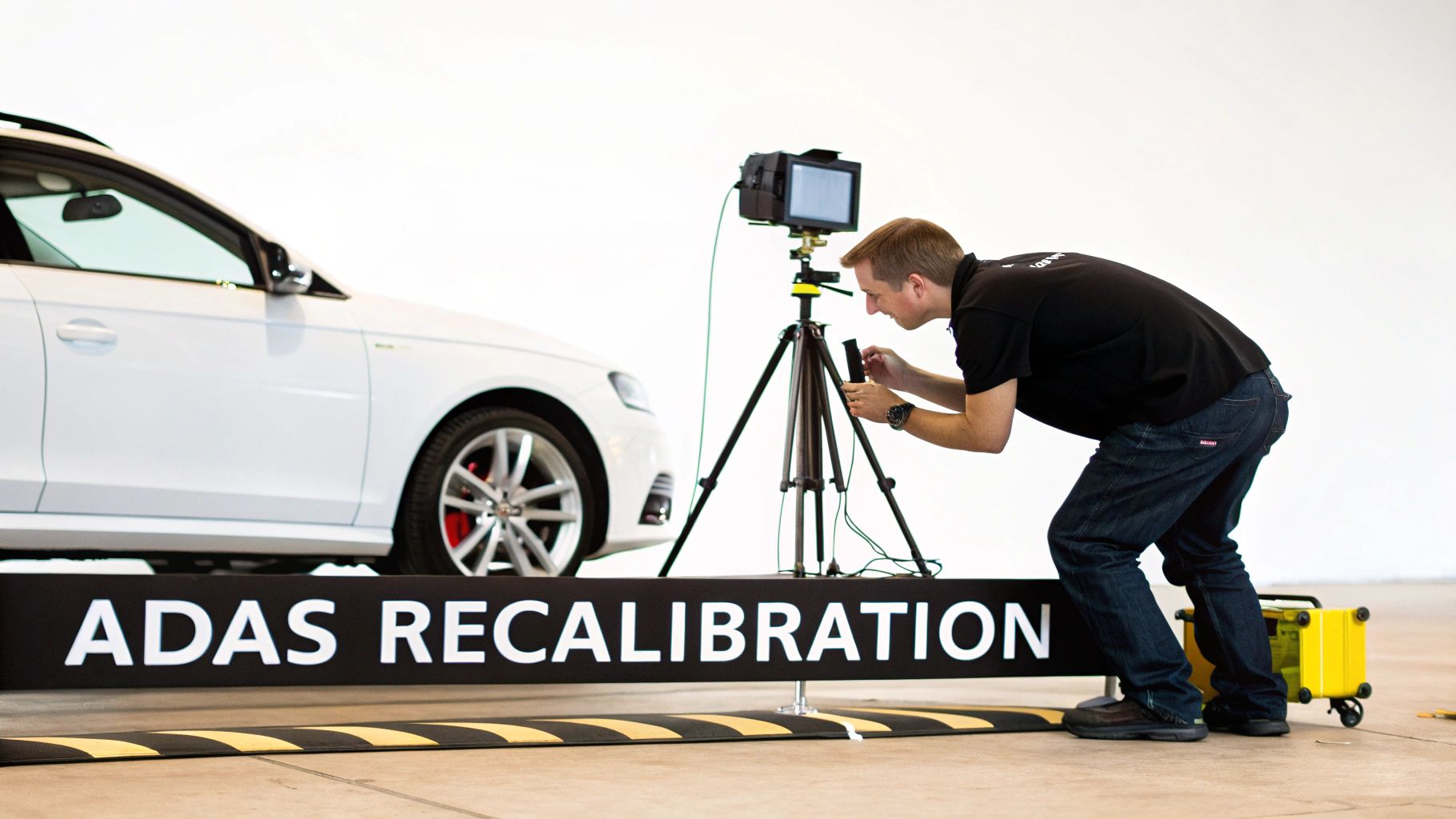
Why Recalibration Adds To The Cost
This isn't a simple tweak you can do with a screwdriver. Recalibrating an ADAS system requires specialized diagnostic equipment and a technician who knows exactly what they're doing. It’s a painstaking process to get everything perfectly aligned back to factory specs.
Recalibration isn't just an optional "add-on" service; it's a critical safety procedure. Failing to recalibrate can render your car's most important safety features unreliable, potentially leading to system malfunctions or even accidents.
This crucial step is often the biggest surprise for people when they see the final bill. ADAS recalibration typically adds between $200 and $400 to a windshield replacement job, depending on what your specific car requires.
Understanding The Types Of Recalibration
There are two main ways to get these systems dialed in, and the method we use is dictated by your vehicle's manufacturer.
Static Recalibration: This is done in the controlled environment of a shop. The technician sets up a specific target board in front of the vehicle and uses diagnostic tools to align the camera perfectly, ensuring it has a crystal-clear view straight ahead.
Dynamic Recalibration: This one happens out on the road. A technician has to drive the vehicle at certain speeds on clearly marked roads, allowing the car's computer to use the real-world lane markings to calibrate the camera while it's in motion.
Some cars even need a combination of both static and dynamic recalibration to get the job done right. To get a better sense of what this involves, you can learn more about what goes into a proper ADAS calibration after windshield replacement in our detailed guide.
Across the U.S., a staggering 17,000 windshields get replaced every single day. For a basic sedan, you might see a cost of $350 to $600. But for a truck or an EV needing that mandatory ADAS recalibration, the price can easily climb to $800-$1,500. And this is becoming the norm, with 40% of new cars expected to have these systems by 2026.
For our customers here in the Bay Area, a mobile service like Auto Renu Auto Glass LLC can handle these complex recalibrations for brands like Tesla right at your location. Because we have lower overhead than a brick-and-mortar shop, we can often do it for 10-20% less.
Will Your Car Insurance Cover The Cost?
When a rock smacks your windshield, your first thought is probably about the damage. Your second is almost always: "Am I going to have to pay for this?" The answer really depends on what kind of car insurance you have.
For most drivers, the key is comprehensive coverage. This is the part of your policy that handles damage from things other than a collision—think hail, a tree branch falling, or a rock flying up from the road.
If you only carry basic liability, you'll likely be paying for a new windshield yourself. But if you have a comprehensive plan, you're in a much better position to get help from your insurance company.
Understanding Your Deductible
Even with the right coverage, there's still the matter of your deductible. Think of it as your share of the repair cost. It's the amount you have to pay before your insurance policy kicks in to cover the rest.
Let's say a full replacement costs $700 and your deductible is $500. You would pay the first $500, and your insurance would handle the remaining $200.
Sometimes, it just doesn't make sense to file a claim. If the replacement is only $450 and your deductible is $500, you’d be paying the entire bill anyway. In that case, it's often better to pay out-of-pocket and keep the claim off your insurance record.
The Advantage of Full Glass Coverage
This is where things get interesting. Some states and insurance providers offer an add-on called full glass coverage, sometimes known as a zero-deductible option for glass. This is a huge benefit if you can get it.
With full glass coverage, your insurance company often waives the deductible entirely for windshield repair or replacement. That means getting a brand-new, professionally installed windshield—including the critical ADAS recalibration—could cost you $0 out-of-pocket.
It’s an incredible value that can save you hundreds of dollars. It's always a good idea to pull up your policy or call your agent to see if you have it. To dive deeper into how different policies work, take a look at our guide on whether insurance covers windshield replacement.
Here at Auto Renu Auto Glass LLC, we take the headache out of the insurance process. We work with all major insurance companies every single day, so we can handle the paperwork and direct billing for you. Our team will help you figure out your coverage, explain your deductible, and find the most affordable solution so you can get back on the road without the stress.
Smart Ways To Save Money On Your Replacement
Knowing what drives up the price of a windshield replacement is one thing, but knowing how to bring that price back down is where you really win. The good news is that with a few savvy moves, you can cut down your out-of-pocket costs without ever skimping on safety.
This isn't just about chasing the lowest quote. It’s about making smarter choices all around—from the service you choose to the type of glass you install. Making the right call can easily save you hundreds of dollars and deliver far better value in the long run.
Choose Smart And Save Big
First things first: do you actually need a full replacement? Before you commit, see if a simple repair will do the trick. Small chips and cracks, usually those smaller than a dollar bill, can often be fixed by injecting a clear resin. This not only restores the glass's strength but is also way faster and typically costs less than $150.
When a full replacement is your only option, you still have plenty of ways to keep the costs in check:
Go with High-Quality Aftermarket Glass: We've already touched on this, but it bears repeating: OEM glass is the most expensive route. A top-tier aftermarket or OEE (Original Equipment Equivalent) windshield offers the same federal safety standards for a much friendlier price, often saving you 30-50%.
Use a Mobile Service: Shops have rent, utilities, and all sorts of overhead. A mobile service like Auto Renu Auto Glass LLC comes straight to your home or office, cutting out those costs. We pass those savings right on to you, which means more competitive pricing. Dive deeper into this on our post about mobile windshield replacement cost.
Don't Forget to Ask About Deals: It never hurts to ask! Auto glass shops often have seasonal specials, promotions, or discounts for customers paying out-of-pocket. A quick question could shave a nice chunk off your final bill.
Proactive Protection And Market Competition
Want to avoid this headache in the future? Look into preventative measures. Thinking about the long-term pros and cons of windshield protection film vs replacement could save you from another expensive replacement down the road. It's a proactive step that can stop damage before it even starts.
The global automotive windshield market was valued at an astounding $34.29 billion in 2023 and is projected to reach $68.35 billion by 2032. This massive scale fuels intense competition among manufacturers and installers.
This intense competition is actually a huge benefit for you, the driver. It forces companies to fight for your business by offering better prices and greater value. By putting these strategies to work, you can take charge of your repair costs and walk away with a safe, quality installation that didn't break the bank.
Common Questions About Windshield Replacement
When you're facing a windshield replacement, it's natural to have a few questions. From safety to timing to the type of glass being installed, you want to feel confident in the process. We've put together some straightforward answers to the questions we hear most often.
Is It Really That Dangerous to Drive With a Cracked Windshield?
Honestly? Yes, it is. Driving with a cracked windshield is a gamble you don't want to take. It's not just about a distracting line in your field of vision; the real problem is how it compromises your car's safety systems.
Your windshield does a lot more than just block the wind. It’s a critical part of your car’s structure, providing up to 30% of its strength in a rollover. A crack seriously weakens that support. On top of that, the passenger-side airbag is designed to bounce off the windshield to protect the person in that seat. A damaged windshield can cause it to deploy improperly.
That tiny chip might not seem like a big deal, but everyday road vibrations and temperature swings can make it spread in a hurry. The safest bet is to have a professional from a team like Auto Renu Auto Glass LLC take a look right away.
How Long Does a Mobile Windshield Replacement Actually Take?
The convenience of a mobile service is a game-changer, and the whole process is faster than most people think. A skilled technician can typically swap out the old glass for the new in about 60 to 90 minutes.
After the new windshield is set, the special adhesive needs some time to cure. This is what creates that rock-solid, watertight seal. We call this the "safe drive-away time," and it usually takes about another hour.
If your car has advanced driver-assistance systems (ADAS), there’s one more crucial step: recalibration. That adds another 30 to 60 minutes. All in all, you can expect the entire mobile appointment—from our arrival to you being ready to drive—to take about two to three hours, all done right in your driveway.
What's the Real Difference Between OEM and Aftermarket Glass?
When you get a quote, you'll see two main options for the glass itself: OEM and aftermarket. Knowing the difference can help you make a smart, budget-friendly choice.
A good way to think about it is like buying medicine—you can get the name brand or the generic. Both do the job safely and effectively, but the name brand costs more.
OEM (Original Equipment Manufacturer) Glass: This is the identical glass that was installed at the factory, right down to the carmaker's logo. You're guaranteed a perfect match, but it's always the pricier option.
Aftermarket Glass (OEE): This glass is made by a different company but is designed to meet the exact same specifications for fit and function. Good aftermarket glass has to meet or exceed all Federal Motor Vehicle Safety Standards (FMVSS).
Any reputable shop will only use high-quality aftermarket glass that's just as safe and durable as the OEM version. For most people, a top-tier aftermarket windshield is the best of both worlds—you get a safe, reliable replacement without paying for the brand name.
Ready to get a clear view of your windshield replacement cost? The team at Auto Renu Auto Glass LLC provides transparent quotes and expert mobile service, including ADAS recalibration, throughout the Bay Area. Visit us online to get your free estimate today!