How to Replace Car Windshield The Right Way
Learn when to replace car windshield with our expert guide. We cover costs, insurance claims, ADAS recalibration, and finding a qualified pro.
Jan 29, 2026
generated
replace car windshield, windshield replacement, auto glass repair, adas recalibration, car safety features
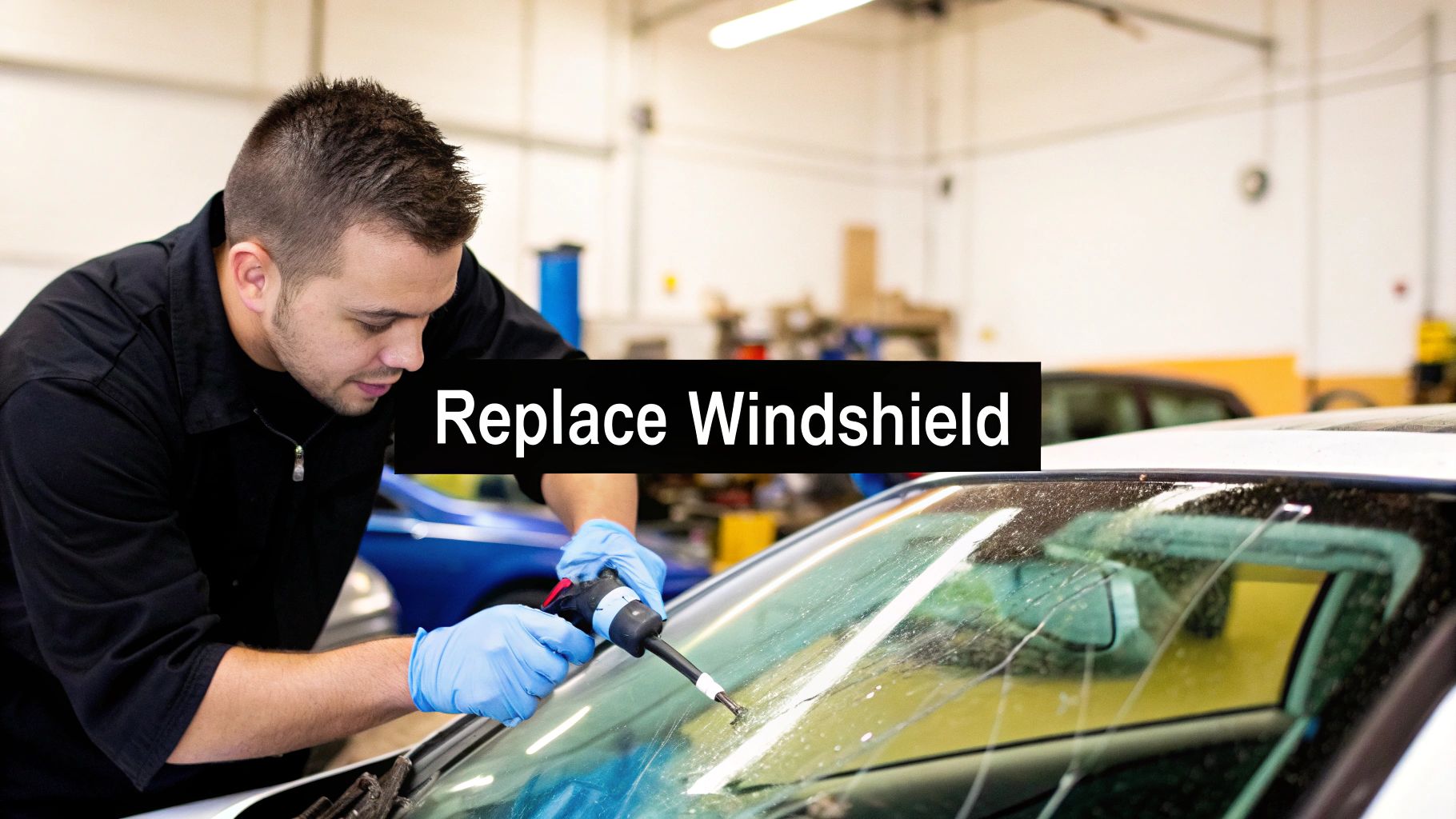
That tiny chip from a stray rock on the highway might seem harmless, but it can quickly spiderweb into a serious safety hazard. Figuring out whether you need a quick repair or a full-on replacement isn't always cut and dry, but there are some clear signs to watch for.
This isn't just about looks—it's about keeping your car's structure sound and making sure your safety systems are ready to go when you need them.
Knowing When to Replace Your Car Windshield
It’s easy to put off dealing with a small chip, but knowing when that "small problem" has become a critical failure is essential. Your windshield is a key piece of your car's safety equipment, doing far more than just keeping the wind out of your face. While resin can fix many small dings, some damage goes too far, making replacement the only safe bet.
To help you make the call, here's a quick breakdown of what can typically be repaired versus what almost always calls for a brand new windshield.
Repair or Replace Deciding Factors
Damage Characteristic | Repairable (Usually) | Requires Replacement (Likely) |
|---|---|---|
Size | Chips smaller than a quarter; single cracks under 3 inches long. | Cracks longer than a dollar bill (about 6 inches). |
Location | Damage is not in the driver's direct line of sight. | Damage is directly in the driver's field of vision. |
Edge Damage | The impact point is several inches from the edge of the glass. | Any chip or crack that reaches the windshield's edge. |
Type of Damage | A simple bullseye or small chip with minimal cracking. | A "star break" with multiple legs, or deep, complex cracks. |
Number of Hits | One or two isolated chips. | Multiple chips across the glass or heavy "pitting." |
Ultimately, the best way to know for sure is to have a professional technician inspect the damage. They have the experience to see how deep an impact goes and whether a repair will truly hold.
Damage That Demands Replacement
Some types of damage are just too severe for a simple resin fix. If you see any of these, you’re almost certainly looking at a replacement:
Cracks at the Edge: Once a crack reaches the edge of your windshield, the glass's structural integrity is shot. That seal between the glass and the car's frame is compromised, weakening the entire setup.
Damage in the Driver's Line of Sight: Even a tiny chip right where you look can distort your view and become a dangerous distraction. Since repairs can leave a slight blur, replacement is the safest option for anything in this critical area.
Complex "Star" Breaks: A star-shaped break, with little legs shooting out from the center, is a nightmare to repair properly. Those legs are just waiting to spread, even after a repair attempt.
Multiple Chips or Pitting: Over the years, countless tiny impacts from road debris can leave your windshield with a "sandblasted" look. This condition, called pitting, creates a dangerous glare from sunlight or oncoming headlights, and the only fix is new glass.
Think about this: Your windshield provides up to 30% of a vehicle's structural strength. In a rollover crash, it's what helps keep the roof from caving in. A compromised windshield just can't do its job.
More Than Just Glass
Modern windshields are highly engineered pieces of safety equipment. Did you know the passenger-side airbag is designed to bounce off the windshield to properly cushion the occupant? If the glass is cracked or poorly installed, it can shatter on impact, making the airbag useless.
And that's not all. With the rise of Advanced Driver-Assistance Systems (ADAS), your windshield is now home to a host of cameras and sensors that control features like automatic emergency braking and lane-keeping assist. Putting off a necessary replacement can mean these systems won't work correctly.
It’s no surprise the demand for these services is booming. The auto windshield repair industry in the U.S. has grown at a 5.1% clip over the last five years, hitting an estimated $8.3 billion in 2025. This growth reflects the reality that on millions of vehicles, small chips often become big problems that need a professional's touch. You can read the full research about the auto glass industry to see just how big this market is.
What a Professional Replacement Actually Looks Like
When you call in a pro to replace your windshield, you’re not just getting a new piece of glass. It’s a meticulous process that restores a critical safety component of your vehicle. Knowing what’s involved helps you understand why cutting corners is never a good idea.
First things first, a good technician preps the area. They’ll carefully drape protective covers over your dashboard, seats, and the paint around the windshield. This is a simple but vital step to prevent any adhesive drips or accidental scratches from messing up your car's interior or finish.
This flowchart shows how a professional thinks, breaking down the key factors they evaluate to decide if a simple repair will do or if a full replacement is the only safe option.
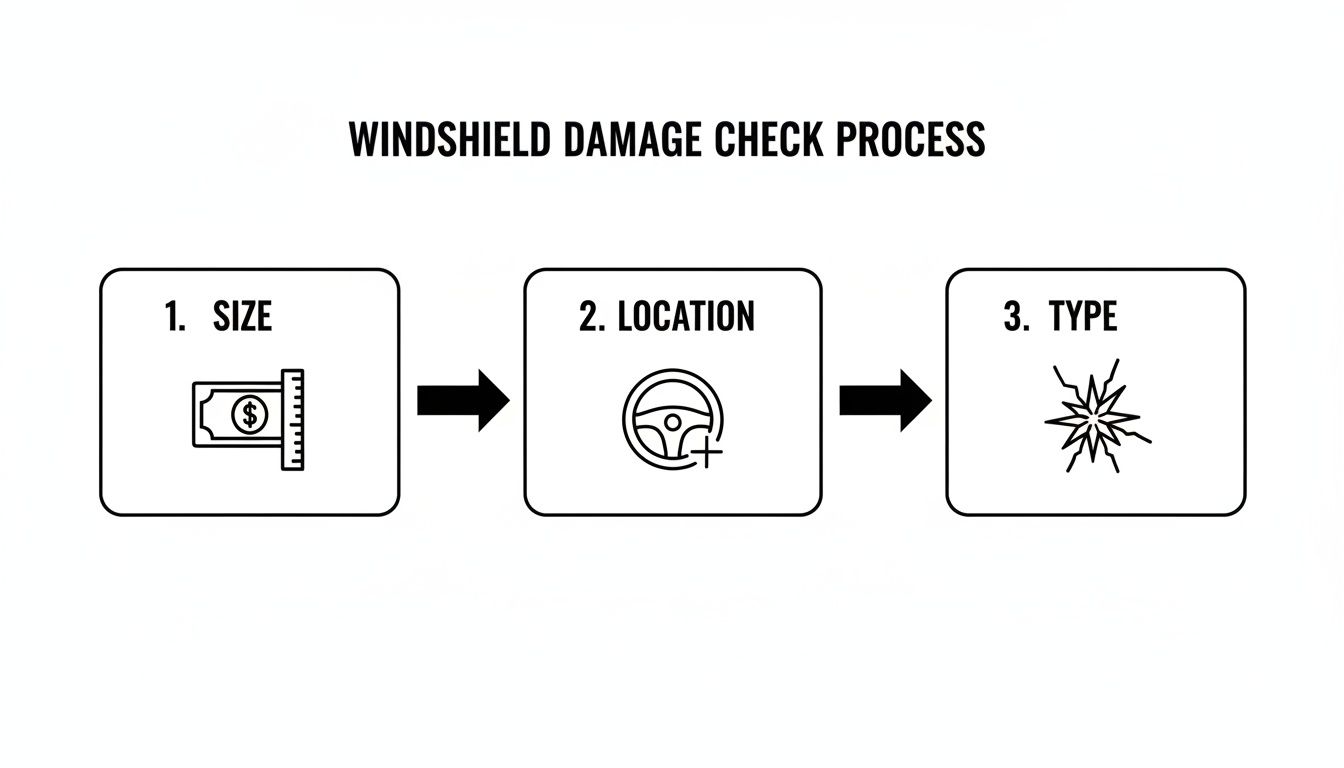
As you can see, it comes down to the size, location, and type of damage. Some issues just can't be safely repaired, making a replacement necessary.
The Art of Safe Removal
With your car protected, the real work begins: getting the old windshield out. This isn't a brute-force job. Technicians use specialized tools to slice through the incredibly strong urethane adhesive that holds the glass to the car's frame.
The main goal here is to remove the glass without damaging the pinchweld—that’s the metal flange the windshield sits on. Gouging or bending the pinchweld is a rookie mistake that can lead to rust, leaks, and a poor seal for the new glass. A seasoned pro knows exactly how to work around it.
Once the old glass is out, they don't just slap the new one in. The old urethane has to be carefully shaved down, leaving just a thin, smooth base. This creates the perfect foundation for the new adhesive to grip onto.
Preparing The Frame For A Perfect Bond
This is probably the most important part of the entire process. The technician meticulously cleans the pinchweld, getting rid of any dirt, grease, or moisture that could ruin the new bond.
Next up is the primer. A special primer is applied directly to the pinchweld, and it does two crucial things:
It acts as a bonding agent, ensuring the new urethane creates a permanent, factory-strength seal.
It seals any tiny scratches in the paint that might have happened during removal, which stops rust in its tracks. If a tech tries to skip this step, it's a huge red flag.
A proper bond is about more than just keeping rain out. In a crash, your windshield provides up to 60% of your vehicle's roof strength and is essential for proper airbag deployment. A weak bond from a poorly prepped frame means these systems could fail when you need them most.
Setting The New Glass With Precision
While the primer is drying, the new windshield gets prepped. It’s cleaned thoroughly, and often a matching primer is applied to the inside edge of the glass where the adhesive will sit. This creates a powerful glass-to-urethane connection.
Then comes the adhesive itself. Using a professional-grade caulking gun, the technician lays a perfectly consistent, triangular bead of OEM-grade urethane adhesive around the pinchweld. The shape and size of this bead are critical for a watertight, flexible seal that can handle the stresses of driving.
Finally, the new windshield is carefully guided into place with large suction cups. The technician lines it up perfectly before gently setting it into the fresh urethane. After that, any trim, moldings, and sensors are reinstalled.
The Critical Curing Period
The job isn’t done just because the glass is in. That urethane adhesive needs time to cure and harden to its full strength. We call this the Safe Drive-Away Time (SDAT).
Depending on the specific adhesive used, the temperature, and the humidity, the SDAT can be anywhere from 30 minutes to a few hours. A reputable installer will give you a specific time and clear instructions.
Don't be tempted to drive off early. Hitting a bump or even just slamming a door too hard before the SDAT is up can compromise the seal. A fender-bender could even cause the windshield to pop out, making it completely useless in a serious accident. Listening to your installer here isn't just a suggestion—it's essential for your safety.
Why You Can't Skip ADAS Recalibration After a Windshield Replacement
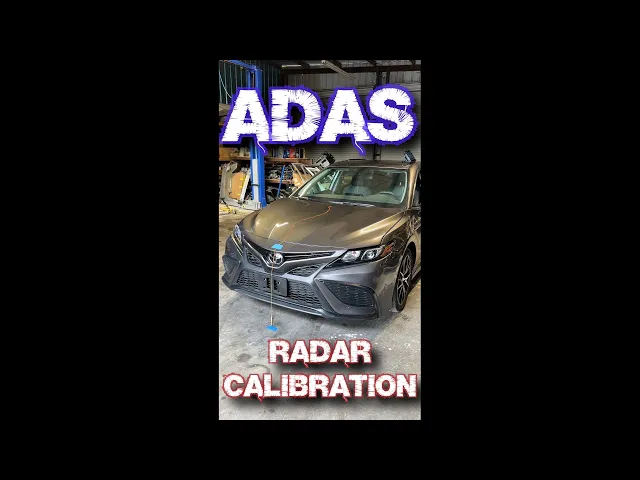
If you're driving a car made in the last few years, a windshield replacement is a whole lot more than a simple glass swap. It's now a high-tech procedure, and for a good reason. Many of your car's most important safety features—like lane-keeping assist, automatic emergency braking, and adaptive cruise control—depend on a camera mounted right on your windshield. This is the eye of your car's Advanced Driver-Assistance Systems (ADAS).
When a technician replaces your windshield, that camera has to be removed from the old glass and mounted to the new one. The problem is, even a microscopic shift in its angle—we're talking fractions of a millimeter—can throw the entire system off. This is why ADAS recalibration isn't an optional add-on; it's a critical final step in the process.
Without it, your safety systems might not just fail—they could actually become dangerous.
The Real-World Risks of an Uncalibrated Camera
It's easy to dismiss a tiny misalignment, but let's put it into perspective. Imagine your lane-keeping assist camera is off by just one degree. That sounds like nothing, right? But at 60 mph, that one-degree error can cause the system to misjudge the lane markings by several feet, potentially steering you toward another car instead of away from the shoulder.
Here are a few all-too-common scenarios that can happen with an uncalibrated system:
Automatic Emergency Braking Fails: The camera might not correctly identify a stopped car or a pedestrian in your path, meaning it won’t hit the brakes in time to avoid a collision.
Phantom Braking Events: On the flip side, the system could mistake a shadow, an overpass, or road debris for an obstacle, causing your car to brake hard for no reason—a huge risk for anyone driving behind you.
Faulty Cruise Control: An improperly calibrated camera can misjudge the distance to the vehicle ahead, causing your adaptive cruise control to follow too closely or brake erratically.
A study I read a while back really drove this home. It found that a windshield replacement without a proper recalibration can make ADAS features completely unreliable. In some tests, the systems became so unpredictable they turned from a safety net into a liability.
This isn't just about making sure a feature works as advertised. It's a fundamental safety issue. We cover the nuts and bolts of the process more deeply in our article on ADAS calibration after windshield replacement, but the bottom line is simple: skipping it is like intentionally disabling the technology designed to protect you.
Static vs. Dynamic Recalibration: What's the Difference?
So what actually happens during a recalibration? A technician will use one of two methods, and the right one is dictated by your vehicle’s manufacturer. There's no guesswork involved.
Static Recalibration happens in a controlled shop environment. The technician parks the car in a specific spot facing a large, patterned target board. They then connect a diagnostic tool to your car's computer to reset the camera's parameters, teaching it to "see" the target exactly as the manufacturer intended.
Dynamic Recalibration, as the name suggests, is done while the car is in motion. A tech hooks up a handheld diagnostic device and takes the vehicle for a drive on clearly marked roads, usually at a specific speed. During the drive, the camera uses the real-world lane markings to calibrate itself.
Which Method Is Right for Your Car?
Luckily, you don't need to figure this out on your own. Any certified technician will follow the precise instructions from your vehicle's manufacturer.
Recalibration Type | Brands That Often Use It | What the Process Looks Like |
|---|---|---|
Static Recalibration | Common for many Honda, Subaru, Audi, and other models. | The car is parked in a workshop facing a target board. A scan tool is used to reset the camera's baseline view. |
Dynamic Recalibration | Frequently required for many domestic vehicles from Ford and GM. | A technician drives the car on well-marked roads while a calibration tool fine-tunes the system in real time. |
Dual Recalibration | Some vehicles, like certain Mercedes-Benz models, need both. | The technician performs the static process in the shop first, then completes the job with a dynamic test drive. |
The growing complexity of these systems is a huge reason the auto glass market is booming. Projections show it rocketing from $20.4 billion in 2025 to $46.2 billion by 2034, largely because the windshield is no longer just a piece of glass—it's a tech hub. This trend is a perfect illustration of why professional replacement that includes recalibration is the only safe choice for modern vehicles.
Decoding The Cost and Navigating Insurance

Alright, let's talk about the big question on everyone’s mind: what’s this going to cost? There’s no simple, one-size-fits-all answer. The final bill for a windshield replacement depends heavily on your vehicle, turning a straightforward swap on an older sedan into a much more involved—and pricier—job for a modern SUV.
Understanding what goes into a quote helps you spot a red flag when you see one. A suspiciously cheap price often means corners are being cut, whether on the quality of the glass or the skill of the installer. The cost reflects the glass itself, the technology packed into it, and the expertise needed for a safe, reliable installation.
What Goes Into Your Quote?
Every quote is tailored to your car's specific needs. A luxury vehicle loaded with advanced features will naturally cost more to service than a basic commuter car because the windshield itself is a far more complex piece of equipment.
So, what exactly influences that final number? Several key things:
Vehicle Make and Model: It's a simple matter of supply and demand. A windshield for a common car like a Honda Civic is easier and cheaper to source than one for a Porsche 911.
Built-in Technology: Does your car have rain sensors, heating elements for the wipers, or a heads-up display (HUD)? Each of these requires a specific, more expensive type of glass and adds to the labor time.
ADAS Recalibration: As we’ve covered, this is non-negotiable for modern cars. The ADAS camera must be recalibrated after the new windshield is installed, and this crucial safety service appears as a separate line item on your invoice.
Type of Glass: You’ll have a choice between OEM (Original Equipment Manufacturer) and OEE (Original Equipment Equivalent) glass. Both meet federal safety standards, but OEM glass is made by the same company that made the original for your car and typically costs more.
This isn't just about glass anymore; it’s about technology. The global market for windshield services is projected to hit $15 billion by 2025, which shows just how critical professional installation has become in our high-tech vehicles.
Windshield Replacement Cost Factors
The price you're quoted is a combination of several variables. This table breaks down what an auto glass shop considers, helping you understand where your money is going.
Cost Factor | Description | Potential Price Impact |
|---|---|---|
Vehicle Make & Model | Common cars have more accessible, affordable glass. Luxury or rare models have costlier, specialized windshields. | Low to High |
Advanced Features | Technology like rain sensors, heating elements, or heads-up displays requires more expensive glass and careful handling. | Medium to High |
ADAS Recalibration | A mandatory safety step for cars with features like lane-keep assist. It's a separate service charge. | Medium |
Glass Type | OEM glass (from the carmaker) is pricier than OEE glass (aftermarket), though both are certified for safety. | Low to Medium |
Labor & Service Type | Mobile services may have a convenience fee, while in-shop services might vary by location and technician experience. | Low to Medium |
Ultimately, a higher price often reflects the complexity of your vehicle and the care required to restore its safety systems properly.
Working with Your Insurance Company
Here's the good news: your auto insurance will likely cover most of the cost. If you have a comprehensive coverage plan, windshield replacement is almost always included. This is the part of your policy that handles damage from non-collision events—like that rock that flew up on the freeway.
But you'll need to know the details of your specific policy. Your deductible is the amount you have to pay out of pocket before your insurance starts paying. For instance, if the replacement is $800 and your deductible is $250, you’ll pay the $250, and your insurer will handle the remaining $550.
Some states, including Florida, Kentucky, and South Carolina, have "zero deductible" windshield replacement laws. If you live in one of these states, your insurer is required to waive your comprehensive deductible, meaning you pay nothing out of pocket for a repair or replacement.
A good auto glass shop can often handle the entire insurance claim for you, but being informed empowers you and helps you avoid any surprises.
Questions to Ask Your Insurance Agent
Before you book the job, get your insurance agent on the phone. A quick five-minute call can save you a lot of headaches and money down the road.
Confirm Your Coverage: Start simple. "Does my comprehensive coverage include full windshield replacement?"
Ask About the Deductible: Get specific. "What is my comprehensive deductible, and does it apply to glass-only claims?"
Check on Glass Type: If you prefer factory glass, ask, "Does my policy cover OEM glass, or will there be an extra out-of-pocket cost if I request it?"
Inquire About Rate Hikes: This is a big one. "Will filing a no-fault glass claim raise my insurance premium?" In most cases, it won’t, but it's always smart to confirm.
For a more detailed look at how insurance handles this, read our guide on whether insurance covers windshield replacement. Getting these answers will let you move forward with confidence, ensuring you get a safe, high-quality replacement without any unexpected bills.
Choosing Your Service Professional vs. DIY Risks
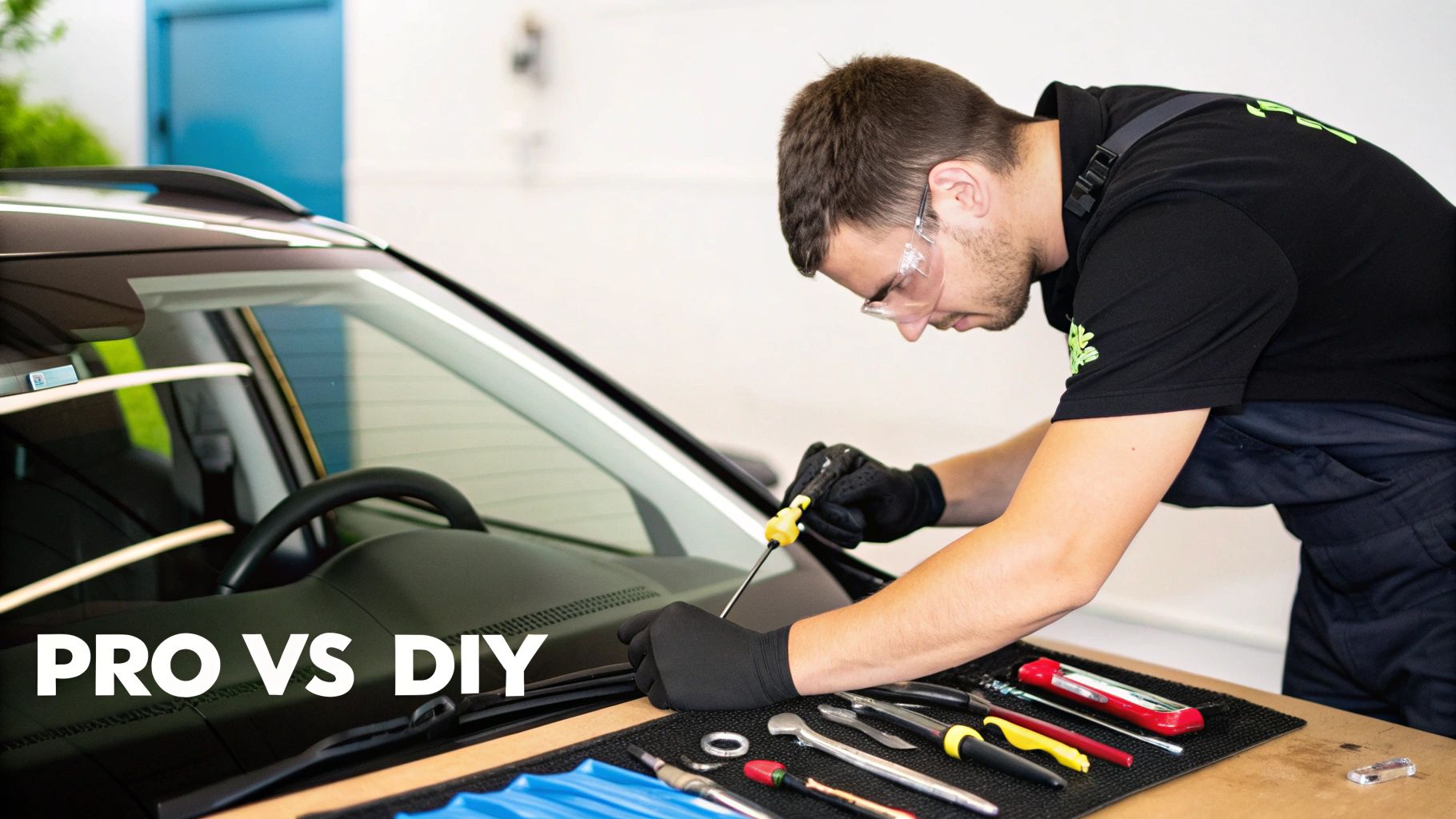
When your windshield is damaged, the temptation to grab a DIY kit from the auto parts store is understandable. It seems like a simple, cost-effective fix. But when you need to replace car windshield glass, the reality is that you're not just swapping out a window—you're working on a critical safety component of your vehicle.
A modern windshield is a structural powerhouse. It’s not just for seeing through. A shoddy installation can lead to catastrophic failures, from an airbag deploying incorrectly to the roof collapsing in a rollover. The potential savings just aren't worth the immense risks.
The Dangers of a Do-It-Yourself Installation
Trying to replace a windshield yourself opens the door to a host of problems that professionals are trained for years to avoid. An incorrect installation compromises your car’s structural integrity in ways you might not notice until it’s too late.
Here are a few of the most common DIY mistakes I've seen:
A Botched Seal: Applying the urethane adhesive is a science. Get it wrong, and you'll have weak spots that cause persistent leaks, maddening wind noise, or worse—the windshield could fly out in a collision.
Damaging the Pinchweld: The pinchweld is the metal frame the windshield sits in. It’s surprisingly easy to scratch or bend it while prying the old glass out. Even a tiny scratch can let moisture in, leading to rust that completely undermines the adhesive bond.
Contamination: Any trace of dust, finger oils, or moisture on the glass or the frame can ruin the bond. Professionals are obsessive about cleanliness for this very reason; it's non-negotiable for a safe installation.
ADAS Misalignment: Without specialized tools, it's virtually impossible to correctly reinstall and recalibrate an ADAS camera. This can render your car’s most advanced safety features useless or, even more dangerously, make them behave erratically.
A professional installation isn't just about clear glass. It's about ensuring a structural component responsible for up to 30% of your vehicle's torsional rigidity is perfectly integrated. A weak DIY bond simply can't guarantee that level of safety.
In-Shop Service vs. Mobile Replacement
Once you've wisely decided to hire a pro, you generally have two choices: take your car to a traditional auto glass shop or have a mobile service come to you. Both get the job done, but the sheer convenience of a mobile service is hard to beat.
A brick-and-mortar shop offers a controlled environment, which can be great for complex jobs or during bad weather. The downside? You have to schedule an appointment, drop off your car, and figure out how to get around, which can easily eat up your day.
Mobile services, on the other hand, bring the entire workshop right to your driveway or office parking lot. This completely cuts out the travel time and the risk of driving with a cracked, unsafe windshield. For a deeper dive, our guide on windshield replacement at home really breaks down why a mobile solution is often the smarter choice.
How to Vet Your Auto Glass Professional
Not all installers are created equal—far from it. To make sure you’re getting a safe, high-quality job, you need to do a little homework. Think of it as a quality-control checklist for your own peace of mind.
A trustworthy technician will be transparent about their qualifications and will always stand behind their work. Before you give anyone the green light, ask them about these key things:
1. Certifications and Training Look for technicians certified by the Auto Glass Safety Council (AGSC). AGSC certification is the gold standard. It means they’ve passed tough exams and are committed to the industry’s highest safety protocols.
2. Quality of Materials Don't be afraid to ask what kind of glass and adhesive they use. A reputable installer will use OEM (Original Equipment Manufacturer) or high-quality OEE (Original Equipment Equivalent) glass. Just as important, they should be using an OEM-grade urethane adhesive to create a bond as strong as the factory's.
3. Comprehensive Warranty A strong warranty shows confidence. Your installer should offer a lifetime warranty that covers their workmanship, protecting you from any future issues like leaks, wind noise, or problems with the molding.
4. ADAS Recalibration Expertise This is non-negotiable if your car has advanced driver-assistance systems. Confirm that the installer has the correct equipment and training to perform both static and dynamic recalibration precisely to your vehicle manufacturer’s specifications.
By choosing a certified professional who uses top-tier materials and guarantees their work, you’re not just buying a new piece of glass. You're investing in the safety of your vehicle, ensuring it protects you and your family exactly as it was designed to.
Your Top Windshield Replacement Questions, Answered
Once the technician has packed up their tools and your new windshield is in place, the job isn't quite finished. You’re probably wondering what comes next. Getting back on the road safely is the top priority, and a little bit of aftercare goes a long way in making sure the new seal holds up just like it did from the factory.
Let's walk through the most common questions I hear from drivers every day. I'll give you the straight-up answers so you know exactly what to do—and what to avoid—in the first few hours and days.
How Long Until I Can Safely Drive My Car?
This is easily the most important question, and the answer comes down to one thing: Safe Drive-Away Time (SDAT). This isn't just a ballpark guess. The SDAT is a precise time calculated by your installer based on the specific urethane adhesive they used, factored against the temperature and humidity that day. It can be as short as 30 minutes or take a few hours.
Seriously, don't rush this. Driving before the adhesive has cured to its minimum strength is a huge gamble. A simple pothole or even a hard brake could shift the glass. That could lead to annoying leaks down the road or, in a worst-case scenario, the windshield could fail to support the airbag in an accident.
Can I Go Through a Car Wash Right Away?
I get it—you’ve got sparkling new glass and you want the rest of the car to match. But you absolutely have to resist the urge to hit the car wash. You’ll want to wait at least 24 to 48 hours before subjecting your car to a high-pressure wash.
Those powerful water jets can easily work their way under the fresh seal and molding before the urethane has fully hardened. You might not even notice the leak for weeks, but that initial blast of water could be the culprit. If you must wash it, a gentle hand wash is generally okay after the first day, just be careful not to aim any high-pressure water near the windshield's edge.
Here's a pro tip: The adhesive sets quickly, but it takes much longer to fully cure. Giving it those first couple of days is the single best thing you can do to prevent frustrating issues like wind noise and water leaks later on.
Will Filing a Windshield Claim Raise My Insurance Rates?
This is a huge worry for a lot of people, but the good news is that, in most cases, the answer is no. A broken windshield almost always falls under your comprehensive insurance coverage. Insurers treat these as "no-fault" claims because the damage came from an outside source—like a rock kicked up on the freeway—not a collision you were responsible for.
Since it's considered no-fault, your premium shouldn't go up. Some states even have laws that require insurance companies to waive the deductible for windshield replacements. That said, it never hurts to give your agent a quick call to confirm how your specific policy handles it before you file.
What Is The Difference Between OEM and OEE Glass?
When you get a quote for a new windshield, you’ll likely hear these terms thrown around. It’s good to know what you’re paying for.
OEM (Original Equipment Manufacturer) Glass: This is the real deal, made by the same company that supplied the original glass for your car. It’s a guaranteed perfect match for fit, tint, and quality.
OEE (Original Equipment Equivalent) Glass: This glass is made by a different manufacturer but is required by federal law to meet the exact same safety and quality standards as OEM glass.
Any reputable installer will use high-quality OEE or OEM glass. Both are fantastic, safe options. The main difference you'll see is the price, as OEM glass usually costs a bit more. Your technician can walk you through the pros and cons for your specific vehicle.
At Auto Renu Auto Glass LLC, we believe knowledge is power. We want our customers to feel confident in the work we do. If you're in the Bay Area and looking for a top-quality windshield replacement that comes to you, we're here to help. Get in touch with us for an honest quote and expert service you can count on.
Find out more and book your mobile service at https://www.autorenu911.com.