Windshield Crack Repair Cost Explained
What does windshield crack repair cost? This guide breaks down pricing, insurance, and the factors that determine your final bill. Get clear answers now.
Oct 17, 2025
generated
windshield crack repair cost, auto glass repair, car maintenance, windshield repair cost
So, you've got a chip or a crack in your windshield. The first question that probably pops into your head is, "How much is this going to set me back?"
Generally speaking, the average windshield crack repair cost for small chips and cracks (think under a few inches) will land you somewhere between $50 and $150. If you're dealing with a longer crack, maybe one that’s creeping up to 24 inches, you’re looking at a higher range, typically from $100 to $250.
Breaking Down the Price of a Clear View
While those numbers are a great starting point, the final invoice isn't always so simple. Think of it like a trip to the doctor for your car—the final bill depends on the specific "injury." A tiny, dime-sized bullseye chip is like getting a quick stitch. A long, spiderwebbing crack? That's a more complex procedure.
The goal is always the same: restore the glass's structural strength and stop that damage in its tracks. It's a much more wallet-friendly approach than having to replace the entire windshield.
The cost for these repairs isn't static; it shifts with new vehicle technologies and the rising price of materials. Fixing a small rock chip usually costs between $50 and $150, while those longer cracks (from 12 to 24 inches) can run from $100 up to $250. Don't forget, the type of car you drive matters, too. Luxury vehicles or those packed with advanced driver-assistance systems (ADAS) often require special care, which can bump up the price.
Estimated Windshield Repair Costs by Damage Type
To give you a better idea of what to expect, let's break down the costs by the specific type of damage. This table gives you a quick snapshot of what you might be looking at.
Type of Damage | Typical Size | Estimated Cost Range |
|---|---|---|
Bullseye Chip | Up to 1 inch in diameter | $50 – $100 |
Star Break | Up to 1 inch in diameter | $60 – $120 |
Combination Break | Up to 2 inches in diameter | $80 – $150 |
Short Crack | 1 to 6 inches long | $90 – $160 |
Long Crack | 6 to 12 inches long | $100 – $200 |
As you can see, the bigger and more complex the break, the more you can expect to pay.
Key Takeaway: The absolute best way to keep repair costs down is to act fast. That small chip you see today is much cheaper to fix than the long crack it could become tomorrow.
Having these baseline figures in mind helps you know what to expect. If you're looking at a fresh chip or crack, your next move should be exploring professional windshield repair to get a safe, durable fix and get back on the road with a clear view.
What Really Determines Your Final Repair Bill
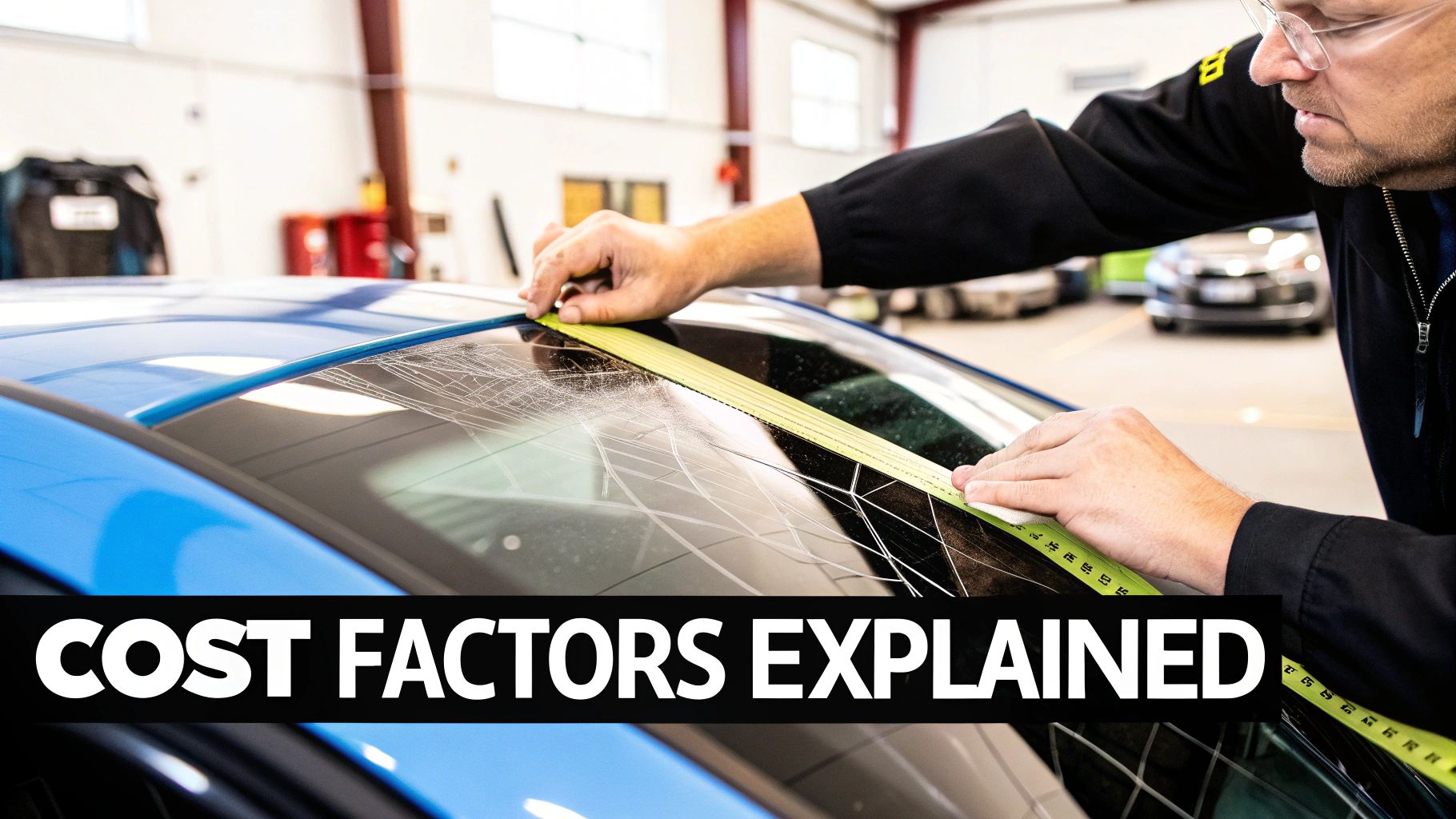
So, you've seen the average price ranges, but you're probably wondering why your neighbor paid $60 for their chip repair while you just got a quote for $200. The final windshield crack repair cost isn't some arbitrary number pulled out of a hat. It's actually a very specific calculation based on what a technician sees when they inspect your car.
Think of it this way: patching a tiny nail hole in a wall is a quick, cheap job. Fixing a massive, jagged hole that requires structural support is a whole different ballgame. Your windshield is no different. The damage itself is the biggest piece of the pricing puzzle.
The Damage Itself: Size, Type, and Location
Not all cracks are created equal. A good technician is going to look at three things right away, and each one tells them how complex—and expensive—the job will be.
Size Matters: The old rule of thumb holds true: smaller is cheaper. A tiny chip that can be covered by a quarter is usually a straightforward, quick fix. But a long crack that’s creeping over six inches? That’s going to take a lot more time, specialized resin, and serious skill to fill and stabilize properly.
Type of Break: A simple, clean "bullseye" chip is the easiest kind to repair. The real trouble starts with more complex shapes, like a "star break" with little legs shooting out in every direction, or a "combination break" that’s a messy mix of a chip and cracks. These are trickier to fill completely and will definitely nudge your bill higher.
Location is Key: Where the damage is located can make or break a repair. If that crack is right in the driver's direct line of sight, the repair has to be practically invisible to avoid distorting your view. On top of that, cracks that run right to the edge of the windshield are a major headache. They can weaken the glass's structural bond to the car's frame, making the repair much more delicate and costly.
Your Vehicle's Technology and Make
The kind of car you drive is just as important as the crack itself. Modern cars, especially, are packed with technology that’s tied directly to the windshield. What used to be a simple piece of glass is now a high-tech command center.
Luxury cars, for instance, often use special acoustic glass to keep the cabin quiet, and that glass is more expensive to work with. But the single biggest game-changer is Advanced Driver Assistance Systems (ADAS).
These are the systems that give you safety features like lane-keeping assist, adaptive cruise control, and automatic emergency braking. They "see" the world through cameras and sensors that are almost always mounted right on your windshield.
Even a minor repair can throw off the precise alignment of these cameras. That means a camera recalibration is often mandatory to make sure those safety features are working exactly as they should. You can learn more about the importance of ADAS windshield calibration in our detailed guide, because this isn't an upsell—it's a critical safety step that adds a necessary charge to the job.
Geographic Location and Glass Quality
Finally, where you live and the type of glass you choose both play a part. It's a simple matter of economics: a repair done in a high-cost urban area is almost always going to be more expensive than the same job in a small town, thanks to differences in labor rates and shop overhead.
The quality of the materials used also affects the price. You might be given a choice between standard aftermarket glass and Original Equipment Manufacturer (OEM) glass, which is identical to what the car came with from the factory. OEM is pricier. These regional and material choices add one last layer to your final repair bill.
How Insurance Can Cover Your Repair Costs
That sinking feeling you get when a rock smacks your windshield is often followed by another worry: the cost. But here's some good news—your car insurance policy can be a huge help, and you might not have to pay a dime out of pocket for a repair.
It all boils down to a part of your policy called comprehensive coverage. Think of this as your shield against anything that isn't a collision. We're talking about things like theft, falling branches, or, you guessed it, a rock flying up and chipping your glass. Most insurance companies would much rather pay for a quick, cheap repair today than foot the bill for an expensive full replacement tomorrow.
Understanding Your Coverage Options
For most drivers, insurance is the secret to making windshield damage a minor inconvenience instead of a major expense. Policies often cover small repairs with little to no deductible, which is a fantastic deal. But if the crack is too big and you need a full replacement, the cost can jump, especially for modern cars loaded with advanced safety systems that need to be recalibrated. If you want to dive deeper, you can learn more about how insurance handles repair versus replacement costs and get some valuable insights.
This simple decision tree breaks down how your insurance company will likely look at your claim.
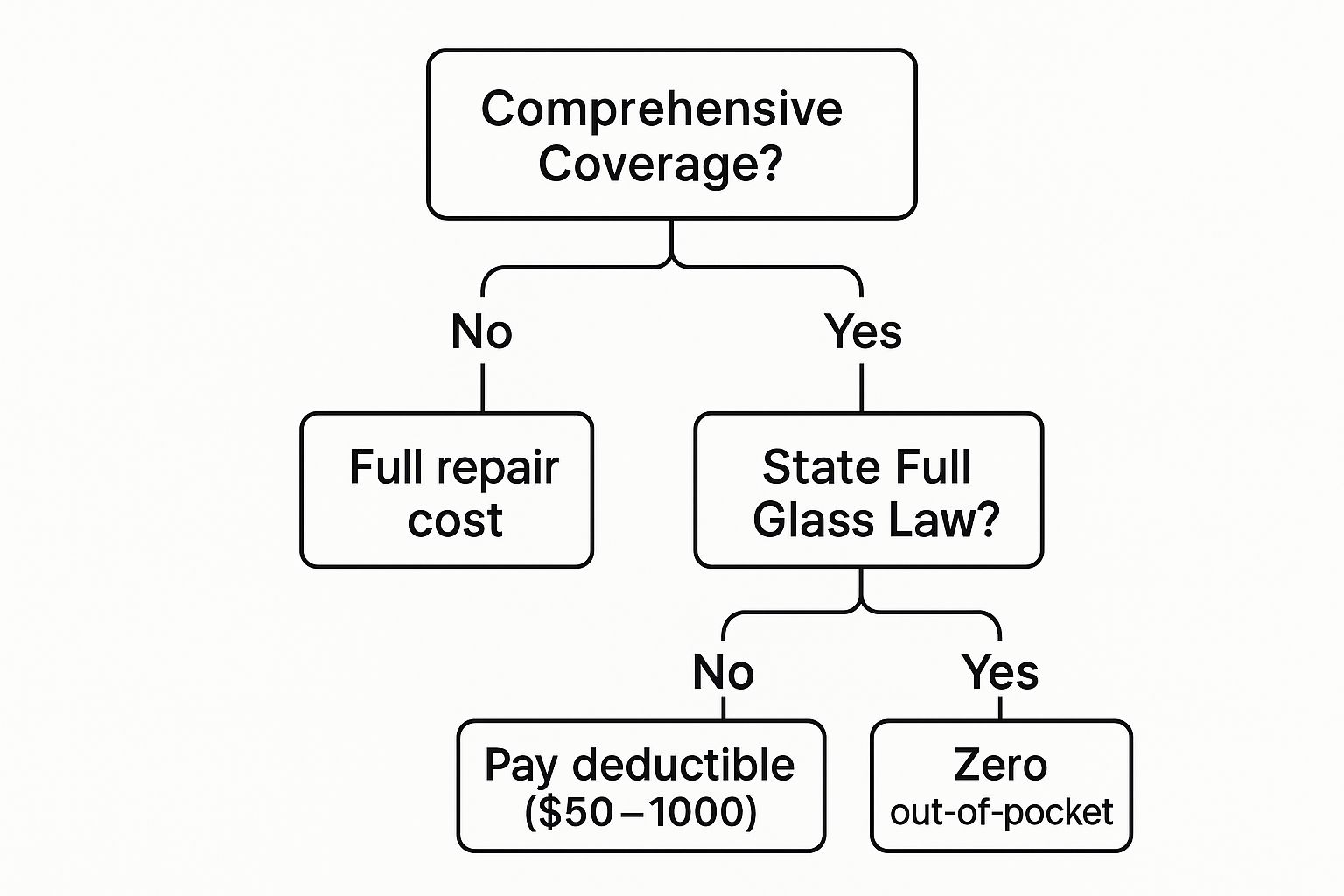
As you can see, having the right policy can shrink what you owe to a small deductible or even nothing at all. This is especially true if you're lucky enough to live in a state with specific glass coverage laws.
Navigating the Claims Process
Don't worry, filing a windshield repair claim is usually painless. Insurers have made the process incredibly simple because they want you to get it fixed fast. A quick repair saves them a ton of money compared to a replacement and keeps the original, factory-installed seal on your windshield intact—which is safer for you.
Here’s what you can typically expect:
Snap a Few Photos: First things first, document the damage. Take clear pictures of the chip or crack from inside and outside your car. Make a note of when and where it happened.
Contact Your Insurance Company: Give your provider a call or hop on their mobile app to start a glass claim. Many insurers even have a special hotline just for this.
Pick a Repair Shop: Your insurance company will have a list of approved auto glass shops. You can often choose your own trusted expert, like Auto Renu, to do the work.
Schedule the Fix: The repair shop handles the rest. They'll work directly with your insurance company to verify your coverage, so you can skip the paperwork headache.
Some states have what's called "full glass coverage" laws that mandate a $0 deductible for windshield repairs. If you have comprehensive coverage and live in one of these states, your repair is completely free. It’s a huge perk, so it's definitely worth checking your policy to see if you have it.
Making the Call: Should You Repair or Replace Your Windshield?
https://www.youtube.com/embed/xuTfkYVxO6U
So you’ve got a chip or crack in your windshield. Now comes the big question: can it be fixed, or do you need a whole new piece of glass? This is a decision that really balances your wallet against your safety on the road. The final call usually boils down to the size, location, and seriousness of the damage.
Let’s be clear: a repair is almost always the best first option if you can get away with it. It’s quick, costs a fraction of a full replacement, and most importantly, it keeps the original factory seal of your windshield intact. That seal is a critical safety feature. But some damage is just too far gone, making a complete replacement the only safe move.
When a Repair Is the Smart Choice
Think of a windshield repair as first aid for your glass. You're catching a small problem before it spiders into a massive, expensive one. Quick action here can literally save you hundreds of dollars.
A great little trick we use in the industry is the "dollar bill rule." If you can place a dollar bill over the damage and it covers it completely, you’re probably in luck. That means cracks under six inches are usually fair game.
Here's a quick checklist for when a repair is your best bet:
Small Chips: The chip is smaller than the size of a quarter.
Short Cracks: You’re dealing with a single crack that's less than six inches long.
Minor Damage: You have three or fewer individual chips.
Location Matters: The damage isn't directly in the driver’s line of sight, where it could be a distraction.
A solid repair injects a special resin that bonds the glass back together, restoring its strength and stopping the crack in its tracks. While it makes the damage far less noticeable, you might still see a faint outline. The real goal here is safety and structural integrity, not making it look like it never happened.
When Replacement Becomes a Must
Sometimes, a repair just won't cut it. The damage is too severe, and no amount of resin can safely restore the windshield's integrity. When this happens, a full replacement isn't just a good idea—it's essential for your safety. A badly compromised windshield might not properly support the roof in a rollover or could even cause your airbag to deploy incorrectly.
If you're facing this situation, it helps to understand what the process involves. For a deeper dive, check out our guide on what to expect during a windshield replacement.
You'll almost certainly need a replacement if:
The crack is longer than six inches.
The crack has run all the way to the edge of the windshield.
The damage is in the driver’s direct line of sight, creating a visual impairment.
The damage is deep enough to have penetrated the inner layer of safety glass.
Windshield Repair vs. Replacement Decision Guide
To help you see the difference at a glance, we've put together a simple table. It lays out the key considerations side-by-side, making your decision a whole lot easier.
Factor | Best for Repair | Requires Replacement |
|---|---|---|
Cost | Low ($50 - $150) | High ($200 - $1,000+) |
Time | Fast (About 30 minutes) | Slower (Several hours) |
Safety | Restores strength | Replaces compromised glass |
Insurance | Often covered with $0 deductible | Usually requires a deductible |
Original Seal | Preserves factory seal | Requires a new seal |
Ultimately, whether you repair or replace, the goal is the same: to ensure your windshield can do its job of protecting you. If you're ever in doubt, it's always best to have a professional take a look.
Proven Ways to Lower Your Repair Bill

While the final windshield crack repair cost is tied to things like the type of damage and your car's make, you're not just a bystander. With a bit of know-how, you can take control and significantly lower what you pay. It’s all about being proactive instead of just reacting when damage happens.
The absolute best way to keep cash in your wallet? Act fast. That tiny chip looks innocent now, but it’s a ticking time bomb. All it takes is a hot day, a cold night, or a bumpy road for that little ding to spiderweb across your glass. Suddenly, a $60 fix becomes a $400+ replacement.
Key Insight: Think of a windshield chip like a small tear in your jeans. If you patch it right away, it's a quick, cheap fix. If you ignore it, it's only a matter of time before the whole thing rips open and you need a new pair.
Be a Savvy Shopper
Once you know you need a repair, don't just pick the first name that pops up in a search. You’d be surprised how much repair costs can swing from one shop to the next for the exact same work. Spending just 15 minutes shopping around is a surefire way to get a fair price.
Here's how to make sure you're getting a good deal:
Get Multiple Quotes: Make it a rule to call at least three different auto glass shops. This gives you a solid feel for the going rate in your area and helps you spot anyone who’s overcharging.
Compare Mobile vs. In-Shop Service: Having a technician come to you is a huge convenience, but it can sometimes cost a little extra. Ask if there’s a discount for bringing your car into their shop—you might save a few bucks for a short drive.
Ask About Warranties: Any shop worth its salt will offer a lifetime warranty on their repair. It won't lower your upfront cost, but it's your safety net. If the repair fails down the line, you won't have to pay to get it fixed again.
Prevention Is the Ultimate Money-Saver
Of course, the cheapest repair is the one you never need. You can't dodge every single rock, but you can definitely stack the odds in your favor with a few simple driving habits.
For starters, give yourself more space. Don't tailgate, especially behind big rigs, dump trucks, or any construction vehicle. Their tires are magnets for gravel and debris just waiting to be launched at your windshield. Also, try to avoid gravel roads if you can, and slow down if you can't. These small changes cost nothing but can save you a whole lot of headache and money.
Is a DIY Windshield Repair Kit Worth It?
You've seen them in the auto parts aisle: a windshield crack repair kit for less than $20. When you’re staring at a potential repair bill, the thought of handling that little chip yourself and saving some cash is pretty tempting. And honestly, for the right kind of damage, it can be a decent quick fix.
But here’s the thing: trying a DIY repair is a bit like doing minor surgery with a first-aid kit. It might work for a tiny, surface-level scratch, but anything more serious really needs a specialist's touch. These kits are designed for one thing only: very small, simple bullseye chips—we're talking no bigger than a dime—that haven't gone deep into the glass.
The upfront savings look great, but the risks are real. If you don't do it perfectly, you could easily trap air bubbles in the resin, which can make the damage look even worse. A bad seal can also fail, and an improper repair often makes it impossible for a professional to fix their work later.
The Hidden Costs of a Botched DIY Job
The biggest gamble with a DIY kit isn't the $20 you might lose. It's that a failed repair can spread. That tiny chip you tried to fill can quickly spiderweb into a long crack the next time you hit a pothole or the temperature swings from hot to cold.
Here's the critical part: a botched DIY attempt often closes the door on a professional repair for good. Once a cheap resin has cured incorrectly inside the chip, a technician can't create the vacuum needed to inject their high-quality resin. The damage is essentially locked in.
What does that mean for your wallet? Your attempt to save on a $100 professional repair could easily backfire, forcing you into a full windshield replacement that costs $400 or more.
Unless you're dealing with the absolute most minor surface chip, calling a professional is almost always the safer bet. It's a smart investment in your windshield's integrity and your own long-term peace of mind.
Answering Your Top Questions About Windshield Repair
When you're dealing with a cracked windshield, a lot of questions pop up. It's totally normal. Getting some straight answers can help you feel more in control and avoid any nasty surprises when the bill comes.
Let's walk through some of the most common questions drivers ask.
Will a Windshield Repair Claim Hike Up My Insurance Rates?
This is a big one, and the answer is usually no. Insurers generally see a repair as a smart, preventative move. It falls under your comprehensive coverage, and since fixing a small crack is far cheaper for them than replacing the whole windshield, they're often happy to encourage it.
Most of the time, they'll even waive your deductible and won't penalize your premium for a single repair claim. Still, it never hurts to give your agent a quick call just to double-check your specific policy details.
How Long Am I Stuck Waiting for a Professional Repair?
You'll be back on the road before you know it. A professional repair is surprisingly quick. Most chips and cracks that are eligible for repair can be completely fixed in about 30 minutes.
Once the technician injects the special resin into the damage and cures it with a UV light, your car is good to go. It’s a huge convenience compared to a full replacement, which can easily take a few hours.
Is the Crack Going to Disappear Completely After the Repair?
The main point of a repair is to restore your windshield's strength and stop that crack from spreading. While the fix makes the damage look a lot better, it's not a magic eraser—it might not become 100% invisible.
A really good repair can clear up the blemish by 80-95%. You’ll likely still be able to see a faint spot where the rock hit, and that's perfectly normal. The important thing is that your windshield is safe and secure again.
Don't wait for that small chip to spiderweb across your windshield. The expert mobile technicians at Auto Renu Auto Glass LLC come right to your location for fast, dependable repairs that restore your safety and peace of mind. Get your free estimate today and schedule a convenient appointment!