ADAS Calibration After Windshield Replacement: Essential Guide
Learn why adas calibration after windshield replacement is vital for safety. Get expert insights on the process and protect your vehicle today.
Oct 6, 2025
generated
adas calibration after windshield replacement, windshield calibration, adas systems, vehicle safety, auto glass repair
When you get a new windshield, the job isn't truly done once the glass is in place. The most critical step comes next: recalibrating your vehicle's Advanced Driver-Assistance Systems (ADAS). This isn't an upsell or an optional extra; it's a fundamental safety requirement that ensures features like lane-keeping assist and automatic emergency braking work as intended.
Skipping this step can leave your car's safety systems completely unreliable, putting you at risk every time you get behind the wheel.
Why a New Windshield Is More Than Just Glass
It’s easy to think of a windshield as just a piece of glass—a simple barrier against the elements. But in today's cars, it's a high-tech command center. Your windshield is the mounting point for the forward-facing camera, which essentially acts as the "eyes" for nearly all of your vehicle's advanced safety features.
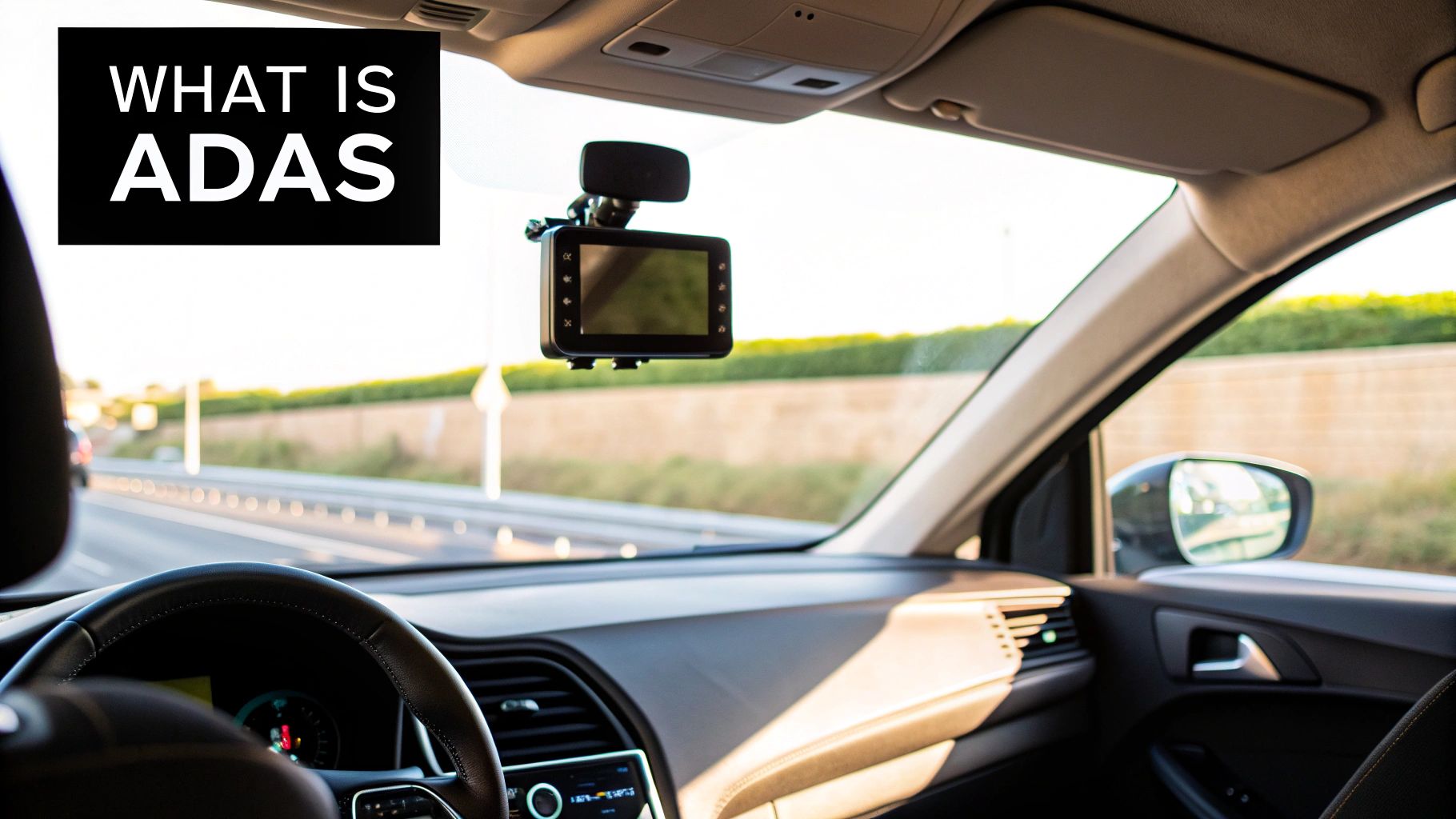
After a windshield replacement, even the tiniest shift in the camera's angle—we’re talking fractions of a millimeter—can completely throw off the system's perception. This isn't just a minor glitch; it's a serious safety hazard.
The Real-World Impact of Misalignment
So, what happens when the camera's alignment is off?
Imagine your Lane Departure Warning system starts screaming at you on a perfectly straight road. Or even worse, it stays silent as you drift out of your lane. Think about your Automatic Emergency Braking system miscalculating the distance to the car in front, causing it to brake too late... or not at all. These aren't just scare tactics; they are the real-world consequences of skipping an ADAS calibration after windshield replacement.
The calibration process essentially re-teaches the camera how to see the world through the new glass, resetting its parameters to factory specifications. Without it, your safety features can become dangerously unpredictable, and often, you won't even see a warning light on the dash.
A vehicle’s ADAS camera needs to be recalibrated to ensure it can properly "see" road markings, other vehicles, and pedestrians. This is not an optional upsell; it is a fundamental part of a safe and complete windshield repair.
Many of the safety features you rely on daily depend on a properly calibrated camera. The table below shows just a few examples and how they can be affected.
ADAS Feature | Function | Impact of Miscalibration |
|---|---|---|
Lane Keeping Assist (LKA) | Helps steer the vehicle back into its lane if it drifts. | May not detect lane markings or could steer erratically. |
Automatic Emergency Braking (AEB) | Detects potential collisions and applies the brakes. | Can fail to detect obstacles or brake unnecessarily. |
Adaptive Cruise Control (ACC) | Maintains a set distance from the vehicle ahead. | May misjudge the distance, leading to abrupt stops or tailgating. |
Traffic Sign Recognition | Identifies and displays road signs like speed limits. | Might display incorrect speed limits or miss signs entirely. |
Without calibration, these systems aren't just turned off; they can become actively unreliable, making your vehicle less safe than one without these features at all.
A Growing Necessity for Modern Vehicles
The need for calibration has exploded in recent years. What was once a rare feature found only on high-end luxury cars is now standard equipment on most new vehicles rolling off the assembly line.
The numbers don't lie. A 2023 industry report revealed that a staggering 89% of model year 2023 and newer vehicles require calibration after a windshield replacement. That's a massive jump from just 25% for 2016 models. The trend is crystal clear: if you have a modern car, you're going to need this service.
Ultimately, understanding that your windshield is a core piece of your car's safety technology is the first step. Proper installation and meticulous recalibration go hand-in-hand to restore not just your car's structural integrity, but its intelligent protective systems as well.
Why Calibration Is Non-Negotiable for Your Safety
It’s easy to think of ADAS calibration as just another technical step in the repair process, something that happens behind the scenes. But the truth is, what happens in the shop has a direct and immediate impact on your safety every single time you drive. Skipping a proper ADAS calibration after windshield replacement isn't a minor shortcut—it's actively introducing a serious, unpredictable risk to your vehicle's safety systems.
The real danger here isn't some dramatic system failure with warning lights flashing all over your dash. In most cases, a miscalibrated system fails silently. It gives you a false sense of security, and you won't know something is wrong until that split second you actually need it to work.
How a Tiny Error Creates a Huge Problem
Let's break this down with a real-world example. Say a new windshield is installed, and the forward-facing camera is remounted just one degree off its factory-specified horizontal angle. It's a tiny shift, completely invisible to the naked eye, but it has huge consequences once you're moving.
At 300 feet down the road, that one-degree error means the camera's point of focus is off by more than five feet. Suddenly, your vehicle might not "see" a pedestrian stepping into a crosswalk or could completely misread the lane markings on a sharp curve.
A tiny error on the glass can translate into feet of miscalculation on the road, turning a potential near-miss into a collision. The precision of the calibration is what bridges the gap between the camera's lens and the reality of the road ahead.
This isn’t just about staying in your lane, either. Think about your adaptive cruise control. A small vertical misalignment could make the system dangerously misjudge the distance to the car in front of you, causing it to brake too late. It might even fail to detect a smaller vehicle or motorcycle altogether. That single, uncalibrated degree compromises the entire safety net your car is supposed to provide.
The Real-World Impact on Road Safety
When these systems work as intended, they are incredibly effective at preventing accidents. Research from AAA has shown that if every vehicle with ADAS used these features properly, we could prevent an estimated 2.7 million crashes and 9,500 deaths each year.
That staggering number shows just how much potential this technology has to save lives. But that potential is only unlocked when the systems are perfectly aligned and functioning correctly. The calibration done after a windshield replacement is the final, crucial check that ensures these features are reliable and ready to protect you, your passengers, and everyone else sharing the road.
Understanding Static vs. Dynamic ADAS Calibration
When it's time for ADAS calibration after a windshield replacement, there isn't just one way to do it. The process breaks down into two main types: static and dynamic. Think of them as two different approaches to reteaching your car's camera how to see the world correctly.
Which method is right for your car? That's not a choice—it's determined by the vehicle's manufacturer. Some cars only need one, others require the other, and many newer, more advanced vehicles actually need a combination of both to get everything working perfectly again. Knowing the difference will help you understand what's happening when your car is in the shop.
Static Calibration: The Precision In-Shop Method
Static calibration is exactly what it sounds like: the car stays completely still. It’s a highly controlled process done inside a dedicated service bay, almost like a high-tech eye exam for your car's camera.
This method requires a very specific, controlled environment to get an accurate reading. The shop needs a few key things:
A perfectly level floor, because even a slight tilt can throw off the camera's perception.
Consistent, controlled lighting to avoid any glares or shadows that might confuse the camera.
Manufacturer-specific targets that are placed at exact, measured distances and heights from the vehicle.
A technician hooks up a diagnostic scan tool, puts the system into calibration mode, and the camera locks onto these targets. It uses them as fixed reference points to relearn its precise orientation relative to the car's centerline. You'll often see this meticulous process used for luxury brands like Mercedes-Benz or Audi, where the systems demand incredible precision to operate safely.
Dynamic Calibration: Learning on the Road
Dynamic calibration is the opposite—it happens while the car is actually being driven. Instead of using fixed targets in a shop, the ADAS camera uses real-world road markings to recalibrate itself. It's less like a sterile lab test and more like on-the-job training.
Here, the technician connects the scan tool and then takes the car for a drive, following a specific set of instructions. This usually means driving at a certain speed, say between 35-55 mph, on a well-marked road. As the car moves, the camera actively scans and identifies the lane markings, using them to adjust its own parameters.
This on-the-road method is pretty common for many Honda, Ford, and Toyota models. It might sound simpler, but it’s completely dependent on having the right conditions. You can't perform a dynamic calibration in the rain, on a snowy day, or on a road with faded or missing lane lines.
If you'd like to get a better handle on how these intricate systems operate, check out our in-depth guide on ADAS calibrations. It offers more context on why this technology is so critical for modern vehicle safety.
In the end, the decision between static and dynamic calibration isn't up to the technician or the car owner. The vehicle's manufacturer dictates the exact procedure, and following it to the letter is non-negotiable. This ensures that life-saving features like lane-keeping assist and automatic emergency braking are restored correctly and will be there to protect you when you need them most.
What to Expect During the Calibration Process
Knowing what really happens during an ADAS calibration after windshield replacement helps you make sure the job is done right. This isn’t just about plugging in a computer; it's a precise, methodical process that brings your car's safety features back to factory specifications. The approach can be either static or dynamic, and each one has its own set of strict requirements.
The first thing a technician will do is run a pre-calibration diagnostic scan. They’ll hook up a specialized tool to your vehicle's computer to hunt for any existing fault codes or errors in the ADAS. This is a non-negotiable first step. It confirms the systems are even ready for calibration and flags any hidden problems that need fixing beforehand.
Static Calibration: It's All About the Environment
If your vehicle needs a static calibration, the workshop environment is everything. I mean everything. The service has to be done on a perfectly level floor. Even a tiny incline can throw off the camera's perspective and lead to a completely botched calibration.
Lighting is just as critical. It needs to be consistent and controlled—no bright sunlight or deep shadows that could confuse the camera as it tries to read the targets.
The technician will set up a series of manufacturer-specific targets at exact distances and heights all around the car. Then, using a high-end scan tool like those from Autel or Bosch, they’ll put the system into learning mode. The camera locks onto these targets, effectively re-learning its precise position and field of view.
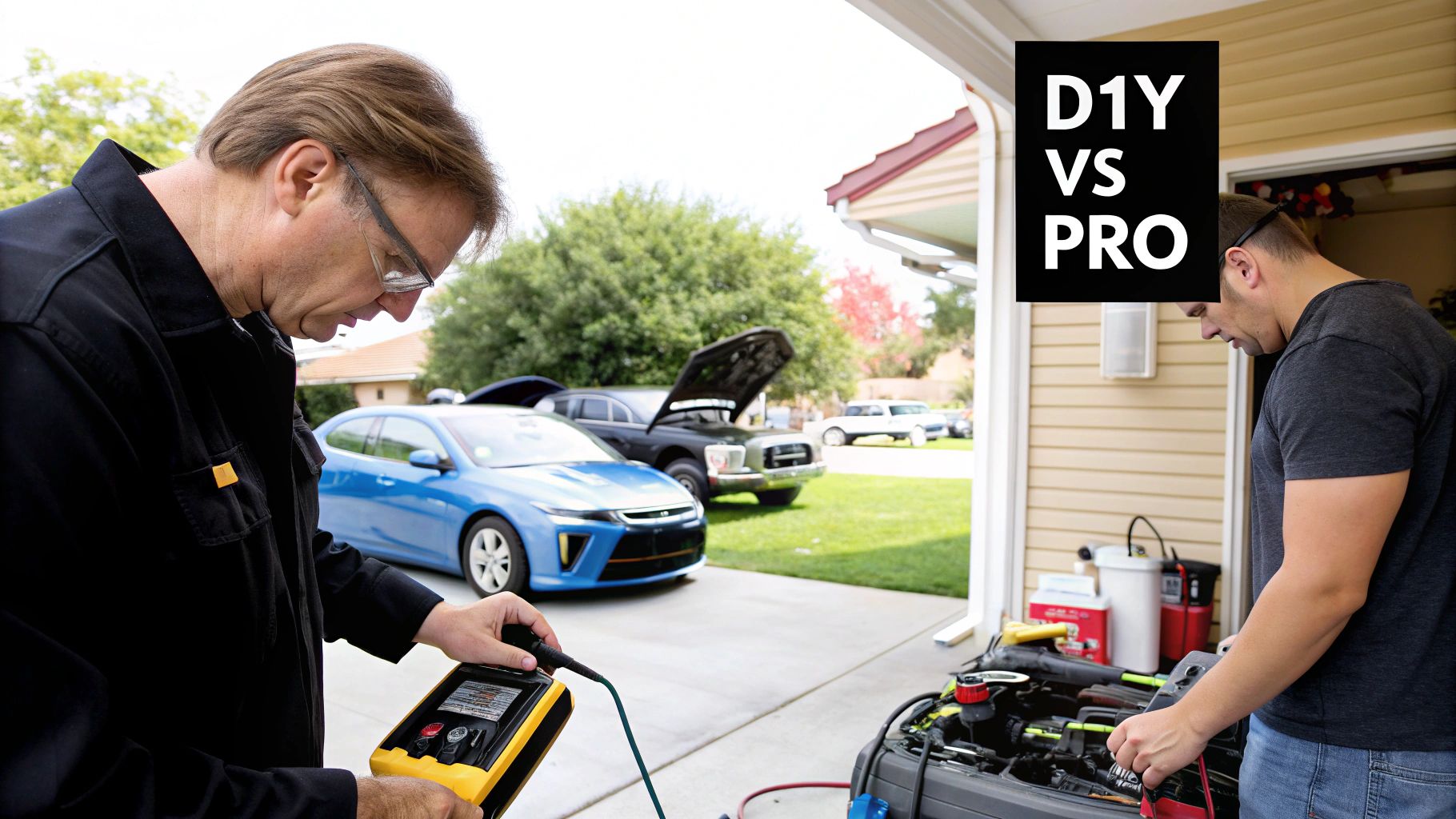
Thinking of tackling this yourself? This infographic quickly lays out the differences in time, accuracy, and cost between a professional job and a DIY attempt.
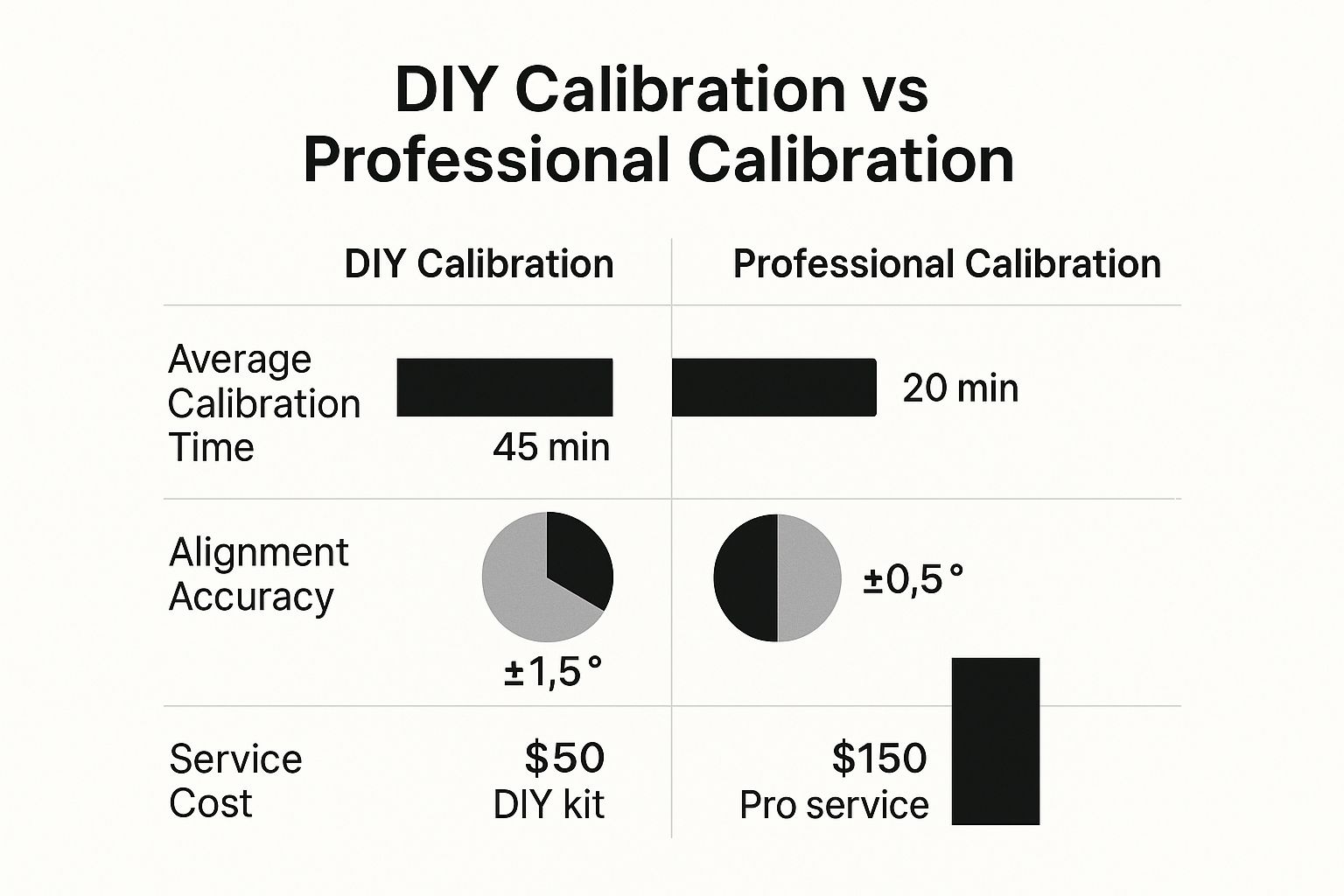
As you can see, a DIY kit might look like it saves money upfront, but a professional service is faster, far more accurate, and ensures your safety systems work as intended.
Static vs. Dynamic Calibration Key Differences
To better understand which method your car might need, it helps to see a direct comparison. Static calibration is done in a controlled shop environment, while dynamic calibration happens on the road.
Attribute | Static Calibration | Dynamic Calibration |
|---|---|---|
Location | Indoor workshop with controlled conditions | On a public road with specific conditions |
Tools | Scan tool, targets, level ground, proper lighting | Scan tool and a vehicle |
Process | Camera learns its position by locking onto fixed targets | Camera learns by recognizing lane markings and other road data |
Pros | Highly precise and repeatable | Doesn't require a specialized bay or physical targets |
Cons | Requires significant investment in space and equipment | Dependent on weather and road conditions; can be time-consuming |
Each method is effective, but only when performed to the manufacturer's exact standards. A shop can't just pick one; they have to use the procedure specified for your vehicle's make, model, and year.
Dynamic Calibration: Taking It to the Streets
For vehicles requiring a dynamic calibration, the work moves out of the shop and onto the road. But this isn't just a quick spin around the block. The system needs very specific conditions to learn and self-adjust correctly.
The technician has to drive the car at a steady speed, usually somewhere between 35 and 55 mph, on a road with clear, well-painted lane markings. There are plenty of things that can stop a dynamic calibration in its tracks, including:
Heavy rain, snow, or fog
Driving at night or on poorly lit roads
Faded, missing, or confusing lane lines
Heavy traffic that makes maintaining a constant speed impossible
This on-road test drive feeds the camera real-world information, allowing it to fine-tune its operating parameters until everything is perfectly dialed in to the manufacturer's specs.
The Final Scan and Your Proof of Service
No matter which method was used, the job isn't done until a final, post-calibration diagnostic scan is performed. This second scan confirms the calibration was a success and that no new error codes popped up during the process.
The single most important takeaway for you as the owner is the post-calibration report. Always, always ask for this document. It’s your official proof that the service was done correctly, which is crucial for your safety, your personal records, and any future insurance claims.
This report will detail the successful recalibration of the ADAS camera and confirm that all related safety systems are back online and fully functional. It's your guarantee that the vehicle is as safe as it was before the windshield was replaced. Without it, you have no real way of knowing if the job was done right.
Common Myths About Windshield Replacement and ADAS
When it comes to Advanced Driver-Assistance Systems (ADAS), a lot of bad information gets passed around. This can lead to some really risky decisions. Most drivers just don't realize how deeply these safety features are tied to the windshield, which has given rise to a few persistent and dangerous myths. Let's clear the air on what's fact and what's fiction for an ADAS calibration after windshield replacement.
Myth 1: If There’s No Warning Light, Everything’s Fine
This is easily the most dangerous misconception out there. We're all trained to look for a check engine light, but your ADAS can fail silently. The system has no way of knowing it's out of alignment; it just keeps operating with bad data, giving you a completely false sense of security.
You’re not going to see an error message pop up because the camera is off by a single degree. What you will experience is your lane-keeping assist failing on a curve or the automatic emergency braking system not seeing a stopped car until it’s far too late. The absence of a dashboard light is absolutely not proof that the system is working correctly.
Myth 2: Calibration Is Just an Upsell Tactic
I hear this one all the time—the idea that calibration is just a sneaky add-on service shops use to pad the bill. Nothing could be further from the truth. Vehicle manufacturers require calibration to restore safety features to factory specifications. It's just as critical as using the right adhesive to install the glass.
The truth is, this service demands expensive, specialized tools and technicians who have gone through extensive training. The cost is a direct reflection of the sophisticated technology in your vehicle, not an attempt by a shop to squeeze more money out of you. Skipping it is pure professional negligence.
Calibration isn't an "extra." It is a fundamental part of a modern vehicle repair. The cost reflects the complex, precision work needed to ensure your safety systems will actually protect you.
The market for this service tells the story. Valued at $4.2 billion in 2023, the ADAS calibration market is expected to explode to $14.9 billion by 2028. This growth is happening because over 80% of new vehicles sold in the U.S. will soon come standard with these features.
Myth 3: Any Auto Glass Shop Can Handle It
While plenty of shops can swap out a piece of glass, not all of them have the setup to perform the complex calibration that must come next. Doing it right is a serious undertaking.
A proper ADAS calibration requires:
A Controlled Environment: The work area needs a perfectly level floor, specific lighting, and no clutter.
Specialized Equipment: This includes manufacturer-specific targets and advanced diagnostic scan tools that can run thousands of dollars.
Trained Technicians: The person doing the work has to be an expert on the exact procedures for your car's make and model.
Before you book a replacement, always ask a shop if they are equipped to perform the necessary ADAS calibration on-site. If the damage is minor, you might be able to sidestep replacement entirely. To see if your damage qualifies, you can learn more about https://www.autorenu911.com/windshield-repair. Choosing a qualified, fully equipped provider is the only way to ensure both the glass and its integrated technology are restored correctly.
Your Top ADAS Calibration Questions, Answered
Even after getting the rundown on why ADAS calibration after a windshield replacement is so important, you probably have a few practical questions. That’s completely normal. It’s a pretty technical process, so let's clear up some of the most common things drivers ask.
How Do I Know If My Car Needs ADAS Calibration?
The quickest way to know is to think about your car's features. Do you have lane-keeping assist, adaptive cruise control, or automatic emergency braking? If so, you absolutely need a calibration.
All those systems get their information from a forward-facing camera that's mounted right on the windshield. When a technician swaps out the glass, that camera's position and angle get thrown off, even by a tiny amount. A recalibration is the only way to get its aim perfect again.
As a general rule, if your car was made after 2016, it's almost a guarantee you have ADAS features. If you're still unsure, your owner's manual will have the details, or you can just ask a qualified technician.
Can I Drive My Car Before It Is Calibrated?
You can, but you really shouldn't. Driving without a proper calibration means your safety systems are, at best, unreliable. At worst, they're a liability.
Imagine your lane-keeping assist suddenly trying to steer you into another lane or your automatic braking system failing to engage when you need it most. Those are real risks.
The best and safest plan is to have the calibration done immediately after the windshield is replaced. Ideally, you should drive straight from the glass shop to the calibration center, and be sure to turn off any driver-assist features for that trip.
Think of it like this: the car's safety net has been taken down for repairs. You're driving without the features you rely on, and they might even act unpredictably.
Does Car Insurance Cover ADAS Calibration Costs?
For most people, the answer is a relieving "yes." If your comprehensive insurance policy is covering the windshield replacement, it almost always covers the necessary ADAS calibration, too.
Why? Because both automakers and the insurance industry see calibration not as an optional extra, but as an essential part of a complete and safe repair. The goal is to return your car to its original factory condition, and that includes fully functional safety systems.
Of course, it's always a good idea to give your insurance agent a quick call to confirm your policy details. A five-minute conversation can prevent any surprise costs and make sure the whole process goes smoothly.
At Auto Renu Auto Glass LLC, we make sure your vehicle is safe and your ADAS is functioning perfectly after every replacement. Don't leave your safety to chance. Schedule your service with us today.