Same-Day Glass Repair Your Complete Guide
Damaged windshield? Get back on the road safely. This guide covers the same-day glass repair process, costs, insurance, and choosing a certified technician.
Oct 5, 2025
generated
same day glass repair, windshield repair, auto glass, mobile glass service, ADAS calibration
You know that little chip in your windshield? It’s easy to write it off as just a cosmetic flaw, but it’s actually a ticking clock. Getting it fixed the same day isn't just about convenience—it's about stopping a small problem before it becomes a big, expensive headache.
Why You Can't Afford to Wait on Auto Glass Repair
Think of that small chip as a tiny crack in a dam. It might seem harmless, but it's a weak spot in a structure that's under constant stress. And your windshield is put through a lot more stress than you might realize.
Every bump, pothole, and uneven patch of road sends vibrations through the glass. Then you have temperature changes causing the glass to expand and contract. All it takes is a sudden overnight frost or blasting the AC on a hot day for that "tiny" chip to spiderweb across your entire windshield. Suddenly, a simple repair is off the table.
The Hidden Dangers of a Damaged Windshield
Putting off a repair is about more than just your line of sight. Your windshield is a critical part of your car's safety system. In fact, it provides up to 45% of your vehicle's structural strength in a front-end collision and a whopping 60% in a rollover.
Here's something most people don't know: a compromised windshield can cause the passenger-side airbag to fail. The airbag is designed to inflate against the glass to protect the passenger. If the windshield is damaged, the force of the airbag can blow it out, making the airbag completely useless.
And it doesn't stop there. Modern cars are packed with Advanced Driver Assistance Systems (ADAS), and many of the cameras for these features are mounted right on the windshield. A chip or crack can block the camera’s view, disabling crucial safety functions.
Automatic Emergency Braking: Might not see an obstacle in time.
Lane-Keeping Assist: Can fail to read the lines on the road.
Adaptive Cruise Control: May struggle to accurately judge the distance to the car ahead.
The Growing Need for Prompt Service
The need for quick repairs is only getting bigger. For one thing, we're keeping our cars longer. The average vehicle on the road in the U.S. is now 12.5 years old, which means more time for wear and tear to take its toll.
On top of that, city drivers face a roughly 20% higher risk of windshield damage thanks to more traffic and road debris. This makes having a reliable same-day repair option essential for millions of drivers. If you're curious, you can learn more about the trends shaping the auto glass market and see why speed is more critical than ever.
Ignoring that little chip is a gamble. A quick, simple repair today prevents a major safety risk and a much costlier replacement down the road. By choosing a same-day service, you’re taking back control and keeping your car safe and sound.
How the Same-Day Repair Process Really Works
Getting your windshield fixed in a single afternoon might sound a bit optimistic, but same-day glass repair is a surprisingly smooth and well-oiled machine. It’s all about getting you back behind the wheel safely without completely derailing your day. From the moment you pick up the phone to the final all-clear, the whole operation is designed for speed and precision.
So, let's pull back the curtain and see what actually happens. When you spot that ugly chip or spreading crack, the process begins. The first, and most critical, step is figuring out exactly what we're dealing with.
Step 1: The Initial Damage Check
When you call a repair shop, the first thing they’ll do is a quick triage over the phone. This isn't just to give you a quote; it's to determine whether you're looking at a straightforward repair or a full-on replacement. They'll ask a few pointed questions to get the lay of the land.
What kind of damage is it? Are we talking about a small bullseye chip (ideally smaller than a quarter) or a crack that's starting to wander across the glass (typically over six inches)?
Where is the damage located? If it's right in your line of sight, a replacement is often the only safe option. You don't want any distortion blurring your view of the road.
How close is it to the edge? A crack that runs to the edge of the windshield is bad news. It weakens the entire structure, making a replacement almost unavoidable.
This quick chat is incredibly important. A good technician can often stop a chip in its tracks, but only if the damage fits within the right criteria. If you want to get into the nitty-gritty of what can and can't be fixed, you can learn more from our guide to professional windshield repair.
Step 2: Picking Your Service and Setting the Time
With the initial assessment done, it's time to get you on the schedule. You generally have two ways this can go, and the choice is all about what works best for you.
Mobile Service: This is the crowd favorite for a reason. The technician comes right to you—whether you're at home, at the office, or even at the gym. It saves you the hassle of a trip to the shop and lets you get on with your life.
In-Shop Service: Sometimes, a trip to the shop is necessary. This might be because the replacement is more complex or because the weather isn't cooperating. Things like heavy rain or freezing temperatures can mess with the adhesives, so a controlled environment is best.
The infographic below gives you a great visual of how a typical mobile service call plays out. You'll see just how fast things can move.
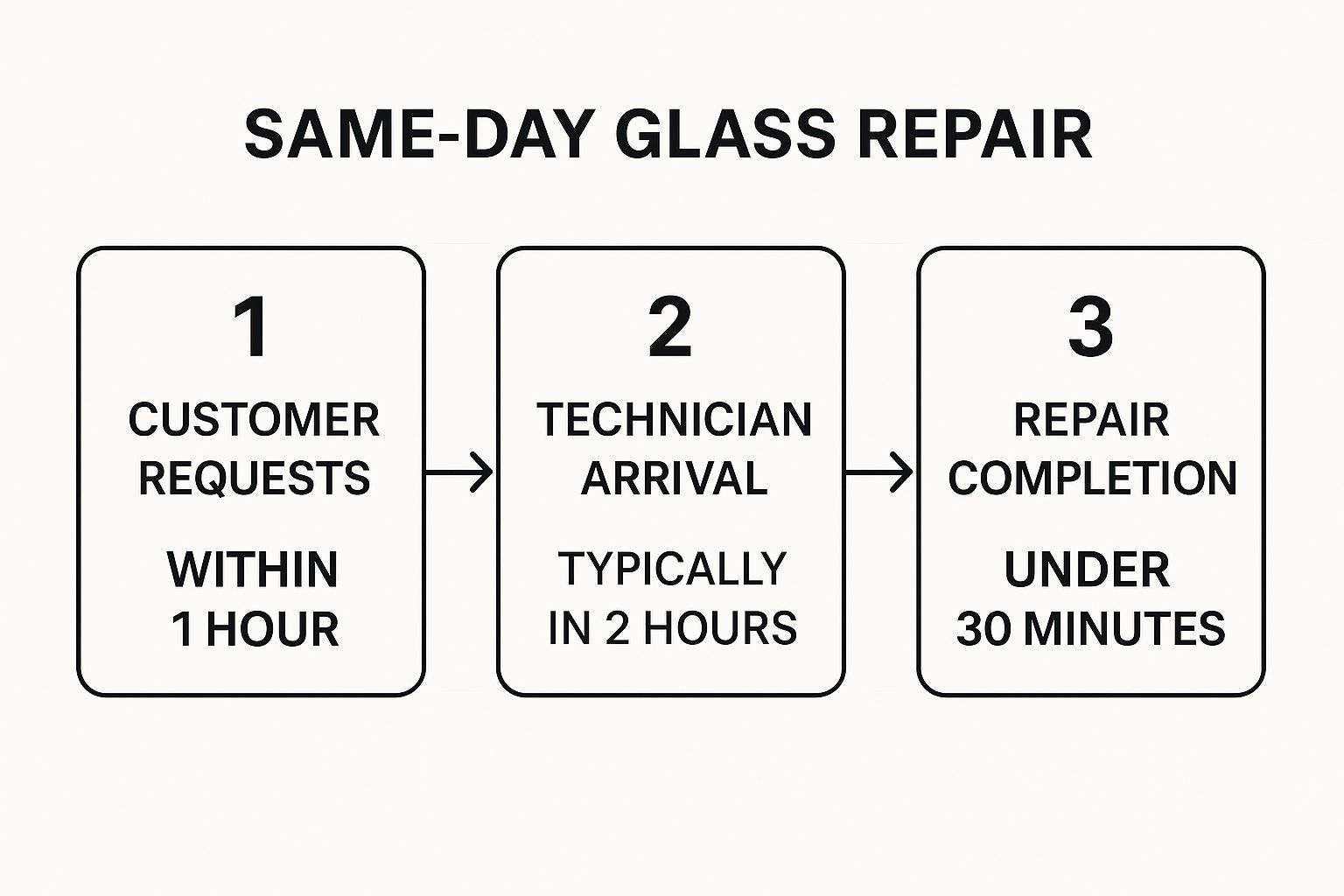
As you can see, the hands-on part of the job is remarkably quick. A simple chip repair can often be done in less than 30 minutes.
Step 3: The Fix and the All-Important Cure Time
Whether the tech is in your driveway or at the shop, their work is meticulous. For a repair, they'll start by cleaning out any tiny bits of glass and dirt from the chip. Then, they inject a clear, high-strength resin that fills the void. An ultraviolet light is used to cure the resin, hardening it until it's as strong as the original glass.
A full replacement is a bit more involved, but still a speedy process:
First, they carefully remove the seals and trim around the old windshield before lifting it out.
Next, they clean the vehicle's frame to ensure there's no old adhesive or debris left.
A new bead of a super-strong urethane adhesive is applied to the frame.
Finally, the new windshield is carefully guided into place to create a perfect, watertight seal.
Crucial Takeaway: The work isn't over when the tools are put away. The most critical part is the adhesive's cure time, what we in the industry call the Safe Drive-Away Time (SDAT). You have to give that urethane time to bond. This usually takes about 30 to 60 minutes, but waiting is non-negotiable. Driving too soon could compromise the seal and your safety.
Understanding ADAS Calibration After a Replacement
Years ago, a windshield replacement was a pretty straightforward job. You’d just pop out the old glass and fit in the new. But that's not how it works anymore. On modern vehicles, replacing the windshield is a high-tech procedure that's tied directly to your car's most important safety features.
What changed? The short answer is Advanced Driver Assistance Systems, better known as ADAS. Think of these systems as a digital co-pilot that’s always on the lookout. They rely on a network of cameras and sensors to monitor the world around your car, running features designed to keep you safe.
You probably use these features every day without thinking about it:
Lane-Keeping Assist: Gently nudges your steering wheel if you drift out of your lane.
Automatic Emergency Braking: Hits the brakes for you to help prevent a collision.
Adaptive Cruise Control: Automatically keeps a safe distance from the vehicle ahead.
For many of these systems, the main camera—their "eyes"—is mounted right on the windshield. When you get a new windshield, you’re essentially giving your car a new set of eyes. And just like a new pair of glasses, they need to be perfectly focused.
Why Recalibration Is Not Optional
When a technician installs a new windshield, its position might shift by just a single millimeter from where the old one sat. You’d never notice it by looking, but for a highly sensitive ADAS camera, a one-millimeter difference is a huge deal. That tiny misalignment can throw off its entire perception of the road.
To put it simply, a misaligned camera might cause your lane-keeping assist to misread the road lines, potentially steering you toward the shoulder. Worse, it could make your emergency braking system engage too late—or not at all. This is why recalibration isn't an upsell; it's a critical safety step.
Skipping a recalibration after your windshield is replaced puts you, your passengers, and everyone else on the road at risk. It’s now an absolutely essential part of any proper same-day glass repair service.
Static vs. Dynamic Calibration Explained
To get your car's ADAS system seeing clearly again, technicians use two main methods. The right one depends on your vehicle manufacturer's specific guidelines. Both are precise procedures that demand a trained professional with the right tools.
1. Static Calibration
This type of calibration happens in a controlled shop environment. The technician sets up specialized targets and patterns at very specific distances and heights in front of the vehicle. The car's computer then uses these targets to precisely realign the camera's field of view.
Where it's done: In-shop, in a dedicated bay.
How it's done: Uses fixed targets and advanced diagnostic tools.
When it's used: For vehicles that require a highly controlled, precise setup.
2. Dynamic Calibration
This method, as the name suggests, happens while the vehicle is in motion. A technician takes the car out for a drive on clearly marked roads, usually at a specific speed. A special handheld device talks to the car’s computer, which calibrates itself by locking onto real-world markers like lane lines.
Where it's done: On the road.
How it's done: The technician drives the car, letting the system learn.
When it's used: For car models designed to self-calibrate while driving.
Sometimes, a vehicle might need a combination of both static and dynamic calibration to get everything working perfectly. Making sure you choose a repair provider with certified ADAS calibration expertise is non-negotiable for any modern vehicle.
For a deeper dive into this essential process, you can explore our detailed guide on what to expect during ADAS windshield calibration. It’s the only way to ensure your car's safety net is fully restored, giving you confidence every time you get behind the wheel.
Navigating Repair Costs and Insurance Claims
When a rock chips your windshield, two thoughts usually pop into your head almost immediately: "What's this going to cost me?" and "Will my insurance even cover this?"
Tackling the financial side of a same-day glass repair can feel a bit overwhelming, but it doesn't have to be. Once you understand what goes into the final price and how the claims process works, you can handle it like a pro. The final bill isn’t just some random number; it’s a total based on a few key things.
A simple chip repair is always going to be your most affordable route—we're talking significantly less than a full replacement. But if the damage is too severe, a brand-new windshield is the only safe option. The cost for that will hinge on your specific vehicle and the type of glass you go with.
Breaking Down the Final Bill
A few different factors come together to determine what you'll actually pay out of pocket. Getting familiar with them ahead of time means no sticker shock when the invoice arrives.
Type of Damage: A small chip fix is a quick job involving a special resin. A full windshield replacement, on the other hand, is a more involved process of removing the old glass and precisely installing a new one, which naturally costs more.
Type of Glass: You’ll have a choice between OEM (Original Equipment Manufacturer) glass, which is the exact same as what your car had from the factory, and aftermarket glass. Aftermarket options are easier on the wallet, but they might not provide the perfect, seamless fit of OEM glass—something that’s really important for modern cars.
ADAS Recalibration Fee: For most cars made in the last 10 years, this is an unavoidable and absolutely critical cost. After a new windshield goes in, the safety cameras mounted to it must be professionally recalibrated to work correctly. This is a separate, essential service with its own fee.
Will Your Insurance Cover the Cost?
Here's the good news: most car insurance policies are built to handle glass damage pretty smoothly. It all comes down to your comprehensive coverage, which is the part of your policy that covers damage from things other than a collision, like theft, falling branches, or, you guessed it, a flying rock.
Here’s a pro-tip many drivers miss: To encourage you to fix small problems before they become big ones, many insurance companies will waive your deductible entirely for a simple chip repair. They'd much rather pay for a small fix now than a huge replacement bill later.
This makes getting that chip looked at right away not just a smart safety move, but a smart financial one, too. Pull out your policy or give your agent a quick call to see if this perk applies to you.
A Step-by-Step Guide to Your Insurance Claim
Filing a claim for a same-day glass repair is usually a walk in the park. Any good auto glass shop has done this a thousand times and can often handle most of the paperwork for you. Still, it helps to know the basic steps.
Review Your Policy: First things first, take a look at your comprehensive coverage. The key piece of information you're looking for is your deductible—that's the amount you have to pay before your insurance starts footing the bill.
Contact Your Glass Repair Provider: Let a technician assess the damage. They'll tell you if it's a simple repair or if you need a full replacement and will give you an accurate quote to pass along to your insurance company.
File the Claim: You can usually file the claim yourself online or over the phone. Or, you can just authorize the glass shop to do it for you. They’ll send all the required info directly to your insurer.
Pay Your Deductible: Once your claim is approved, you’ll pay your deductible (if you have one) directly to the repair shop. Your insurance company will then cover the rest. And remember, for a simple chip repair, you might get to skip this step completely.
By knowing what to ask and what your policy covers, you can get through the financial part of an auto glass repair without any of the usual stress.
How to Choose a Reputable Repair Provider

When you’ve got a cracked windshield, the pressure is on. The promise of a same-day glass repair makes it tempting to just call the first number that pops up in a search. But hold on—this isn't a decision to rush.
Not all auto glass services are the same. A botched windshield installation can do more than just leak; it can seriously weaken your car's frame and cause critical safety systems to malfunction. It’s a core safety component, so a little due diligence goes a long way.
Look for Certified Technicians
First things first, check their credentials. You want technicians who are certified by a legitimate organization, and in the auto glass world, the gold standard is the Auto Glass Safety Council (AGSC). AGSC certification means a technician has been trained to follow strict safety and installation standards.
Think of it this way: you wouldn't let an unlicensed electrician work on your house. The same logic applies here. Asking if their techs are AGSC-certified is a quick and easy way to separate the pros from the amateurs.
Verify Their ADAS Calibration Expertise
If you drive a car made in the last few years, this is a deal-breaker. Your Advanced Driver Assistance Systems (ADAS)—the tech behind automatic braking and lane-keeping alerts—rely on cameras and sensors mounted directly to your windshield. When the glass is replaced, those systems must be recalibrated.
Before you book anything, ask these direct questions:
Do you handle ADAS recalibration yourselves, or do you send it out?
Are your technicians trained to calibrate my specific make and model?
Do you have the right equipment for both static (in-shop) and dynamic (on-road) calibration?
A professional shop will answer these questions without hesitation. If they get vague or tell you it’s not a big deal, hang up and call someone else. This technology is a huge reason the automotive aftermarket glass industry is projected to reach USD 28.54 billion by 2030—the glass is now a sophisticated piece of tech.
Ask About the Glass Quality
You'll usually have two options for replacement glass, and it's important to know the difference.
OEM (Original Equipment Manufacturer) Glass: This is the real deal—the exact same glass your car had when it rolled off the assembly line, made by the same manufacturer. It guarantees a perfect fit and seamless integration with your car's technology.
Aftermarket Glass: This glass is made by a different company to similar (but not identical) specifications. While it’s often cheaper, the quality and fit can be a bit of a gamble, which is a risk you don’t want to take with sensitive ADAS cameras.
For any newer vehicle with advanced safety features, sticking with OEM glass is almost always the best bet to ensure everything works exactly as it should.
Check Warranties and Reviews
A reputable company will always stand behind its craftsmanship. Ask about the warranty upfront. You’re looking for a lifetime warranty that covers their workmanship against things like leaks, wind noise, or installation defects. This shows they’re confident in their skills and materials.
Finally, do a quick gut check with online reviews. Don't just glance at the star rating; read what people are actually saying. Are customers mentioning the technician by name? Are they talking about great communication and a perfect installation? Consistent, detailed praise is a fantastic sign you’ve found a winner.
To help you keep track, use this simple checklist when you call around to different shops.
Provider Comparison Checklist
Use this checklist to evaluate and compare same-day glass repair providers to ensure you choose a quality service.
Evaluation Criterion | Provider A | Provider B | What to Look For |
|---|---|---|---|
AGSC Certified? | ☐ Yes ☐ No | ☐ Yes ☐ No | A "yes" is a strong indicator of quality. |
In-House ADAS Calibration? | ☐ Yes ☐ No | ☐ Yes ☐ No | In-house service is preferred for quality control. |
Offers OEM Glass? | ☐ Yes ☐ No | ☐ Yes ☐ No | Essential for cars with ADAS features. |
Lifetime Workmanship Warranty? | ☐ Yes ☐ No | ☐ Yes ☐ No | A must-have for peace of mind. |
Positive Online Reviews? | ☐ Yes ☐ No | ☐ Yes ☐ No | Look for consistent praise of professionalism and quality. |
Handles Insurance Claims? | ☐ Yes ☐ No | ☐ Yes ☐ No | This can save you a major headache. |
Taking a few extra minutes to vet your options ensures the job is done right the first time, keeping you safe on the road.
Got Questions About Same-Day Glass Repair? We’ve Got Answers.
Even if you understand the basics, a few practical questions always pop up when it's time to get your auto glass fixed. That's completely normal. When it comes to your car's safety, you want to be sure about every little detail.
Let’s tackle the real-world concerns we hear from drivers every day. We'll clear up any lingering doubts so you can schedule your repair with confidence, knowing exactly what to expect.
How Long Do I Have to Wait Before Driving?
This is, without a doubt, the most important question we get. While the technician might only take an hour or so to install your new windshield, the job isn't done until the adhesive is properly cured. Driving off too early is a serious safety gamble.
Your technician will give you a Safe Drive-Away Time (SDAT), which is the absolute minimum time you need to wait. This is usually somewhere between 30 and 60 minutes after the glass is set in place. This window gives the powerful adhesive enough time to bond and meet federal safety standards. Keep in mind, factors like high humidity or cold weather can affect this timing.
For the best, most durable result, listen carefully to your technician's specific instructions. It’s also a smart move to take it easy for the first 24 hours. That means avoiding high-pressure car washes, bumpy roads, and slamming your doors, all of which can interfere with the new seal as it reaches maximum strength.
Will a Glass Claim Make My Insurance Rates Go Up?
It's a common fear, but in most situations, you can relax. Filing a claim for a cracked or chipped windshield will not raise your insurance premium.
Here’s why: auto glass damage is typically covered under the comprehensive part of your policy. This is the coverage that handles "no-fault" incidents like storm damage, theft, or a rock flying up from the road. Since you weren't at fault, insurers generally don't penalize you with a rate hike.
In fact, many insurance companies would rather you fix small chips right away. To encourage this, they often waive the deductible for simple repairs. It’s a win-win situation—you get your windshield fixed for free, and they avoid a much bigger payout for a full replacement down the line. It's always a good idea to confirm the details of your specific policy, but you can usually file a glass claim without worrying about the cost.
What’s the Difference Between OEM and Aftermarket Glass?
When your windshield needs to be replaced, you'll likely hear these two terms. Understanding the difference is key to making the right choice for your car.
OEM (Original Equipment Manufacturer) Glass: Think of this as the name-brand stuff. It's made by the same company that supplied the original glass for your car at the factory. It’s a perfect match in every way—fit, thickness, color, and compatibility with sensors.
Aftermarket Glass: This is the generic-brand equivalent. It's made by a different company and, while it must meet federal safety standards, it may have tiny variations in its shape, clarity, or thickness. It's a more budget-friendly option, but sometimes these small differences can lead to issues with wind noise or even water leaks.
So, which should you choose? For newer cars loaded with advanced safety features (ADAS), OEM glass is the way to go. Those systems rely on cameras that need to see through the glass perfectly. An OEM windshield ensures the camera's view isn't distorted, making recalibration more accurate and reliable.
Can You Really Fix Any Chip or Crack the Same Day?
Yes, absolutely. Whether you need a quick chip repair or a full windshield replacement, a professional service is set up to get the job done in a single visit. The real question isn't if it can be done the same day, but whether the damage can be repaired instead of replaced.
Here are the rules of thumb most technicians follow:
It's Repairable If: The chip is smaller than a quarter, or you have a single crack that's shorter than six inches. The damage also can't be directly in the driver's line of sight, as the repair might leave a slight blemish.
It Needs Replacement If: The damage is severe, like a "starburst" crack with long legs, or if the crack runs to the very edge of the windshield. A replacement is also the only safe option if the damage is in the driver's primary field of vision.
A quick inspection is all a technician needs to tell you the best course of action. Either way, you can count on a same-day glass repair service to restore your vehicle’s safety and get you back on your way.
When you need fast, reliable service that comes to you, trust the experts at Auto Renu Auto Glass LLC. We combine certified expertise with the convenience of mobile service to make your auto glass repair simple and stress-free. Visit us online to get your free estimate today. https://www.autorenu911.com