
A Complete Guide to Auto Glass Repair Services
From quick chip repairs to full windshield replacements, explore your options with our expert guide to auto glass repair services, including ADAS and insurance.
Jan 25, 2026
generated
auto glass repair services, windshield repair, mobile auto glass repair, adas recalibration, car window replacement
When you see a chip or crack in your car's glass, that sinking feeling in your stomach is all too common. Suddenly, your mind starts racing with questions about safety, cost, and what to do next. But don't worry—navigating the world of auto glass repair is actually pretty straightforward once you understand the basic options.
It all boils down to a few key services designed for specific types of damage. Getting a handle on these will help you make the right call with confidence. And it's a big industry for a reason; the North American market for vehicle glass repair and replacement was valued at $4.7 billion and is expected to hit $7.9 billion, which just shows how essential these services are for keeping our cars safe on the road. You can dive deeper into these trends in the full industry report.
Decoding Your Auto Glass Repair Service Options
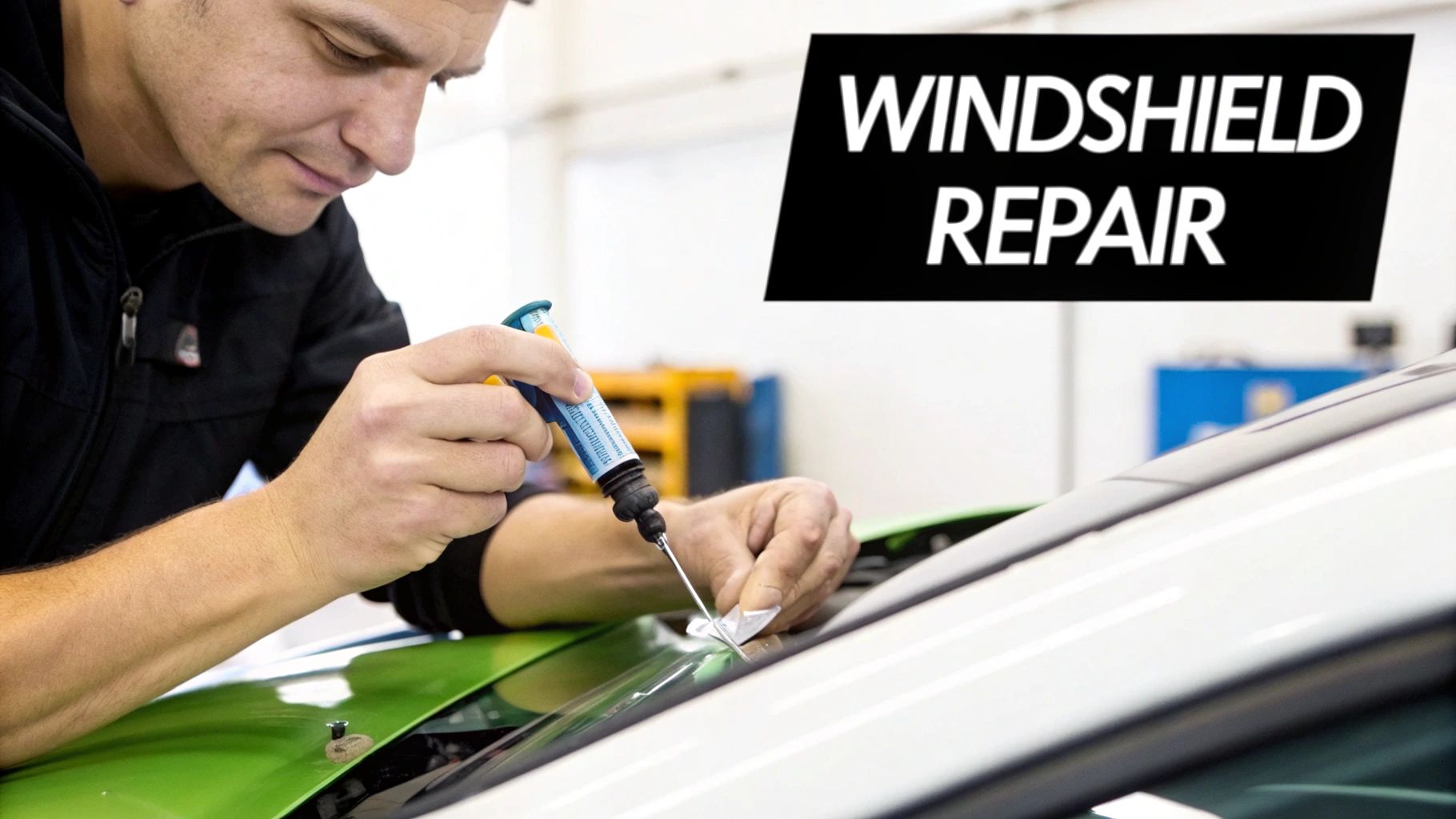
Windshield Chip and Crack Repair
That little rock that flew up on the highway and left a star-shaped ding? That's the most common problem we see. The good news is, it's usually an easy fix.
Think of windshield chip repair like a dentist filling a tiny cavity. A technician will meticulously clean out the damaged spot and inject a special, clear resin that seeps into every nook and cranny of the break. Once it’s filled, they cure the resin with an ultraviolet light, which hardens it and bonds the glass back together.
This simple process achieves two critical things:
It restores strength. The repair stops the chip from spider-webbing across your windshield, which would force you into a full replacement.
It improves clarity. While you might still see a tiny blemish if you look closely, the repair makes the damage far less noticeable.
This kind of fix is quick, affordable, and often 100% covered by insurance with no out-of-pocket cost to you.
A timely repair for a small chip can save you from the much higher cost of a full windshield replacement down the line. It's a small investment in your vehicle's long-term safety and structural integrity.
Full Windshield Replacement
Sometimes, a chip is left for too long and turns into a long crack, or the initial impact was just too severe. When the damage is longer than a dollar bill, sits directly in the driver's line of sight, or runs to the edge of the glass, a repair just won't cut it. A full windshield replacement becomes the only safe solution.
Your windshield does a lot more than just block wind and rain. It’s a vital piece of your car’s safety system, providing up to 60% of the structural strength to the cabin during a rollover. It also plays a key role in making sure your airbags deploy correctly in a crash. A professional replacement means that this structural integrity is restored with high-quality glass and industry-approved adhesives.
To help you decide what your windshield needs, here's a quick cheat sheet.
Quick Guide: Repair vs. Replacement
Use this quick reference table to understand whether your windshield damage likely needs a simple repair or a full replacement.
Damage Type | Best Solution | Key Considerations |
|---|---|---|
Small Chip (Quarter-Sized) | Repair | Quick, affordable, and often covered by insurance. Best to fix it ASAP. |
Short Crack (Under 6 Inches) | Repair | As long as it's not in the driver's direct line of sight, it's often repairable. |
Long Crack (Over 6 Inches) | Replacement | The crack has likely compromised the windshield's structural integrity. |
Damage in Driver's View | Replacement | Even a small repair can leave a slight distortion, which is a safety hazard. |
Damage at the Edge | Replacement | Cracks starting at the edge of the glass can spread rapidly and weaken the whole unit. |
Remember, this is just a general guide. A professional technician can give you a definitive recommendation after inspecting the damage up close.
Side and Rear Window Services
Your side and rear windows are a different story. Unlike your laminated windshield (two layers of glass with a protective film between them), these windows are made from tempered glass. And there's a very good reason for that.
Tempered glass is designed to shatter into thousands of tiny, pebble-like pieces on impact. This prevents large, dangerous shards of glass from flying around in an accident. Because of this, if a side or rear window gets damaged, it can’t be repaired—it has to be replaced. A technician will carefully vacuum out all the broken bits and install a new window that fits your vehicle perfectly.
Many newer cars also have specialized glass with unique features, so it's important to know what you have.
Acoustic Glass: Has an extra layer to dampen road noise, giving you a quieter ride.
Heated Glass: You'll see this often in rear windows, with fine wires embedded for quick defrosting.
Tinted or Coated Glass: Provides privacy, UV protection, and helps keep the cabin cool.
A good technician will identify these features to ensure you get the exact replacement glass your car needs to function as it should.
The Convenience of Mobile Auto Glass Repair
What if you could get your windshield fixed without ever leaving your driveway or the office parking lot? That’s not a gimmick; it’s the reality of modern mobile auto glass repair. We bring the entire workshop to you, completely flipping the script on how auto glass service gets done. No more rearranging your day or driving with a dangerous crack in your line of sight.
For a busy professional, this means we can replace your windshield in the company lot while you’re in a meeting—zero productivity lost. For a parent at home, it means you don't have to load the kids into a car with a compromised windshield just to get to a shop. The service works around your schedule, not the other way around.
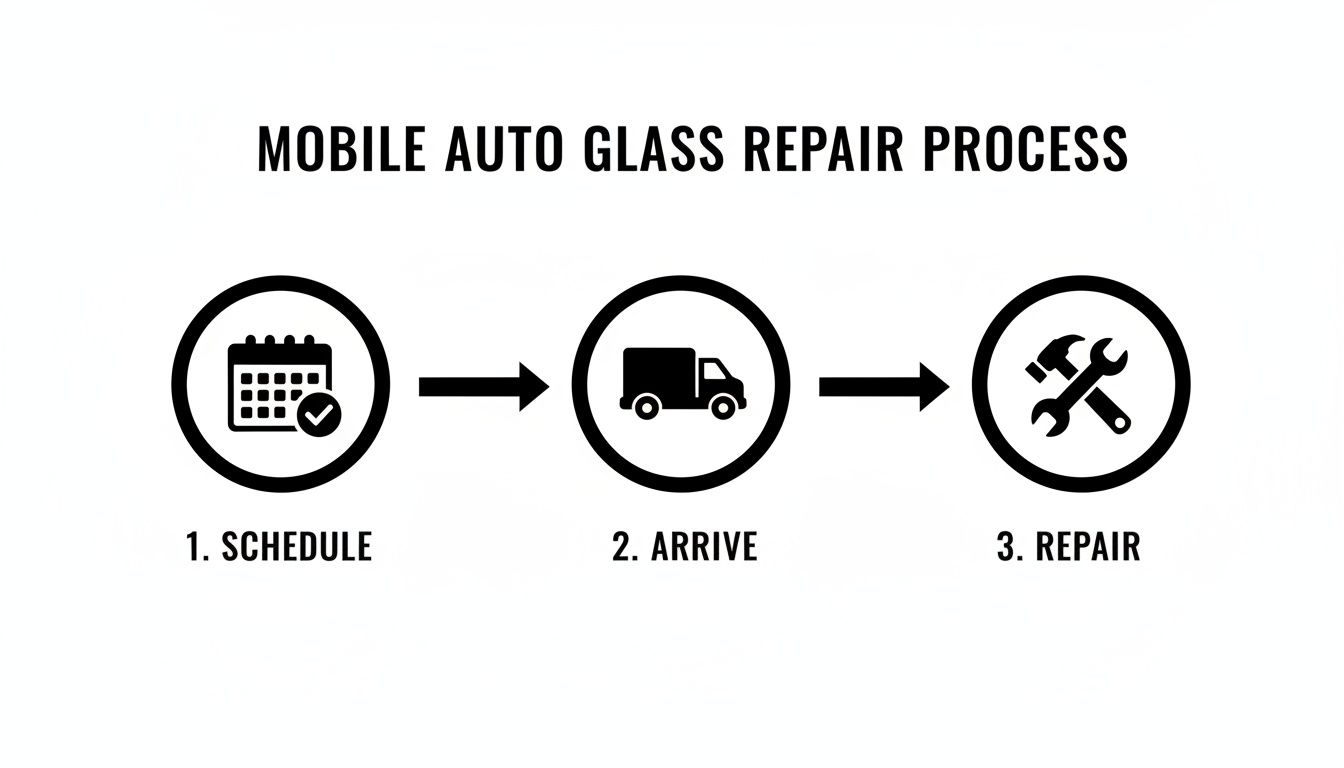
How a Mobile Appointment Works
Our mobile service is designed to be as simple and non-intrusive as possible. One of our vans, fully stocked with everything needed for a dealership-quality job, pulls up to your location. We’ve got the tools, the new glass, and the best materials right on board.
The whole process is clean, professional, and respectful of your property:
Prep Work: First, our certified technician will assess the damage and lay down protective coverings on your vehicle to keep everything pristine.
The Job Itself: Using specialized equipment, we’ll carefully remove the old, damaged glass. Then, the new glass is meticulously installed with industry-leading adhesives.
Curing and Cleanup: We make sure the adhesive starts to cure correctly and then clean up everything. The only thing we leave behind is a perfectly installed piece of glass.
Final Check: We do one last quality inspection and walk you through the post-service instructions, including the crucial safe drive-away time.
It’s all about bringing that professional precision right to your doorstep.
The real beauty of mobile service is that it just makes life easier. By taking the shop visit out of the equation, you get back your valuable time and keep your vehicle safely parked until the repair is 100% complete.
Quality and Safety on Your Terms
One of the first questions people ask is, "Is a mobile repair as good as an in-shop one?" The answer is an emphatic yes. A reputable company like Auto Renu Auto Glass LLC uses the exact same OEM-quality glass and adhesives whether we're at our facility or in your driveway. Our technicians are all certified professionals following the same strict safety protocols. You can read more about how we deliver these high standards on the go in our guide to mobile automotive glass repair.
Of course, there are a few things to keep in mind. Extreme weather—think heavy rain or frigid temperatures—can interfere with how the adhesive cures. A true professional will always put safety first and reschedule if the conditions aren’t right. But for the vast majority of the time, mobile service is the perfect blend of convenience and quality.
For anyone managing a fleet of vehicles, the benefits are even bigger. Instead of dealing with the headache of getting multiple vehicles to a shop, our mobile team can service the entire fleet right where it’s parked. This slashes operational downtime, keeping your business moving and your vehicles out on the road where they make you money. On-site service just makes fleet maintenance smarter and more cost-effective.
Understanding ADAS Recalibration After a Windshield Replacement
Your windshield isn't just a piece of glass anymore. In most new cars, it’s a critical part of your vehicle's safety technology, housing the cameras and sensors for the Advanced Driver-Assistance System (ADAS). This is the tech that powers features you rely on every day, like automatic emergency braking, lane-keeping assist, and adaptive cruise control.
When a windshield is replaced, the position of these sensitive cameras can shift ever so slightly—even by just a millimeter. It's like putting on a new pair of prescription glasses. If the lenses aren't perfectly aligned with your eyes, your vision is distorted. Your car’s ADAS experiences the same problem. If its "vision" is off, it can't accurately see lane markings or judge distances, which could cause those life-saving features to fail when you need them most.
That’s why ADAS recalibration is an non-negotiable step after any modern windshield replacement. It's the process of realigning your car's safety cameras to factory specifications. Skipping this is like leaving a seatbelt unbuckled; you're not fully protected.
While the repair process itself is straightforward, recalibration is the crucial final step to ensure your car is truly road-safe again.
Fixing the glass gets your car back on the road, but recalibration ensures its advanced safety systems are working perfectly to keep you there.
Two Paths to Perfect Alignment
Recalibration isn't a one-size-fits-all job. Depending on your car's manufacturer, one of two methods is used to get your ADAS seeing straight again. A skilled technician providing professional auto glass repair services will know exactly which one your vehicle requires.
The two main types of recalibration are:
Static Recalibration: This is done in a controlled shop setting. A technician sets up a specific target board in front of the vehicle and uses specialized computer software to reset the camera's alignment to precise factory standards.
Dynamic Recalibration: This type requires the vehicle to be driven. A technician connects diagnostic tools to the car's computer and drives on clearly marked roads at specific speeds, allowing the system to recalibrate itself using real-world conditions.
Some vehicles actually need a combination of both methods to get the job done right. This level of detail is essential for restoring full functionality to every safety feature. You can learn more about this critical procedure by exploring our professional ADAS recalibration services.
Why Professional Recalibration Matters
Trying to replace a modern windshield without the right ADAS recalibration tools and training is a huge safety risk. These systems are incredibly sensitive, and only a certified technician has the knowledge to do the job correctly.
A bad calibration can be even more dangerous than no calibration at all. It can make safety systems react unpredictably—braking for no reason or failing to see a real hazard—which can lead to dangerous situations on the road.
When you're choosing an auto glass company, always ask if they perform ADAS recalibration. For any vehicle with these features, it's a mandatory part of the service. Making sure your car's digital eyes are perfectly focused is the final, most important step in restoring its complete safety net.
Making Sense of Auto Glass Costs and Insurance
Let's be honest—when your glass cracks, one of the first things you think about is the cost. The good news is that for auto glass repair services, it's often far less painful and complicated than you might imagine, especially if you have the right insurance coverage.
The final price tag really depends on a few things: the extent of the damage, the kind of car you drive, and the tech built into it. A quick chip repair is always the most affordable route. On the other hand, a full windshield replacement on a newer SUV packed with driver-assist cameras will naturally cost more. This is a big reason why the global automotive glass market is booming, expected to jump from $24.6 billion to nearly $49.94 billion as vehicles get smarter.
This trend just goes to show how much more advanced—and valuable—auto glass has become, making insurance a real lifesaver.
How Your Insurance Policy Steps In
Your auto insurance policy is your best friend here. Most of the time, glass damage is handled under your comprehensive coverage, which is the part of your plan that deals with things other than collisions—think flying rocks, falling tree branches, or even vandalism.
Here’s a little insider tip: insurance companies want you to get small chips repaired. They'd much rather pay for a quick, inexpensive fix now than a full, costly replacement later. That's why many policies will waive your deductible for a chip repair, meaning the service could cost you absolutely nothing.
For a full replacement, you'll likely need to pay your deductible. That’s the amount you agreed to cover yourself before your insurance kicks in. So, if your deductible is $500 and the replacement is $800, you pay your $500, and the insurance company takes care of the other $300. Simple as that.
A great auto glass partner, like Auto Renu Auto Glass LLC, will actually call your insurance company for you to verify your coverage. We figure out exactly what you'll owe—if anything—so you know the full picture before we even start. No surprises, just clear communication.
Want to learn more about the specifics? Our guide on whether insurance covers windshield replacement breaks it all down.
We Make the Claims Process Painless
Filing an insurance claim shouldn't feel like a second job. When you work with a professional service, we take the entire burden off your shoulders by dealing directly with your insurance company.
Here’s how easy we make it:
You Call Us: Just give us your vehicle and insurance info. That’s it.
We Do the Rest: We get on the phone with your insurance agent, confirm your coverage, and handle all the claim paperwork.
We Schedule Your Service: Once the claim gets the green light (which often happens in minutes), we book your mobile appointment.
We Bill Them Directly: After we've finished the job, we send the bill straight to your insurance provider. All you handle is your deductible, if you have one.
This process is designed to save you from phone trees, paperwork, and headaches. Whether it's for your daily driver or you're trying to figure out the RV window replacement cost, the goal is always the same: get you back on the road safely, with as little disruption to your life as possible.
Specialized Solutions for Business Fleets and Dealerships
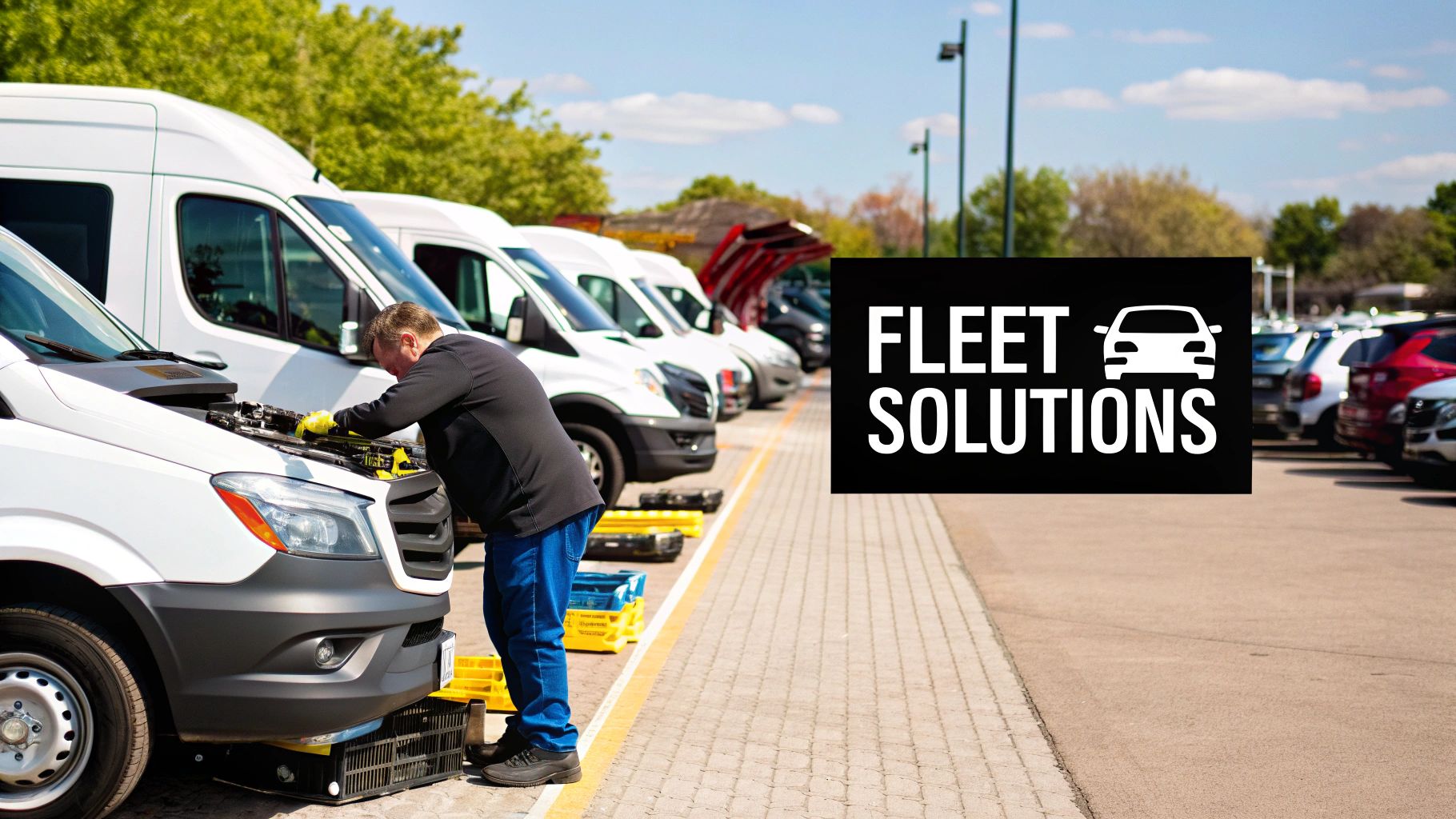
For a business, a vehicle with a damaged windshield isn't just a nuisance—it's a direct hit to your productivity and profit. Every hour one of your delivery vans or service trucks is out of commission, you're losing money and falling behind. This is where specialized auto glass repair services stop being a simple fix and start becoming a powerful business tool.
The auto glass industry isn't small potatoes; it's a massive $8.3 billion market in the U.S. alone, spread across nearly 6,000 businesses. That tells you just how vital these services are to keeping commerce moving. For any company managing a fleet of vehicles, finding the right mobile auto glass partner isn't just a good idea—it’s a strategic move that directly boosts your bottom line.
Keeping Your Fleet on the Road
If you're a fleet manager, your number one enemy is downtime. The old way of doing things—pulling drivers off their routes, juggling schedules, and shuttling vehicles back and forth to a brick-and-mortar shop—is a logistical nightmare. A mobile-first approach completely flips the script.
Just picture it: our technician shows up at your facility and works through multiple vehicles right there in your parking lot. The logistical headaches simply disappear.
Minimized Downtime: We can repair your vehicles on-site, even during off-hours or weekends, so they’re ready for the next shift without missing a beat.
Streamlined Billing: Forget a pile of individual receipts. We offer consolidated invoicing and service plans built around your fleet’s needs to make your accounting simple.
Consistent Quality: Every truck, van, and car in your fleet gets the exact same high standard of care with OEM-quality glass and certified installation. No exceptions.
This kind of proactive partnership keeps your fleet safe, compliant with regulations, and—most importantly—on the road making you money.
Accelerating Operations for Car Dealerships
Car dealerships live and die by speed and quality. Whether you’re getting a trade-in ready for the front line or handling a service appointment, efficiency is everything. Mobile auto glass services give you the rapid response you need to keep inventory moving and customers happy.
A cracked windshield on a car you just took on trade can hold up the sale for days. Our mobile team can get it fixed fast, helping you move that car from the back lot to "retail-ready" in record time. Plus, we know how critical it is to meet strict manufacturer standards to protect your dealership's good name.
For a dealership, every car on the lot is a reflection of its brand. Providing swift, OEM-quality glass replacement ensures that reflection is flawless, building customer trust and protecting your investment.
Your reputation is everything, and quick, professional repairs are a key part of effective auto dealer reputation management. When you partner with us, you’re essentially getting a seamless extension of your own commitment to quality. It guarantees every vehicle leaves your lot in pristine, safe condition, reinforcing the professional standard your customers have come to expect.
How to Choose the Right Auto Glass Repair Provider
Picking an auto glass company can feel overwhelming, but it's one of the most important decisions you'll make for your vehicle's safety. It's tempting to shop around for the lowest price, but the best choice is always a company that balances quality materials, proven expertise, and honest communication.
Think of it this way: you're not just fixing a piece of glass. You're looking for a partner who can restore your vehicle's safety systems back to factory-perfect condition.
Key Questions to Ask Any Provider
Before you let anyone touch your vehicle, you need to do a little homework. Asking a few smart questions upfront can save you a world of headaches later and help you spot the true professionals. A reputable company will welcome your questions and have clear, confident answers.
To help you get started, we've put together a simple checklist. Think of this as your guide to vetting any potential provider.
Provider Selection Checklist
Question to Ask | Why It Matters | The Professional Standard |
|---|---|---|
Are your technicians certified? | Certification from groups like the Auto Glass Safety Council (AGSC) proves a technician is trained on the latest safety protocols and materials. | Technicians should be AGSC-certified or have equivalent, verifiable training in modern auto glass installation. |
What kind of glass do you use? | The quality of the glass affects everything from fit and clarity to structural integrity and how your ADAS cameras see the road. | They should use Original Equipment Manufacturer (OEM) glass or high-quality glass that meets or exceeds OEM standards. |
What kind of warranty do you offer? | A strong warranty shows that a company stands behind its materials and workmanship. You want protection against leaks, defects, or errors. | A lifetime warranty on workmanship, covering issues like air or water leaks, is the gold standard in the industry. |
Can you handle ADAS recalibration for my vehicle? | This is a non-negotiable for modern cars. An improper recalibration can disable critical safety features like automatic emergency braking. | They must have the certified technicians and specific equipment to perform static and dynamic recalibrations in-house. |
Running through these questions will quickly tell you if you're dealing with a company that prioritizes your safety or one that just wants to make a quick buck.
The Make-or-Break Question: ADAS Recalibration
If your car was made in the last decade, the single most important question you can ask is about ADAS recalibration. Be direct: "Are you equipped to recalibrate the safety systems on my specific make and model after the windshield is replaced?"
An auto glass "repair" that doesn't include recalibration is an incomplete and dangerous job. A provider who brushes this off, can't explain their process, or outsources it without a clear plan isn't putting your safety first.
A true expert will have the tools and training to perform both static (in-shop) and dynamic (on-the-road) recalibrations. They should be able to walk you through the process and guarantee your car's safety features are dialed back into their exact factory settings. In today's world, choosing a provider who has mastered this technology is essential.
Got Questions? We've Got Answers.
When it comes to your car's glass, you want to be sure you're making the right call. It's completely normal to have a few lingering questions, especially about safety and timing. We hear them all the time, so we’ve put together some quick, no-nonsense answers to the most common ones.
Think of this as your final check-in to make sure you feel totally confident about getting your glass fixed.
How Soon Can I Drive After a Windshield Replacement?
This is, without a doubt, the number one question we get. The short answer? Your technician will give you a specific safe drive-away time, which is usually between 30 minutes and an hour.
This isn't just a suggestion—it's critical for your safety. The special adhesive needs that time to cure and form a solid bond. If you drive off too early, the windshield could shift, leading to leaks or, worse, failing to protect you properly in an accident.
Will the Chip Still Be Visible After You Repair It?
A chip repair is first and foremost about restoring the structural integrity of your windshield and stopping the damage from spreading. While the process dramatically clears up the damaged spot, it might not make it vanish entirely.
You can expect the chip's visibility to be reduced by 70-95%. Often, you'll have to search for it to even notice it was ever there. The main goal is strength and safety; the cosmetic improvement is a fantastic bonus.
The final appearance really depends on the chip itself. A fresh, clean break that hasn't collected any road grime will almost always look better after a repair than an older chip that's been sitting for a while.
OEM vs. Aftermarket Glass: What's the Real Difference?
Knowing your glass options is key to a great replacement. You'll mainly hear about two types: Original Equipment Manufacturer (OEM) and aftermarket.
OEM Glass: This is the same glass your car had when it rolled off the assembly line, made by the same company. It's a perfect match in every way—from thickness and color to shape and durability. The fit is guaranteed.
Aftermarket Glass: This glass is made by a different company to meet similar specifications. A high-quality aftermarket piece can be a good, budget-friendly option, but the quality and fit can sometimes be inconsistent.
Here's a crucial point: if your vehicle has modern safety features (ADAS), OEM-quality glass is often the only way to go. The system's cameras are finely tuned to the original windshield's exact specs. Even tiny variations in aftermarket glass can throw off the calibration and create serious safety risks.
Ready to get your glass back to perfect? The team at Auto Renu Auto Glass LLC brings dealership-quality service and mobile convenience right to your location. Schedule your expert repair or replacement today at https://www.autorenu911.com.