What Is Carbon Window Tint and Is It the Right Choice for Your Car?
Considering an upgrade? We explain what is carbon window tint, how it works, and how its powerful heat rejection and UV blocking compare to other options.
Jan 24, 2026
generated
what is carbon window tint, carbon window tint, automotive window film, car tinting benefits, UV protection film
If you're exploring window tint options, you've probably come across the term "carbon tint." So, what is it exactly?
Think of carbon window tint as a modern, high-tech upgrade for your car's glass. It's made with microscopic carbon particles embedded into a durable film. This construction is a game-changer because it excels at rejecting heat and blocking UV rays without messing with your electronic signals—a common headache with older metalized tints. That means your GPS, cell phone, and radio will work flawlessly.
Decoding Carbon Window Tint
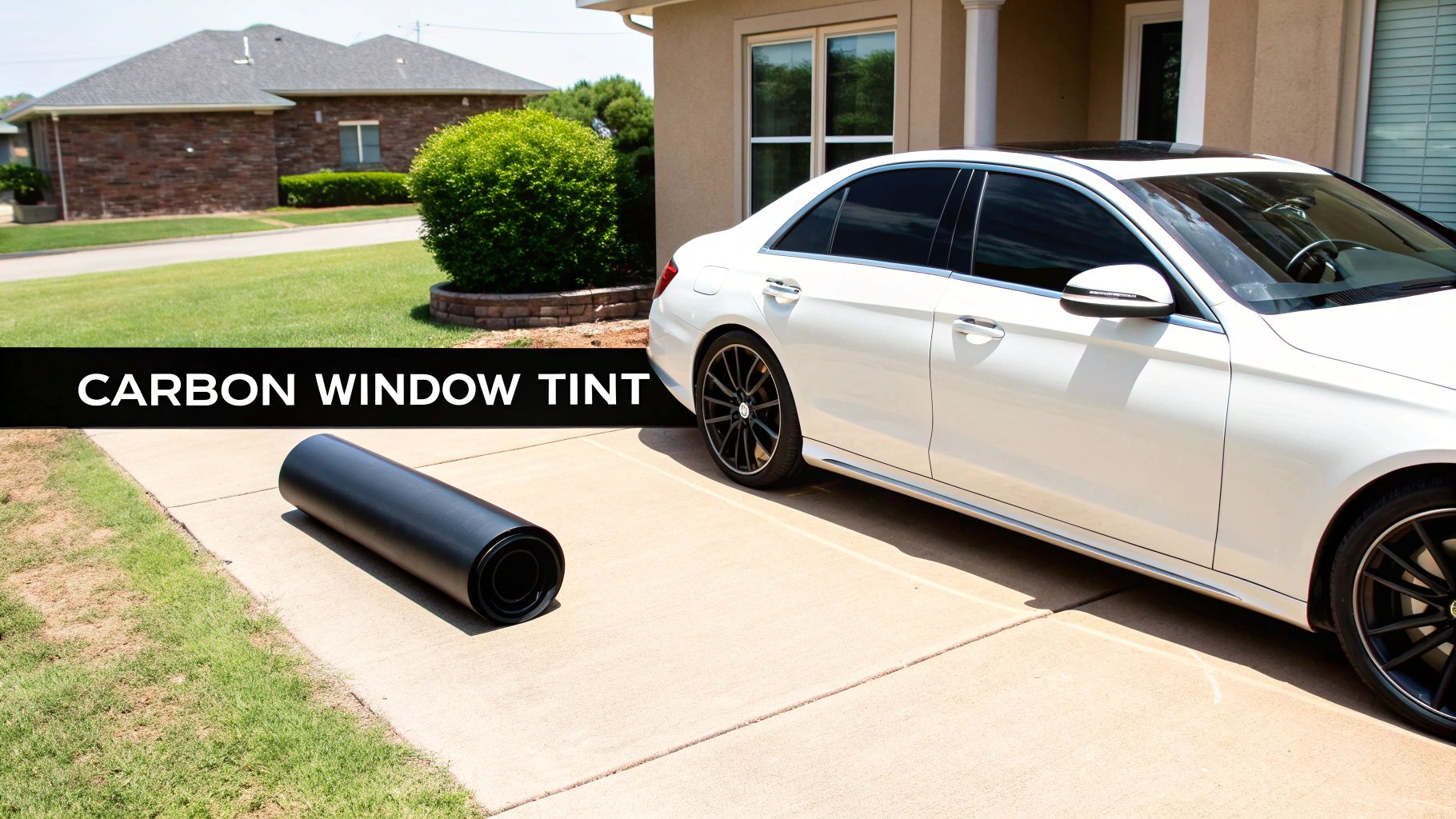
Carbon window tint is a huge leap forward from the basic dyed films you might see on older cars. Those older films are mostly for looks and are notorious for fading, bubbling, and eventually turning that dreaded shade of purple. Carbon film, on the other hand, is built from the ground up for performance that lasts.
The magic is in the nano-carbon particles scattered throughout the film's layers. These tiny particles are fantastic at absorbing and scattering infrared light, which is the part of the solar spectrum that makes your car feel like an oven on a hot day. It’s a simple concept with a huge impact on your comfort.
Carbon Window Tint at a Glance
To really get a feel for what carbon tint brings to the table, it helps to see its core features laid out.
This table breaks down why it's such a popular choice for drivers who want real-world benefits without breaking the bank.
Feature | Performance & Benefit |
|---|---|
Material Composition | Polyester film infused with non-metallic carbon particles. |
Heat Rejection | Blocks roughly 40% of infrared heat, keeping your cabin much cooler. |
UV Protection | Blocks over 99% of damaging UV rays, protecting both you and your car's interior. |
Signal Interference | Zero signal interference, so all your electronics work without a hitch. |
Appearance | A true black, non-reflective matte finish that looks great and never fades. |
Durability | Built to last. It won't fade, bubble, or turn purple like cheaper films. |
When you look at the whole package, carbon tint really hits the sweet spot. You get serious performance improvements over a basic dyed film, but you don't have to stretch your budget to the premium price point of a ceramic tint.
For most drivers, it’s the perfect blend of modern technology, a clean look, and genuine long-term value.
How Carbon Particles Keep Your Car Cool
So, how does a simple-looking film make such a huge difference in your car's comfort? It all comes down to some really clever science happening at a microscopic level. It's not magic, but it’s close.
The film is built on a tough polyester base, but the real heroes are the thousands of nano-sized carbon particles embedded within it. These tiny particles are what go to work managing the sun’s intense energy before it ever gets a chance to bake your interior.
A good way to think about it is like high-tech sportswear. A moisture-wicking shirt pulls sweat off your skin to keep you cool. In the same way, these carbon particles absorb and scatter the sun's energy, specifically targeting the infrared light that makes you feel the heat.
Absorbing Heat and Blocking Rays
Older metallic films work by reflecting heat, but carbon tint is different—it acts more like a sponge. It soaks up that infrared energy, stopping it from passing through your windows and into the cabin. And it’s incredibly effective at its job.
A quality carbon window tint leverages this nano-carbon technology to reject over 50% of the sun's infrared heat. It also blocks up to 99% of harmful UV rays. On a sweltering summer day, that translates into a much cooler car and less need to blast the AC on full.
The key takeaway is that carbon tint doesn't just block light; it actively manages solar energy. By absorbing and dispersing heat-causing infrared rays, it fundamentally changes how your car interacts with the sun.
This heat reduction offers more than just comfort. For modern vehicles, particularly electric ones, putting less strain on the air conditioner can improve overall efficiency and range. That makes carbon tint one of the smarter accessories for electric cars on the market today.
A Metal-Free Matte Finish
Another huge benefit of carbon window tint comes from what it doesn't have: metal. By using carbon particles instead of metallic ones, you get some major advantages.
No Signal Interference: Unlike metallic tints that can mess with your electronics, carbon films won't block GPS, cell phone, or radio signals. Everything just works.
True Black Finish: The carbon gives the tint a sleek, non-reflective matte black look that complements any vehicle. It’s a clean, factory-style appearance.
No Fading: The carbon particles are incredibly stable. They won’t turn purple or fade over time like cheap dyed films often do.
It’s this perfect blend of high performance, good looks, and long-term stability that has made carbon tint a go-to choice for so many drivers. You get top-tier cooling and UV protection without any of the old-school compromises.
Here’s the rewritten section, designed to sound completely human-written and natural.
What Carbon Tint Actually Does for You and Your Car
It’s one thing to talk about the science of carbon tint, but what really matters is how it feels when you're behind the wheel. The day-to-day difference is where this technology truly shines, offering real, tangible benefits you’ll notice every time you drive. We're talking about more than just a cool look; it's about comfort, protection, and even safety.
The first thing you’ll feel—literally—is a much cooler interior. We’ve all had that moment of dread before opening a car door after it’s been baking in the sun. Carbon tint is a game-changer here because it’s engineered to reject a huge amount of infrared heat. That means less time blasting the AC on full, which saves you a bit of fuel and puts less wear and tear on your car's system.
Protecting What’s Inside: From Your Skin to Your Dashboard
While a cooler ride is great, the protective benefits are where carbon tint really proves its worth. Think of it as a powerful sunscreen for both you and your car.
The film blocks over 99% of harmful ultraviolet (UV) rays. These are the same rays that cause sunburns and long-term skin damage, so having that barrier is a huge plus for your health. But that protection doesn't stop with you. UV rays are also the primary culprit behind a faded, cracked dashboard and aging leather seats. Carbon tint acts as a shield, preserving your car’s interior and keeping it looking new for years.
This isn’t just about aesthetics; it’s a smart move to protect your investment. The demand for high-quality window films is skyrocketing for a reason—the global automotive tinting film market is projected to jump from $4.2 billion in 2025 to $7.0 billion by 2035. Why? Because a good carbon film can cut down on interior fading by as much as 80%, which directly helps maintain your vehicle’s resale value.
A Safer, Clearer View of the Road
Good visibility is non-negotiable for safe driving, and this is another area where carbon tint makes a big difference. It dramatically cuts down on harsh glare. That blinding low-angle sun in the morning or the intense headlights from oncoming cars at night? The tint softens that light, so you can see the road clearly without squinting and straining your eyes.
But there’s another layer of safety here. Carbon window tint adds a bit of strength to your glass. If your window ever shatters—whether from an accident or a break-in attempt—the film helps hold all those sharp pieces together.
This shatter-resistant quality is a critical safety feature. It can prevent dangerous glass fragments from spraying into the cabin, protecting you and your passengers from serious injury.
It’s a simple upgrade that gives you an extra measure of security and peace of mind on every single drive.
Choosing The Right Film: Carbon vs. Ceramic And Other Tints
Trying to pick the right window tint can feel overwhelming. You've got dyed, metallic, carbon, ceramic... what's the real difference? Each one offers a unique mix of performance, durability, and cost, so the "best" choice really comes down to what matters most to you.
Let's break them down. Think of the different tint types as tiers on a ladder.
At the bottom rung, you have dyed film. It's the most basic option, great for adding privacy and a sleek look, but it doesn't do much to block heat and is known for fading to that dreaded purple color over time. A step up from that is metallic film. It's much better at reflecting heat, thanks to tiny metal particles in the film. The big downside? Those same metal particles can wreak havoc on your cell phone, GPS, and radio signals.
Finding The Sweet Spot In Performance
This is exactly why carbon and ceramic tints have become so popular. They solve the problems of the older technologies.
Ceramic film is the undisputed king of the hill. It provides the best heat rejection and UV protection you can get, all without any signal interference. But, top-tier performance comes with a top-tier price tag, and it's not always in the budget.
This is where carbon window tint truly shines. It’s the perfect middle-ground. You get fantastic heat rejection and block 99% of harmful UV rays, just like the high-end stuff, but without the signal interference of metallic films or the high cost of ceramic. It really hits that sweet spot of performance and value.
The infographic below shows the benefits you get from a quality tint job—all of which are delivered exceptionally well by carbon film.
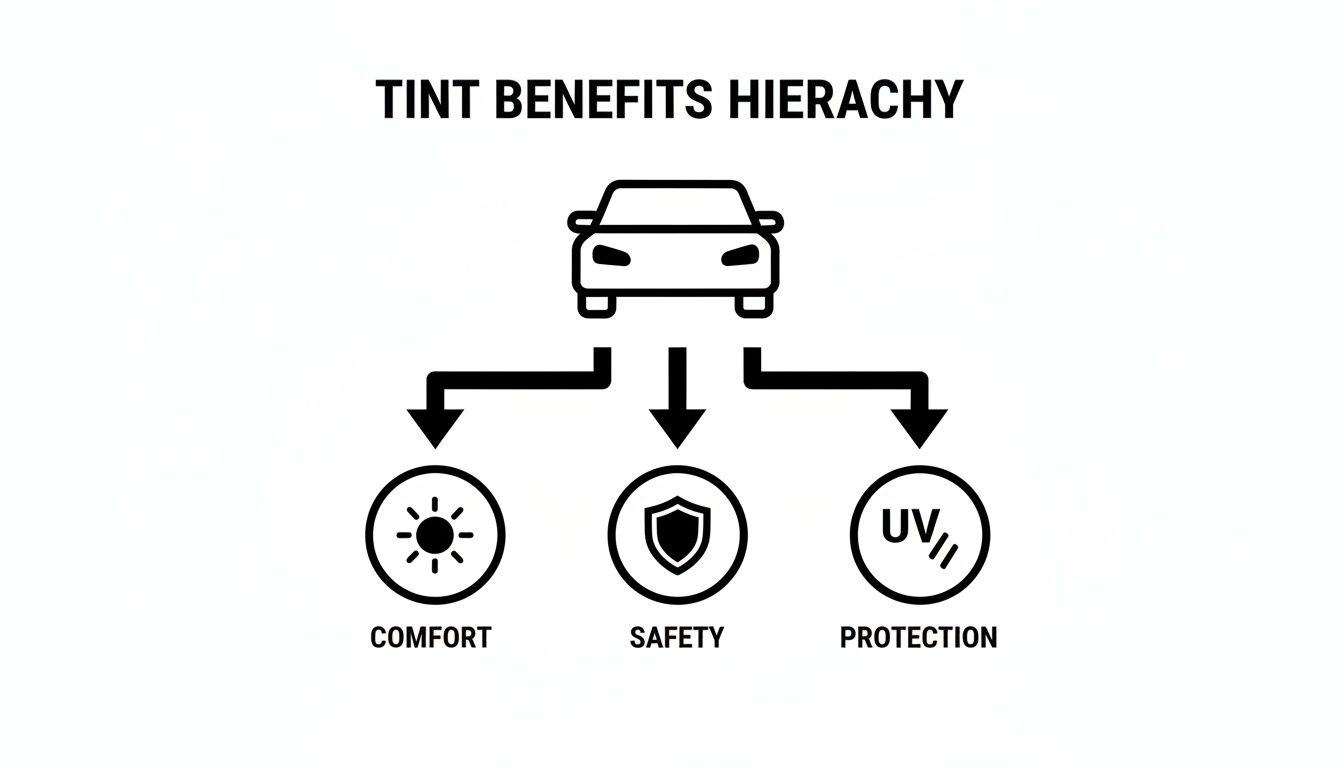
As you can see, a good tint isn't just about looks; it’s about making your drive safer, more comfortable, and protecting your car's interior from sun damage.
A Head-To-Head Tint Comparison
To really see the difference, it helps to put them side-by-side. Each film has its place, but understanding the trade-offs is crucial. If you want a deeper dive into the science, our guide on how does window tinting work breaks it all down.
To make things simple, here’s a quick comparison of the main options you’ll find.
Window Tint Comparison: Dyed vs. Metallic vs. Carbon vs. Ceramic
Tint Type | Heat Rejection | UV Protection | Signal Interference | Durability & Lifespan | Average Cost |
|---|---|---|---|---|---|
Dyed | Low | Good | None | Low (fades over time) | $ |
Metallic | Good | Excellent | High | Medium | $$ |
Carbon | Very Good | Excellent (99%) | None | Excellent | $$$ |
Ceramic | Excellent | Excellent (99%+) | None | Excellent | $$$$ |
Looking at the chart, it’s easy to see why carbon is such a popular choice. It completely avoids the signal issues of metallic film and won't fade like a dyed film. You get powerful heat and UV protection that comes very close to ceramic, making it a smart, long-lasting investment for your vehicle.
Cost, Lifespan, and Staying Within Legal Limits
When you're thinking about carbon window tint, it's easy to get hung up on the initial price. But this isn't just an accessory; it's a long-term investment in your vehicle's comfort and value. While you might pay more upfront compared to a basic dyed film, the performance and durability you get make it a much smarter financial move down the road.
Think of it this way: that cheaper dyed tint might look okay for a little while, but give it a few years. You'll likely see it start to bubble, fade, or take on that dreaded purple hue. Carbon tint, however, is engineered for the long haul. The stable carbon particles won't break down, ensuring your tint keeps its color and heat-blocking power for over 10 years. It’s a one-and-done upgrade that keeps paying you back. For a deeper dive, check out our guide on how long window tint lasts.
The financial upside isn't just about avoiding replacement costs. For our commercial clients, the return on investment is crystal clear. Car dealerships often see a 10-20% boost in resale value from a quality tint job, and fleet managers can cut their fuel bills by 10-15% thanks to less reliance on air conditioning. It's a practical upgrade with a real-world financial impact, as noted by the growing window tint market research on cognitivemarketresearch.com.
Understanding Tint Laws and VLT
Before you pick out that perfect shade, you have to know the rules of the road. Tint laws are in place to make sure drivers can see clearly, and they can be wildly different depending on where you live. The most important term you'll hear is Visible Light Transmission, or VLT.
Simply put, VLT is the percentage of visible light that can pass through your tinted window. The lower the VLT number, the darker the tint.
70% VLT: This is a very light tint. Many cars come from the factory with this level on the front windows.
35% VLT: A very popular choice that offers a good balance of privacy and visibility.
5% VLT: Commonly known as "limo tint." It's extremely dark and almost always illegal for front side windows.
For instance, California law requires front side windows to let in more than 70% of light. But for the back-seat windows and rear windshield, you can go as dark as you want.
Trying to figure out these regulations on your own can be a headache, and getting it wrong can mean an expensive ticket and an order to remove the film. This is exactly why it pays to work with a pro. A seasoned installer knows the VLT laws for your state inside and out, guiding you to a carbon window tint that not only looks fantastic but keeps you 100% legal.
Why Mobile Installation Delivers a Better Finish
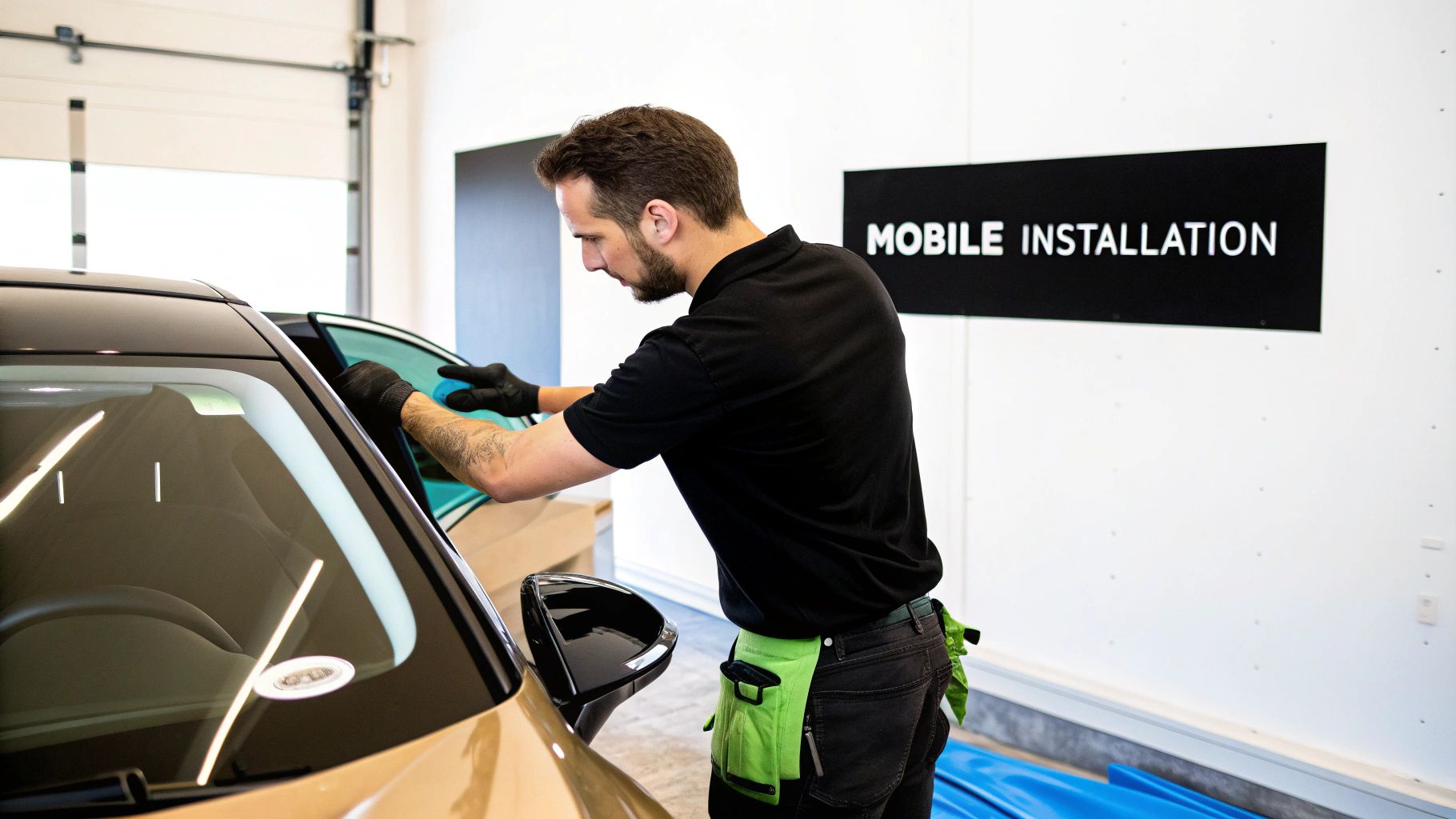
Picking a high-performance material like carbon window tint is just the first step. The real make-or-break factor is the quality of the installation itself. You can take your car to a shop, of course, but a professional mobile installation service often delivers a much cleaner, more impressive result.
The most obvious perk is pure convenience. Why kill a few hours in a waiting room when a trained technician can come right to your home or office? We fit the service into your day, not the other way around.
The Controlled Environment Advantage
Here’s the secret to a perfect, bubble-free tint job: the environment. Think about a typical auto shop—doors are always opening, cars are rolling in and out, and the air is full of dust and debris. Every one of those tiny particles is an enemy to a flawless finish, waiting to get trapped under the film.
When a mobile installer works in your personal garage, they can create a controlled "cleanroom" on the spot. This drastically cuts down the risk of contamination and allows the film's adhesive to bond perfectly with the glass.
This level of care is essential for a premium film like carbon window tint. You’re investing in that smooth, uniform look, and a dusty environment can ruin it. By bringing the service to a controlled space—your space—we ensure the setting is as high-quality as the film.
Professionalism, Delivered to You
Don't mistake convenience for a compromise in quality. A reputable mobile tinting service uses the exact same professional-grade tools and films you'd find at a high-end brick-and-mortar shop. What you get is a focused, one-on-one service dedicated entirely to your vehicle, right on your own turf.
When you're ready for an impeccable finish without the shop hassle, you can learn more about our professional mobile window tint services and see how we bring precision and quality directly to your doorstep.
Your Top Carbon Window Tint Questions, Answered
Alright, so you're thinking about getting your windows tinted with a carbon film. It's a smart move, but you probably have a few questions swirling around before you commit. Let's tackle some of the most common things people ask me about carbon tint and how it holds up in the real world.
One of the first things everyone wants to know is, "Will this stuff turn purple and bubble up like the tint I see on old cars?" That’s a fair question. The short answer is no, not a chance. Those cheap, bubbly tints are dyed films, and the dye breaks down under the sun. Carbon tint is different; its color comes from tiny, stable carbon particles infused into the film.
This construction is incredibly tough. It means the film is guaranteed to never fade or discolor, so you get that clean, matte-black look for the entire life of your vehicle.
Performance and Practicalities
Next up, people always ask about the installation process. How long will my car be out of commission? A professional job on a typical car usually takes about two to four hours. The real beauty of a mobile service is we bring the shop to you—whether you're at home or at the office. No more wasting half your day in a waiting room.
This brings us to a big one for anyone with a newer vehicle: will this tint mess with my car’s electronics? Absolutely not.
Because carbon tint is completely metal-free, it's 100% signal-friendly. It won’t interfere with your GPS, satellite radio, cell phone, or keyless entry system. Everything just works.
Finally, what about upkeep? Taking care of your new tint is incredibly simple. For the first few days, just leave the windows rolled up to let the adhesive cure properly. After that, a quick wipe with an ammonia-free cleaner and a soft microfiber cloth is all you'll ever need. That’s it. A little bit of gentle care will keep your windows looking perfect for years.
Ready for a flawless finish that combines style, comfort, and long-lasting performance? Contact Auto Renu Auto Glass LLC today for a free quote on our premium mobile window tinting services. Get your free estimate now!