The Ultimate Guide to the Best Window Tint for Heat Reduction
Discover the best window tint for heat reduction. Our guide compares ceramic, metallic, and dyed films on performance, cost, and clarity to keep you cool.
Dec 16, 2025
generated
best window tint for heat reduction, ceramic window tint, car window tinting, heat blocking film, energy savings
Hands down, the best window tint for pure heat reduction is ceramic tint. It's a game-changer. Unlike older films that just make your windows darker, modern ceramic tints are engineered with nano-ceramic particles that specifically target and block infrared heat—the exact rays that make your car feel like an oven. The best part? They do this without needing to be super dark.
Decoding Window Tint Performance for Maximum Heat Reduction
Choosing a window tint can feel like swimming in a sea of acronyms—TSER, IRR, VLT. But don't let the jargon intimidate you. Getting a handle on these three metrics is the secret to cutting through marketing fluff and finding a film that actually keeps your car cool. Think of them as the "nutritional facts" for window tint; they tell you exactly what you're getting.
There's a reason sun control films dominate the market, holding a 47.8% share in 2024. They are specifically designed to slash solar heat gain, which takes a huge load off your car's AC system. The numbers don't lie: high-performance films can block up to 78% of incoming solar heat. That's a massive difference you can feel, and it translates directly into a more comfortable drive. You can dig deeper into these market trends and their impact to see where the industry is heading.
Understanding the Key Performance Metrics
To make a smart choice, you have to know how to read a tint's spec sheet. A high price tag doesn't always mean better performance, but the data is what truly counts. Focusing on the right metrics ensures your money goes toward real-world results, not just a brand name.
Here are the three non-negotiable terms you need to know:
Total Solar Energy Rejected (TSER): This is the single most important number. TSER measures the total amount of solar energy—that's UV light, visible light, and infrared heat—that a film blocks. A higher TSER value means a cooler car. Period.
Infrared Rejection (IRR): This metric hones in on infrared radiation, which is what you feel as heat from the sun. A high IRR is crucial for comfort, and you'll see premium ceramic films boasting ratings of 90% or more.
Visible Light Transmission (VLT): This simply tells you how much visible light gets through the window. A lower VLT percentage means a darker tint, which is great for privacy but also heavily regulated by state laws. Crucially, a dark tint doesn't automatically mean it's good at blocking heat.
To quickly get a handle on these terms, here's a simple breakdown.
Key Heat Reduction Metrics at a Glance
This table provides a quick reference for the essential performance metrics you'll encounter when evaluating window tint for heat reduction.
Metric | What It Measures | Why It Matters for Heat Reduction |
|---|---|---|
TSER | Total solar energy (UV + visible light + IR) blocked | The most accurate, all-encompassing measure of a tint's cooling power. Higher is better. |
IRR | Percentage of infrared radiation blocked | Directly relates to reducing the "felt" heat from sunlight. A high IRR means significant comfort. |
VLT | Percentage of visible light that passes through | Affects darkness, privacy, and legal compliance. It is not a reliable indicator of heat rejection. |
Understanding these specs is what separates a smart purchase from a disappointing one.
How These Metrics Translate to Real-World Comfort
Let's put this into a real-world scenario. Imagine two cars side-by-side. One has a very dark, 5% VLT dyed film. The other has a much lighter, almost clear 70% VLT ceramic film.
You might assume the darker film is better, but you'd be wrong. The dark dyed film might have a TSER of only 35%, while the nearly invisible ceramic film could have a TSER of 55% or more. The person in the ceramic-tinted car is going to be far more comfortable.
Key Takeaway: The best window tint for heat reduction prioritizes high TSER and IRR, not just a low VLT. Modern ceramic technology makes it possible for nearly clear films to dramatically outperform old-school dark tints at blocking heat.
This means you no longer have to choose between visibility and comfort. You can get powerful heat rejection without making your windows illegally dark or sacrificing your ability to see clearly at night. By focusing on the technology and its TSER and IRR ratings, you can find a tint that keeps you cool while staying safe and legal.
Comparing Tint Technologies: Ceramic vs. Metallic vs. Dyed Films
When you’re looking for the best window tint to reduce heat, you have to look past how dark the film is and understand the technology doing the work. Not all tints are made the same. The materials used in the film are what determine how well it blocks heat, how long it will last, and whether it’s going to mess with your phone’s signal.
You'll generally run into three main types of tint: dyed, metallic, and ceramic. Each one has a completely different way of dealing with the sun's energy, and the right choice really depends on what you value most—price, performance, or a balance of both. A cheap, dark dyed film might look good initially, but it won’t hold a candle to a high-tech ceramic film when the sun is really beating down.
Let's break down the real-world differences.
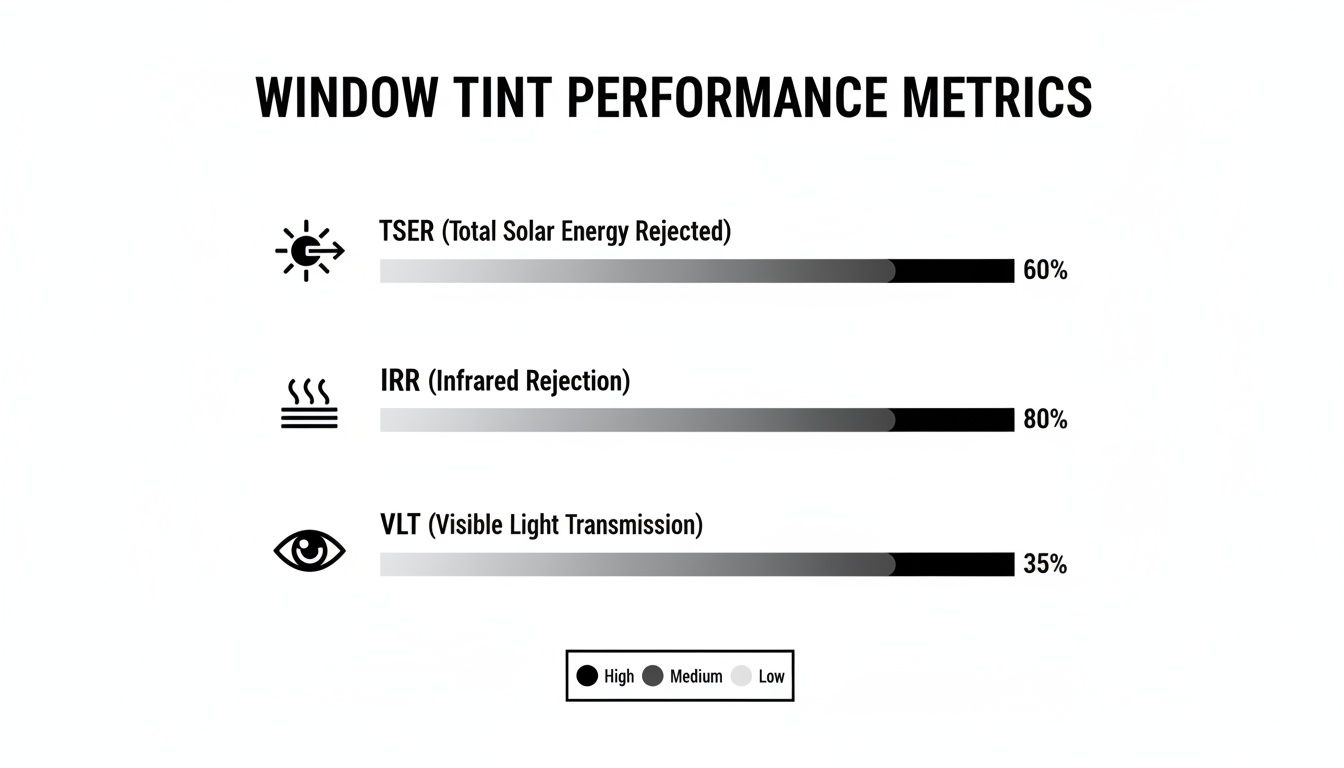
As you can see, a top-tier film strikes a crucial balance. It needs a high TSER and IRR to effectively block heat while keeping the VLT at a level that’s both legal and safe for driving.
Dyed Window Film: The Budget-Friendly Option
Dyed window tint is the entry-level choice and by far the most common, mostly because it’s so affordable. It’s made from layers of polyester film with dye added to absorb sunlight. This absorption process darkens the windows, giving you privacy and cutting down on glare.
While it looks the part and provides some basic UV protection, its ability to reduce heat is pretty limited. The film works by soaking up solar energy, which means the glass itself gets hot and eventually radiates that heat right into your car.
The biggest issue with dyed film, though, is durability. Sun exposure breaks down the dyes over time, causing that ugly purple discoloration and bubbling you've probably seen on older cars. You’ll be lucky to get a few years out of it before it needs to be replaced.
Metallic Window Film: Reflective and Effective
Metallic window tint is a solid step up. These films have a super-thin layer of metallic particles embedded in them that act like a mirror, reflecting the sun’s heat away before it ever hits the glass. This makes them much, much better at heat reduction than dyed films.
That reflective quality also makes metallic films tough. They’re highly scratch-resistant and won’t fade or change color, so you get a solution that lasts.
But there's a major catch: signal interference. The very same metallic particles that reflect heat can also block radio waves, which means your GPS, cell phone, and radio reception can become spotty or just plain unreliable. For most people today, that’s a deal-breaker.
Ceramic Window Film: The Pinnacle of Performance
This is where modern technology really shines. Ceramic films deliver the best heat reduction available, period. They can achieve a Total Solar Energy Rejection (TSER) rate of over 60%, which is worlds beyond what dyed or metallic films can do.
What makes ceramic so special is its use of non-metallic, non-conductive nano-ceramic particles. These tiny particles are engineered to specifically target and block infrared radiation—the part of the sunlight that you feel as heat. We’re talking up to 80% of infrared heat and 99% of UV rays blocked, all without needing a super-dark tint. This means you get incredible performance without sacrificing visibility or your phone’s connection.
For a deeper dive into the specific advantages, this guide on Unlocking the Year-Round Benefits of Ceramic Window Tint is a great resource. If you want to see the high-quality films we use, you can find more on our window tint page.
Head-to-Head: Technology Showdown
So, how do you choose? It really comes down to balancing your budget with your expectations for performance. Each film has its place.
To make it simple, here’s a side-by-side look at how these technologies stack up against each other.
Window Tint Technology Comparison
Feature | Dyed Film | Metallic Film | Ceramic Film |
|---|---|---|---|
Heat Rejection | Low (absorbs heat) | High (reflects heat) | Highest (rejects IR heat) |
Signal Interference | None | Yes (High) | None |
Durability | Low (fades to purple) | High (does not fade) | Highest (does not fade) |
UV Protection | Good (up to 99%) | Excellent (up to 99%) | Excellent (up to 99%) |
Cost | $ | $$ | $$$ |
Best For | Budget-conscious styling | Durability & heat reflection | Maximum performance & clarity |
This table lays it all out. Dyed film is a low-cost way to get some privacy, but it just doesn't perform. Metallic film is a durable middle-ground option, but the signal interference is a major flaw for most drivers.
That leaves ceramic film as the clear winner for anyone serious about comfort. It delivers unmatched heat rejection, fantastic clarity, and zero signal issues, making it the undeniable best window tint for heat reduction.
Choosing the Right Tint for Your Specific Needs
Knowing the tech specs of different tints is great, but what really matters is how that translates to your daily life. The "best" window tint for blocking heat isn't a one-size-fits-all answer. It's about finding the right film that fits your car, your routine, and what you care about most.
Are you a daily commuter stuck in rush-hour sun? A luxury car owner protecting a serious investment? Or maybe a homeowner trying to tame those summer energy bills? Each situation calls for a different approach. Let's walk through a few common scenarios to help you pinpoint the perfect tint for you.
For the Daily Commuter
If your car is your second office, your priorities are comfort, safety, and no-fuss reliability. You need a film that delivers solid heat rejection to make traffic a little more bearable, cuts down on blinding glare, and doesn't mess with your phone or GPS.
A mid-tier ceramic tint is your best bet here. It’ll give you a TSER of 50-55% without the hefty price tag of the top-shelf stuff. Critically, its non-metallic structure means zero interference with your signals—a must-have for anyone relying on Waze or taking calls on the go. It’s the perfect workhorse film that gets the job done.
Key Consideration for Commuters: Signal clarity is everything. Nothing is more frustrating than a tint that kills your GPS signal or drops calls. Ceramic films take that problem off the table entirely, making them a much smarter choice than metallic options.
For the Luxury Vehicle Owner
When you’ve put serious money into a high-end vehicle, you're not looking to cut corners. The goal is maximum performance while preserving the car's flawless aesthetic and sophisticated electronics. Your tint needs to provide the absolute best heat and UV protection to keep that fine leather, wood trim, or carbon fiber interior from degrading over time.
For this, you have to go with a high-performance nano-ceramic film. The best-in-class options, like Llumar IRX or XPEL PRIME XR Plus, boast industry-leading TSER ratings often hitting over 60% and IR rejection climbing past 90%. They also offer incredible optical clarity without any distortion, giving you a sleek, factory-tinted appearance that enhances the car’s design. This is the top choice when only the best will do.
For the Homeowner in a Hot Climate
The windows in your home are essentially giant heat magnets, forcing your AC to work overtime and sending your energy bills through the roof. The trick is to block that solar heat without losing all the beautiful natural light that makes your space feel open and inviting.
A spectrally selective architectural film is the answer. These are incredibly sophisticated tints engineered to zero in on infrared heat while letting most of the visible light pass right through. You get a massive reduction in heat gain and protect your furniture, flooring, and art from UV fading, all without turning your home into a dark cave. It's a smart upgrade that can trim cooling costs by as much as 30%.
For the Budget-Conscious Driver
Let's say you're just looking for an affordable way to get some privacy and a bit of relief from the heat. A quality dyed or hybrid film is a perfectly good option that won't drain your wallet. While these films can't match the infrared-blocking power of ceramic, they still provide a noticeable level of comfort and block 99% of damaging UV rays.
Modern dyed films from reputable brands are a world away from the old stuff that would bubble and turn purple. They work by absorbing solar energy, so while the glass itself will get warm, less of that heat radiates into the cabin. It’s a practical, entry-level solution that’s great for older cars or for drivers whose main goals are privacy and a sharper look.
Navigating Legal Limits and Professional Installation
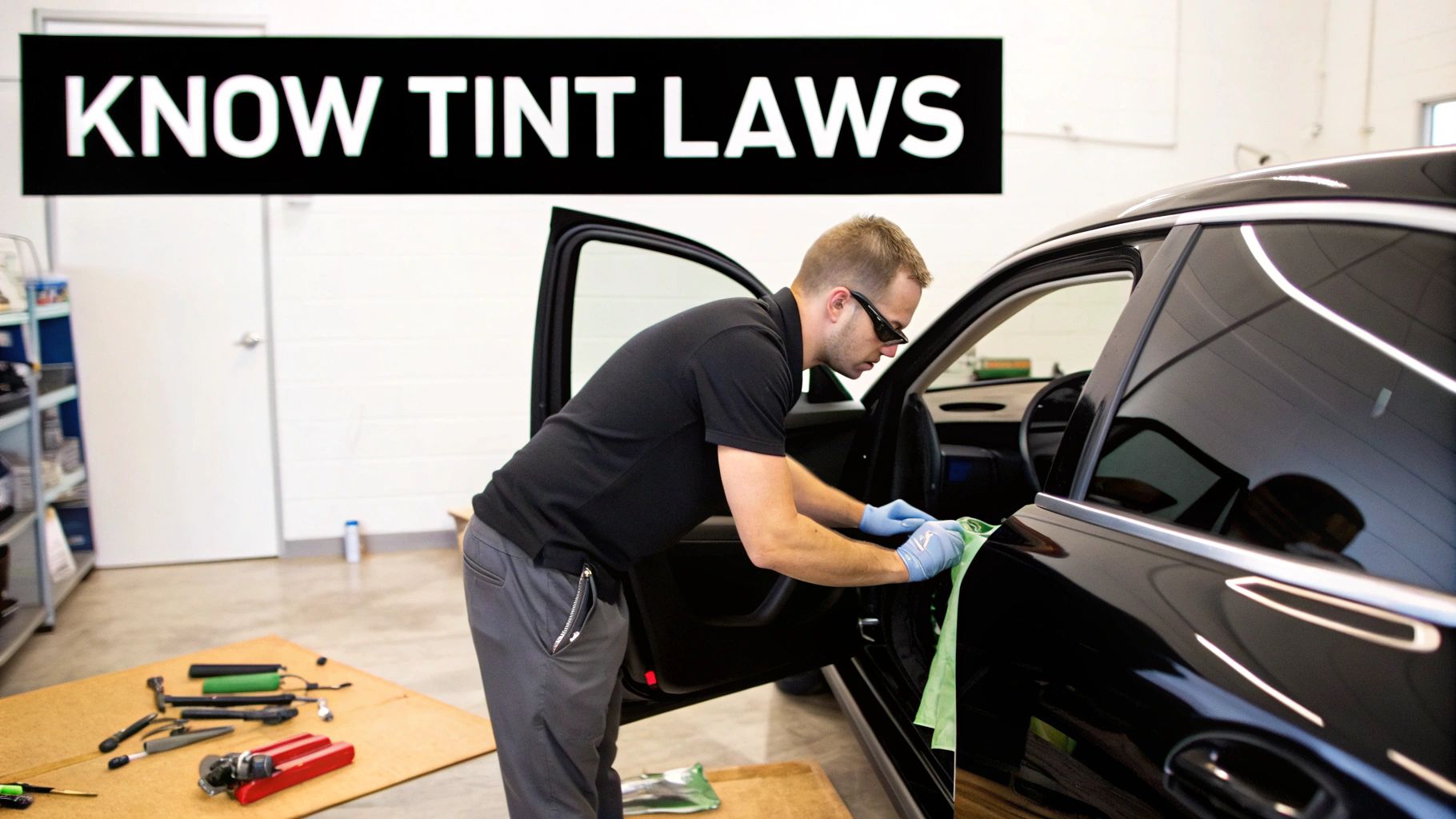
Picking out the best tint for heat reduction is just the first step. You also have to make sure it's legal and installed correctly, otherwise, that high-tech ceramic film is just an expensive ticket waiting to happen. Every state has its own rules for window tint, and figuring them out can be a real headache.
The main thing to know is Visible Light Transmission (VLT), which is just a fancy way of saying how much light the tint lets through. State laws get specific, often setting different VLT limits for front windows versus the back ones. Go darker than what's allowed, and you could be looking at fines or a failed vehicle inspection.
Why Professional Installation is Non-Negotiable
Beyond staying on the right side of the law, the quality of the installation makes all the difference. It’s what determines whether your tint actually works as promised and lasts for the long haul. You can find DIY kits everywhere, but they almost always end in frustration and a less-than-perfect look. A professional job is flawless for a reason—it takes the right tools, a clean space, and a lot of practice.
Trying to do it yourself often leads to some classic problems:
Bubbling and Peeling: This is the most common giveaway of a DIY job, caused by air and moisture getting trapped under the film.
Contamination: Even the tiniest specs of dust or hair can get stuck, creating ugly bumps and preventing the film from sticking properly.
Uneven Edges: Crooked cuts and gaps along the window’s edge look terrible and are the first places the film will start to peel.
Creasing: Once you accidentally fold or crease the film, that mark is there for good.
A pro knows how to avoid all of this. They use precision techniques to make sure the film bonds perfectly to the glass, giving you crystal-clear views and a durable finish. Plus, their work usually comes with a lifetime warranty—something you definitely don't get with a DIY kit.
The Convenience of Mobile Tinting Services
It used to be that getting your windows tinted meant leaving your car at a shop all day. Now, services like Auto Renu bring the shop right to your doorstep. Mobile window tinting saves you a ton of time and hassle by getting the job done at your home or office without cutting any corners on quality.
Key Insight: A professional mobile service gives you the best of both worlds: the flawless finish you’d get at a shop combined with ultimate convenience. The technician shows up with everything they need to get a perfect, contaminant-free installation right where you are.
This modern approach guarantees your vehicle is tinted by a certified expert in a controlled setting, giving you a result that's both legal and built to last. It’s the easiest way to protect your car and start feeling the cool, comfortable benefits right away.
If a perfect finish without the hassle sounds good to you, it's simple to request a quote for mobile window tinting and have an expert come to you.
Understanding the True Cost and Return on Investment
It's easy to get fixated on the upfront price when you're looking for the best window tint to reduce heat. But thinking of it as just another expense is missing the point. The right window tint is an investment—one that pays you back in more ways than just comfort.
Of course, the initial cost will depend on the technology you choose. A basic dyed film is the most budget-friendly option, usually running a few hundred dollars for an average car. Metallic tints are a solid mid-range choice, while the high-performance ceramic and nano-ceramic films sit at the premium end, and their price reflects their superior ability to block heat.
Breaking Down the Financial Benefits
The real magic happens when you look at the long-term return. The most obvious financial win is how much less you'll run your air conditioner. When your tint blocks a serious amount of solar heat from getting into your car, your AC system doesn't have to fight nearly as hard to keep things cool.
This has a direct impact on your fuel efficiency. A less burdened AC compressor means your engine uses less gas. While the savings on a single trip might seem small, they really add up over the years. Window tinting is a fantastic way to cut down on AC-related costs; for even more ideas, check out these more tips to reduce air conditioning costs.
It's amazing what a high-performance film can do. Top-tier tints with excellent infrared rejection can block a massive 50-80% of solar heat and almost 99% of UV rays. This makes the interior noticeably cooler and takes a huge load off your AC system.
The Intangible Returns on Comfort and Protection
Beyond saving money at the pump, a quality tint offers returns that improve your daily drive in ways you can't put a price on.
Interior Preservation: UV rays are relentless, and they will absolutely wreck your car's interior over time. Think cracked dashboards, faded leather, and brittle upholstery. By blocking 99% of harmful UV rays, a good tint acts like a bodyguard for your car, preserving its condition and protecting its resale value.
Enhanced Driving Comfort: Let's be honest, a cooler car is just a better place to be. It reduces that feeling of being drained after a long commute and makes every trip more enjoyable for everyone inside. The glare reduction is another huge plus, making it easier and safer to see, especially when the sun is low in the sky.
Health and Skin Protection: Those same UV rays that damage your car are also damaging your skin. Quality tint provides crucial protection from sun exposure while you're driving—it's like having a powerful, transparent sunscreen on your windows.
When you add it all up, investing in the best window tint for heat reduction is a smart move. The initial cost is quickly balanced out by the real-world savings and the priceless improvements in comfort, safety, and your vehicle's longevity. But you don't have to take our word for it—see what our clients have to say on our customer testimonials and reviews page.
Your Top Questions About Heat-Blocking Tints Answered
Even after digging into the technology, you probably still have a few questions. That's completely normal. Choosing the right tint for your car is a big decision, and you want to be confident you're making the right call. Here are some clear, no-nonsense answers to the most common questions we hear from drivers.
Let's clear up the confusion so you can pick the best window tint for your needs.
Does a Darker Tint Automatically Mean More Heat Rejection?
This is easily one of the biggest myths in the window tinting world. The short answer is no, not at all. A dark, cheap dyed film might absorb a little bit of solar energy, but it does very little to actually block the heat you feel. When it comes to real heat rejection, the technology inside the film is what counts, not just how dark it looks.
High-performance ceramic films, for instance, can be nearly clear yet block an incredible amount of infrared heat. A film's darkness is measured by its Visible Light Transmission (VLT), but its actual cooling power comes from its Total Solar Energy Rejected (TSER) and Infrared Rejection (IRR) ratings. A light ceramic film with a high IRR will always feel cooler than a dark dyed film.
Expert Insight: Think of it like sunglasses. A pair of cheap, dark plastic lenses might dim your view, but you'll still be squinting from the glare. On the other hand, high-quality polarized lenses can be much lighter in color but cut glare completely and offer better UV protection. Window tint works the same way—it's the quality of the technology, not the darkness, that does the heavy lifting.
How Long Does a Professional Window Tint Job Really Last?
The lifespan of your tint comes down to two things: the quality of the film you choose and the skill of the person installing it. This is one area where you absolutely get what you pay for.
Dyed Films: As the most budget-friendly option, these have the shortest lifespan. Expect them to last 2-5 years before you start seeing the classic signs of failure—bubbling, peeling, or fading into that notorious purple haze.
Metallic and Carbon Films: A solid step up. These films are far more durable and won't fade or discolor like dyed films. With proper care, they can easily last 10 years or more.
Ceramic Films: These are the top-of-the-line films built to go the distance. When installed by a certified pro, they almost always come with a lifetime warranty covering bubbling, peeling, fading, and discoloration. That durability makes them a smart long-term investment.
Can Window Tint Damage My Windows or Rear Defroster?
When installed by a skilled professional, window tint is 100% safe for your car's glass and the delicate defroster lines on the rear window. A seasoned technician uses specific tools and proven techniques to apply the film without ever touching the glass with a sharp edge. They know exactly how to work around the defroster grid to keep it perfectly intact and functional.
The real danger comes from improper removal. If you try to scrape off old, failing tint yourself with a razor blade, it’s incredibly easy to slice through those thin defroster lines, permanently damaging them. If your tint ever needs to be removed, always have a professional handle it.
Is Ceramic Tint Really Worth the Extra Money for Heat Reduction?
If your main goal is to beat the heat and stay comfortable, the answer is an emphatic yes. While ceramic tint has a higher upfront cost, its performance and long-term value are simply in a different league. The difference you feel inside your car on a sweltering day isn't just a little better; it's a night-and-day improvement.
Think about what you’re getting for the investment:
Unbeatable Heat Rejection: It blocks significantly more infrared heat (the kind you feel) than any other type of film.
Zero Signal Interference: Its non-metallic formula means your GPS, cell phone, and radio reception will be crystal clear.
Built to Last: A lifetime warranty means you pay for it once, and you're done.
Crystal-Clear Views: You get powerful heat-blocking without needing a super-dark tint that reduces your visibility.
When you add up the superior comfort, the protection for your car's interior from sun damage, and even the potential fuel savings from running the AC less, ceramic tint delivers the best overall value and is the undisputed champion of performance.
Ready to experience a cooler, more comfortable drive with the best heat-blocking technology available? At Auto Renu Auto Glass LLC, our mobile tinting experts bring premium ceramic films and professional installation directly to you. Get a flawless finish and lasting results without the hassle. Visit us at https://www.autorenu911.com to get your free quote today