Guide: how much does windshield chip repair cost and when to repair
Discover how much does windshield chip repair cost and what factors affect the price, plus tips on insurance and when to repair vs. replace.
Dec 15, 2025
generated
windshield chip repair cost, auto glass repair, car maintenance cost, windshield repair cost, diy windshield repair
That sinking feeling you get when a rock smacks your windshield is usually followed by one big question: "How much is this going to cost me?" The good news is, you can expect to pay somewhere between $60 and $150 for a professional chip repair if you're paying out-of-pocket. It’s a small price to pay to stop a tiny annoyance from morphing into a major expense, especially when a full windshield replacement can easily top $500.
Your Quick Answer on Windshield Chip Repair Costs
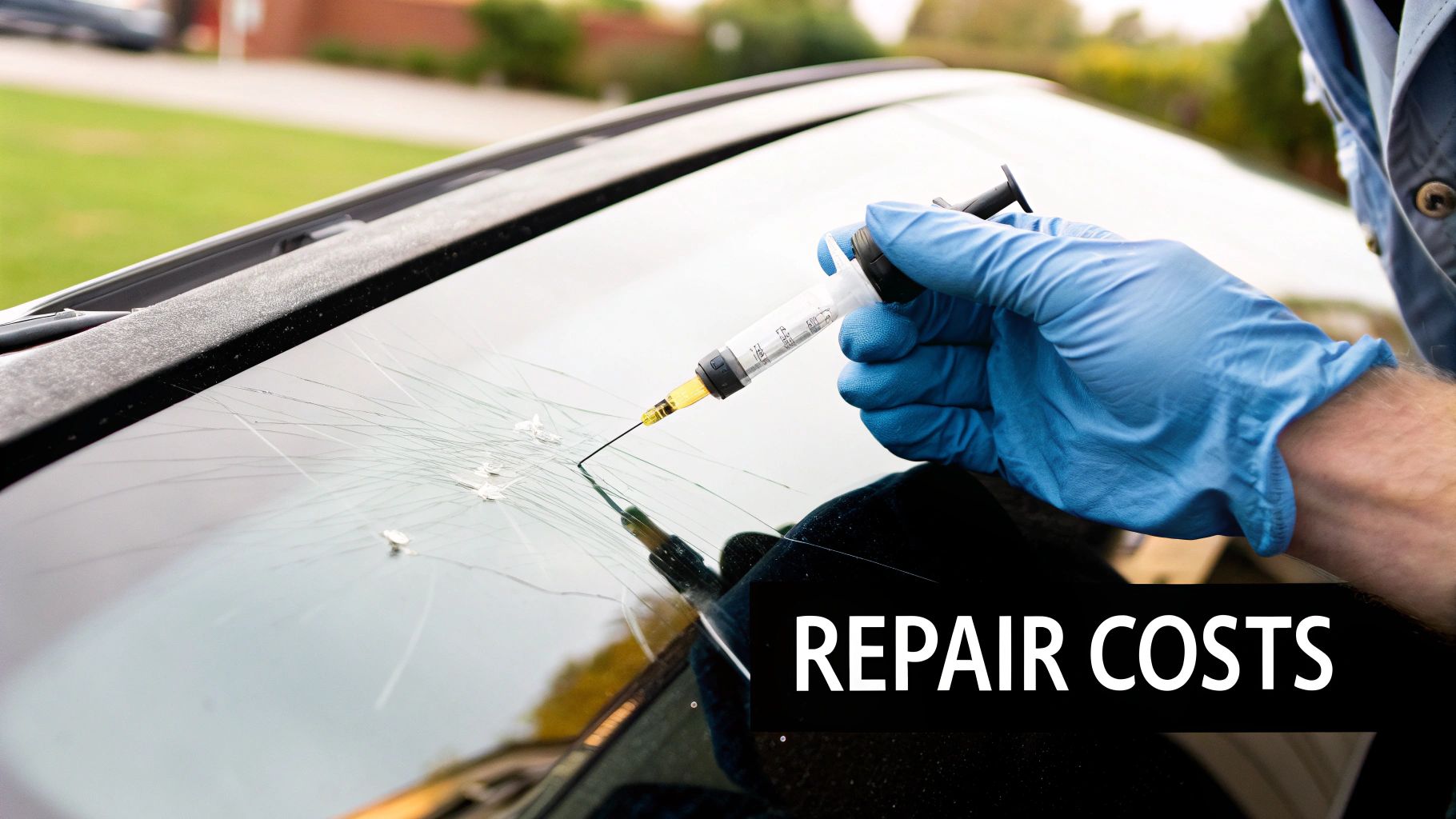
Let's cut to the chase. That new chip is an unwelcome surprise, and you’re probably wondering what the damage to your wallet will be. Thankfully, getting a chip fixed is one of the most affordable pieces of car maintenance you'll ever have to deal with.
The best way to think about it is as a small, preventative measure. Spending a little bit of money now saves you from a much larger bill down the road. A chip can easily spiderweb into a long crack from everyday road vibrations or a sudden temperature change, forcing you into a full—and much more expensive—windshield replacement. Acting fast is always the smartest financial move.
Out-of-Pocket Cost Estimates
So, what can you expect to pay if you're footing the bill yourself? To give you a clearer idea, here's a quick look at the typical costs you might see.
Estimated Windshield Chip Repair Costs Out of Pocket
This table provides a quick overview of typical out-of-pocket costs for repairing one or more chips on a standard vehicle windshield.
Number of Chips | Average Cost Range | Notes |
|---|---|---|
One Chip | $60 – $100 | This is the most common scenario for drivers who catch the damage early. |
Two Chips | $80 – $140 | Technicians often give you a price break for the second and third repairs. |
Three Chips | $100 – $180 | Fixes multiple impact points during a single service call. |
As you can see, getting a chip filled is far more budget-friendly than a replacement, which can often start around $200 and go up significantly from there. It really highlights the value of dealing with damage right away.
The key takeaway is simple: repairing a chip is a proactive investment in your vehicle’s safety and your financial well-being. It’s a small price to pay to maintain the structural integrity of your windshield and avoid a much more significant expense down the road.
Decoding What Determines Your Final Repair Bill
Figuring out what a windshield chip repair will set you back isn't always cut and dry, mainly because no two chips are exactly the same. It's a bit like fixing a wall in your house—a tiny nail hole is a quick patch job, but a bigger gouge takes more time, skill, and material. The same logic applies to your windshield, where a few key variables determine the final price.
The biggest factors are the size and type of the damage. A small, clean “bullseye” chip? That’s usually the most straightforward and affordable fix. But if you're looking at a “star break,” which has little cracks shooting out from the impact point, the technician has to be much more careful to get the resin into every single leg of that crack. The bigger the chip or the funkier its shape, the more that intricacy will be reflected in your bill.
Location, Location, Location
Just like in real estate, where the chip is located on your windshield makes a huge difference. If the damage is tucked away over on the passenger side, it's a pretty standard repair. But the second that chip lands directly in the driver's line of sight, the rules change.
This critical zone demands near-perfect clarity. Technicians have to work with extreme precision to make sure the finished repair doesn't cause any visual distortion.
A repair in the driver's direct line of vision has to be flawless to avoid creating a dangerous distraction. That need for perfection means a higher level of skill and care is required, which often translates to a slightly higher cost.
The Complexity of Different Chip Types
Not all rock chips are created equal. The actual shape and structure of the break will dictate how much work is needed to get a solid, lasting repair. Knowing a little about these types can help you understand the "why" behind a technician's quote.
Here’s a look at a few common chip types and what they mean for the repair process:
Bullseye: This is your classic, cone-shaped chip. It's relatively simple to fill and is often the least expensive type to fix.
Star Break: With its short cracks branching out from a central point, this one requires a careful hand to inject the resin and stop those legs from spreading any further.
Combination Break: Just like it sounds, this is a mash-up of a bullseye and a star break. It's more complex and typically costs more to repair because of the intricate damage.
Half Moon: This is a semi-circular break that looks like a bullseye that got cut in half. These are also fairly straightforward but need to be filled correctly so they don’t crack out later on.
Each of these chip types needs a unique approach. A good technician doesn't just fill a hole; they assess the damage to choose the right tools and the right amount of resin to make sure your windshield's structural integrity is back to 100%. This careful evaluation is a huge part of what determines your final windshield chip repair cost.
How Advanced Safety Systems Can Affect the Price
Your car's windshield isn't just a piece of glass anymore. For many modern vehicles, it's a sophisticated piece of technology that serves as the eyes for the car's high-tech brain. If you have features like lane-keep assist or automatic emergency braking, you have what's known as an Advanced Driver-Assistance System (ADAS), which relies on cameras and sensors mounted right on your windshield.
This changes the game for even a simple chip repair. A small chip far away from all that tech is usually a quick fix. But if the damage is anywhere near a camera's line of sight, things get a little more complicated. The integrity of the entire safety system could be at risk, which is something you can't afford to ignore.
Why Recalibration Might Be Necessary
With ADAS, the big question is always whether the system will work perfectly after the glass is touched. When a technician injects resin into a chip near a camera, the process could ever-so-slightly change how that camera sees the road ahead. That's where recalibration enters the picture.
Think of it like adjusting the focus on a camera. Recalibration is just the technical process of realigning the ADAS cameras to the car maker's exact specifications. Without this crucial step, your car’s safety features could malfunction, leading to some pretty scary situations on the road.
An ADAS camera that's even a fraction of a degree off might not read lane markings correctly or could miscalculate the distance to the car in front of you. This is why recalibration isn't just an upsell; for many modern cars, it's an essential safety procedure.
Factoring Calibration into Your Repair Bill
The chip repair itself will likely still cost you somewhere in the usual $60 to $150 ballpark. However, if ADAS recalibration is required, that's a separate service with its own price tag. Adding this service can tack on an additional $150 to over $400 to the final invoice, dramatically changing how much your windshield chip repair costs.
It's vital to bring this up with your technician from the get-go. Getting a full picture of what's involved, including understanding the full scope of ADAS recalibration after a windshield repair, ensures you're not hit with surprise costs. More importantly, it guarantees your car's safety features are reset to factory-perfect condition, keeping you safe on the road.
Repair vs. Replacement: The Tipping Point for Your Wallet
When that rock hits your windshield, you’re suddenly at a crossroads. Do you go for a quick repair, or are you looking at a full-blown replacement? This is one of those moments where a small decision can have a huge impact on your wallet.
A simple chip repair will typically set you back less than $150, but a complete windshield replacement? That’s a whole different story, often running anywhere from $500 to over $1,500. The gap between those numbers is why acting fast on a small chip just makes good financial sense.
The game has changed with modern cars, too. As Kelley Blue Book points out, what used to be a few hundred dollar job can now easily top $1,000 for newer electric vehicles and luxury cars. It’s not just about the glass anymore; it’s about the complex tech that comes with it.
Knowing When to Repair and When to Replace
So, how do you know which path to take? A great little trick I’ve always used is the "dollar bill test." If you can completely cover the chip or crack with a dollar bill, you're almost certainly in repair territory. It’s a simple, effective way to size up the damage on the spot.
However, some damage is just an automatic no-go for repair. Long cracks, especially anything over six inches, are usually too far gone. They’ve already compromised the structural integrity of your windshield, and a resin fill just won’t bring back the strength you need. The same goes for any damage that has punched through both layers of the glass—that’s an immediate signal for a replacement.
If you think the damage might be too severe, it's a good idea to understand what's involved in the full https://www.autorenu911.com/windshield-replacement process.
This is especially true for cars with modern safety systems. The moment cameras and sensors are involved, the cost equation changes dramatically.
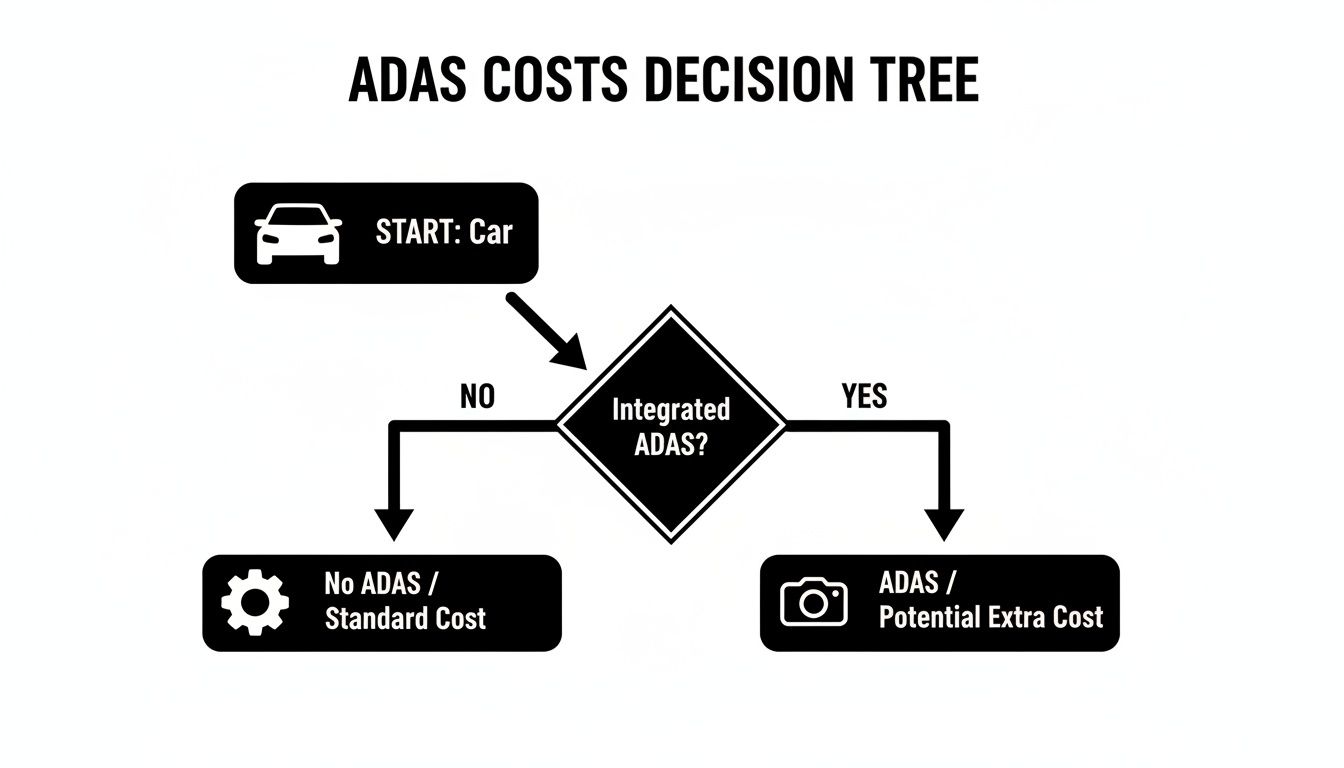
As you can see, vehicles equipped with Advanced Driver-Assistance Systems (ADAS) often need recalibration after a replacement, which adds significant time and cost compared to a standard car.
The High Cost of Waiting
Let’s be honest: procrastination is the real enemy here. That tiny chip might not look like much, but it's a weak point just waiting to fail. All it takes is a pothole, a speed bump, or a sudden temperature change, and that cheap-to-fix chip can spread into a massive, wallet-draining crack overnight.
The smartest financial move you can make is to act immediately. Repairing a chip right away not only saves you hundreds of dollars but also keeps your windshield’s original factory seal intact—and that seal is always better than any aftermarket one.
To get a clearer picture of the financial breakdown, here's a side-by-side look at what you can expect.
Cost Comparison: Repair vs. Full Replacement
Consideration | Chip Repair | Full Replacement (Standard Vehicle) | Full Replacement (ADAS Vehicle) |
|---|---|---|---|
Average Cost | $70 - $150 | $500 - $800 | $800 - $1,500+ |
Turnaround Time | Under 1 hour | 2 - 4 hours | 3 - 5 hours (includes recalibration) |
Structural Integrity | Restores strength to the damaged area | Fully restores with a new windshield | Fully restores with a new windshield |
Factory Seal | Preserved | Broken and replaced | Broken and replaced |
ADAS Impact | None; no recalibration needed | None | Requires professional recalibration |
When you lay it all out, the value of a quick repair is undeniable. While sometimes a replacement is unavoidable, as with the principles behind most glass replacement services, catching the problem early is the best strategy. Dealing with that chip as soon as it happens is the surest way to control your costs and avoid a much bigger bill down the road.
Navigating Insurance for Your Windshield Repair
When you spot a fresh chip in your windshield, your mind probably jumps straight to the repair bill. But here's some good news: for many drivers, the final cost is actually $0. That's because most comprehensive auto insurance policies will cover minor windshield repairs without you ever having to touch your deductible.
Why would insurance companies be so generous? It all comes down to simple economics. They'd much rather pay for a quick and easy chip repair now than a full, expensive windshield replacement down the road. They know that an ignored chip can quickly spiderweb across the glass, turning a $70 fix into a $700 headache.
Will a Glass Claim Jack Up My Insurance Rates?
This is probably the biggest question on every driver's mind. Will filing a claim make my premium shoot up? In almost every case, the answer is a relieving no. A single chip repair is usually seen as a minor, no-fault claim and is highly unlikely to affect your rates.
That said, if you're filing multiple glass claims in a short amount of time, it could raise a red flag with your insurer. To play it safe, some people choose to pay out-of-pocket for a tiny bit of damage, saving their insurance claim for a more serious issue that might pop up later.
In most states, it's actually illegal for insurance companies to raise your rates for a single, no-fault glass claim. They view it as preventative maintenance that saves everyone money.
The Claims Process Made Easy
Getting your insurance to handle the repair is usually a walk in the park. Your first move is to call your insurance provider to report the damage. They'll confirm you have the right coverage and then point you toward an approved auto glass shop in their network. Mobile services like Auto Renu Auto Glass LLC often work directly with insurance companies, making the entire process completely painless for you.
Here's a quick look at how it typically works:
Call Your Insurer: Give them a ring or start a claim online to let them know about the chip.
Share the Details: Have your policy number handy and be ready to explain when and where the damage happened.
Pick a Repair Shop: Your insurance company will give you a list of approved technicians, including both physical shops and mobile services.
Book the Appointment: The repair shop takes it from there, billing your insurance company directly so you don't have to deal with any of the paperwork.
By taking a few minutes to understand your policy, you can often get that chip fixed for free and drive away without the stress of an unexpected bill.
DIY Kits vs. Professional Repair Services
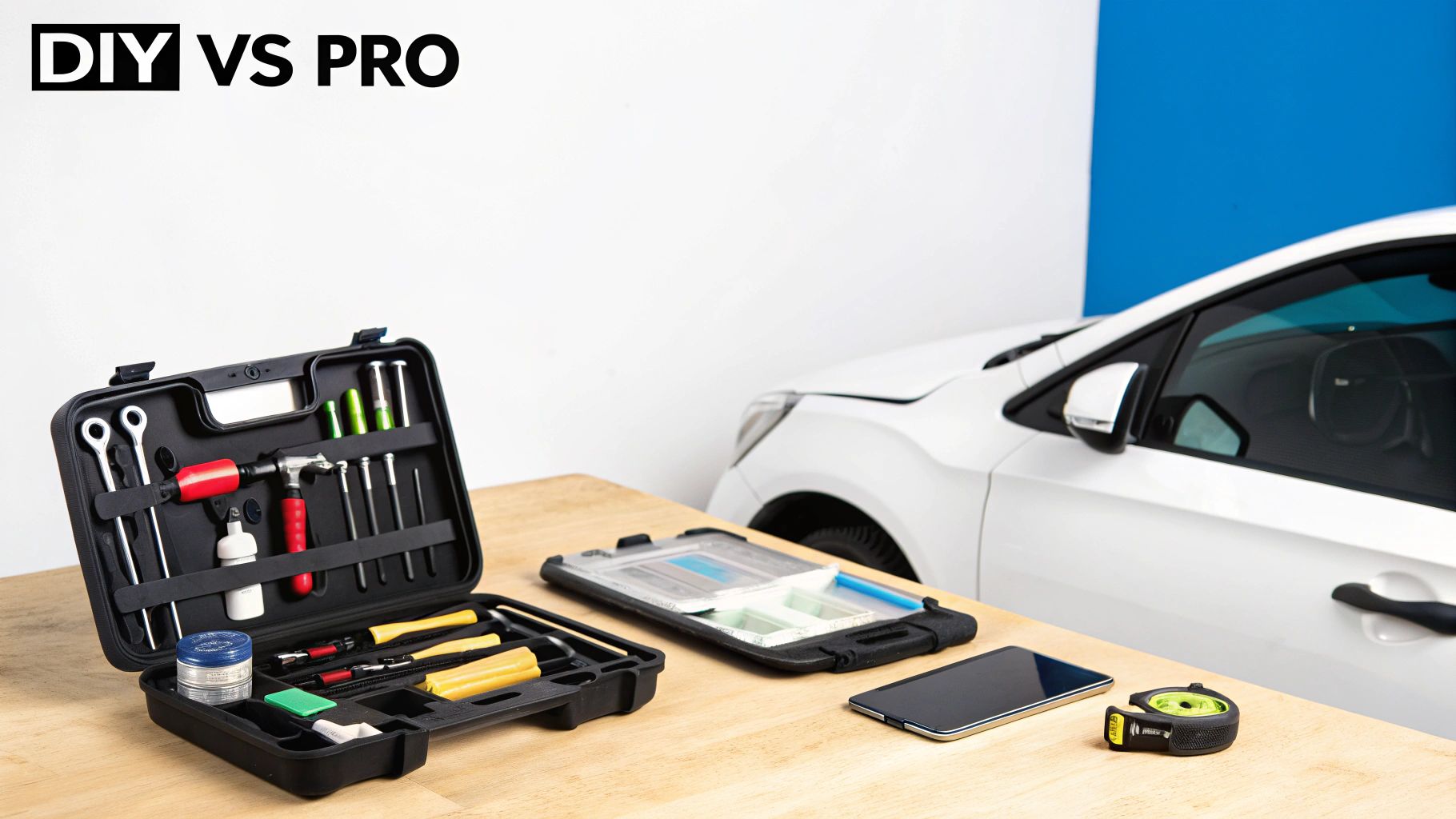
When you spot that fresh chip in your windshield, the first thought for many is to grab a $20 DIY kit from the local auto parts store. It feels like a quick, cheap fix, and for a tiny, purely cosmetic blemish, it might seem to do the trick.
But going the DIY route is a real gamble. It’s a bit like using duct tape on a leaky pipe—it might stop the drip for a day or two, but it’s not a real fix. The resins in those kits just don't measure up, and without the right tools, you're likely to get a weak seal that leaves the chip primed to spread the next time the temperature changes.
Even worse, a botched DIY job can make things a whole lot messier. Once a low-quality resin is applied incorrectly and cures, a professional technician often can't go back in to fix it the right way. Your "quick fix" could easily force you into the one thing you were trying to avoid: a full, and much more expensive, windshield replacement.
The Value of Professional Expertise
Hiring a pro isn't just about convenience; it's an investment in your safety and the longevity of your windshield. Certified technicians work with industrial-grade resins that are light-years ahead of what you can buy off the shelf. These resins are incredibly strong and optically clear.
They also use specialized tools that create a vacuum over the chip, sucking out every last bit of air before injecting the resin under high pressure. This process forces the resin deep into every microscopic crack, ensuring a solid, permanent bond. The goal isn't just to plug a hole—it's to restore the structural integrity of your windshield.
A professional repair is engineered to last for the life of your windshield. It stops the chip in its tracks and keeps your line of sight completely clear, without any distracting blurs or distortions.
The numbers back this up. Professional repairs have a vastly higher success rate and are far less likely to fail down the road. An untreated or poorly repaired chip is a ticking time bomb, ready to crack across your entire windshield during the next frost or heatwave. This turns a small, manageable problem into a major expense.
When you're weighing how much does windshield chip repair cost, the long-term value of a professional job becomes obvious. A DIY kit might save you a few bucks today, but the risk of failure, a subpar result, and the potential for a full replacement make a professional windshield repair the smarter, safer, and ultimately more cost-effective choice.
Got More Questions About Windshield Repair Costs?
Even with a full cost breakdown, it's natural to have a few more questions rattling around. Getting the full picture helps you feel confident you're making the right call. Let's tackle some of the most common things drivers ask.
Is a Repaired Windshield Really Safe?
Absolutely. When a professional repairs a chip, they’re not just patching a hole—they’re restoring the windshield’s structural integrity. They do this by injecting a powerful, industrial-grade resin deep into the damaged area, which then hardens to bond the glass back together.
This isn't just about looks. The process stops the chip from spreading and ensures the windshield can do its job in an emergency, like supporting the roof in a rollover or allowing airbags to deploy correctly. Once the resin cures, the repaired spot is often just as strong as the surrounding glass—sometimes even stronger.
A proper repair isn't just a cosmetic touch-up; it's a critical safety procedure. It brings your windshield back up to factory strength so it can continue protecting you and your passengers.
How Long Does a Chip Repair Take?
One of the best things about fixing a chip is how quick and painless it is. From start to finish, the entire repair usually takes less than 30 minutes. And since mobile technicians can come to your home or office, it’s incredibly convenient.
That kind of speed means you can get the problem handled right away without having to rearrange your entire day. It’s a simple fix that prevents a tiny chip from becoming a huge headache that requires a full windshield replacement.
What Will the Repair Look Like When It’s Done?
The goal of a professional repair is to make the damage practically invisible. While it's impossible to make a chip vanish completely, a good repair can improve its appearance by 80% to 95%.
What you see afterward really depends on the size, type, and age of the chip. Newer, cleaner chips almost always give the best-looking results. After the resin hardens, you're typically left with a tiny, faint blemish that’s way less distracting than the original damage. The number one priority is always safety, but the cosmetic improvement is a huge bonus.
Don't let a small chip turn into a big problem. The expert mobile technicians at Auto Renu Auto Glass LLC come directly to you, providing fast, professional, and reliable windshield repairs that restore your safety and peace of mind. Schedule your convenient mobile service today!