Can a cracked windshield be fixed? Repair vs. replacement
Can a cracked windshield be fixed? Learn when repair is possible, typical costs, and how to decide if replacement is safer; can a cracked windshield be fixed
Nov 9, 2025
generated
cracked windshield repair, windshield chip repair, auto glass repair, car safety, windshield replacement
The short answer? Yes, a cracked windshield can often be fixed without needing a full replacement, especially if you catch the damage early. Think of it like a small tear in your favorite jeans—a quick stitch can make it strong again. But whether your windshield qualifies for this kind of quick fix depends on a few key things, namely the crack's size and where it's located.
Your Guide to Windshield Repair and Safety
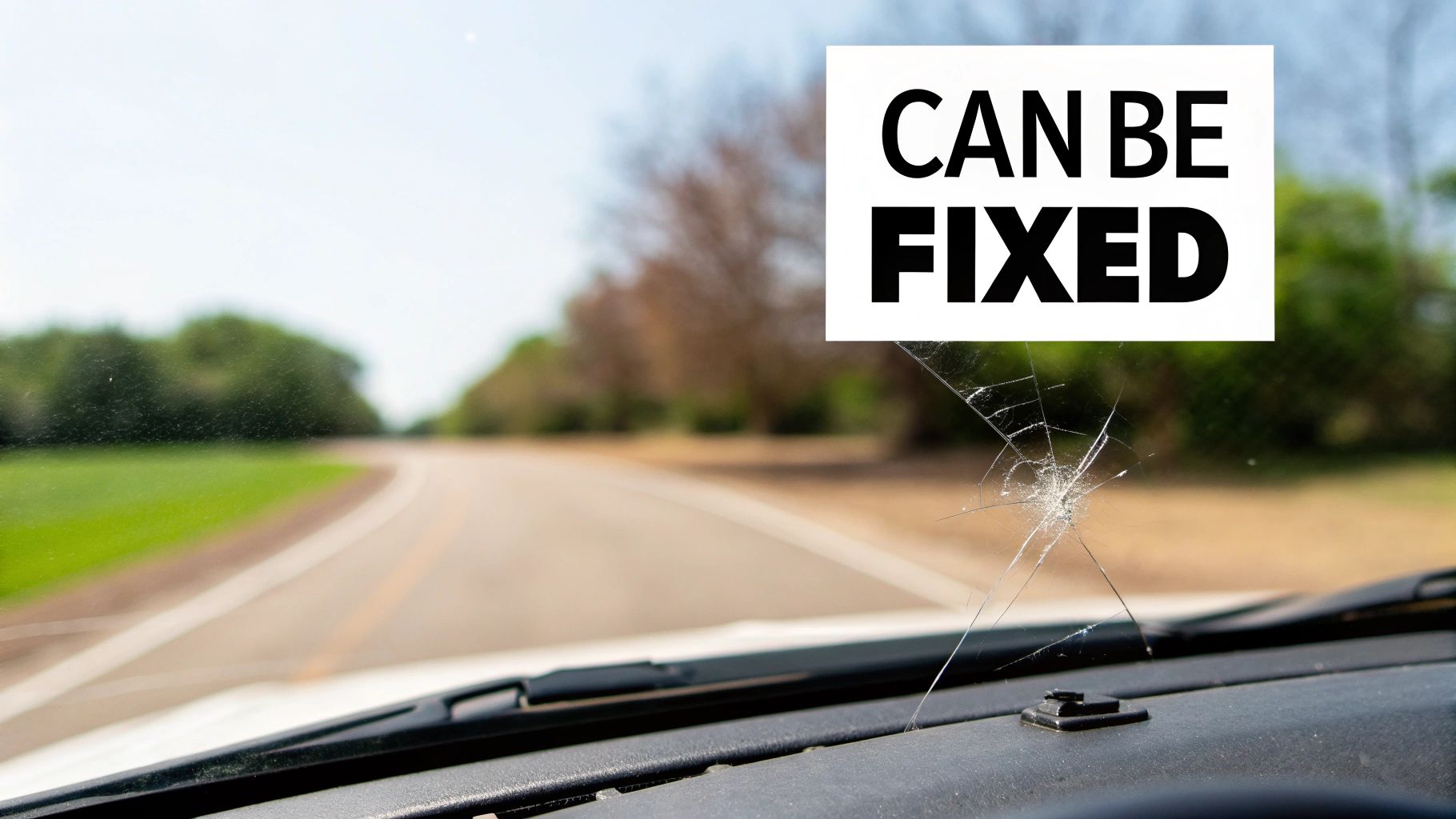
That heart-stopping thwack of a rock hitting your windshield doesn't always spell disaster for your wallet. A lot of the time, a fast and surprisingly strong repair is all you need, saving you a good chunk of time and money. Modern repair techniques are fantastic; a technician can inject a special resin that restores the glass's structural integrity, making it a safe and reliable solution.
The real trick is to act fast. A tiny chip can spiderweb across your windshield in no time, thanks to road vibrations, temperature swings, or even the pressure from a car wash. What starts as a simple fix can quickly become a much bigger problem that demands a brand-new windshield.
When Can You Repair vs. Replace?
So, how do you know if that crack is fixable? Professionals have a straightforward checklist they run through to decide if a repair is on the table. These aren't just arbitrary rules; they're all about making sure the final fix is safe for the long haul.
Size Matters: The most common rule of thumb is about the size. Small dings and short cracks are almost always repairable.
Location, Location, Location: A crack's position is just as important as its size. If it's directly in the driver's line of sight or too close to the edge of the windshield, a replacement is often the only safe option.
Type of Damage: Not all damage is created equal. A simple, round "bull's-eye" chip is much easier to fix than a long, linear crack that's already started to spread.
To give you a clearer idea, here's a quick breakdown of what's typically repairable.
Quick Guide to Windshield Damage Repairability
Type of Damage | Typical Size Limit for Repair | Usually Repairable? |
|---|---|---|
Chip or Ding | Smaller than a quarter | Yes |
Bull's-Eye | Up to 1 inch in diameter | Yes |
Star Break | Up to 1 inch in diameter | Yes |
Short Crack | Less than 6 inches long | Yes, in most cases |
Long Crack | Over 6 inches long | No |
Edge Crack | Crack starts at the edge | No |
This table is a great starting point, but always have a professional take a look to be sure.
The good news? The vast majority of minor windshield damage is repairable. Industry data shows that around 80% to 90% of chips and cracks smaller than a dollar bill are perfect candidates for a resin injection repair. If you're curious about the technology, you can find a lot of information by exploring industry reports on the windshield repair market.
At the end of the day, knowing these basics helps you make a smart call when you spot that first bit of damage, letting you get ahead of the problem before it gets worse.
So, you’ve got a crack in your windshield. The big question is, can it be fixed, or are you looking at a full replacement? It really boils down to three things that any glass expert will check: the size, location, and type of the damage.
Think of it as a quick triage you can do yourself. This initial once-over will give you a solid idea of what to expect before you even pick up the phone.
Size: The Dollar Bill Test
First up is the size. This is the most straightforward factor. A good rule of thumb is to grab a dollar bill. If a crack is shorter than the length of a standard dollar bill (about 6 inches), it's very likely repairable.
For chips, use a quarter for comparison. If the chip is smaller than a quarter, you're probably in good shape for a simple resin repair. Anything larger, and you're venturing into replacement territory.
Location, Location, Location
Next, where is the damage? A crack's position is just as critical as its size, mostly for safety reasons. If the chip or crack is directly in the driver’s line of sight, most shops will recommend a full replacement. Even the best repairs can leave a tiny bit of distortion, and you don’t want anything impairing your view of the road.
Another critical spot is near the edge of the windshield. A crack that's too close to the edge—usually within two or three inches—can mess with the structural integrity of the glass and its seal to the car's frame. That seal is a crucial safety feature, so you don't want to compromise it.
Damage Type: Not All Cracks Are Created Equal
Finally, let’s look at the "personality" of the crack. Different impact patterns have different repair success rates.
Bull's-Eye: This is that classic circular-looking chip. It's usually the easiest type to fix cleanly.
Star Break: Looks just like it sounds—a small impact point with little cracks radiating outward. These are also great candidates for repair, especially if you get to them quickly.
Combination Break: A mix of a bull's-eye and a star break. Repair is often an option, but it depends on how complex the break is.
Long Crack: This is a single line that has started to spread. Once it gets longer than about six inches, a repair is usually off the table.
Industry standards generally confirm that repairs are highly successful for cracks up to 6 inches long and for chips smaller than a quarter. However, when damage is extensive or interferes with the driver's direct view, replacement becomes the recommended course of action to maintain safety. You can discover more insights about the automotive glass market and its safety standards.
Making the right call between a quick fix and a total swap-out is crucial for both your wallet and your safety. This table breaks down the key decision points to help you see where your windshield damage falls.
Windshield Repair vs Replacement Criteria
Factor | Choose Repair When | Choose Replacement When |
|---|---|---|
Size of Damage | The chip is smaller than a quarter, or the crack is less than 6 inches long. | The chip is larger than a quarter, or the crack is longer than 6 inches. |
Location | The damage is NOT in the driver's direct line of sight. | The damage is directly in the driver's field of vision. |
Proximity to Edge | The crack is more than 2-3 inches away from the edge of the windshield. | The crack starts at or extends to the edge, compromising the seal. |
Number of Cracks | There are one or two small, separate points of damage. | There are three or more chips or cracks on the windshield. |
Type of Damage | It's a simple bull's-eye or a small star break. | It's a complex combination break or a crack that has "spidered" out. |
Technology Interference | Your vehicle does not have advanced driver-assistance systems (ADAS) near the damage. | The crack or chip obstructs sensors or cameras for systems like lane-keep assist. |
Ultimately, while this guide gives you a great starting point, a professional inspection is the best way to get a definitive answer. They'll assess the damage and ensure your vehicle remains safe on the road.
The Windshield Repair Process Explained
Ever wondered how a technician can make a crack in your windshield seemingly vanish? It's not magic, but it is a pretty clever process. Think of it less like a construction job and more like a delicate procedure to restore the glass's clarity and, more importantly, its structural integrity.
The first step is a meticulous cleaning of the damaged spot. A technician will carefully pick out any tiny glass fragments, dirt, or moisture trapped inside the crack. This prep work is absolutely crucial—any leftover debris can ruin the repair, leaving it weak or cloudy.
Next, a special tool is mounted right over the crack. This device creates a vacuum, pulling every last bit of air out of the fracture. It's the same principle as getting a clean surface before applying a strong adhesive; you have to eliminate anything that might cause a weak spot or an air bubble. This ensures the repair resin can flow into every nook and cranny.
The Injection and Curing Stage
With the air removed, a high-quality, clear liquid resin gets slowly injected into the void. This resin is specially formulated to have the same optical properties as glass, which is the secret to making the repair nearly invisible when it's all done. The pressure from the tool forces the resin deep into the crack, completely filling it.
To lock it all in place, a UV light is used to cure the resin. This intense light hardens the liquid, causing it to bond chemically with the surrounding glass. The result is a tough, watertight seal that restores the windshield’s original strength and stops the crack in its tracks.
Want to see this in action? For a closer look, you can explore our guide to professional windshield repair services.
This decision tree infographic is a great way to see if your windshield damage is a good candidate for repair based on its size, location, and type.
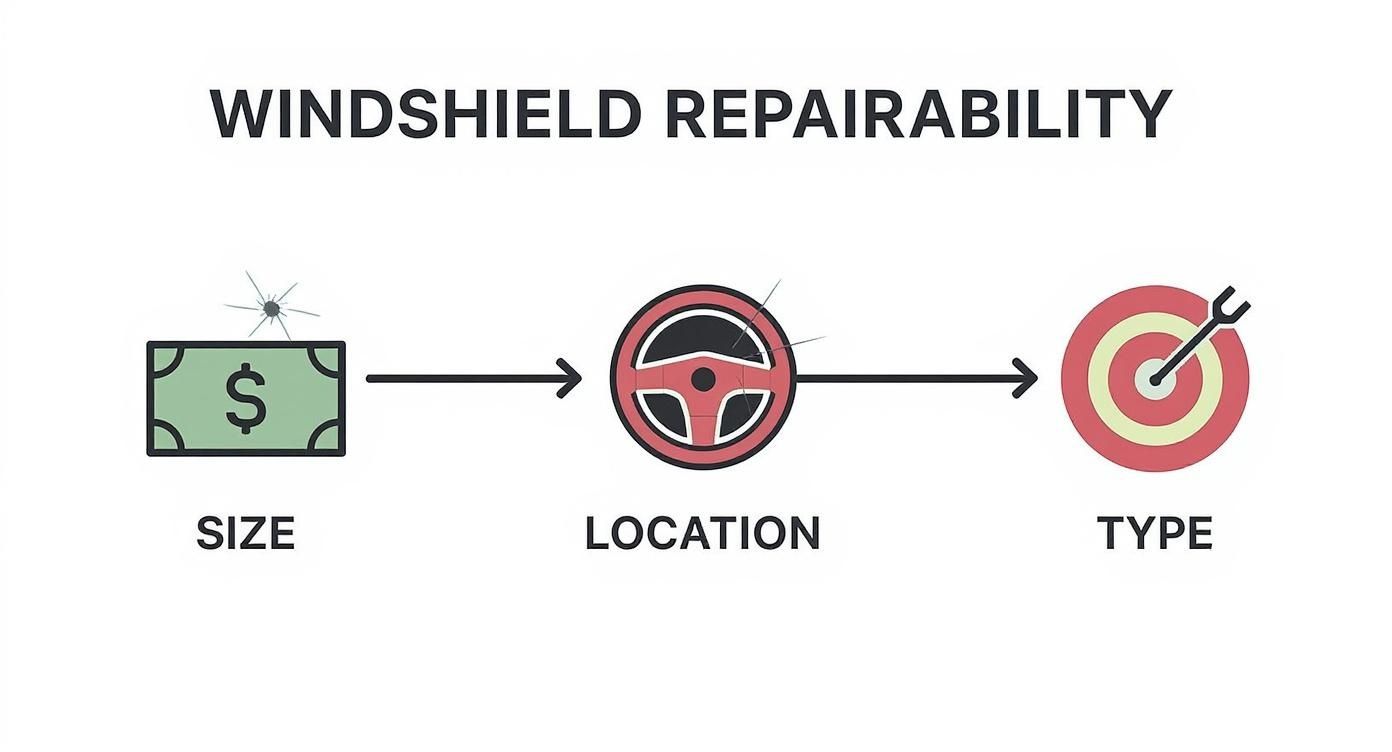
As you can see, if the damage is small, out of the driver's direct line of sight, and not a complex spiderweb crack, a repair is usually the best way to go.
Comparing the Costs: Repair vs. Replacement
Let's get right to it—for most drivers, the biggest question is what this will cost. When you stack up the price of a simple repair against a full-blown replacement, the repair is going to win the financial argument almost every single time. And we're not talking about saving a few bucks here; the difference is often huge.
Typically, a professional windshield repair will set you back somewhere between $50 and $150. It's a straightforward process that gets your glass back to full strength without the hassle and expense of a complete swap.
Why a Full Replacement Hits the Wallet Harder
On the other hand, getting a brand new windshield is a much bigger deal. The cost usually starts around $200 for an older, simpler car and can easily shoot past $600 for newer models.
If your car has modern safety features like lane-keep assist or automatic braking, that price can climb even higher. These Advanced Driver-Assistance Systems (ADAS) rely on cameras and sensors attached to the windshield. After a replacement, they all need to be professionally recalibrated, which adds another layer of cost and time to the job. If the damage is just too big for a repair, it's worth understanding the full windshield replacement process to see what you're in for.
This isn't just a local trend; the economics make sense everywhere. A windshield repair costs, on average, 30% to 50% less than a replacement. That makes it the go-to, budget-friendly option for drivers all over. Plus, you get the added bonus of keeping another piece of glass out of a landfill.
Here's the best part: your insurance company probably wants you to repair it, too. Since it saves them a bundle compared to a replacement, many insurers will cover 100% of the repair cost, and they’ll often waive your deductible.
That's right. For many people with comprehensive coverage, getting that small chip or crack fixed is completely free. It’s a true win-win that saves you money, gets you back on the road faster, and keeps your car safe.
Why You Should Never Ignore a Small Windshield Crack
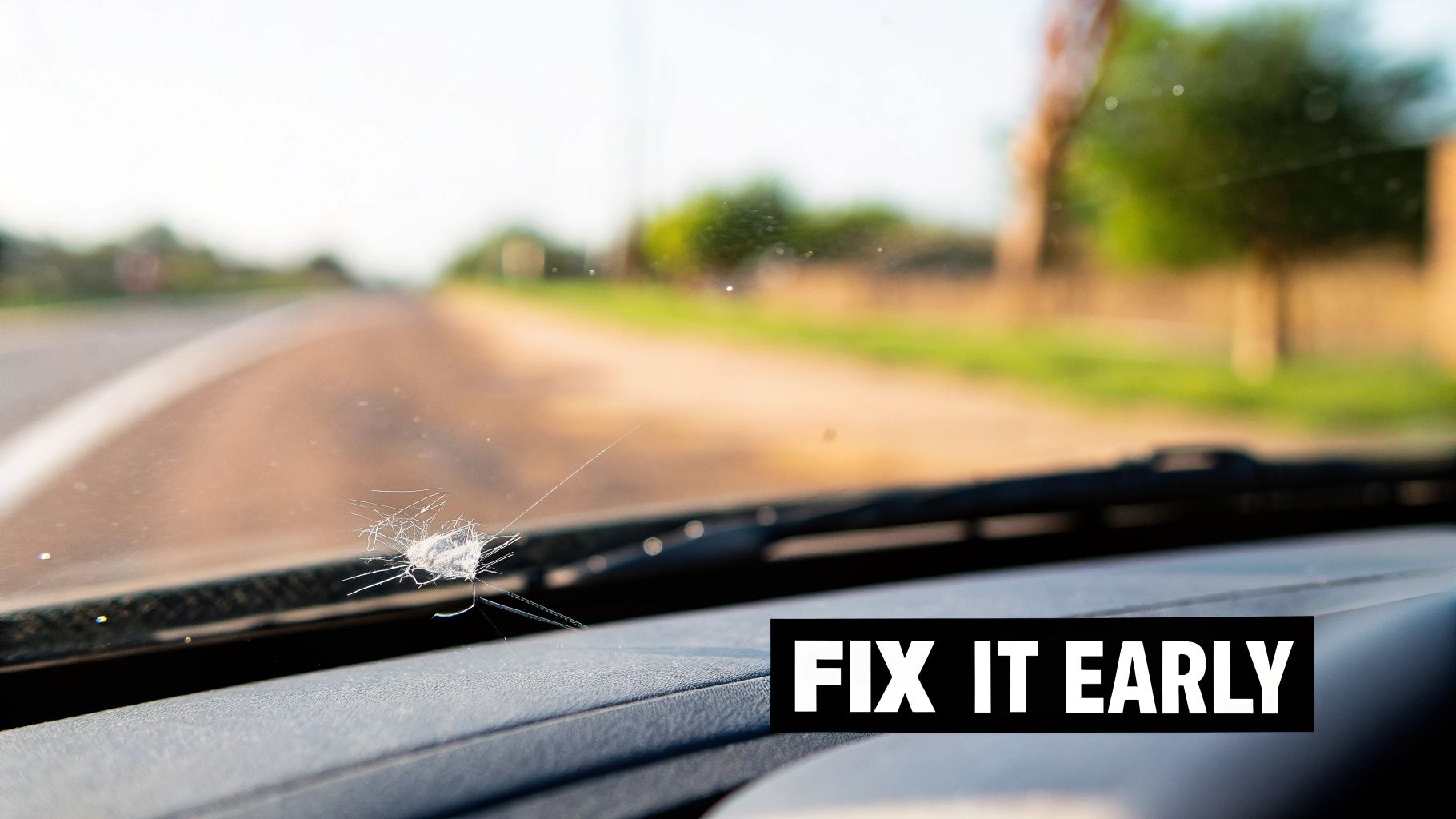
It’s easy to dismiss a tiny chip as a minor cosmetic flaw, but trust me, that's a gamble you don't want to take. Think of that small bit of damage like a loose thread on a sweater; once you start pulling, the whole thing can unravel. The same kind of forces are constantly working on your windshield every single day.
Everyday driving puts your windshield under more stress than you might think. Minor road vibrations, hitting an unexpected pothole, or even just slamming a car door can be enough to turn a small chip into a sprawling crack.
How Cracks Spread and Weaken Glass
Temperature swings are a crack’s best friend. Ever blast the AC on a blistering hot day or crank the defroster to clear ice? That creates a huge temperature difference between the inside and outside of the glass. This thermal stress puts immense pressure on any existing weak spot, often forcing it to expand.
Even direct sunlight can do a number on it. As the sun heats the glass, the material expands. This process puts pressure on the damaged area, and before you know it, that tiny crack is inching its way across your line of sight.
Your windshield is a key safety feature, providing up to 60% of your car's structural integrity in a rollover accident. A crack seriously weakens this protection and can even interfere with how your airbags deploy.
What starts as a quick, affordable repair can quickly spiral into a costly full replacement. The longer you wait, the more dirt and moisture work their way deep into the crack, making a clean, effective repair impossible.
So, when you ask, "can a cracked windshield be fixed?" the answer is almost always yes—but only if you act fast. Getting it taken care of immediately restores your vehicle's safety and saves you from a much bigger bill down the road.
Got Questions About Windshield Repair? We've Got Answers.
Even when you know the basics, it's natural to have a few more questions about what to expect when you get a chip or crack fixed. Let's tackle some of the most common things people ask so you can feel confident about the process from start to finish.
One of the best parts about modern windshield repair is how fast it is. Most technicians can fix a standard chip or small crack in less than 30 minutes. You'll be back on the road before you know it, with minimal interruption to your day.
What to Expect After the Fix
So, what will it look like afterward? A common misconception is that the damage will completely vanish. While a professional repair makes the blemish 80-95% less visible, a faint outline might still be there. That's perfectly normal.
The real goal isn't just cosmetic—it's about safety. We're restoring the structural integrity of the glass to keep the crack from spreading and ensure your windshield is strong again.
Speaking of safety, is a repaired windshield really as strong as a new one? You bet. A correctly performed repair uses a specialized resin that bonds to the glass, restoring its original strength. Your windshield is a key safety feature, and a proper fix ensures it can do its job supporting the roof and airbags.
A properly repaired windshield is just as strong and safe as an undamaged one. The process restores the structural integrity required for airbag support and rollover protection, ensuring your vehicle's safety systems function as designed.
For anyone driving a newer car, there's another big plus. Repairing your windshield means you can often avoid the complicated and expensive task of ADAS windshield calibration that's mandatory after a full replacement.
Simple Aftercare for Your Repaired Windshield
Taking care of your newly repaired windshield couldn't be easier, but a little patience goes a long way. Following a couple of simple guidelines helps the resin cure perfectly and makes sure the fix lasts.
Hold Off on Car Washes: Give it at least 24 hours before you head to a car wash. High-pressure water and sudden temperature changes can put stress on the fresh repair.
Be Gentle: For the first day or so, try not to slam your car doors. The vibration is minor, but it's best to let the resin fully harden without any extra jostling.
That's it! By following these simple tips, you're helping ensure the repair holds strong for the long haul.