
Car Window Tinting Cost Explained A Complete Pricing Guide
Curious about car window tinting cost? This guide breaks down prices, film types, and key factors to help you understand your quote and make a smart choice.
Feb 2, 2026
generated
car window tinting cost, auto tint prices, ceramic tint cost, vehicle tinting, tint installation cost
So, you're thinking about tinting your car windows and wondering what it's going to cost. The short answer is it can range anywhere from $250 to over $800. It really depends on what you're driving and the type of tint you pick. A standard film on a small sedan will land you on the lower end, but if you're looking at a high-performance ceramic tint for a big SUV, you'll be on the higher side of that scale.
What Is the Average Cost of Car Window Tinting
When you start shopping around for window tinting, you'll see pretty quickly that there's no single sticker price. The best way to think about it is like buying a cup of coffee. A basic drip coffee is cheap and gets the job done. But a fancy latte with premium beans and extra shots costs more because the ingredients are better and it takes more skill to make. Window tinting is exactly the same—the final price comes down to the quality of the materials and the expertise of the installer.
The two main things that will move the needle on your quote are the type of vehicle you own and the quality of the tint film you choose. A two-door coupe just has less glass to cover than a full-size SUV with all its side windows and a large rear windshield. Less glass means less material and less time, which naturally brings the cost down.
Estimated Car Window Tinting Costs at a Glance
To give you a solid idea of what to expect, here’s a quick summary of what you'll likely pay for a professional installation. We always recommend going with a pro; while DIY kits look tempting, they often end up as a bubbly, peeling mess that you have to pay someone to fix anyway.
This table breaks down typical price ranges, comparing standard films (like dyed or basic carbon) against premium options (like ceramic) that do a much better job of blocking heat and UV rays.
Vehicle Type | Standard Tint (Dyed/Carbon) | Premium Tint (Ceramic/Infrared) |
|---|---|---|
Coupe (2-Door) | $200 – $350 | $350 – $600 |
Sedan (4-Door) | $250 – $450 | $400 – $750 |
Small SUV/Crossover | $300 – $500 | $450 – $800 |
Large SUV/Truck/Van | $350 – $550 | $500 – $900+ |
These numbers are a great starting point, but remember they are just estimates. The final car window tinting cost you receive could be a bit different.
Key Takeaway: While a standard tint is great for looks and privacy, upgrading to a premium ceramic film is a smart investment in comfort. Its superior heat rejection makes a huge difference on a hot day and can even ease the load on your car's air conditioning.
Now that you have a ballpark figure in mind, let's dig into the details. In the next sections, we'll break down exactly why these prices vary and cover all the factors that play into your final quote, so you know exactly what you're paying for.
What Really Drives the Cost of a Window Tint Job?
Ever get a quote for window tinting and wonder why it's so much different from your buddy's? That final price isn't just a number pulled out of thin air. It’s a careful calculation based on a few key ingredients, and knowing what they are is the first step to getting a fair deal.
Think of it like buying a good jacket. You can grab a cheap windbreaker that does a basic job, or you can invest in a high-tech GORE-TEX shell built to withstand a downpour. Both are jackets, but the materials, the technology, and the performance are worlds apart—and so is the price. The same exact logic applies to the car window tinting cost.
Let's pull back the curtain on the four main factors that build your final quote.
The Type of Tint Film You Choose
This is the big one. It's easily the most significant factor that will swing the price up or down. The global market for automotive tint film is massive—valued at USD 7.59 billion—and it's growing because drivers want more than just a dark look. They want real protection and comfort.
North America makes up a huge 33.4% of that market, mostly because we've moved past the cheap stuff. We prefer premium tints that genuinely block UV rays and slash the heat inside our cars. These better films can easily increase the price by 20-50% over a basic dyed film. You can get a sense of how fast this technology is evolving from this detailed automotive tinting film market analysis.
Here’s a quick rundown of your options, from basic to premium:
Dyed Film: This is your entry-level, budget-friendly choice. It uses a simple dye to absorb sunlight, giving you privacy. The downside? It doesn't block much heat and, over time, that dye will break down and turn that dreaded shade of purple.
Carbon Film: A fantastic middle-of-the-road option. Carbon film is color-stable, so it will never fade. It delivers solid heat rejection and excellent UV protection without breaking the bank.
Ceramic & Infrared Film: This is the top-shelf stuff. These films use advanced ceramic nanoparticles to reject a massive amount of heat and block up to 99% of harmful UV rays. The best part? They do it all without interfering with your cell phone or GPS signals and don't have to be super dark to perform.
Your Vehicle's Size and Style
Next up is the car itself. It mostly comes down to surface area and complexity. A little two-door coupe just has less glass than a big SUV or a minivan, so it's going to require less film and less time.
But it’s not just about how many windows you have. The shape of the glass is a huge, often overlooked, factor.
Some cars, especially newer Teslas or sleek sports cars, have extremely curved rear windshields. These aren't simple, flat pieces of glass. A technician has to be a true artist, carefully heat-shrinking the film to mold it perfectly to every curve without a single crease or bubble. That skill and extra time definitely factor into the cost.
Funny enough, a giant, flat window on a pickup truck can be much quicker and easier to tint than a tiny, complex-curved window on a sports car.
The Number of Windows Tinted
This one might seem like a no-brainer, but it's worth spelling out. You don't have to tint your entire car at once. Shops offer different packages to fit your budget and what you're trying to accomplish.
Front Two Windows Only: This is really popular for people who own SUVs or trucks that already have factory-tinted "privacy glass" on the back half. This just matches the front windows to the back.
Full Vehicle (Excluding Windshield): The most common job. This covers all your side windows and the rear glass.
Windshield Strip (Eyebrow): Just a dark strip across the top of the windshield to cut down on sun glare. Quick and affordable.
Full Windshield: This is a premium service using a nearly clear ceramic or IR film. It’s not for looks; it’s purely for maximum heat and UV rejection, keeping your dashboard from cracking and your cabin cool.
Obviously, a full tint on a sedan will cost more than just doing the front two windows. Many automotive services work this way, where the final price depends on a mix of parts and labor. To see a similar breakdown in a different context, check out a complete pricing guide for car lockout services. Understanding this à la carte approach helps you see exactly what you're paying for.
Comparing Window Tint Films and Their Costs
The single biggest factor that moves the needle on your car window tinting cost is the film itself. It’s a classic case of "you get what you pay for." Not all tints are the same; they’re really different grades of technology, each designed to do a specific job. Your choice isn't just about picking a shade—it's about selecting a performance level that truly fits what you need and what you want to spend.
Think of it like buying sunglasses. You could grab a cheap plastic pair that just makes everything dark. Or, you could invest in high-quality polarized lenses that actively cut down on glare and give your eyes real protection. Window films operate on a very similar principle, with options ranging from simple dyed films to seriously advanced ceramic materials.
This visual breaks down the main things that influence the final price, from the film you pick to the car you drive.
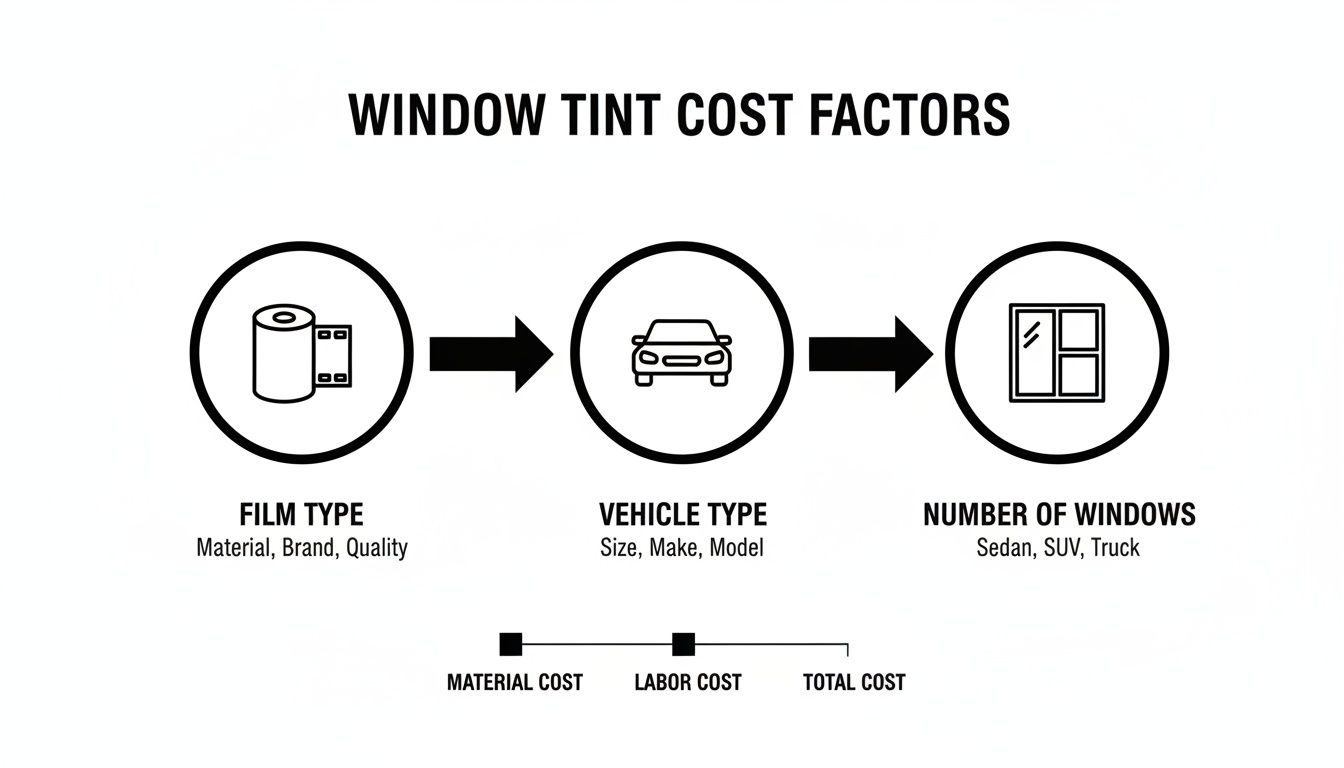
As you can see, the technology baked into the film is the starting line for what you can expect to pay for a professional tint job.
Dyed Window Film The Budget Friendly Option
Dyed film is your basic, entry-level option and the most affordable one out there. It’s pretty simple: a layer of dye is sandwiched between a protective topcoat and the adhesive that sticks to your window. That dye is what makes the film dark and helps it absorb a bit of the sun's energy.
Its main job is to give you privacy and that classic tinted look. It does a decent job of blocking UV rays, but when it comes to rejecting heat, it doesn't do much.
The biggest downside? Durability. Over time, the sun's powerful rays break down the dyes, causing the film to fade and often turn that infamous shade of purple. It’s a decent starting point if your only goal is changing the look of your car on a tight budget.
Carbon Window Film The Solid Mid-Range Performer
Ready to step it up in both performance and price? Meet carbon window film. Instead of dye, this film has microscopic carbon particles infused right into the material, and that's a huge leap forward for a couple of reasons.
For one, carbon is incredibly stable, so it will never fade or change color like a dyed film will. It also does a much better job of rejecting heat by blocking the infrared light that makes your car feel like an oven.
No Signal Interference: Unlike some older metallic tints, carbon film is non-conductive. That means it won’t mess with your cell phone, GPS, or radio signals.
Enhanced UV Protection: It offers top-notch protection, typically blocking over 99% of harmful UV rays.
Durable Finish: The matte look is sharp and holds its color far better than any dyed alternative.
Carbon film strikes a great balance between cost, performance, and longevity. It has become a go-to choice for drivers who want more than just dark windows.
Ceramic Window Film The Ultimate in Performance
At the very top of the food chain is ceramic window film. This is the premium choice for anyone who demands the absolute best in comfort and protection. It uses advanced ceramic nanoparticles that you can't even see but are superstars at blocking heat.
These tiny particles are non-metallic and non-conductive, so you get all the performance without a hint of signal interference. The real magic of ceramic tint is its ability to reject a massive amount of solar heat and infrared light without having to be limo-dark.
This means you can get a lighter, clearer tint that still outperforms a dark carbon or dyed film in keeping your car cool. A quality ceramic film can reduce cabin temperatures by up to 60%, which takes a huge load off your A/C and can even improve fuel efficiency.
The cost of a tint job is tied directly to this technology. A premium ceramic film that blocks 99% of IR rays might run you $8 to $15 per square foot installed, while a basic dyed film sits closer to $3 to $6. For a whole car, that translates to a full ceramic tint on an SUV costing $400 to $900, whereas a sedan might average $250 to $550. These numbers are part of a growing market expected to hit USD 9.94 billion by 2030, all driven by people wanting better heat rejection.
Window Tint Film Comparison Cost vs Performance
To help you sort it all out, let's put these films side-by-side. The table below compares the three main types, showing you exactly what you get for your money. If you're curious about the science behind it all, check out our article explaining how window tinting works.
Film Type | How It Works | Heat Rejection | UV Protection | Average Cost Range (Full Sedan) | Best For |
|---|---|---|---|---|---|
Dyed | Uses dye to absorb solar energy | Low | Good (99%) | $250 – $450 | Budget-conscious buyers focused purely on privacy and looks. |
Carbon | Uses carbon particles to block IR light | Medium | Excellent (99%+) | $350 – $500 | Drivers wanting a great balance of performance and price without signal issues. |
Ceramic | Uses ceramic nanoparticles to reflect heat | High to Excellent | Excellent (99%+) | $400 – $750+ | Owners in hot climates who prioritize maximum heat rejection and comfort. |
In the end, choosing a window film is an investment in your vehicle. A high-end ceramic film has a higher upfront cost, no doubt. But the long-term payoff in comfort, protection for your car's interior, and sheer durability often delivers the best value by a long shot.
Professional Installation vs. DIY: The Real Cost Analysis
It’s the classic question for anyone looking to save a buck: "Why pay someone when I can just do it myself?" The temptation of a DIY window tinting kit is real, especially when you see a $50 to $100 price tag staring back at you. On the surface, the math seems simple. But the true car window tinting cost goes way beyond the price of a roll of film—it’s about your time, your sanity, and the final look of your car.
Before you click "buy now" on that kit, it's worth taking a moment to think about what you’re really getting into. A professional installer isn’t just selling you tint; they’re providing a flawless, long-lasting finish that comes from experience and a workshop full of specialized tools. When you go it alone, you're on the hook for everything, and the road is paved with frustrating pitfalls that can vaporize those initial savings in a heartbeat.
The Upfront Costs of a DIY Kit
A basic DIY tint kit looks like a steal. For under $100, you can often get film that's pre-cut for your specific car. But that's just the film. To have any shot at a decent result, you’ll need a handful of tools that definitely don't come in the box.
Heat Gun: This is a must-have for shrinking the film to conform to your car's curved windows. A cheap one might get you by, but a quality gun costs extra.
Squeegees: You'll need different kinds—a hard card for tucking edges and a softer one for the main application—to avoid scratching the film.
Application Solution: You can't just use soapy water. A proper slip solution is crucial for positioning the film perfectly before it sticks for good.
Lint-Free Cloths and Blades: A perfectly clean, dust-free environment is everything. You'll also need sharp, precise blades for any trimming.
These "extras" can easily tack on another $50 to $75 to your project, which starts to close the gap between doing it yourself and just having a pro handle it.
The Hidden Costs: Time and Frustration
Honestly, the biggest cost of DIY tinting isn't money—it's time and aggravation. Applying window tint is a skilled craft, one that professional installers spend hundreds of hours perfecting. For a first-timer, a job that takes a pro a couple of hours can quickly turn into an entire weekend of painstaking, frustrating work.
The learning curve is incredibly steep. You need to work in a spotless, dust-free space, which most home garages are not. A single speck of dust or a stray pet hair trapped under the film will create a permanent, ugly bubble. Creases, peeling corners, and crooked lines are all hallmarks of a first attempt.
A botched DIY job often looks worse than no tint at all. The money you "saved" is wasted the moment you have to pay a professional not only to tint your windows but also to remove the failed DIY attempt first, which can cost an additional $100 to $250.
The Value of a Professional: A Flawless Finish and a Warranty
When you hire a professional, you're paying for a guaranteed result. You get clean edges, perfect adhesion, and absolutely zero bubbles or creases. Even more important, you get a warranty. If that film ever bubbles, peels, or fades, a reputable shop will fix it on their dime. That kind of peace of mind is priceless.
In the end, while the DIY route looks cheaper upfront, the high risk of a botched job and the cost of buying all the right tools often make it a bad financial move. Investing in a professional installation ensures the job is done right the first time, protecting both your car's appearance and your wallet in the long run.
How Local Laws and Your Location Affect the Final Bill
It’s not just about the film and the car. Two huge outside factors can swing your final car window tinting cost: the laws in your state and the labor rates in your town. These two things can determine not only what tint you can legally get but also how much you’ll have to shell out for a pro to install it.
Think of it like getting a haircut. The cost isn't just for the scissors; it's for the stylist's time and the salon's rent. A high-end salon in a major city will charge far more than a small-town barbershop for the exact same cut. Window tinting is no different.
State Laws and Tint Darkness
The big term you need to know here is Visible Light Transmission (VLT). It’s just a fancy way of saying how much light the tint lets through, measured as a percentage. The lower the VLT number, the darker the tint.
A 5% VLT is what you see on limousines—it's almost totally blacked out. On the flip side, a 70% VLT tint is so light you might not even notice it's there. Every state sets its own rules on what VLT is allowed on which window.
Front Side Windows: These are usually the most regulated. States want law enforcement to be able to see the driver, so they often require a lighter tint (higher VLT).
Rear Side Windows & Back Windshield: The rules are often much more relaxed for these windows, allowing darker tints for added privacy.
Windshield: Tinting the whole windshield is a big no-no almost everywhere. However, most states allow a small strip, often called an "eyebrow," across the top.
These laws directly affect your cost by influencing your choices. If your state mandates a lighter tint, you might decide to invest in a high-quality ceramic film that blocks tons of heat without being super dark. For a deep dive into the rules for the Golden State, check out our guide on California's car window tinting laws.
Why Your City Changes the Price
The second major variable is simply where you live. The cost of running a business—from rent to employee wages—is wildly different from city to city, and that gets baked into the labor rates for tint installation.
A top-notch tint installer working out of a shop in a bustling city with high overhead is going to charge more than a shop in a quiet rural town. It’s just simple economics.
Key Insight: Don't be surprised if a quote you get in downtown San Francisco is 20-30% higher than for the exact same job in a smaller town a couple of hours away. The price difference isn't about the film; it's about the cost of skilled labor in that market.
Knowing this helps you manage your budget expectations. The prices you see floating around online are usually national averages, but it's your local market that will set the final price for a professional, legal, and beautiful tint job.
Finding a Quality Installer and Getting an Accurate Quote
Alright, you've done your homework on the different types of films, you know the local laws, and you have a handle on what drives the cost. The last—and arguably most important—step is picking the right person for the job.
This isn't a decision to take lightly. You can buy the most expensive ceramic tint on the market, but if it's installed by a hack, it’ll look awful and start failing in no time. Your entire investment goes right down the drain. A skilled, professional installer is the key to turning your car window tinting cost into a flawless finish that lasts.
Vetting Installers and Asking the Right Questions
Let's be clear: not all tint shops are the same. A true professional operates out of a clean, dedicated space. This is critical because dust is the mortal enemy of a good tint job—it’s what causes those ugly, annoying bubbles. They should also be completely upfront about the films they use and the warranties they offer. A lifetime warranty against bubbling, peeling, and fading isn't a luxury; it's the standard for quality work.
Think of this part as an interview. Before you hand over your keys, call a few local shops or mobile installers and ask some pointed questions. A real pro will be happy to talk shop with you. If they get dodgy or dismissive, that’s a huge red flag.
Here’s a quick checklist to run through:
What brands of film do you carry? Pros work with trusted names like 3M, LLumar, or XPEL. If they’re cagey about the brand or just say "generic," you should probably walk away.
What does your warranty cover? Get specific. Does it cover just the film, or the labor too? A solid warranty protects you from both material defects and installation mistakes for as long as you own the car.
Do you use a computer to cut the film? The best shops use computer-controlled plotters that cut the film to the exact specifications of your vehicle. This eliminates the risk of a technician taking a razor blade to your glass and leaving a permanent scratch.
Can I see examples of your work? Any installer worth their salt will be proud to show off their handiwork. Look for a portfolio on their website or in the shop that shows clean edges and a bubble-free finish.
Getting a Clear and Accurate Quote
Once you've found an installer who feels right, the final piece is getting a solid quote. It should always be in writing and spell everything out so there are no surprises when it's time to pay.
An all-inclusive quote is the mark of a trustworthy business. It needs to clearly state the total price, the exact film brand and type being used, which windows are being done, the full warranty terms, and about how long the job will take.
This kind of transparency is non-negotiable. It’s also part of the value you're paying for—the confidence that comes with professional service. For example, our mobile window tint solutions bring that same professional experience right to your driveway, adding a layer of convenience.
By taking the time to ask these questions and get detailed quotes, you can hire with total confidence, knowing your money is being well-spent on a perfect tint job that will protect your car for years to come.
Frequently Asked Questions About Car Tinting
Let's wrap things up by tackling some of the most common questions people have when they're looking into tinting their car windows. Getting these details straight can give you the final bit of confidence you need to make the right choice.
Does a Lifetime Warranty on Window Tint Really Matter?
You bet it does. Think of a lifetime warranty as a stamp of approval from both the film manufacturer and the installer. It’s their way of saying, "We stand behind this product and our work." This kind of guarantee usually covers the big problems you don't want to see, like bubbling, peeling, cracking, or the tint turning that weird shade of purple.
Sure, it might add a little to the initial price, but it's your safety net. It protects your investment for the entire time you own the car, saving you from the headache and cost of a full replacement if the film fails down the line.
How Long Does Professional Window Tinting Take?
The time it takes really depends on the car. For a typical sedan with four doors, a pro can usually get the job done in about 1.5 to 3 hours.
If you've got a bigger vehicle like an SUV, or a car with tricky curved windows, it might take a bit longer. This speed and precision is one of the huge advantages of hiring a professional. A DIY job can easily eat up your whole weekend and still leave you with a finish you're not happy with.
Can I Tint My Front Windshield?
This is a big one, and the answer comes down to your local laws. Most states have strict rules against putting any dark, vision-blocking tint on the entire front windshield. What's often allowed is a non-reflective strip across the very top—sometimes called an "eyebrow"—which is great for cutting down sun glare.
There's a catch, though. Some new, almost invisible ceramic films are designed just for blocking heat and UV rays, not for darkening the glass. These might be legal for a full windshield application in some places. Always, always double-check your state's specific laws with your installer to stay compliant.
Will Window Tint Damage My Rear Window Defroster?
When a skilled professional does the job, your rear defroster is perfectly safe. Experienced installers know exactly how to work around those delicate heating lines on the glass without causing any harm.
The risk comes into play if you try to remove old tint yourself or hire someone who doesn't know what they're doing. It’s surprisingly easy to break those sensitive defroster lines. Beyond the tinting cost itself, it’s always smart to know what your auto policy covers for other situations, like potential car wash damage, to get a full picture of your car care budget. Trusting a pro protects all your car's features.
Ready for a flawless finish without the hassle? Auto Renu Auto Glass LLC brings expert mobile window tinting directly to your home or office. Get a free, transparent quote and experience the convenience of professional service at your doorstep.