Ceramic Tint vs Regular Tint Car Window Guide
Ceramic tint vs regular tint: A complete guide comparing heat rejection, UV protection, durability, and cost to help you choose the best for your car.
Nov 29, 2025
generated
ceramic tint vs regular tint, car window tint, ceramic tint, automotive tint, tinting options
When you're trying to decide between ceramic and regular window tint, it really boils down to the technology inside the film and what you expect it to do for your car. Ceramic tint is the premium option, packing serious performance for heat and UV rejection, while regular tints are more about basic privacy and affordability. The right choice depends on if you're looking for top-tier, long-lasting comfort or a simple, budget-friendly upgrade.
Your Quick Guide To Choosing The Right Tint
Picking the right window tint genuinely changes how it feels to be in your car, but you have to know what you're looking for. For years, the go-to options were "regular" tints, which usually means either dyed or metallic films.
Dyed tint is the most common and affordable choice out there. It works by using a layer of dye to absorb the sun's heat. Metallic tint is a step up, using microscopic metal particles to actually reflect heat away. The problem? Dyed films eventually fade and can turn that weird purple color, and metallic films are notorious for messing with your GPS, satellite radio, and even cell phone signal.
This is where ceramic tint comes in. It's a huge leap forward in film technology. Instead of dye or metal, it’s made with non-conductive ceramic nanoparticles. This modern construction is why it beats most regular tints in all the important categories, and it does it without causing any signal interference.
The real magic of ceramic tint is its ability to block infrared heat—the heat you actually feel—without having to be dark. You can get a lighter film that keeps your view crystal clear while keeping your car's interior significantly cooler.
This visual gives you a quick snapshot of the key differences.
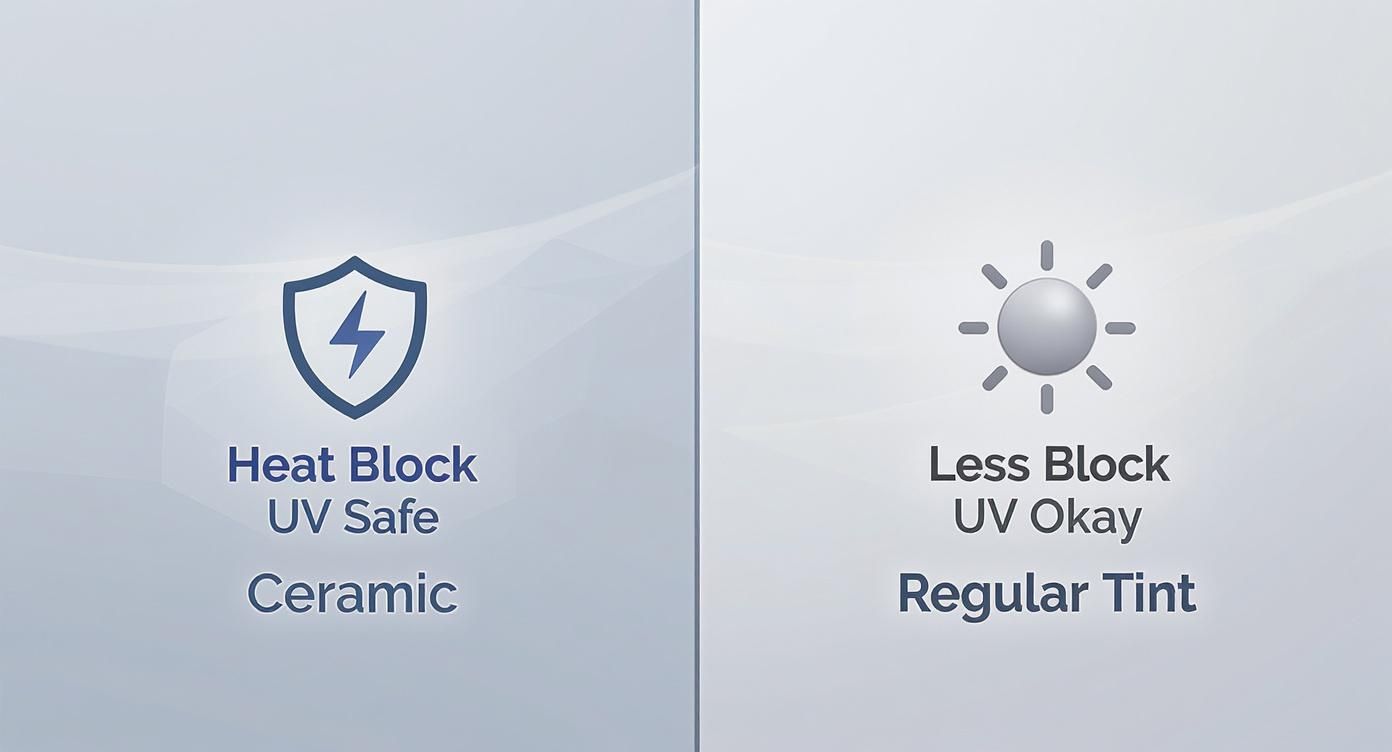
As the graphic shows, ceramic film is engineered for high-performance protection, whereas regular tint provides a more basic level of coverage.
To help you see how these films stack up side-by-side, here’s a quick breakdown of what matters most.
At-a-Glance Ceramic vs Regular Tint Comparison
Feature | Ceramic Tint | Regular Tint (Dyed) | Regular Tint (Metallic) |
|---|---|---|---|
Heat Rejection | Superior (Up to 98% IR) | Good | Very Good |
UV Protection | Excellent (Up to 99%) | Good (Up to 99%) | Excellent (Up to 99%) |
Clarity/Visibility | Excellent, no haze | Good, can fade | Good, can be reflective |
Signal Interference | None | None | Yes (GPS, Radio) |
Durability | Very High (No fading) | Low (Fades, turns purple) | High (Doesn't fade) |
Cost | Premium | Low | Mid-Range |
Ultimately, the table highlights the trade-offs: ceramic offers unmatched performance and longevity at a premium price, while dyed and metallic films provide more budget-conscious alternatives with specific drawbacks.
Understanding Your Window Tint Options
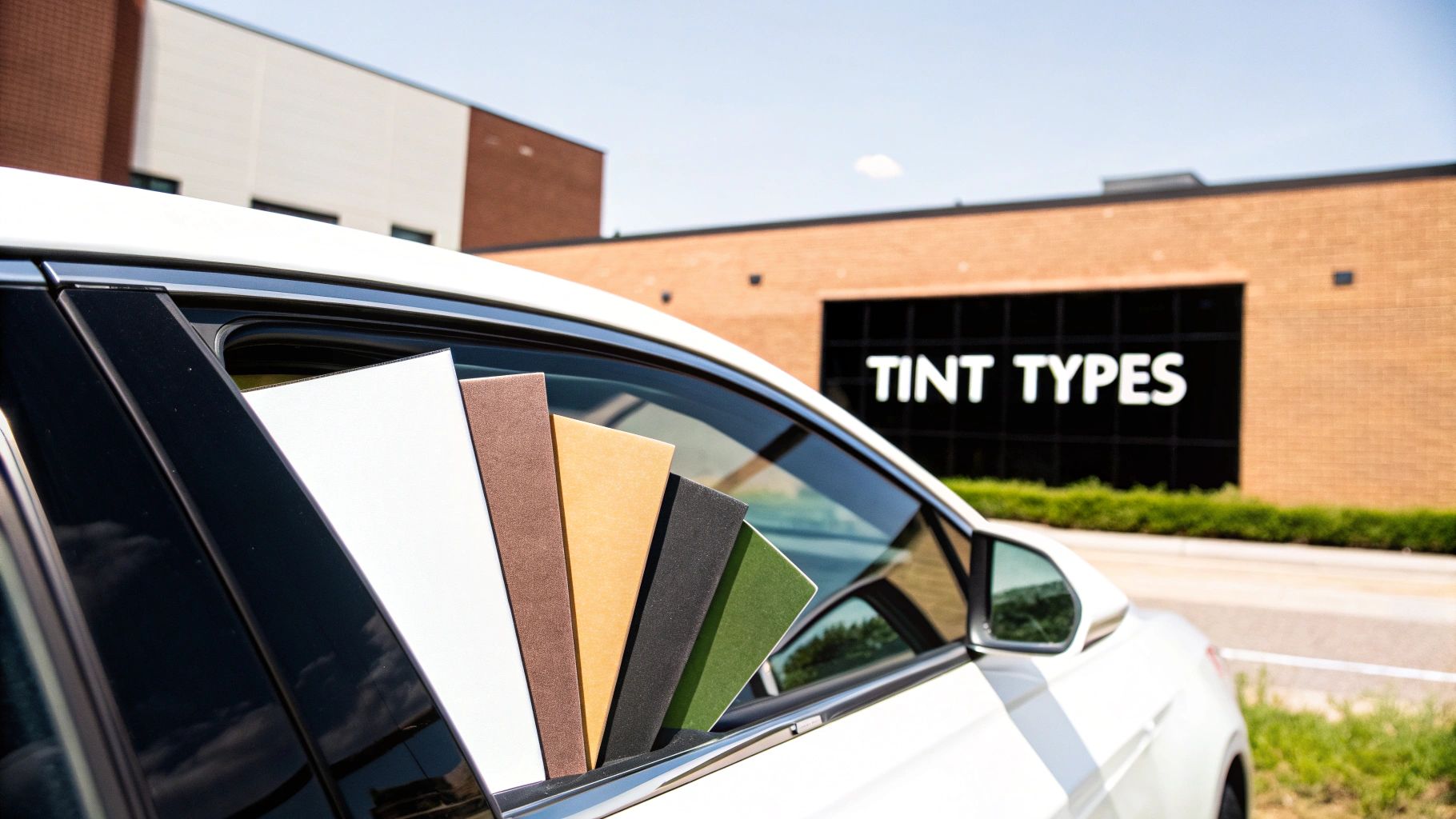
Before we jump into a head-to-head comparison, it’s worth taking a moment to understand what we're actually talking about. The term "regular tint" isn't just one thing; it's a catch-all for a few different film technologies. Knowing how they're made is key to understanding why they perform the way they do.
The most basic and wallet-friendly choice is dyed window tint. Just as the name implies, this film has a layer of dye that absorbs sunlight, giving you that classic dark look. It does a decent job of cutting down on glare and providing some heat reduction, but its biggest weakness is the dye itself. Over time, UV exposure breaks it down, causing it to fade and often turn that dreaded purple color.
Advancements in Tint Technology
For a bit more performance, you can step up to metallic tint. This film has a layer of incredibly small metallic particles that act like a mirror, reflecting solar heat away from your car. It’s a noticeable improvement over dyed films in both heat rejection and durability. The one significant catch? Those same metal particles can play havoc with your electronic signals, interfering with everything from GPS and satellite radio to your cell phone reception.
This is where carbon tint comes in as a great all-arounder. Instead of dye or metal, this film is made with tiny carbon particles. It provides fantastic heat rejection and won't fade like dyed films. Plus, since there's no metal, you get a clean, matte-black finish without any signal interference, which is a huge plus for most drivers.
Ceramic tint is really the pinnacle of window film technology. It uses non-metallic, non-conductive nano-ceramic particles to stop solar energy in its tracks. This is what allows it to reject a massive amount of heat, particularly infrared heat, without needing to be dark and with zero impact on your electronics.
The Clear Superiority of Ceramic Film
And that brings us to ceramic tint, the top-tier option for any vehicle. Its nano-ceramic particles are expert insulators, specifically targeting and blocking infrared rays—the part of the solar spectrum that you feel as heat. This unique ability is why a lighter shade of ceramic film can outperform a much darker traditional tint. You get incredible comfort and up to 99% UV protection without compromising your view of the road.
Thinking about window tint is a lot like other decisions you make for your car, such as choosing between synthetic and regular oil. In both situations, the more advanced product costs a bit more upfront but delivers far better performance and long-term value. To get a better grasp of all the options out there, exploring the different types of window tint can give you the full picture.
Real-World Performance And Protection
Technical specs are one thing, but how a tint actually performs on your daily drive is what truly matters. This is where the debate between ceramic tint vs regular tint moves from a spec sheet to the real world, and the differences become impossible to ignore. The main event here is heat rejection, and frankly, it's not a fair fight.
Regular dyed tints work by absorbing solar energy, which means they eventually start radiating that heat right back into your car's cabin. Metallic tints do a better job by reflecting heat, but the technology has its limits. Ceramic tint, on the other hand, was engineered from the ground up to specifically target and block infrared radiation—the very wavelength of sunlight that makes you feel the heat.
Heat Rejection And Interior Comfort
The impact on your car's interior temperature is night and day. On a scorching summer afternoon, a car with standard tint is still going to feel like an oven, forcing your A/C to blast on high just to make the cabin bearable.
Contrast that with a ceramic-tinted vehicle, which stays noticeably cooler. By blocking a huge percentage of infrared rays, the interior remains at a much more comfortable temperature, even after baking in a sunny parking lot. This isn't just about comfort; it means your air conditioning doesn't have to work as hard, which can improve fuel or battery efficiency. When you think about real-world performance, it helps to understand factors like the effects of weather on windows, especially in punishing climates.
The biggest real-world win for ceramic tint is its ability to deliver top-tier heat rejection without needing to be limo-dark. You can get a lighter film that keeps your view clear while blocking more heat than a much darker traditional tint.
UV Protection And Interior Preservation
Here's some good news: both ceramic and quality regular tints provide outstanding protection against harmful UV rays, typically blocking 99% of UVA and UVB radiation. This is a must-have feature for protecting your skin and your car's interior.
Constant sun exposure is brutal on your dashboard, leather seats, and plastic trim, causing them to fade, crack, and wear out prematurely. By blocking those damaging rays, both types of tint act like sunscreen for your car, helping maintain its condition and protect its resale value.
The real difference is in the long game. The dyes used in standard films can degrade over time, which may reduce their UV-blocking power. Ceramic films, being far more stable and durable, offer consistent, long-term protection you can rely on for years.
Clarity, Glare, And Driving Safety
Optical clarity is another area where ceramic tint really shines. It’s built to give you a crisp, distortion-free view of the road. You’ll especially appreciate this at night or in rainy weather, when a clear line of sight is critical.
While any tint helps cut down on glare, some lower-end dyed or metallic films can introduce a subtle haze or an annoying reflective sheen from certain angles. Ceramic tint’s non-reflective, non-metallic construction delivers a cleaner, more natural view. This superior clarity and glare reduction make for a safer, less fatiguing drive. When you compare ceramic tint vs regular tint on the road, the sharper view through the ceramic film is immediately obvious.
Ultimately, ceramic tint's performance in hot climates is what sets it apart. Its nano-ceramic particles can block up to 90% of infrared heat, while regular tints top out around 50-70%. That efficiency keeps your car cooler and takes the strain off your A/C, which for many drivers, easily justifies the higher $400 to $800 price tag.
Durability, Lifespan, and Signal Interference
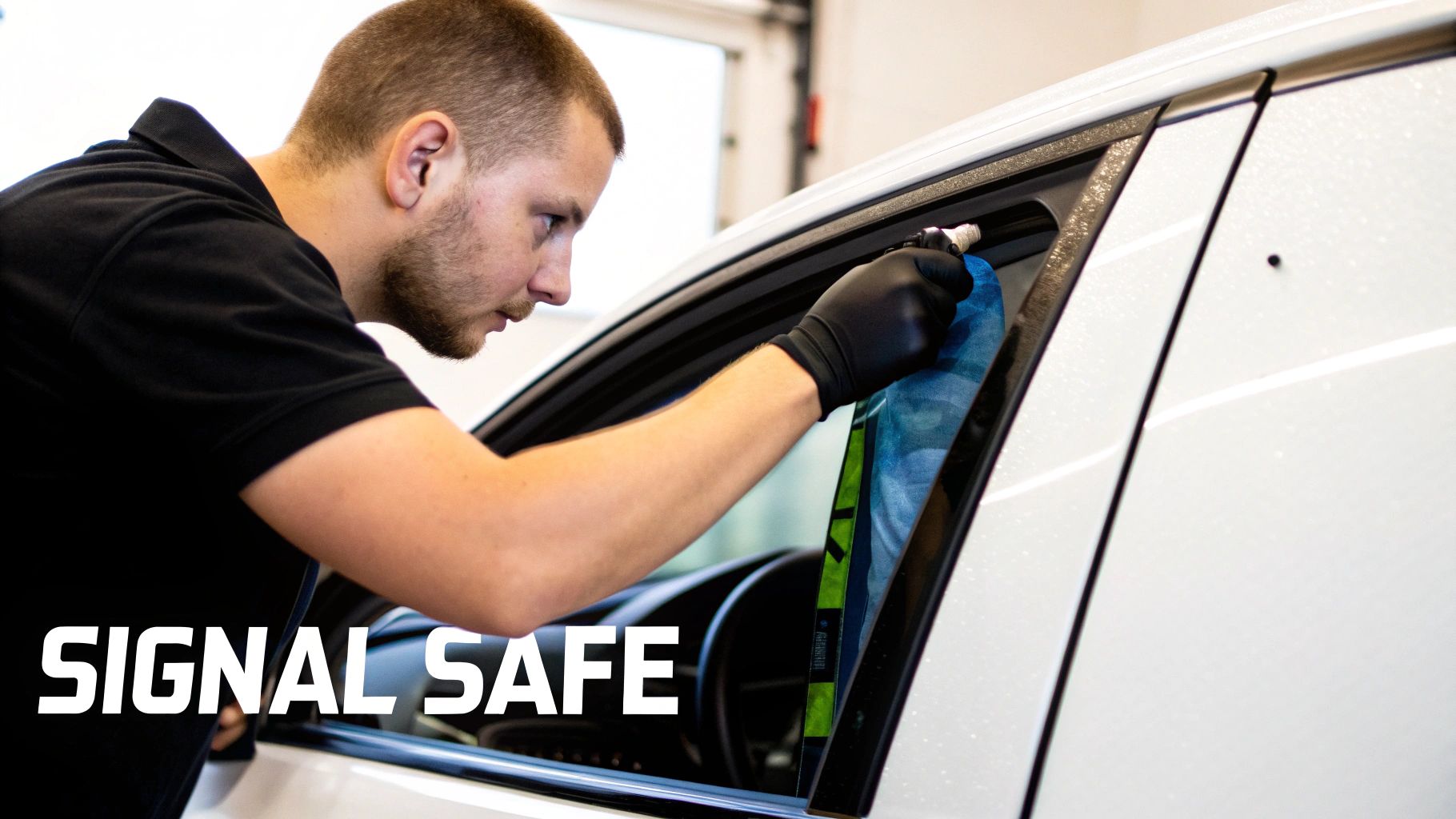
When you tint your windows, you’re not just paying for a new look—you're making an investment in your vehicle's comfort and protection. How long that investment holds up is a key factor, and this is where the differences between ceramic and regular tint become crystal clear. Standard dyed films, for instance, are budget-friendly but don't hold up well over time.
The organic dyes in these films break down under constant sun exposure. In just a couple of years, you can expect to see them fade, start to bubble, or turn that infamous ugly purple color. This isn't just a cosmetic problem; it means the film has lost its ability to block heat and UV rays, forcing you to replace it far sooner than you'd like.
Longevity: A Clear Advantage for Ceramic
Ceramic tint is in a completely different league. It's built from the ground up for endurance. The film is infused with inorganic nano-ceramic particles that are chemically stable and completely unaffected by UV radiation, meaning they will never fade. A professionally installed ceramic tint should look and perform just as well years down the road as it did the day you drove it out of the shop.
This incredible durability translates to real long-term value. Yes, the initial price is higher, but you're buying a product that lasts. You sidestep the cost and frustration of having to strip and replace a failing regular tint every few years. When films peel or bubble, they can even cause issues for the glass itself. If you're concerned about damage, our guide on professional windshield replacement offers more insight.
Ceramic tint is a true 'install it and forget it' solution. Its resistance to fading, bubbling, and discoloration means it will look and perform just as well on year ten as it did on day one, making it a future-proof investment for your vehicle.
The Critical Issue of Signal Interference
In a car filled with modern tech, clear signals for your devices are essential. This is another area where the materials in your window tint matter immensely. A common type of "regular" film is metallic tint, which contains tiny metal particles that are great at reflecting heat.
The problem? Those same metal particles can act like a shield, blocking the electromagnetic signals your devices rely on. This can lead to some seriously frustrating issues:
GPS Navigation: Your maps might lag, lose connection, or fail to find a signal altogether.
Cell Service: Get ready for more dropped calls and frustratingly slow data.
Radio Reception: Both satellite and standard AM/FM radio can become crackly or cut out completely.
Ceramic tint, on the other hand, is 100% non-metallic and non-conductive. The ceramic particles that do the heavy lifting of blocking heat are invisible to electronic frequencies. This means your GPS, phone, radio, and any other connected tech will work exactly as they should. For any modern, tech-forward vehicle, it's really the only smart choice.
Analyzing The True Cost And Return On Investment
Let's talk money. The price tag is usually where people start, but it's far from the whole story. When you're looking at ceramic tint versus a regular dyed tint, you’ll see a clear difference upfront. A quality ceramic installation will typically run you between $400 to $800 for a full vehicle, whereas a standard dyed film might be in the $100 to $400 range.
That initial price gap is because ceramic films are made with advanced materials and demand a more careful, precise installation process. But looking only at that number is a classic rookie mistake. The real value shows up when you consider what you're getting for your money over the life of your car.
Calculating The Long-Term Savings
I've seen it a hundred times: a standard dyed tint looks fine for a year or two, then the tell-tale signs of failure appear. It starts bubbling, fading, or worse, turns that awful shade of purple. This means you're not just paying for a new tint job; you're paying to have the old, failed tint scraped off first. You could easily end up paying for tint two or three times before a single ceramic application even blinks.
Ceramic tint, on the other hand, is engineered for the long haul. Its durability is rock-solid, which is why it almost always comes with a lifetime warranty against fading and breaking down. You pay once, and you're done.
The real ROI with ceramic tint isn't just about what you don't spend on replacements. It's about the tangible savings you see every day from using less A/C, protecting your car's interior, and enjoying a more comfortable drive.
And the savings don't stop at durability. The performance of ceramic film directly translates into money back in your pocket.
Fuel and Energy Efficiency: This is a big one. By blocking so much more infrared heat, ceramic tint keeps your cabin significantly cooler. Your air conditioner doesn't have to work nearly as hard, which means better gas mileage for traditional cars and more range for EVs.
Interior Preservation: While both tints block 99% of damaging UV rays, the superior heat rejection from ceramic film is what really saves your interior. By keeping the inside from baking in the sun, it prevents your dashboard, leather seats, and plastic trim from cracking and fading. That goes a long way in preserving your car's resale value.
Thinking about how these benefits stack up for your specific vehicle? The best way to weigh the numbers is to get a personalized window tint quote. It will help you see the upfront cost clearly against all the long-term advantages.
Ultimately, while regular tint offers a cheaper entry point, ceramic tint is simply the smarter financial play. It's an investment that protects your car and truly pays for itself over time.
Which Window Tint Is Right For You?
So, ceramic or regular tint? The best way to decide isn't just by looking at spec sheets. It's about matching the technology to your real-world needs, your budget, and how you actually use your car.
Let's break it down by looking at a few common driver profiles. This will help you see past the numbers and find the film that will make a real difference in your daily drive.
The Daily Commuter In A Hot Climate
If you live somewhere the sun is relentless, you know the feeling of getting into a car that’s been baking in a parking lot. Your main goal is beating the heat and staying comfortable behind the wheel. For you, the answer is pretty clear.
Recommendation: Ceramic Tint
There's no contest here. Ceramic film's ability to block up to 98% of infrared heat is what you need. It’s the difference between a sweltering cabin and a comfortable one, and it means your A/C doesn't have to work nearly as hard. That superior heat rejection is something you'll appreciate every single time you open your car door on a sunny day.
The Budget-Conscious Driver
Maybe you're not battling extreme heat. You're mainly looking for more privacy, less glare, and that classic tinted look, but you don't want to break the bank. In that case, a standard tint is a perfectly sensible option.
Recommendation: Carbon or High-Quality Dyed Tint
A good carbon or dyed film will give you solid UV protection and the privacy you’re after for much less than ceramic. It won't perform miracles against heat, but it’s a functional and affordable upgrade that gets the basic job done well. Just remember that you'll likely be replacing it sooner than a premium film.
The key for any driver is to align the tint's primary benefit with your primary need. A tech-heavy car requires a signal-friendly film, while a car in a hot climate demands maximum heat rejection.
The Tech-Savvy Vehicle Owner
Your car is loaded with technology—GPS, satellite radio, toll pass transponders, and maybe even advanced driver-assistance systems. The last thing you need is your window tint messing with all those signals.
Recommendation: Ceramic Tint
This one’s a no-brainer. Metalized tints can and do interfere with electronic signals, which is a major headache. Ceramic tint, on the other hand, is 100% non-metallic, which means it's completely invisible to your car's electronics. It’s the only choice that protects you from the sun without disconnecting you from the world.
Common Questions About Window Tint
Even with all the data in front of you, a few questions always pop up when you're on the fence between ceramic and regular tint. Let's clear up some of the most common ones so you can make your final choice.
Does Ceramic Tint Look Different Than Regular Tint?
From the outside looking in, you’d be hard-pressed to tell a quality ceramic film from a good regular tint. They can look virtually identical. The real difference is what you see from the driver's seat.
Ceramic films are built for exceptional optical clarity, giving you a much crisper, clearer view of the road. Another key difference is that ceramic tint doesn't have to be super dark to do its job. It can block a ton of heat even in lighter shades, whereas a regular tint often needs to be darker to achieve similar performance.
How Long Does Ceramic Tint Last?
This is where ceramic tint really pulls ahead. It's just built to be more durable. A professionally installed, top-tier ceramic film almost always comes with a lifetime warranty covering issues like fading, bubbling, or that dreaded purple look.
On the other hand, standard dyed films—which are the most common type of "regular tint"—have a much shorter lifespan. You might only get a few good years out of them before they start to break down, lose their color, and stop blocking heat effectively.
You can't overstate the importance of professional installation, especially for a high-end product like ceramic film. The process demands a clean, controlled environment and a specific skillset to avoid bubbles and dust. It's the only way to make sure the film bonds properly and that your lifetime warranty is actually valid.
For a flawless finish that lasts, trust the mobile installation experts at Auto Renu Auto Glass LLC. We bring dealership-quality service directly to you. Book your appointment online today!