
Chip in windshield? What to Do Next for Safer Driving
Dealing with a chip in windshield? Learn repair vs. replacement, costs, insurance tips, and why fast action protects safety and wallet.
Dec 10, 2025
generated
chip in windshield, windshield repair, auto glass, car maintenance, ADAS calibration
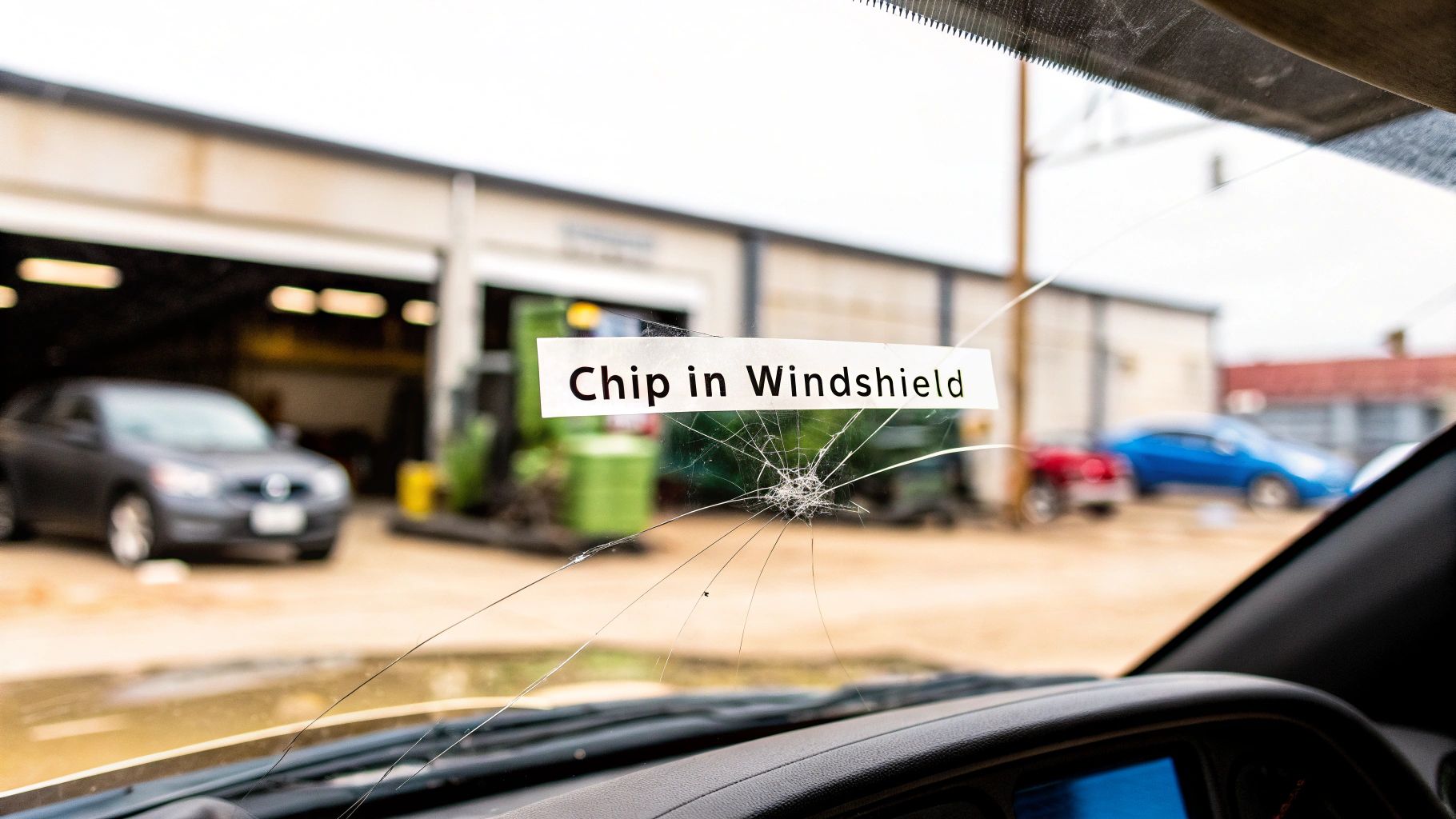
It's a sound every driver knows and hates—the sharp thwack of a rock hitting the windshield. That new chip in your windshield is more than just a visual annoyance. It’s a weak spot that can seriously compromise your safety, and leaving it alone is a recipe for a much bigger, more expensive problem.
Acting fast is the key. You can save yourself a ton of time, money, and hassle by preventing that small chip from spiderwebbing into a crack that requires a full windshield replacement.
Why a Small Chip Is a Big Deal

That tiny blemish might not seem like much, but it’s the starting point for some serious trouble. Think of it like a small snag in a sweater—pull the thread, and the whole thing can unravel. A windshield chip is the same concept; it's a fracture in a sophisticated piece of laminated safety glass.
Your windshield isn't just a barrier against wind and rain. It’s a critical structural part of your car, providing up to 60% of your vehicle's cabin strength during a rollover. A chip weakens that integrity, making the glass far more likely to fail when you need it most.
The Real Cost of Waiting
Ignoring a chip is a gamble, and the odds are stacked against you. Normal driving—vibrations, bumps, potholes—puts constant stress on the glass. Even a simple change in temperature can be the tipping point that forces a chip to spread into a long, distracting crack right in your line of sight.
Just think about these everyday situations that can turn a small fix into a big replacement:
Temperature Swings: Blasting the defroster on a frosty morning or cranking the AC on a blistering afternoon causes the glass to expand and contract. This puts incredible pressure on the weak point of the chip.
Road Vibrations: That pothole you couldn't avoid or even just driving on a rough road sends shudders through your car's frame, easily forcing a chip to crack further.
Structural Flex: As you drive, your car's body naturally flexes. This subtle movement is often all it takes for a stable chip to start running.
The moment you spot a chip, the clock starts ticking. A quick, affordable repair is possible now, but once that damage spreads, a full replacement becomes your only safe option.
Your Guide to the Right Solution
Figuring out what to do next can feel confusing, but it doesn't have to be. This guide is here to cut through the noise and give you clear, straightforward advice. We'll walk you through everything you need to know about that chip in your windshield.
You'll learn how to identify the type of damage you're dealing with, what goes into a professional repair, and how to know if you truly need a full replacement. Our goal is to give you the expert knowledge to make the right call for your car, your safety, and your wallet, so you can get it fixed right the first time.
Identifying the Chip in Your Windshield
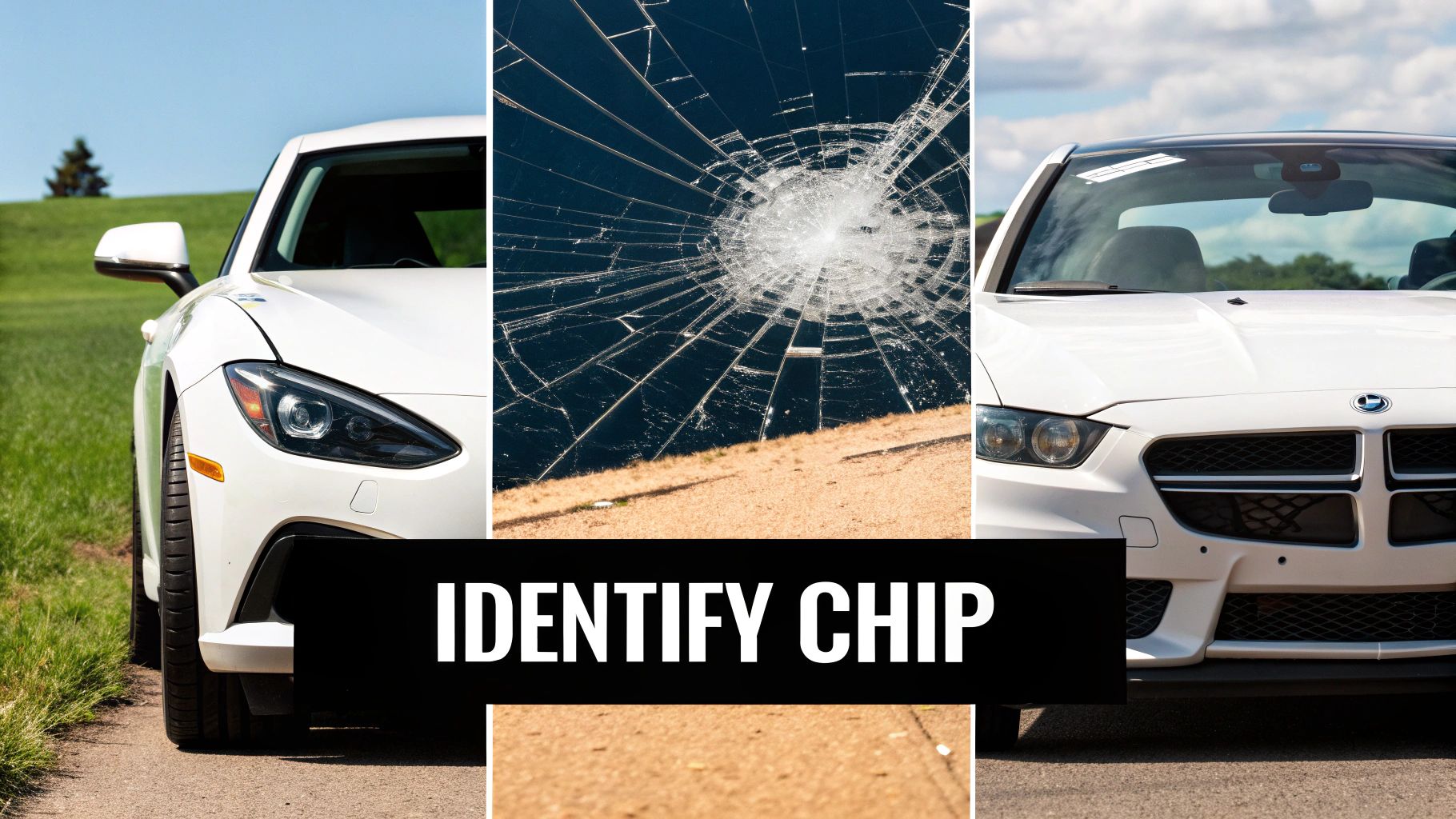
So, you've got a fresh mark on your windshield. It’s easy to just call it a "chip," but that little blemish has a specific name, shape, and even a personality. The first step to a proper fix is figuring out exactly what you're dealing with. Think of it as a field guide for auto glass—knowing what to look for helps you understand the risk and explain the problem clearly to a technician.
It's a crucial point because not all chips are created equal. Some are fairly harmless and stable, while others are like tiny time bombs, just waiting for the right bump or temperature change to spread across your entire windshield.
Let's break down what you're most likely to find.
The Most Common Types of Windshield Chips
The names we use in the auto glass industry aren't fancy; they’re descriptive. Once you know the lingo, you'll be able to spot the differences yourself. The usual suspects are the Bull's-Eye, the Star Break, and the Combination Break.
Each one has a unique structure, which directly affects how likely it is to spread. A clean, simple chip is far less volatile than one that already has little cracks branching out from the point of impact.
Understanding the specific type of chip in your windshield is crucial. It directly influences the repair technique a professional will use and helps determine the urgency of the repair before it worsens.
A Bull's-Eye, for instance, is probably the most recognizable type of damage. It looks just like its name implies: a dark, circular mark with a cone shape in the glass, like a tiny target. This happens when a roundish object, like a piece of gravel, hits the glass head-on. These are usually the easiest to repair because the damage is contained and doesn't have legs that can spread.
Then you have the Star Break. This one is a bit more menacing. It has a central impact point, but with several small cracks—or "legs"—radiating outward like a starburst. These legs are the real danger, as they are active cracks that will almost certainly lengthen over time if left untreated.
And finally, there's the Combination Break. As the name suggests, it's a nasty hybrid of the other two. You'll see the dark circle of a bull's-eye right in the middle, but it will also have cracks radiating out from it. This mix of a structural weak spot and active cracks makes it one of the trickiest and most urgent types of damage to fix.
Windshield Chip Types At a Glance
To make identifying your chip even easier, here’s a quick-reference table. Use it to assess the damage on your windshield and get a better sense of what it means for your car.
Chip Type | Appearance | Risk of Spreading | Repairability |
|---|---|---|---|
Bull's-Eye | A clean, circular cone shape, often with a dark center. | Low | High - Generally the easiest to repair for a nearly invisible finish. |
Star Break | A central impact point with several small cracks radiating outwards. | High | Moderate - Repairable if small, but the legs can spread easily. |
Combination Break | A mix of a bull's-eye and a star break, with a central circle and radiating cracks. | Very High | Moderate - More complex to repair due to its mixed structure. |
Knowing these distinctions is more than just car trivia—it’s practical knowledge that can save you a lot of money. Damaged windshields are incredibly common. One survey of parking lots across 13 U.S. cities revealed that about 14% of windshields had a long crack. Even more telling, a staggering 79% of those cracks started near the edge of the glass, where they can spread much faster.
You can learn more about the prevalence of auto glass damage in this insightful market report.
How We Make a Windshield Chip Disappear
Repairing a chip in your windshield is a bit like dental work for your car. A technician doesn't just slap some glue on it; they meticulously clean out the damage and fill it with a special material to restore the original strength and clarity. The goal is to make it look like the damage never even happened.
A real professional follows a precise, multi-step process. It's this careful technique that makes the repair strong, clear, and permanent—and it's what separates a pro job from a risky DIY kit you might find at an auto parts store. Every single step is crucial for a fix that you'll never have to think about again.
This methodical approach ensures the windshield is just as strong as it was before, stopping a tiny chip from turning into a massive crack.
The Step-by-Step Repair Process
The secret to a lasting repair is all in the details. Our technicians use specialized tools to create a perfect seal around the chip, forcing a unique resin deep into the glass for a fix that's both durable and practically invisible. The whole thing is clean, surprisingly fast, and usually takes less than 30 minutes.
Here’s a quick look at how it's done:
Prep and Clean: First things first, the technician inspects the damage up close. They’ll carefully pick out any loose glass shards and thoroughly clean the impact point. Getting rid of every speck of dirt, moisture, and debris is key to making sure the resin forms a flawless bond.
Create a Vacuum: A special tool is mounted directly over the chip. This device creates a powerful vacuum, sucking every last bit of air out of the chip’s tiny, web-like cracks. If any air gets trapped, it creates weak spots and leaves behind a cloudy, noticeable blemish. This is a step you just can't skip.
Inject the Resin: While the vacuum holds the cracks open, a high-quality, clear acrylic resin is injected under pressure. This forces the liquid resin to seep into every nook and cranny, completely filling the void left by the impact.
Cure with UV Light: Once the chip is totally full, a UV light is placed over the spot. The ultraviolet light cures and hardens the resin in just a few minutes, bonding it permanently to the glass and restoring its strength. Finally, any excess resin is scraped off to leave a perfectly smooth finish.
This is exactly why a professional fix is worlds apart from an at-home kit. To see our experts in action, you can learn more about our specific windshield repair services.
Why This Method is So Effective
It all comes down to two things: getting the air out and using the right resin. By creating a vacuum, the resin can flow into the entire fracture without air pockets getting in the way of a solid bond. Think about trying to glue something with air bubbles trapped underneath—it’s just not going to hold.
The professional vacuum-and-inject technique is designed to completely displace trapped air with a durable resin. This not only restores the windshield's structural integrity but also dramatically improves its optical clarity, making the damage virtually disappear.
The specialized resin is the other key ingredient. It’s engineered to have the same refractive index as glass, which just means it bends light the same way your windshield does. This optical property is why a properly repaired chip in your windshield becomes almost impossible to see. Once it's cured by the UV light, that resin is incredibly strong, preventing the chip from ever spreading.
Should You Repair or Replace Your Windshield?
You're staring at that fresh chip, and the big question pops into your head: can this be a quick fix, or am I looking at a full windshield replacement? It’s the most important decision you'll make in this situation. Thankfully, the criteria we professionals use are pretty straightforward.
The choice almost always boils down to three key things: the chip’s size, its location, and its depth.
Deciding between a repair and a replacement isn't just about saving a few bucks—it's about safety. A professional repair actually restores the original structural integrity of your glass, which is often the safest and quickest solution. When we can repair the chip, we preserve the crucial factory seal around your windshield, something that a brand-new installation can never perfectly replicate.
The Three Pillars of Assessment: Size, Location, and Depth
First off, let's talk size. A great rule of thumb is the "dollar bill test." If you can cover the entire damaged area—the chip and any tiny cracks spidering out from it—with a dollar bill, it's almost certainly a good candidate for repair. Anything bigger than that usually compromises too much of the glass, making a full replacement the only safe route.
Next, we have to consider the chip’s location. This one is non-negotiable from a safety perspective. If the damage is smack in the driver’s line of sight, most technicians will immediately recommend a replacement. Even the most flawless repair can leave a tiny bit of distortion, and you definitely don’t want anything blurring your view of the road.
Finally, how close is the chip to the edge of the windshield? This is critical. Any damage within two to three inches of the edge can seriously weaken the entire piece of glass. The edges are already under a ton of stress, and a chip there can quickly turn into a long, winding crack that makes the whole windshield unsafe.
When Replacement is the Only Safe Choice
While repair is always our preferred first option, some situations just don't leave a choice. Knowing when a replacement is unavoidable can help you prepare and make sure your car stays safe.
A full replacement becomes the only option when:
The damage is too big: Cracks that are longer than a dollar bill are generally off the table for repair.
The chip is in your direct line of sight: Safety regulations prioritize a completely clear, unobstructed view for the driver.
The damage is right on the edge: Chips too close to the perimeter compromise the structural integrity of the entire windshield.
The impact went too deep: If a rock punches through both layers of glass and hits the inner plastic layer, it can't be safely repaired.
If you find yourself in one of these situations, the next logical step is to look into a professional windshield replacement service.
The ultimate goal is to get your vehicle back to its safest state. While a repair is faster and more affordable, a replacement is the right and necessary call when the damage is too severe to be fixed reliably.
Here’s a look at the simple but effective four-step process we use to repair a chip safely.
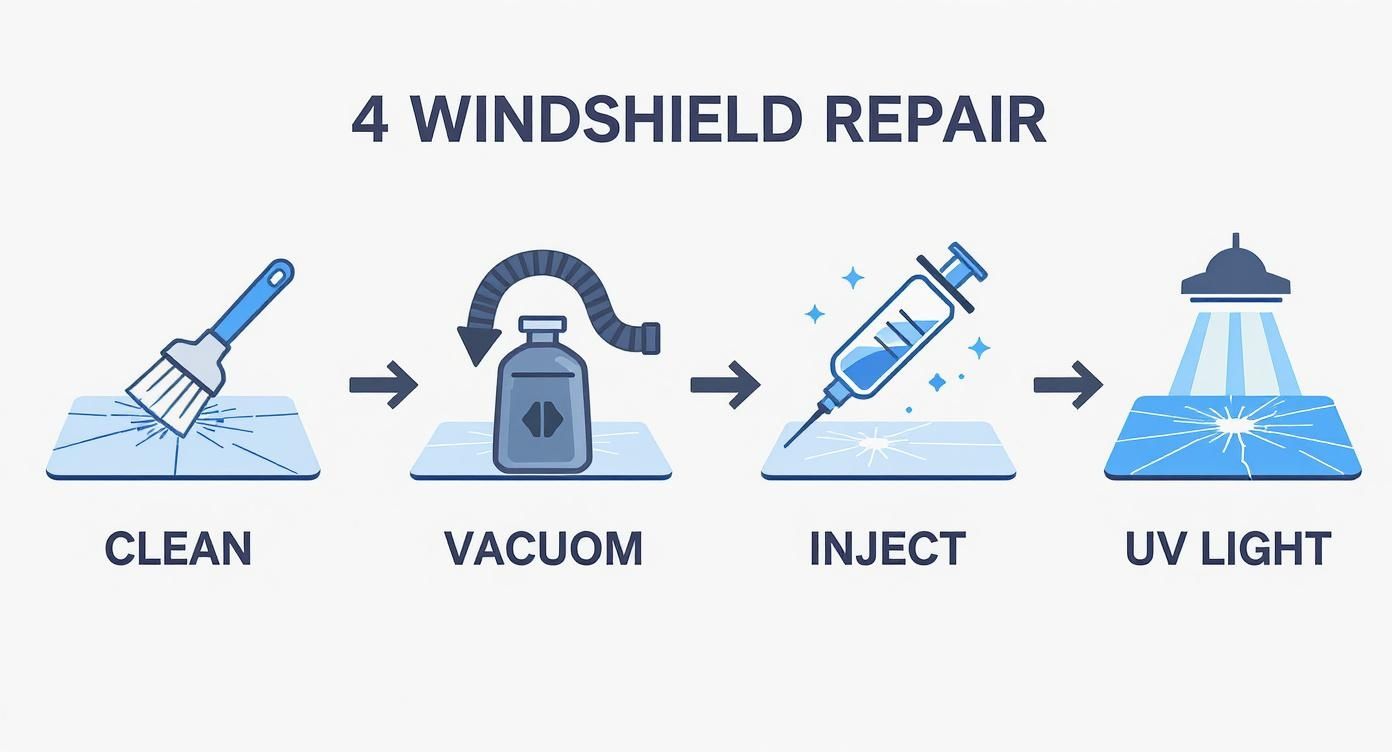
This process shows how every step, from cleaning out the debris to curing the resin with UV light, is essential for a strong, clear, and lasting repair.
Financial Considerations and Insurance
Of course, cost is a huge factor for most people. It's a big business, too—the global automotive windshield market was valued at around USD 29.74 billion in 2023 and is expected to hit USD 59.04 billion by 2032.
The good news? Your insurance policy will likely cover the cost of a windshield repair, often with no deductible. Insurers actually prefer repair because it's so much cheaper than a full replacement, and it gets your car back to a safe condition right away.
The key is to understand your policy. It really helps to know what comprehensive auto insurance covers, since this is usually where glass damage claims fall. Before you schedule anything, it’s always a smart move to check your policy details or give your agent a quick call to confirm your coverage.
Why Your Car's Safety Systems Care About the Windshield

It’s easy to think of your windshield as just a simple pane of glass keeping the wind and rain out. But in any modern car, it's so much more. Your windshield has become a critical piece of your vehicle's safety technology, acting as the eyes for your car's brain.
This is because many of your Advanced Driver-Assistance Systems (ADAS) depend on cameras and sensors mounted right there, behind the glass. These systems are your silent co-pilots, working every second to keep you safe on the road.
The ADAS and Windshield Connection
So, what exactly do we mean by ADAS? These are the high-tech features that are constantly watching your surroundings to help you avoid an accident.
Many of the most common ADAS features rely on a clear, perfectly positioned windshield to work correctly:
Lane Departure Warning: A camera watches the lane markings on the road and warns you if you start to drift without signaling.
Automatic Emergency Braking: Cameras and sensors scan for potential collisions with cars or pedestrians, hitting the brakes for you if needed.
Adaptive Cruise Control: This handy feature uses sensors to maintain a safe following distance from the car ahead, automatically adjusting your speed.
Traffic Sign Recognition: Cameras read signs like speed limits and display them on your dashboard for you.
The precision these systems require is astounding. Their cameras are calibrated from the factory to view the road from a very specific angle and height. Even the smallest change to the windshield can throw their calculations completely out of whack.
A chip in your windshield might seem small, but if it lands in the ADAS camera's line of sight, it can warp what the system "sees." A full windshield replacement, however, creates an even bigger problem: it makes a complete system recalibration mandatory.
Why Recalibration is Non-Negotiable After Replacement
When a new windshield goes in, it's impossible to install it in the exact same position as the original. We're talking about differences of less than a millimeter, but to these sensitive systems, that's a huge shift.
This tiny change means the ADAS camera is now looking at the road from a slightly different angle, which can make its safety judgments unreliable. Think of it like trying to see clearly when your glasses prescription is just a little bit off—everything becomes blurry and distorted. That's why a professional ADAS recalibration is absolutely essential after a replacement to get those cameras seeing straight again. Keeping up with a regular vehicle inspection checklist helps ensure every part of your car, from the tires to the windshield's tech, is in safe working order.
The Hidden Advantage of Windshield Chip Repair
This brings us to one of the most overlooked benefits of repairing a chip instead of replacing the whole windshield. Since a repair doesn't involve removing the glass, the original factory seal and positioning of your ADAS cameras are never touched.
In nearly every case, a professional chip repair lets you completely avoid the extra cost and time of an ADAS recalibration. You can dive deeper into this important service in our guide to ADAS windshield calibration. Opting for a repair keeps your car’s safety systems perfectly tuned and saves you from a crucial but often costly procedure.
The Hidden Risks of DIY Windshield Repair Kits
Wandering through an auto parts store, you’ve probably seen them: the DIY windshield repair kits. They sit on the shelf promising a quick, cheap, and easy fix for that annoying chip in your windshield. It feels like a smart, budget-friendly solution, but the truth is, that little box can lead to much bigger—and more expensive—problems down the road.
The appeal is obvious. Who wouldn't want to save a few bucks? It's no surprise the global market for these kits is projected to hit USD 1.5 billion by 2025. People are clearly looking for a simple fix, as shown in this market analysis.
But what those kits don’t tell you is that a professional repair is about much more than just squirting some resin into a crack. It’s a technical process that requires specialized tools and a whole lot of know-how to get right.
Why DIY Repairs Often Fail
The single biggest reason a DIY kit falls short is its inability to properly prep the damage. A professional technician uses a special vacuum injector to pull every last bit of air and moisture out of the chip. This step is non-negotiable. If you don't create a perfect vacuum, the resin simply can't flow into every microscopic fissure in the glass.
When you use a simple plastic syringe from a kit, you're almost certain to trap air inside the chip. That leads to a few major issues:
A Weak, Unreliable Bond: Trapped air bubbles create tiny pockets where the resin never bonds with the glass. This results in a weak spot that’s just waiting to fail under stress.
A Cloudy, Visible Blemish: The air also keeps the resin from curing properly, leaving you with a hazy or cloudy blemish that’s often just as distracting as the original chip was.
An Increased Risk of Spreading: An improperly filled chip is still a structural weak point. The slightest temperature change or a jolt from a pothole can cause the damage to crack out, often far worse than before.
A failed DIY repair attempt isn't just a cosmetic problem. It contaminates the chip with cheap resin and trapped air, making it impossible for a professional to come in and fix it properly later.
The Point of No Return
This is the real kicker and the biggest hidden risk of a DIY kit. Once you inject that resin yourself, you've likely closed the window for a successful professional repair. The improperly cured resin and trapped debris can't be flushed out, leaving only one option: a full windshield replacement.
Suddenly, that small amount you "saved" on the kit turns into a bill for hundreds of dollars for new glass, not even counting the potential cost of ADAS recalibration.
At the end of the day, trying to fix a chip in your windshield yourself is a gamble. You’re betting a few bucks against the structural integrity of your windshield and your safety. A professional repair, on the other hand, is a smart investment. It’s a guarantee the job is done right the first time, fully restoring the strength and clarity of your glass and giving you genuine peace of mind on the road.
Your Top Windshield Chip Questions Answered
Even with all the details laid out, you might still have a few things on your mind. That’s perfectly normal. Getting straight answers helps you make the right call and feel confident about getting your car back to 100%.
Let's dive into some of the most common questions we get from drivers staring at a fresh chip in their windshield. We'll give you clear, no-nonsense answers to clear up any confusion.
Will My Insurance Actually Pay for This?
This is the big one, and the answer is almost always a very happy yes. Most comprehensive auto insurance plans will cover the entire cost of a windshield chip repair, often without you ever having to touch your deductible.
You might be wondering why they’re so eager to help. It all comes down to simple math. A professional repair is a fraction of the cost of a full windshield replacement. By paying for the small fix now, they avoid a much bigger bill later—one that often includes the pricey task of ADAS recalibration. It’s a classic win-win: you get a free, professional repair, and they save a bundle.
It's always a good idea to double-check. A quick call to your insurance agent can confirm your coverage and get the claim approved in just a few minutes, making the whole process incredibly smooth.
How Long Am I Going to Be Stuck Waiting?
You'll be back on the road before you know it. A professional windshield chip repair is surprisingly fast, typically taking less than 30 minutes from start to finish.
This is where mobile repair services really shine. A technician can come to your home or office and have the entire job done while you're still on your coffee break. No need to rearrange your schedule or waste time at a shop.
Can the Weather Really Make a Chip Worse?
Definitely. Temperature swings are a chip's worst enemy, putting a ton of stress on that tiny weak spot in your glass. A small, stable chip can quickly spiral out of control.
Just think about these everyday situations:
Blazing Hot Day: You hop in your car and crank the AC. That blast of cold air on the hot glass creates a huge temperature shock right around the chip.
Icy Morning: You turn on the defroster to clear your windshield. The rapid heating causes the glass to expand unevenly, which can easily force a chip to crack.
Rain and Freezing Temps: Water seeps into the chip, carrying tiny bits of dirt with it. When that water freezes, it expands like a tiny ice cube, wedging the glass apart from the inside.
This is precisely why you can’t afford to wait. Getting a chip in your windshield repaired as soon as possible seals that vulnerable spot before Mother Nature turns it into a giant crack. The faster you act, the better your chances of avoiding a full—and much more expensive—windshield replacement.
Ready to get that chip fixed right? The team at Auto Renu Auto Glass LLC offers fast, reliable mobile service to make the process completely seamless. Schedule your expert windshield repair today!