Cost to Replace a Windshield: Get Accurate Estimates Today
Learn the true cost to replace a windshield. Discover factors affecting price and get helpful tips to budget your repair or replacement.
Sep 22, 2025
generated
cost to replace a windshield, windshield replacement, auto glass cost, adas calibration, car maintenance
When you get a quote for a new windshield, the numbers can seem all over the place. The average cost to replace a windshield typically falls somewhere between $200 and $600 for a standard car. But for luxury vehicles or those packed with modern safety tech, that price can easily jump past $1,000.
What gives? The final bill really comes down to your car's make and model, and especially the technology built right into the glass.
Your Quick Guide to Windshield Replacement Costs
Trying to pin down the cost of a new windshield can be frustrating. The truth is, not all windshields are the same anymore. The glass for an older, basic sedan is a world apart from the windshield on a new SUV loaded with cameras and sensors—and the price reflects that.
Think of it this way: a basic windshield is just a pane of glass that keeps the wind and rain out. A modern windshield, on the other hand, is a critical part of your car’s central nervous system. It holds the "eyes" for safety systems like automatic emergency braking and lane-keeping assist. That huge leap in technology is the main reason you see such a wide range of prices today.
A Clear Look at the Numbers
So, what should you really expect to pay? In major markets like the United States and Europe, most replacements land in that $200 to $600 sweet spot, but this is heavily influenced by the car's complexity. For a closer look at the market forces behind these numbers, the automotive windshield market research from Fortune Business Insights offers some great context. Knowing this baseline helps you go in with realistic expectations.
The biggest factor driving up costs today isn't just the glass itself. It's the mandatory recalibration of your car's Advanced Driver-Assistance Systems (ADAS). This step is non-negotiable—it ensures all your safety features work correctly after the new windshield is in.
To help you get a better handle on potential costs, we’ve put together a quick reference table. It breaks down what you might pay based on common vehicle types.
Estimated Windshield Replacement Costs by Vehicle Type
This table gives a ballpark idea of costs, separating the glass and labor from the often-overlooked expense of ADAS recalibration.
Vehicle Type | Glass Type | Estimated Cost Range (Excluding ADAS) | Estimated ADAS Recalibration Cost |
|---|---|---|---|
Standard Sedan | Basic Tempered/Laminated | $200 - $400 | N/A or $50 - $150 (if equipped) |
Modern SUV/Crossover | Laminated w/ Sensors | $400 - $700 | $250 - $500 |
Luxury Vehicle | Acoustic, HUD, Heated | $700 - $1,200+ | $400 - $800+ |
Light-Duty Truck | Standard or Laminated w/ Sensors | $300 - $600 | $200 - $450 |
As you can see, the recalibration alone can add a significant amount to your final bill. This is why a simple glass swap has turned into a much more technical—and often more expensive—job.
What Goes Into Your Windshield Replacement Quote?
Ever get a quote for a windshield replacement and wonder where that number came from? It’s not just a random figure. The final price is a blend of a few key ingredients, and knowing what they are helps you understand exactly what you’re paying for.
Think of it like this: the cost to replace a windshield rests on three main pillars. First, the car you drive. Second, the type of glass you pick. And third, the actual work involved in putting it in safely. Each one has a real impact on your final bill.
Your Car’s Make and Model
It all starts with your vehicle. The simple truth is that not all windshields are created equal, and the year, make, and model of your car is the first thing any technician needs to know. A windshield for a 2015 Honda Civic is going to be a lot more straightforward—and less expensive—than one for a brand-new Mercedes-Benz SUV.
So, what's the big difference? Luxury cars, newer models, and specialty vehicles often have windshields with unique shapes, sizes, or built-in tech. This makes the glass itself more complex and costly to produce. It's the same reason a tire for a high-performance sports car costs more than one for a standard family sedan; it’s built to a different spec.
This image really helps break down how all the pieces come together to form your total cost.
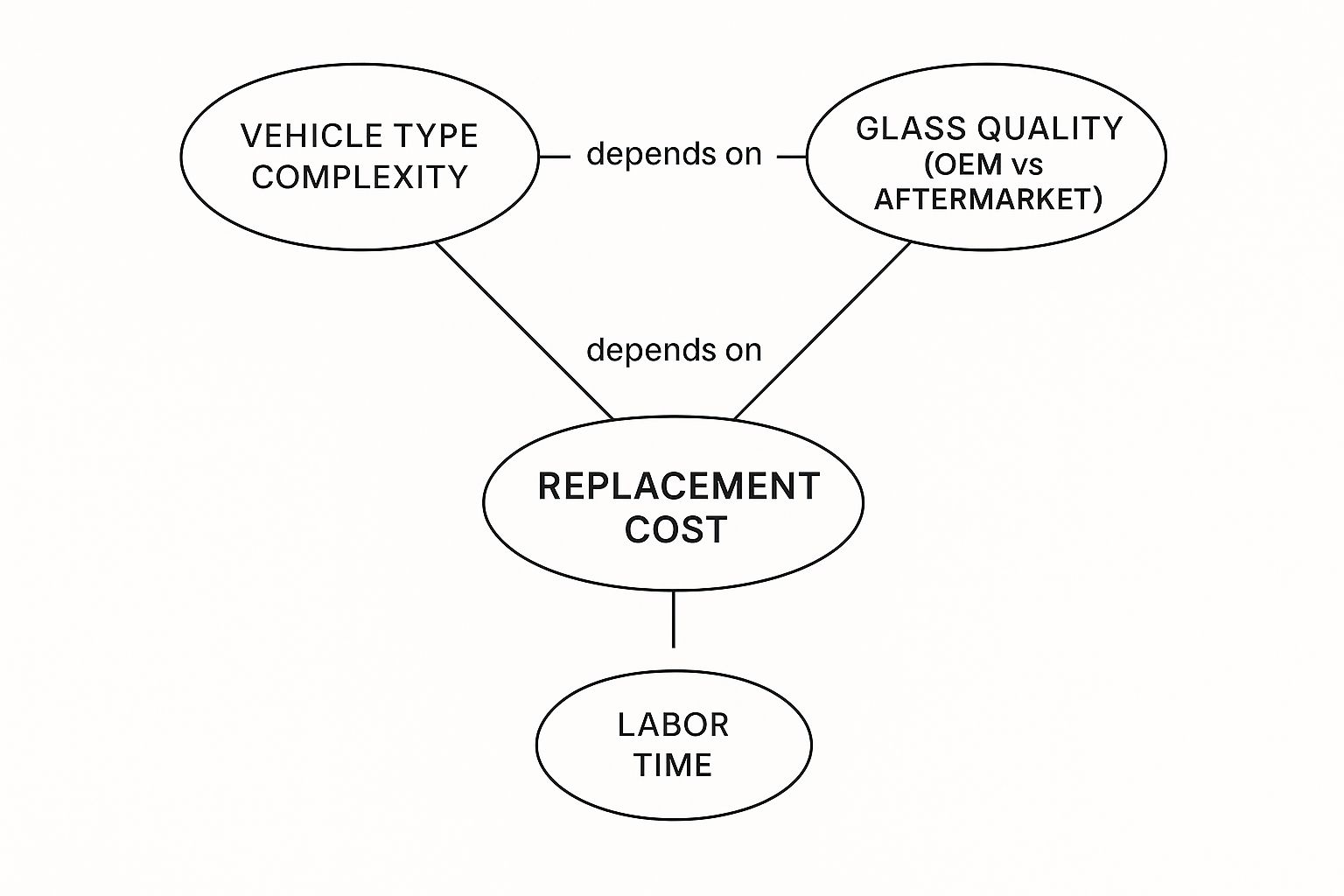
As you can see, the final price is a careful balance of the glass you choose, how complex your car is, and the hands-on time a technician needs to do the job right.
OEM vs. Aftermarket Glass: What’s the Difference?
Next up, you’ll usually get a choice between two kinds of glass, and this decision is a major fork in the road for your budget.
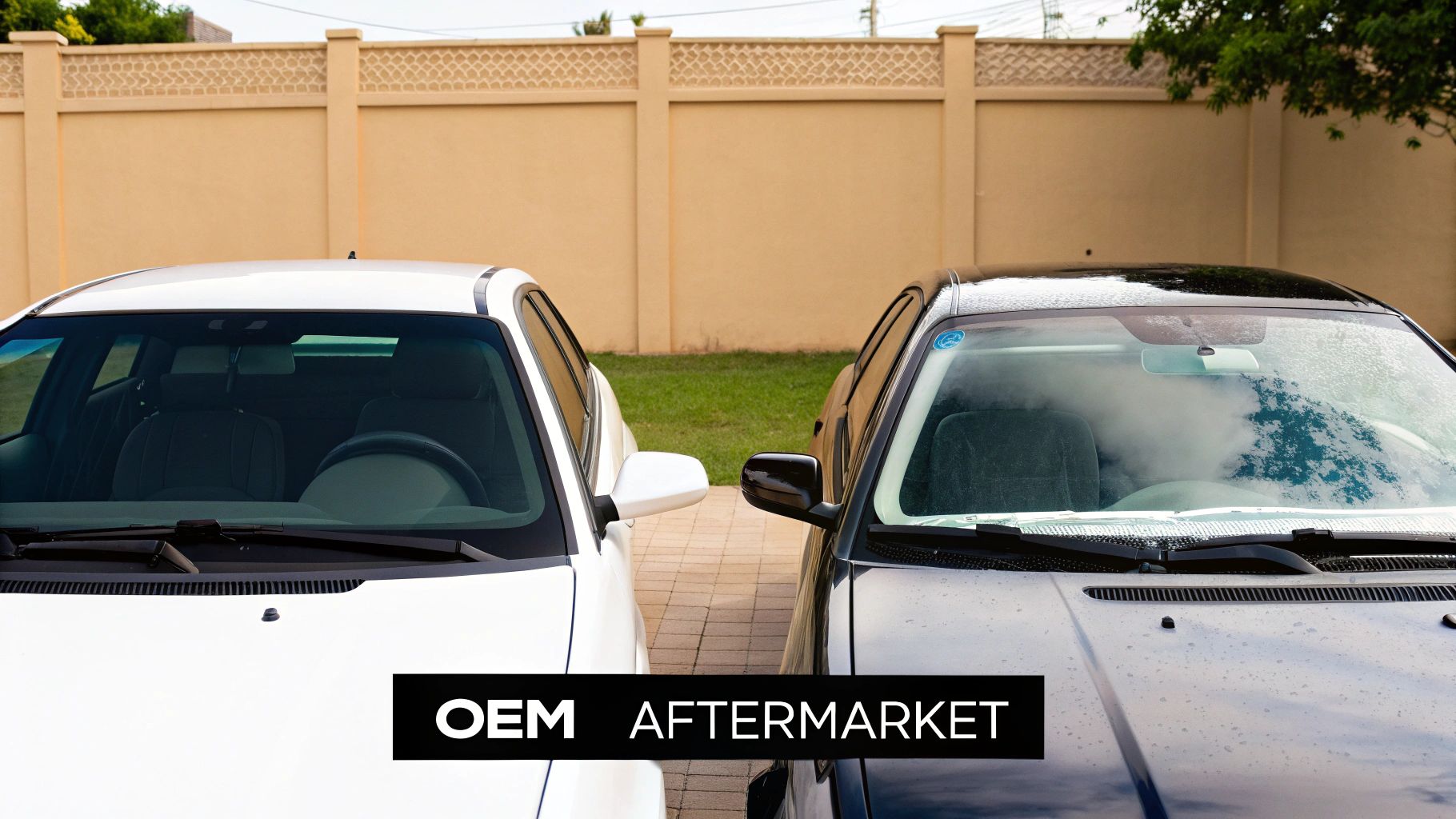
OEM (Original Equipment Manufacturer): This is the exact same glass your car had when it rolled off the assembly line, right down to the little logo from the automaker. It’s a guaranteed perfect match in fit and quality, but it's also the most expensive option.
Aftermarket (or OEE - Original Equipment Equivalent): This glass is made by a different company but is legally required to meet the same strict safety standards as the original. It’s a perfectly safe, high-quality option that’s much friendlier to your wallet.
The choice is a lot like buying a car part from the dealership versus getting an equivalent from a trusted auto parts store. Both get the job done safely, but one comes with a premium price tag.
Keep in mind that while aftermarket glass is a great, safe choice for most vehicles, sometimes with very new or rare models, an OEM windshield is the only one available. This can definitely push the replacement cost higher.
High-Tech Features and Tricky Installations
Finally, we have to talk about what’s in your windshield. A plain slab of glass is one thing, but modern windshields are packed with technology, and that complexity directly adds to the cost.
The more features your windshield has, the more it will cost to replace. We’re talking about things like:
Rain-sensing wipers
Heated wiper park areas
Acoustic layers to keep the cabin quiet
Heads-Up Displays (HUD) that project info onto the glass
Each of these adds to the material cost of the glass itself. They also make the installation a much more delicate and time-consuming job for the technician, which means higher labor costs. And this doesn’t even touch on ADAS recalibration, which is a crucial—and separate—cost for any modern car with safety cameras. All these elements together are why a "simple" glass replacement has become such a technical job.
Why Modern Cars Add a Hidden Recalibration Cost
If you drive a car made in the last few years, the biggest surprise on your bill will likely be for something called ADAS recalibration. It's a mandatory step that many people don't even know exists until they see the final invoice, and it can seriously bump up the total cost to replace a windshield.
So, what is this ADAS thing, anyway? The acronym stands for Advanced Driver-Assistance Systems, which is just the official term for all the high-tech safety features that are now common in modern vehicles.
The Eyes of Your Vehicle
Think of ADAS as your car's digital co-pilot. The whole system runs on a network of cameras and sensors that constantly watch the road, and guess where many of them are mounted? Right on your windshield.
These are the features that depend on those sensors:
Automatic Emergency Braking: Can slam on the brakes for you if it senses a collision is about to happen.
Lane Departure Warnings: Alerts you if you start drifting out of your lane without using your turn signal.
Adaptive Cruise Control: Automatically keeps a safe following distance from the car in front of you on the highway.
When a technician puts in a new windshield, those "eyes" get disturbed. Even a tiny shift—we're talking a millimeter—can completely throw off their perception of the world. They might not see straight anymore, making them unreliable or flat-out useless.
Recalibration is simply the process of re-aligning those cameras and sensors with surgical precision, getting them back to the original factory settings. It’s like getting a new pair of prescription glasses and having the optometrist adjust them perfectly to your face.
Skipping this step is not an option. A misaligned camera could fail to see a pedestrian stepping into the road or, just as bad, cause your car to brake suddenly for no reason. For your safety and everyone else's, proper recalibration is non-negotiable.
Why Recalibration Adds to the Cost
Recalibration isn't just plugging in a computer and clicking a button. It’s a complex, technical job that demands specialized tools and technicians who know exactly what they're doing. This is where that "hidden" cost comes from. As automotive glass technology evolves and incorporates these systems, the installation becomes more intricate, adding hundreds of dollars to the final bill.
The process ensures your safety features work exactly as the manufacturer designed them to. If you want to get into the nuts and bolts of it, we have a complete guide that covers the essentials of ADAS windshield calibration. At the end of the day, that extra fee is a crucial investment in making sure your car's life-saving technology is ready to perform when you need it most.
How Your Location Affects the Final Price
You might be surprised to learn that the cost to replace a windshield can swing wildly just by crossing a state line. Where you live plays a huge part in the final bill, turning what seems like a simple quote in one city into a much more expensive job in another. A few key local factors are behind these regional price shifts.
The biggest one? Labor rates. The cost of living and what skilled technicians get paid varies a ton across the country. A tech working in a high-cost city like San Francisco is going to have a much higher hourly rate than someone in a small rural town, and you’ll see that difference reflected right in your installation quote.
Local Market and Climate Dynamics
It's not just about wages, though. The local market itself shapes the price. Basic supply and demand is at play here. In places that get a lot of hailstorms or have tons of gravel roads, the demand for windshield replacements is just naturally higher. Sometimes this means more competition and better prices, but it can also strain the local supply of certain windshields, which actually drives costs up.
Don't forget about state and city sales tax, either. That gets added to both the glass and the labor. It might not seem like much, but on a pricey replacement for a luxury car, those taxes can add a hefty sum to the bottom line. To get a better sense of how prices can change, it's a good idea to check out the typical costs at different service locations and see what your local market looks like.
The global cost to replace a windshield is a major component of the growing automotive windshield market. This market is projected to expand from roughly USD 20.4 billion in 2025 to USD 46.2 billion by 2034, reflecting the increasing complexity and value of modern auto glass. Learn more about the trends driving the automotive windshield market.
Supply Chain and Parts Availability
Finally, it comes down to whether the right piece of glass is even available nearby. If you drive something common like a Ford F-150 or a Toyota Camry, chances are you can find affordable aftermarket glass just about anywhere. It's a breeze.
But for less common cars, luxury vehicles, or brand-new models, the supply chain gets a lot tighter. A local shop might have to get your windshield shipped in from a warehouse states away, tacking on some serious freight charges to your bill. This logistical headache doesn't just bump up the price—it also means you could be waiting a lot longer to get your car back on the road. It just goes to show that when it comes to cost, your location is a critical piece of the puzzle.
Using Insurance To Cover Your Windshield Costs
Facing a big windshield repair bill can feel like getting whacked by a stray pebble at highway speed. Thankfully, your auto policy’s comprehensive coverage often steps in to soften that blow. With a few key details in hand, you’ll breeze through the claim process instead of hitting dead ends.
Understanding Your Deductible
Your deductible is the amount you cover out of pocket before your insurer pays up. Think of it as the price of admission—once you pay it, the rest of the ride is on them.
For example:
Replacement Cost: $800
Your Deductible: $500
Insurer Pays: $300
If the total repair bill stays below your deductible, you’re essentially footing the whole cost yourself. In that case, filing a claim would be like buying a movie ticket and never watching the film.
Only file a claim when the replacement cost significantly exceeds your deductible. This simple rule can help keep your future premiums from creeping up.
Special State Laws Full Glass Coverage
In certain states, you might not pay a dime for windshield glass. Florida, Kentucky, and South Carolina have mandates that waive the deductible on auto glass as long as you carry comprehensive coverage.
Before you call your agent, double-check:
Do you have comprehensive coverage?
What is your current deductible?
Does your state offer zero-deductible glass?
The Claim Process Step-By-Step
Contact your insurer to confirm coverage and deductible details.
Get a recommendation for an approved auto glass shop—or pick your own local specialist.
Schedule the replacement; the shop usually bills your insurer directly, sparing you the extra paperwork.
Leveraging your insurance this way can keep your wallet intact and get you back on the road faster.
The global market for automotive glass replacement is projected to hit USD 40.7 billion by 2025, thanks in part to broader insurance coverage that encourages more drivers to file claims. For a deep dive into what’s driving these numbers, check out the factors driving the auto glass market.
Deciding Between a Quick Repair or Full Replacement

Not every rock chip or crack means you're in for a total windshield replacement. Before you start bracing for a big bill, it’s smart to ask a simple but crucial question: can this just be repaired? Often, a quick and inexpensive repair is all you need to get back on the road safely, saving you a significant amount of money.
The choice really boils down to three things: the size, location, and type of damage.
As a general rule of thumb, if the damage is smaller than a dollar bill, you're likely a good candidate for a repair. It's a simple, practical guideline that most auto glass technicians stand by.
But size isn't everything. The location of that chip or crack is just as critical. If it's right in the driver's direct line of sight, or if a crack has spread all the way to the edge of the glass, a full replacement is almost always the only safe path forward. A repair in these spots can compromise your vision or the windshield's structural integrity, and that's a risk no one should take.
Windshield Repair vs. Replacement Comparison
So, how do you make the final call? Let's lay out the differences side-by-side. This should give you a clearer picture of what to expect and help you have a productive conversation with your auto glass specialist.
Here's a straightforward comparison table to help you decide whether a repair or a full replacement is the right move for your situation.
Factor | Windshield Repair | Windshield Replacement |
|---|---|---|
Cost | Significantly lower, often $50 - $150. | Higher, typically $200 - $1,200+. |
Time | Fast, usually under 30 minutes. | Longer, taking 1-3 hours plus adhesive cure time. |
Safety | Restores structural strength for small damages. | Fully restores the vehicle's structural integrity. |
Insurance | Often covered 100% with no deductible. | Usually requires paying a comprehensive deductible. |
Appearance | Damage becomes much less noticeable. | Flawless, brand-new glass. |
Ultimately, a repair is about stopping damage from spreading while making it far less obvious. A replacement, on the other hand, is a complete reset, bringing your vehicle back to its factory-fresh condition.
If you're leaning toward a repair, you can learn more about what the process involves in our detailed guide to professional windshield repair services.
Still Have Questions? Let's Clear Things Up
Even with a full cost breakdown, it's natural to have a few more questions rattling around. Getting your windshield replaced is a big deal, and knowing the ins and outs helps you make a confident choice. Let's tackle some of the most common things people ask when they're in your shoes.
Is Aftermarket Glass as Safe as OEM Glass?
You bet it is. High-quality aftermarket glass isn’t just a good option; it’s a perfectly safe one. By law, it has to meet the exact same Federal Motor Vehicle Safety Standards (FMVSS) as the Original Equipment Manufacturer (OEM) glass that your car rolled off the factory line with.
Think of it this way: OEM glass is the brand-name version, while a good aftermarket part is the top-tier generic. It does the same job and passes the same safety tests, just without the carmaker’s logo and price tag. The real key here is making sure your installer sources their glass from reputable suppliers.
A common myth is that "aftermarket" automatically means "cheap" or "low-quality." The reality is it just means the glass wasn't made by the car manufacturer. It still has to endure a whole battery of safety tests to prove it will protect you just as effectively in a crash.
How Long Does a Windshield Replacement Take?
The actual hands-on work of swapping out the glass is faster than most people think—usually about 60 to 90 minutes. But the most important part of the entire process happens after the new windshield is in place.
We have to wait for the powerful urethane adhesive to cure and form an unbreakable bond. This is what's known as the "safe drive-away time," and it typically adds another one to three hours. For your own safety, you should plan on leaving the car parked for at least three hours total. This gives the adhesive enough time to set properly, ensuring the windshield is a truly structural part of your vehicle again.
Can I Drive My Car Right After Installation?
This is a hard no, and it’s non-negotiable. You absolutely must wait for the adhesive to cure before you get behind the wheel. Driving away too soon is a serious gamble. Why? Because your windshield is responsible for up to 60% of your car's structural integrity during a rollover accident.
Your technician will give you a very specific "safe drive-away time." Follow it to the letter. This is what guarantees the windshield can do its job and protect you and your passengers if the worst should happen.
Will a Replacement Windshield Be Exactly Like My Original?
If you go with OEM glass, then yes—it will be a perfect twin to your original, complete with the car manufacturer’s little logo etched in the corner.
If you choose a high-quality aftermarket windshield, it will match the size, shape, thickness, and safety specifications of the original. The only real difference is that it won't have the carmaker's logo. When it comes to built-in tech like rain sensors or heating elements, both OEM and good aftermarket glass will work seamlessly with your car’s systems.
Ready for a hassle-free windshield replacement? The certified technicians at Auto Renu Auto Glass LLC come directly to you, providing fast, safe, and reliable service. Get your free, no-obligation quote today and see how easy it can be. Get an Instant Quote on AutoRenu911.com.
Article created using Outrank