
Guide: fix crack in windshield for DIY repairs
Learn how to fix crack in windshield with clear steps, when to DIY, and when to call a pro for a safe, lasting repair.
Jan 9, 2026
generated
fix crack in windshield, windshield repair kit, auto glass repair, ADAS calibration, chip repair
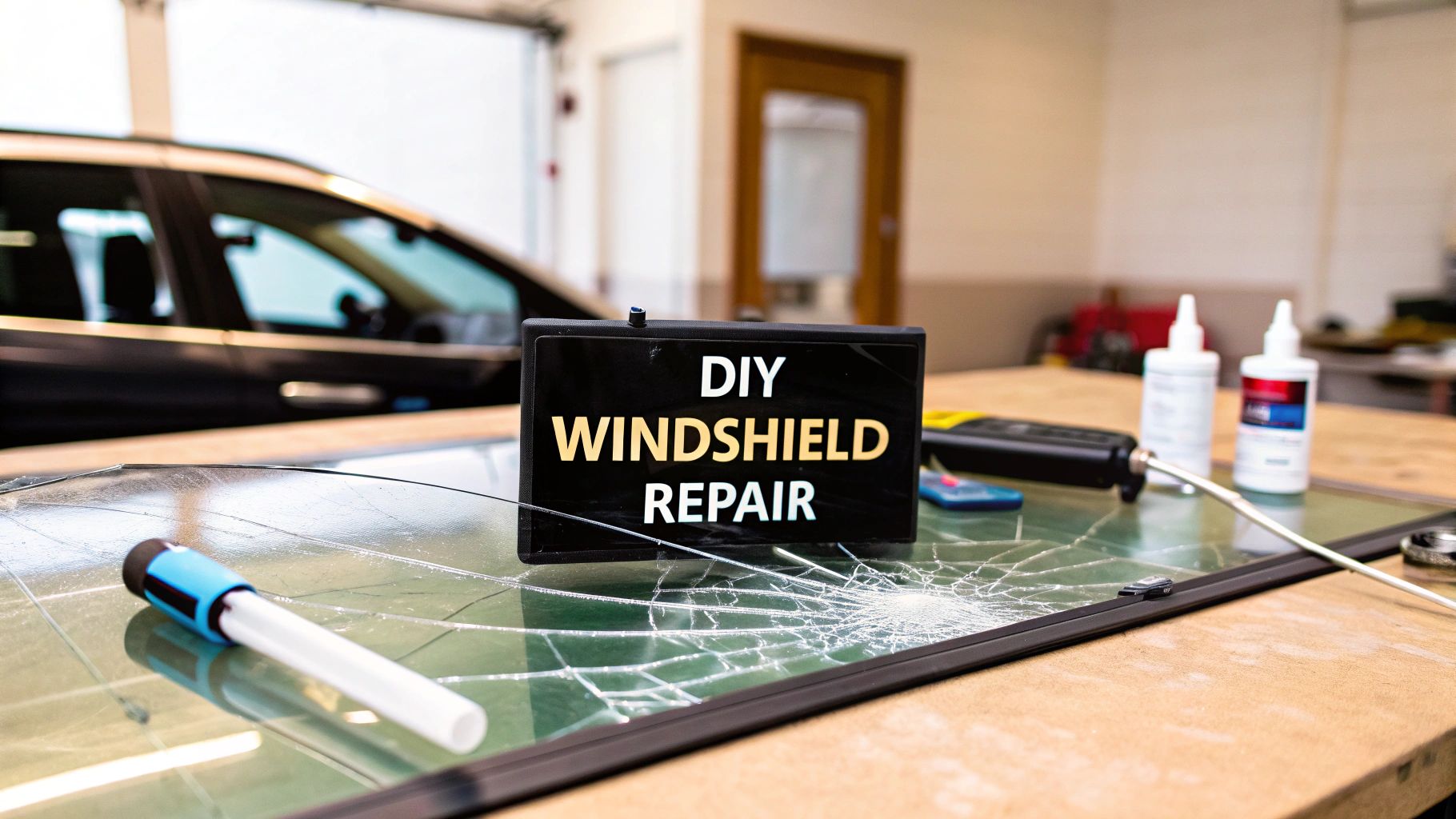
That sickening smack of a rock hitting your windshield is a sound every driver dreads. But before your mind jumps to an expensive replacement, take a deep breath. The first and most important step is to figure out exactly what you're dealing with.
The size, type, and location of that new blemish will tell you everything you need to know about whether you can fix the crack in your windshield yourself or if it's time to call in a pro.
What to Do the Moment You Spot a Crack
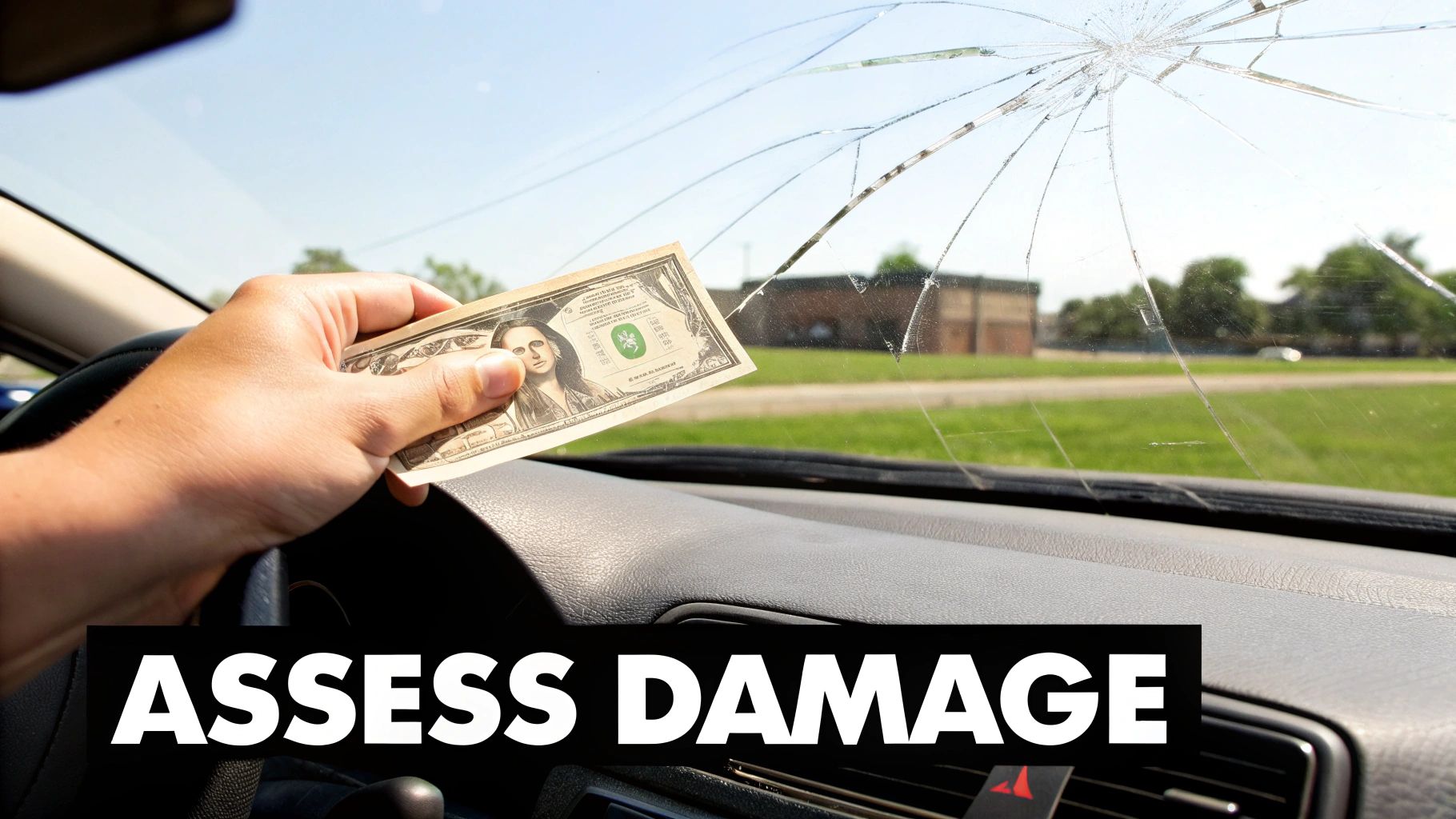
How you react in the first few hours can make a world of difference. That tiny chip can easily spiderweb into a massive, unfixable crack if you're not careful.
The biggest culprits are sudden temperature swings. Blasting the AC on a scorching day or cranking the defroster when it's freezing puts immense stress on the glass, encouraging that little flaw to spread. Even simple things like slamming a car door or hitting a nasty pothole can send vibrations through the windshield and make the problem much worse.
Know Your Enemy: Identifying the Damage Type
Windshield damage isn't a one-size-fits-all problem. Getting a handle on the specific type of flaw is the key to understanding if a repair is even on the table. Each one has its own personality.
Chip or Pit: This is the most straightforward—a small piece of glass is just gone. These are usually the easiest to fix.
Bullseye: Looks just like its name—a dark, circular cone shape where the rock hit. If they're small, these are often good candidates for repair.
Star Break: You'll see little cracks, or "legs," shooting out from a central point. You have to act fast with these before those legs start running across your windshield.
Combination Break: A nasty mix of a bullseye and a star break. These get a bit more complicated to handle.
If you want to get a closer look, we've put together a full guide on the different types of windshield damage and what each one means for your car's safety.
Here’s a quick reference table to help you make a fast, informed decision on the spot.
Quick Damage Assessment Guide
Use this table to quickly identify your windshield damage and understand the best next step for a safe and effective fix.
Type of Damage | Description | Is It Repairable? | Recommended Action |
|---|---|---|---|
Chip / Pit | A small nick where glass is missing. | Yes (if smaller than a quarter) | DIY repair kit or professional repair. |
Bullseye | A dark, cone-shaped circle. | Yes (if under 1 inch in diameter) | Professional repair is best to ensure a clear fill. |
Star Break | Cracks radiating from an impact point. | Yes (if smaller than a quarter) | Act quickly. Call a professional to stop the cracks from spreading. |
Crack | A single line in the glass. | Maybe (if under 6 inches) | Apply the "Dollar Bill Rule." Call a pro for assessment. |
Combination | A mix of a bullseye and star break. | Maybe | Professional assessment is strongly recommended due to complexity. |
This table should give you a solid starting point, but always remember that location is just as important as the type of damage.
Key Takeaway: The most critical factor is the location. If any crack or chip is directly in the driver's line of sight, a professional repair or replacement is almost always necessary to ensure clear, undistorted vision.
The Good Ol' Dollar Bill Rule
Here’s a tried-and-true trick we use in the industry: the "dollar bill rule." Pull a dollar bill out of your wallet. If the crack is shorter than the length of the bill (that’s about six inches), there's a good chance it can be professionally repaired. If it’s any longer, you’re almost certainly looking at a full windshield replacement to keep your vehicle safe.
With more cars on the road and constant construction, cracked windshields are a fact of life. This has turned auto glass into a massive industry, with the global repair market soaring to nearly USD 59.92 billion. It’s no surprise that front windshields are the most commonly replaced part, which just goes to show how often these small, seemingly minor cracks can become a major safety hazard.
Your Hands-On Guide to DIY Windshield Repair
So, you've looked at the damage, and it’s a small chip or a crack no bigger than a quarter. Good news—this is probably something you can tackle yourself. Taking on a DIY windshield fix is a satisfying project, but a great result comes down to doing it right. This is more than just plugging a hole with goo; you're creating a permanent bond that brings back the windshield's strength.
Before you even pop the top on the repair kit, the real work begins. Your main objective is to make the damaged spot surgically clean. If any dirt, moisture, or road gunk gets trapped in there, the repair will fail. It’s that simple.
Prepping the Damage for a Solid Fix
First thing's first: you have to clean out the impact point itself. Grab the little metal pick from your kit (a pushpin works in a pinch) and gently dig out any loose, flaky bits of glass from the chip. Take your time with this—the last thing you want to do is make the crack bigger.
Once the loose stuff is gone, clean the glass around the chip with some rubbing alcohol on a microfiber towel. Steer clear of household glass cleaners. Many of them leave behind residues that will sabotage the resin's ability to stick to the glass.
A pro tip from years of experience: If the car has been in the rain recently, you absolutely must get the crack completely dry. Moisture is the arch-nemesis of a good repair. I always use a hairdryer on a low, warm setting for a couple of minutes to chase out any water hiding deep in the crack.
With the area clean and bone-dry, you’re ready for the main event.
Getting the Resin in There Just Right
Your DIY kit should have an applicator—a little device that suctions onto the windshield right over the chip. This gadget is the key; it creates a vacuum to pull air out and then uses pressure to shove the liquid resin into every nook and cranny of the break.
Follow the kit's directions for mounting the applicator and make sure you get a perfect, airtight seal. Then, add the specified amount of resin into the chamber. Now, be patient. The process involves slowly twisting a plunger to inject the resin, which then builds the pressure needed to fill the damage completely.
Pressure is Everything: Don't get impatient here. The whole point is to squeeze out every last air bubble. For star-shaped breaks with little legs, you might have to alternate between pressure and vacuum a few times to get the resin all the way to the tips.
Check Your Work: Peek at the damage from inside the car. You should see the crack slowly disappear as the clear resin fills it in. It's actually pretty cool to watch.
After you're confident the resin has filled the entire void, you can remove the applicator tool.
Curing the Resin for a Strong, Clear Finish
The last step is making the resin hard and permanent. This is called curing. The resin in these kits is designed to harden when exposed to ultraviolet (UV) light. Take one of the little plastic curing strips from the kit and lay it flat over the wet resin, making sure to smooth out any air bubbles.
Now, let nature take over. Park the car so the windshield is in direct, bright sunlight. Give it at least 15-20 minutes, but an hour is even better for a rock-solid cure. If it’s a cloudy day, a UV flashlight will get the job done, too. This UV exposure triggers a chemical reaction that bonds the glass back together.
Once it's fully cured, take a new, sharp razor blade, hold it at a 45-degree angle, and carefully shave off the excess, hardened resin from the glass surface. A quick wipe-down with a clean cloth, and you're done. You’ve successfully stopped the crack from spreading and made the damage nearly invisible.
When to Put Down the DIY Kit and Call a Pro
A DIY kit can be a lifesaver for those tiny, annoying rock chips, but it's crucial to know its limits. Tackling a crack that's too far gone isn't just a waste of an afternoon—it's a serious safety gamble. Recognizing the red flags that scream "call a professional" is key to keeping your car structurally sound and safe to drive.
The most straightforward deal-breaker is size. If you're looking at a crack longer than a dollar bill (that's about six inches), step away from the repair kit. Damage of that size has already compromised the glass in a big way, and only a professional can truly restore its strength, often through a full replacement.
Another hard stop? Damage depth. The safety glass in your windshield has two layers. Run your fingernail over the crack from inside the car. If you can feel a dip or an edge, the damage has penetrated both layers, making it far too severe for a DIY fix.
Damage That Demands Expert Attention
Location is just as important as size. Any chip, star break, or crack sitting directly in the driver's line of sight is an immediate "no-go" for a home repair. Even the best DIY job can leave a tiny bit of distortion, and that’s the last thing you want interfering with your view of the road.
Cracks that creep to the very edge of the windshield are also particularly nasty. They have a nasty habit of spreading quickly from road vibrations and temperature shifts, putting the entire windshield at risk. A pro needs to get their eyes on it to make sure the windshield's critical seal hasn't been compromised.
For the small stuff you can handle, this flowchart gives you a good idea of the basic process.
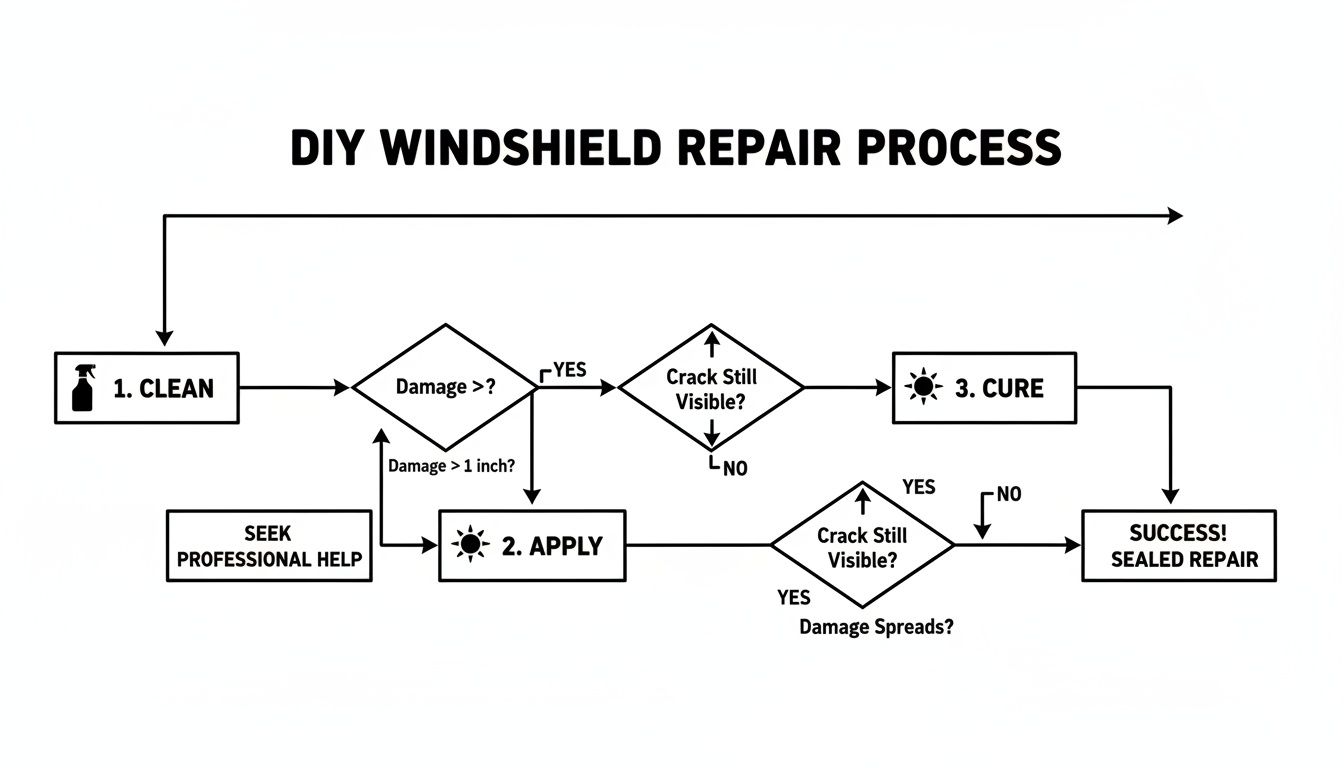
As you can see, the DIY route is really only meant for simple, isolated damage where the clean-and-fill process is straightforward.
The ADAS Complication in Modern Vehicles
On newer cars, the windshield is more than just a piece of glass—it’s the eyes for your car's brain. Most modern vehicles are equipped with Advanced Driver-Assistance Systems (ADAS), which rely on cameras and sensors mounted right on the windshield. These systems manage everything from your lane-keeping assist to automatic emergency braking.
A professional assessment is vital because any damage near these sensors can throw their calibration way off. You could end up with critical safety features being disabled without any warning light. A certified service like Auto Renu Auto Glass LLC is trained to handle these sensitive systems properly.
If the damage is bad enough to need a full replacement, things get even more complex. Industry data shows that over 65% of collision repairs now require some form of ADAS recalibration. This isn't just an optional add-on; it's a critical step to ensure your car's safety features work as intended. For a deeper dive into what this involves, you can get more details on ADAS calibration timelines and costs.
DIY Repair vs. Professional Service: A Decision Checklist
Still on the fence? This checklist helps you weigh the factors and decide whether to attempt a DIY repair or call a professional for guaranteed results.
Consideration | Good for a DIY Repair | Best to Call a Professional |
|---|---|---|
Damage Type & Size | Small, simple bullseye or star chip (under 1.25 inches) | Long cracks (over 6 inches), multiple chips, or complex breaks |
Location on Windshield | Anywhere outside the driver's direct line of sight | Directly in the driver's line of sight or near the windshield edge |
Vehicle Technology | Older vehicle with no ADAS cameras or sensors near the damage | Any damage near ADAS sensors, requiring potential recalibration |
Your Experience Level | You're comfortable with detailed, patient hands-on work | You've never done it before or prefer a flawless, warrantied result |
Time & Convenience | You have an hour or two in a dry, shaded spot to work | You need a fast, mobile repair or the weather isn't cooperating |
Cost vs. Risk | The low cost of a kit outweighs the small risk of error | The cost of a new windshield is too high to risk a failed repair |
Ultimately, a DIY kit is a fantastic tool for minor blemishes. But for anything that compromises your vision, your car's technology, or the structural integrity of the glass, making a call to a professional is always the smartest, safest move.
Why Mobile Auto Glass Service is a Game-Changer
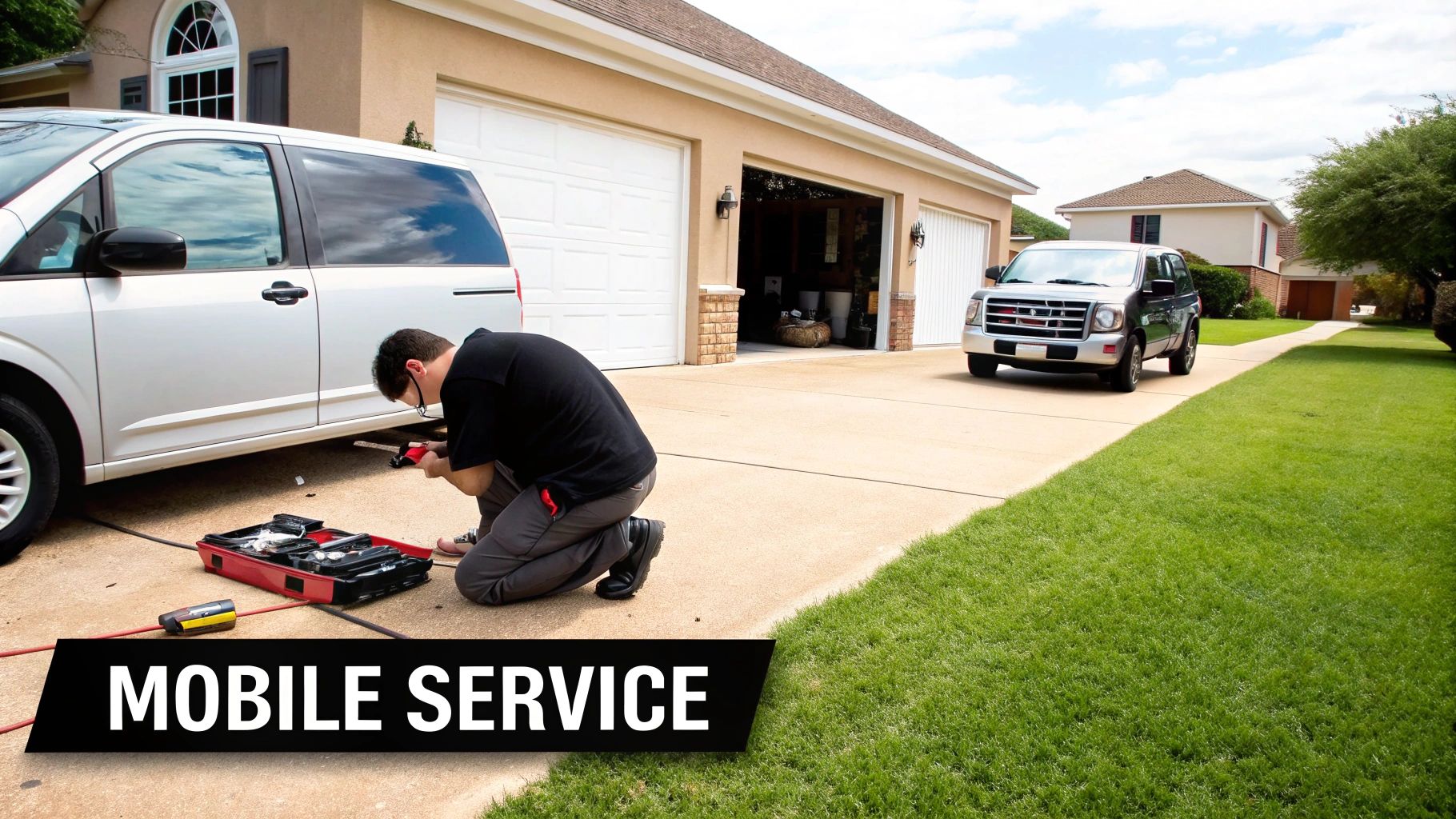
Let’s be honest, when you need to fix a crack in your windshield, the last thing you want to do is add another errand to your list. This is precisely why mobile auto glass services are so popular. Instead of taking time out of your day to drive to a shop and wait, a trained technician comes right to you.
Imagine getting your windshield repaired in your driveway while you're taking a work call, or in the office parking lot during a meeting. Mobile service turns a frustrating disruption into a minor background event, saving you a ton of time and hassle. It’s convenience, plain and simple.
But the real advantage goes far beyond just saving a trip. A professional technician arrives with specialized tools and materials that are leagues ahead of anything you can buy in a DIY kit at the auto parts store.
Professional Tools and Resins Make All the Difference
The secret to a strong, nearly invisible repair isn't magic—it’s the quality of the resin and the equipment used to inject it. Mobile pros, like our team at Auto Renu Auto Glass LLC, use industry-grade resins that provide far better clarity and strength than the stuff in consumer-grade kits.
This isn't just glue. Professional resins are engineered to flex with your windshield as temperatures change, which is crucial for making the repair last. Technicians use specialized vacuum and pressure tools to force this resin deep into every tiny crevice of the crack, pushing every last bit of air out. This step is what restores the windshield's structural integrity.
The biggest reason DIY repairs fail is trapped air. If you don't get all the air out of the crack before the resin cures, you're left with a weak spot. A professional service guarantees this is done right, giving you a clear, permanent fix.
Think of it this way: a DIY kit is like putting a bandage on a deep cut. It might work for a little while. A professional mobile repair is like getting stitches from a doctor—it's a real, long-term solution built for safety and performance. To learn more, check out our guide on the benefits of mobile automotive glass repair services.
Don't Forget About ADAS Recalibration
In today's cars, a windshield is so much more than a piece of glass. It’s a high-tech component that holds the cameras and sensors for your Advanced Driver-Assistance Systems (ADAS).
If the damage means you need a full windshield replacement, ADAS recalibration isn't a suggestion—it's a critical safety step. These systems manage functions you depend on without even thinking about them.
Lane-Keeping Assist: Keeps your car from unintentionally drifting.
Automatic Emergency Braking: Hits the brakes for you to prevent a collision.
Adaptive Cruise Control: Adjusts your speed to maintain a safe following distance.
When a new windshield goes in, the camera's viewing angle can be off by just a single millimeter. That tiny shift is enough to make the system misjudge road lines or the car in front of you, which could cause a catastrophic failure when you need it most.
A professional mobile technician brings the diagnostic equipment needed to perform this precise recalibration right on-site. They ensure that after the new glass is installed, every safety feature is working exactly as the manufacturer designed it. Skipping this step is a gamble with your safety, which is why a professional is the only smart choice for any vehicle with ADAS.
Navigating Insurance Claims for Windshield Damage
That sickening "thwack" of a rock hitting your windshield is usually followed by one big question: "How much is this going to cost me?" You might be surprised. The good news is, your auto insurance often picks up the entire tab, especially for a repair.
Many drivers don't realize that windshield damage is treated a little differently than a fender-bender. For smaller issues like a chip or a short crack, your comprehensive auto insurance policy is what kicks in. This isn't your collision coverage; comprehensive is designed for non-accident events like falling branches, hail, and—you guessed it—flying road debris.
From an insurer's perspective, it's simple math. They would much rather pay for a quick, cheap repair today than a massive, expensive full replacement tomorrow. Fixing a chip early on is a classic win-win situation.
Understanding Your Coverage for Glass Repair
The magic words you're looking for in your policy are "full glass coverage" or a similar zero-deductible option for glass repair. In many states, insurers are even encouraged to waive the deductible for repairs, meaning you could get that chip sealed for $0 out of pocket.
Keep in mind, this amazing perk is almost always for repairs. If the damage is too far gone and your whole windshield needs to be replaced, you'll likely have to pay your standard comprehensive deductible. This is probably the best reason there is to deal with a small chip before it spreads.
Don't just assume you aren't covered. Before you do anything else, pull up your policy online or give your agent a quick call. A few minutes of your time can clarify your glass coverage and potentially save you hundreds.
Making the Claim Process Simple
Filing a windshield repair claim is typically a painless process. Better yet, it's almost always considered a no-fault claim, so it shouldn't send your rates soaring.
When you contact your insurance provider, they'll just need a few basic details.
Have this information ready:
Your policy number
Roughly when the damage happened
A quick description of the damage (Is it a chip or a crack? How big is it?)
Your vehicle's year, make, and model
Once you've got that, you're ready to start the claim. But here's an even better pro-tip: a professional auto glass shop like Auto Renu Auto Glass LLC can handle the entire insurance headache for you. We work directly with all the major insurance companies every single day.
This direct billing process means we take the paperwork, the phone calls, and the back-and-forth off your shoulders. You schedule the repair, we confirm your coverage, and the work gets done. It's that easy.
If you want to see if your plan qualifies, you can learn more about how insurance often covers windshield replacement and repairs. Choosing a shop that manages the insurance for you makes the whole experience completely stress-free.
Your Windshield Repair Questions, Answered
When you hear that dreaded tick of a rock hitting your windshield, a dozen questions probably race through your mind. It's a common experience, but that doesn't make it less stressful. I've heard every question imaginable from drivers over the years, so let's clear up some of the most common concerns.
How Long Does a Windshield Repair Take?
This is usually the first thing people ask, and it really hinges on how you tackle the problem.
If you go the DIY route with a kit from the auto parts store, set aside a good 30 to 60 minutes. Most of that time isn't even hands-on work; it's waiting for the resin to properly cure, which often requires direct sunlight.
A professional mobile repair, on the other hand, is surprisingly quick. A seasoned technician from a service like ours can usually have the whole thing done in under 30 minutes. A full windshield replacement is a different story, taking about 60 to 90 minutes, plus some critical time for the adhesive to set before the car is safe to drive again.
Is It Really Safe to Drive with a Cracked Windshield?
I get this one a lot. A tiny chip might seem like no big deal, but it's a weak spot in a critical piece of safety equipment. Your windshield isn't just a window; it provides up to 60% of your car's structural strength in a rollover. A crack compromises that integrity.
Legally, you can also get into trouble. Most states have laws against driving with a crack that obstructs your view. But beyond a ticket, the real risk is that a small chip can suddenly spiderweb across your entire windshield after you hit a pothole or the temperature changes. It's always smarter—and safer—to get it fixed right away.
What Will the Repair Look Like When It's Done?
Let's set some realistic expectations. The goal of a repair is to restore structural integrity and stop the damage from spreading, not to make the chip vanish into thin air. While the improvement is dramatic, the blemish won't be 100% invisible.
A top-notch professional repair will typically improve the appearance by 80-95%. You'll likely still be able to find a faint mark where the impact happened if you look closely, but the ugly, distracting crack will be gone. This is where professional-grade resins make all the difference.
What's the First Thing I Should Do When My Windshield Gets Chipped?
What you do in the first few minutes can have a big impact on the final repair. As soon as you can safely do so, pull over and take a look. If you're dealing with a chip or a small crack, grab a piece of clear tape and place it over the damage on the outside of the glass.
It sounds simple, but this one little step keeps dirt, road grime, and moisture from getting into the break, which is key to getting a clear, strong repair. Until you can get it fixed, try to avoid things that can make it worse:
Slamming your car doors
Blasting the A/C or defroster, causing sudden temperature shifts
Going through a car wash
The most important thing, though, is to schedule a repair as soon as possible before that little chip decides to grow up.
Don't let a small chip turn into a big problem. The expert team at Auto Renu Auto Glass LLC provides fast, reliable mobile repair services that come directly to you. We handle the insurance paperwork and use professional-grade materials to ensure a safe, clear, and durable fix. Schedule your mobile repair today!