How Much Does a Car Window Repair Cost? Find Out Now
Wondering how much does a car window repair cost? Get a quick breakdown of prices and factors affecting your repair bill to plan effectively.
Sep 26, 2025
generated
car window repair cost, auto glass repair, windshield replacement, auto repair costs
That sinking feeling you get when a rock flies up and smacks your windshield is instantly followed by one question: "How much is this going to set me back?" Knowing what to expect financially can make a stressful situation a whole lot easier to handle.
Let's break down the numbers so you can make a smart decision without the guesswork.
Your Quick Guide to Car Window Repair Costs
When it comes to auto glass, the final bill can swing wildly. A minor repair might just cost you lunch money, while a full-blown replacement, especially on a newer car, can be a significant expense.
Generally, you can expect a simple chip or crack repair to run between $50 and $150. On the other hand, a full window replacement starts around $200 and can easily climb past $1,000 depending on your car.
The good news? Acting fast on small damage saves you a ton of cash. A tiny chip, maybe the size of a quarter, can often be fixed for as little as $20 to $60. Even a single crack, if it's under a foot long, might only cost you $50 to $70 to repair. If you want a deeper dive into what influences these prices, you can find more great info on the cost of windshield chip repair.
To give you a clearer picture, here’s a quick look at what you can generally expect to pay for different types of auto glass work.
Average Car Window Repair and Replacement Costs
This table summarizes the typical cost ranges for common auto glass services, helping you quickly estimate your potential expenses.
Service Type | Average Cost Range | Best For |
|---|---|---|
Windshield Chip Repair | $50 - $150 | Small chips, "bullseyes," or star breaks smaller than a quarter. |
Windshield Crack Repair | $60 - $200 | Single cracks that are typically less than 6-12 inches long. |
Side Window Replacement | $200 - $500 | Shattered, cracked, or malfunctioning side (door) windows. |
Windshield Replacement | $250 - $1,000+ | Large cracks, extensive pitting, or damage in the driver's line of sight. |
Think of these numbers as a starting point. Your final quote will always depend on a few key things, like the specific type of glass in your car, any built-in technology (like rain sensors), and the labor rates in your area.
What Really Drives Your Repair Bill
Ever wondered why one person pays a hundred bucks for a window repair and another pays four times that? It's not random. The final bill is a mix of several key ingredients, and understanding them is the first step to knowing what you're paying for.
Think about it this way: a front windshield is a totally different beast than a side window. Your windshield is made of laminated safety glass—two layers with a plastic sheet in between—designed to hold together in a crash. Side and rear windows, on the other hand, are usually tempered glass, built to shatter into tiny, relatively harmless pebbles on impact. That fundamental difference in materials and manufacturing is a major cost driver right from the start.
Vehicle Make and Model
Of course, what you drive matters. A lot. Swapping out a window on a BMW or a high-end truck is almost guaranteed to be pricier than on your trusty Honda Accord. It's not just badge snobbery; luxury vehicles often come with glass that has special acoustic dampening, unique tints, or built-in sensors. All those bells and whistles add up.
The specific make and model of your vehicle can be one of the most significant variables in your final bill. Features like custom tints, integrated antennas, or unique curvatures all add to the complexity and cost of the replacement glass.
OEM vs. Aftermarket Glass
Here’s where you get a real choice that directly impacts your wallet. When it's time for a replacement, you'll have to decide between two types of glass:
Original Equipment Manufacturer (OEM) Glass: This is the real deal—the exact same glass your car was built with, from the same company that made it. It’s a guaranteed perfect fit with all the original specs, but that guarantee comes with a premium price tag.
Aftermarket Glass: This glass is made by a different company but is engineered to fit and perform just like the original. It’s a much more budget-friendly option, though you might occasionally see tiny differences in thickness or tint.
Let’s take a standard side window as an example. The average cost can swing anywhere from $100 to $350. A basic aftermarket pane for an older car might be on the low end, while choosing OEM glass for a vehicle with power windows will push you toward the higher end. If you want to dig deeper, you can find more detailed info on side window replacement costs on tsautoglass.com. Knowing the difference helps you make a call that balances quality with your budget.
Why Modern Windshields Cost So Much More
If you've owned cars for a while, you might be in for a real shock when you get a quote for a new windshield. The price isn't just about inflation; it's about technology. Today's windshield is no longer just a simple pane of glass—it's become a critical component for your car's advanced safety features.
This integrated tech is called Advanced Driver Assistance Systems (ADAS). These systems use cameras and sensors, often mounted directly on your windshield, to run features that actively keep you safe on the road.
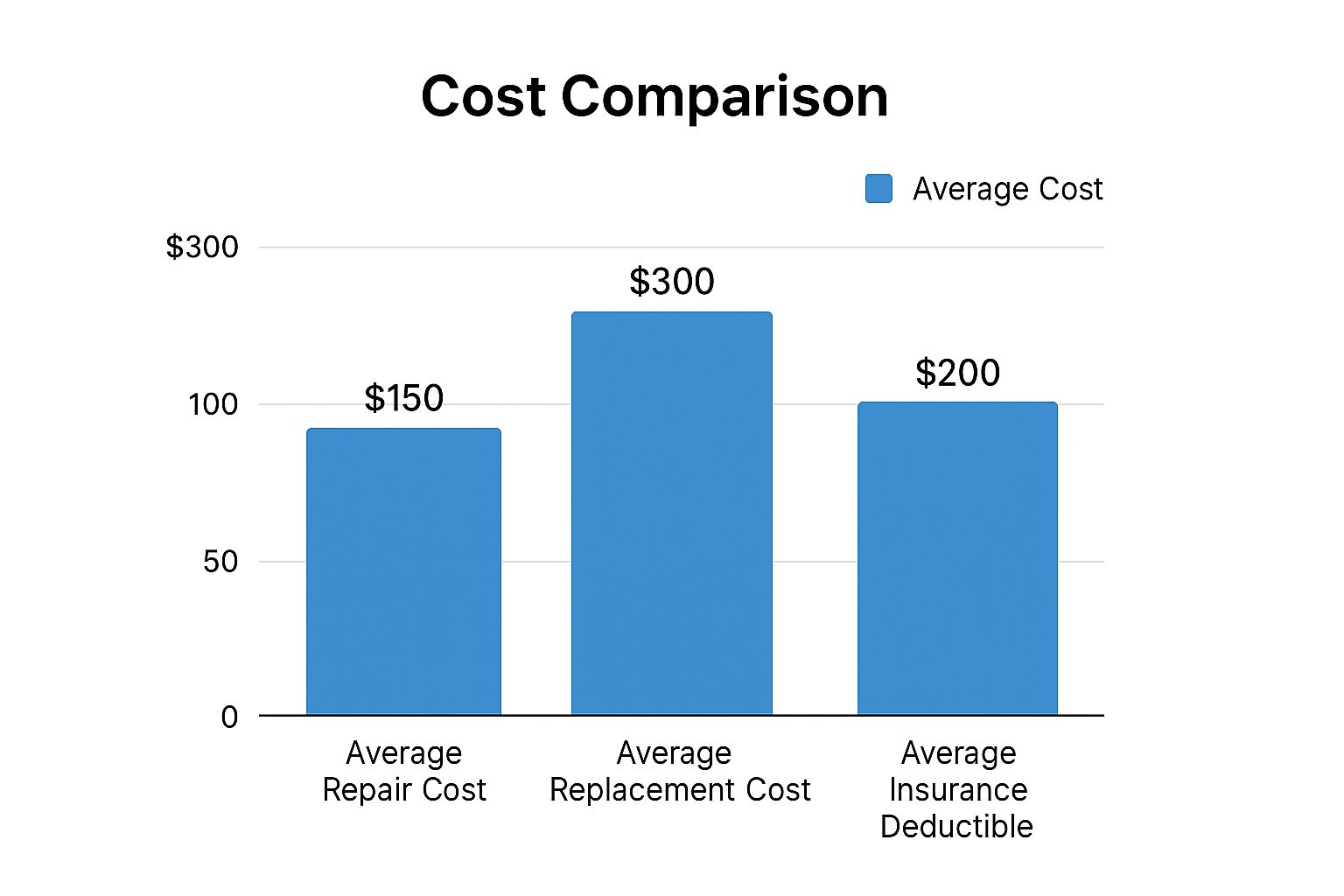
As you can see, a full replacement already costs quite a bit more than a simple repair, and that's just the starting point before we even factor in modern technology.
The ADAS Recalibration Factor
When a technician replaces a windshield on a car with ADAS, the job isn't done when the new glass is in place. There's a vital final step: recalibration.
Think of it like getting a new pair of prescription glasses. The lenses have to be perfectly set in the frames for you to see clearly. In the same way, the ADAS camera needs to be perfectly aligned with the car's new windshield to "see" the road correctly.
Even a tiny misalignment, as small as a single millimeter, can cause a safety system to misjudge distances. This could mean it fails to brake in an emergency or drifts out of its lane. That’s why professional recalibration isn't just a suggestion—it's an essential safety procedure.
To show the real-world cost difference, let's compare replacing a basic, older windshield to a modern one equipped with ADAS technology.
Cost Comparison Old vs New Windshield Technology
Feature | Standard Windshield (Older Car) | ADAS Windshield (Modern Car) |
|---|---|---|
Base Glass Cost | $200 - $400 | $400 - $800+ |
Sensors/Cameras | None | Rain Sensors, Light Sensors, Forward-Facing Camera |
Recalibration Required | No | Yes, mandatory for safety system function |
Specialized Labor | Standard Installation | Requires technicians trained in ADAS calibration |
Total Estimated Cost | $250 - $500 | $700 - $1,500+ |
This mandatory recalibration step adds significant time and requires specialized, expensive equipment, which is directly reflected in the final bill.
So, while an older car's windshield replacement might run you between $250 and $500, a modern vehicle with features like lane-keeping assist can easily push that cost well over $1,000. To get a better sense of what's involved, you can learn more about the specifics of ADAS windshield calibration in our detailed guide. It really breaks down why servicing these systems properly is so crucial for your safety.
Deciding Between a Quick Repair and a Full Replacement
Seeing a chip or crack in your windshield is frustrating, but it doesn't always mean you're in for a massive bill. In many cases, a simple, affordable repair is all you need to get back on the road safely. Knowing when you can get away with a repair versus when you truly need a full replacement is the key to managing costs without cutting corners on safety.
Luckily, you don't have to be a professional to get a good sense of what's needed. Technicians rely on a few straightforward guidelines to assess damage, and you can use them, too. Think of them as quick diagnostic checks you can do right in your driveway.
Quick Rules of Thumb
Two of the easiest and most common guidelines are the "quarter rule" for chips and the "dollar bill rule" for cracks. These are great real-world analogies that make it simple to size up the problem.
The Quarter Rule for Chips: If that rock chip or bullseye is smaller than a quarter, you're almost certainly in luck. A technician can inject a special resin that fills the void, restoring the windshield's strength and making the damage nearly invisible.
The Dollar Bill Rule for Cracks: Got a single crack running across the glass? If you can cover its entire length with a dollar bill (which is about six inches long), it's usually repairable. Anything longer than that starts to seriously threaten the structural integrity of the windshield.
Your windshield does more than just keep the wind out of your face. In a rollover accident, a properly installed windshield provides up to 60% of the vehicle's structural strength. A timely repair preserves this critical safety feature, while a full replacement restores it completely.
When Replacement Is a Must
While a repair is always the more wallet-friendly option, some situations simply demand a full replacement. In these cases, putting off the job isn't just risky—it's dangerous. A small issue can escalate into a major safety hazard in a heartbeat.
A full replacement is almost always non-negotiable if:
The damage is directly in the driver's line of sight. Even the best repairs can leave a slight distortion, which is the last thing you want obstructing your view of the road.
A crack runs to the edge of the windshield. These are notorious for spreading quickly, compromising the entire structure and the seal that holds it in place.
The damage is on a side or rear window. Unlike windshields, these are typically made from tempered glass. Once shattered, they can't be repaired; they have to be replaced.
Knowing the difference helps you make the right call for your car and your safety. To get a better feel for what’s involved in a bigger job, you can explore our complete guide on windshield replacement services and see what the process looks like from start to finish.
Using Insurance vs. Paying Out of Pocket
So you've got a cracked window, and the big question pops up: should you file an insurance claim or just handle the bill yourself? The truth is, the right move really boils down to your specific policy and the total car window repair cost.
A lot of drivers are surprised to learn that comprehensive insurance coverage often takes care of auto glass damage. Some insurers even sweeten the deal by waiving the deductible for small chip repairs. It's a smart move for them—they'd rather pay a little now than a lot more for a full replacement later.
But hold on, filing a claim isn't always a magic wand. You have to think about whether the upfront savings are worth a potential hike in your premium later. A single, minor glass claim probably won't send your rates soaring, but a pattern of claims might raise a red flag with your provider.
Key Questions for Your Insurance Agent
Before you decide anything, pick up the phone and talk to your agent. Guessing here can get expensive, so you need to ask some direct questions to get the full picture.
Knowing the specifics of your policy is the most important step. Don't assume you have glass coverage or that your deductible will be waived—verify everything with your provider first to avoid unexpected out-of-pocket expenses.
Here's a quick checklist of what you absolutely need to ask:
Do I have specific glass coverage? Find out if it’s part of your comprehensive plan or something you added on.
Is my deductible waived for a repair? You'll want to know if this only covers tiny chips or if it applies to larger cracks as well.
What is my deductible for a full replacement? If the repair bill is less than your deductible, paying out of pocket is a no-brainer.
Will this claim impact my rates or my no-claims discount? This is the million-dollar question. The answer will tell you the real long-term cost of filing the claim.
Once you have these answers, you can do a simple cost comparison and figure out which option truly saves you the most money.
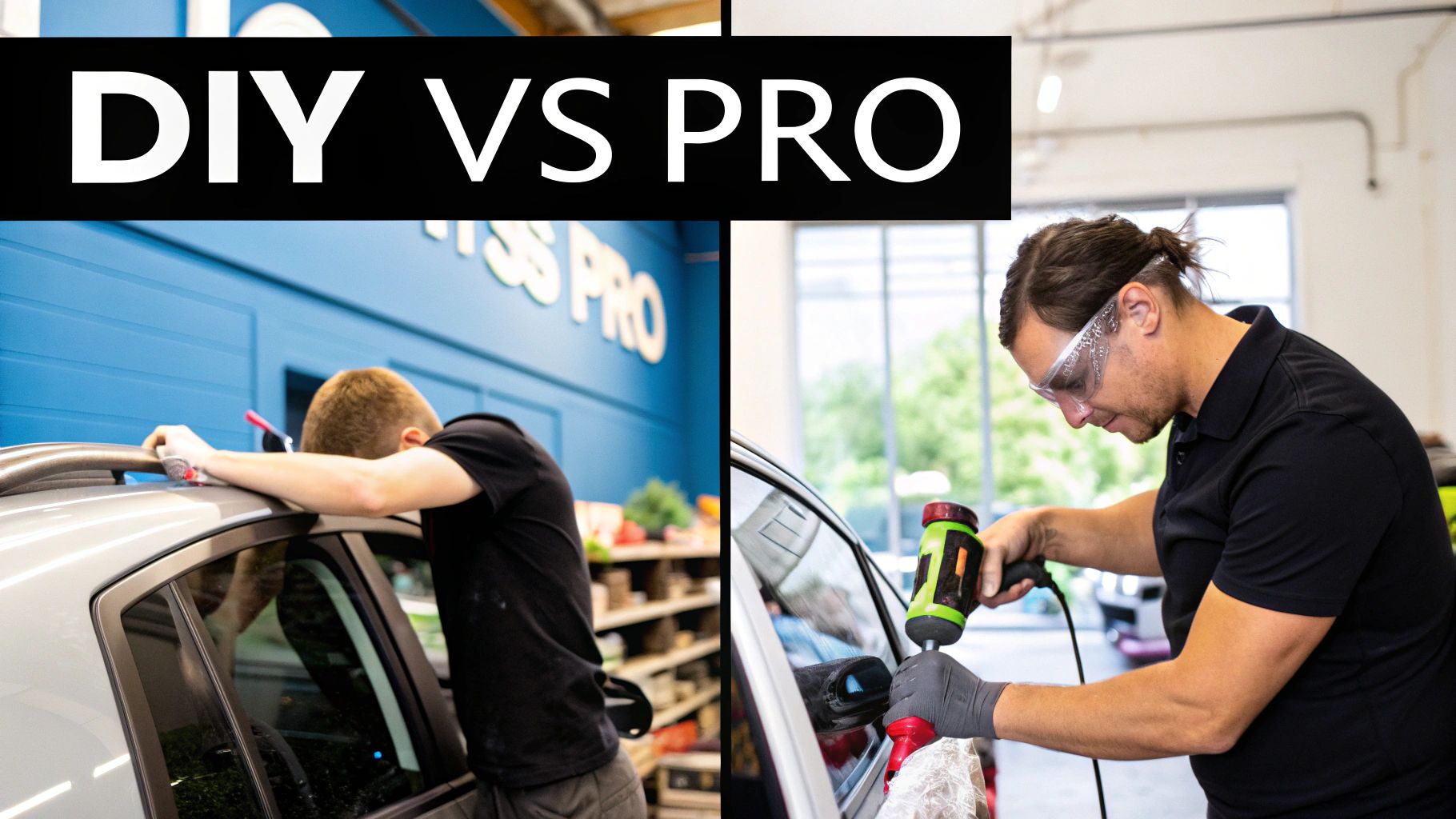
DIY Repair Kits vs. Professional Service
When you see a $20 DIY kit at the auto parts store, it's easy to think you've found a cheap and easy solution for that annoying rock chip. For a brand new, tiny nick, it can feel like a smart move. These kits give you a bit of resin and an applicator to fill the damage, hoping to stop it in its tracks.
But here's the reality: trying to fix auto glass yourself is a real gamble. It's kind of like using a Sharpie to hide a deep scratch on a beautiful oak table. From far away, it might fool someone, but get up close and the botched repair is all you can see. Worse, it might not even hold up.
The Risks of a DIY Fix
The real problem with those kits isn't just how the repair looks—it's what happens when it goes wrong. If you don't apply the resin perfectly or if it doesn't cure just right, the fix can fail. When that happens, the chip is often contaminated, making it impossible for a professional to properly repair it later. You’re then forced into a full, and much more expensive, replacement.
Even more importantly, a bad seal weakens the entire windshield. That glass is a critical part of your vehicle's structural support system, especially in a rollover crash. A compromised windshield is a serious safety hazard.
A failed DIY repair doesn't just look bad—it can permanently weaken your windshield. Once a chip is contaminated with a low-quality resin, professional technicians often cannot re-repair it, making a costly replacement your only safe option.
The Value of Professional Service
Choosing a professional is really an investment in your safety and your peace of mind. A trained technician doesn't just squirt some resin in a hole. They use high-strength, commercial-grade resins and specialized vacuum tools that suck every bit of air out of the chip. This creates a powerful, permanent bond that truly restores the glass's clarity and, most importantly, its structural strength.
Here’s what you're really paying for with a professional:
Guaranteed Results: Reputable shops almost always stand by their work with a warranty.
Specialized Equipment: Pros have the right tools to make the repair incredibly durable and nearly invisible.
Safety Assurance: They know exactly how to work on modern vehicles to maintain the glass's integrity, especially with all the ADAS cameras and sensors mounted to windshields these days.
This level of expertise is even more critical for side windows, which have complex internal mechanisms. If your door window is stuck or acting up, our guide to power window repair dives into why calling a pro is almost always the right call.
A Few Final Questions You Might Have
Even after breaking down the costs, you probably still have a couple of practical questions floating around. Let's tackle the most common ones people ask when dealing with window damage.
How Long Am I Stuck Without My Car?
This is usually the first thing people want to know! For a simple side window, a skilled technician can often have it swapped out in about an hour.
A windshield is a different story. The actual replacement process typically takes 1 to 2 hours. But the crucial part is letting the adhesive cure. You can't just drive off immediately. Most shops will tell you to wait at least another hour—sometimes longer—to make sure that new windshield is properly bonded and secure.
Will a Cracked Windshield Actually Fail My State Inspection?
In a lot of places, yes, it’s an automatic fail. Most state inspection laws have strict rules about damage in the driver's line of sight. Even a small chip or crack right in front of you can get your car flagged.
Damage along the edges can also be a problem, as it can weaken the entire structure of the windshield. Your best move is always to get the damage fixed before heading in for an inspection. It saves you the headache of a failed test and a potential ticket.
It’s worth repeating: it is always, always cheaper to fix a small chip right away. A quick resin repair might only set you back $50, but letting that chip turn into a spiderweb crack will mean a full replacement costing hundreds more. A little bit of prevention goes a long way.
Don't let a tiny chip grow into a huge bill. The expert mobile technicians at Auto Renu Auto Glass LLC come directly to you, providing fast, reliable repairs and replacements across the Bay Area. Get your free, no-obligation estimate today!