When to Replace Windshield: Signs You Should Know
Learn when to replace windshield with our expert guide. Identify damage and safety risks to decide if repair or replacement is needed. Click to learn more!
Sep 27, 2025
generated
when to replace windshield, windshield repair, auto glass, car safety, vehicle maintenance
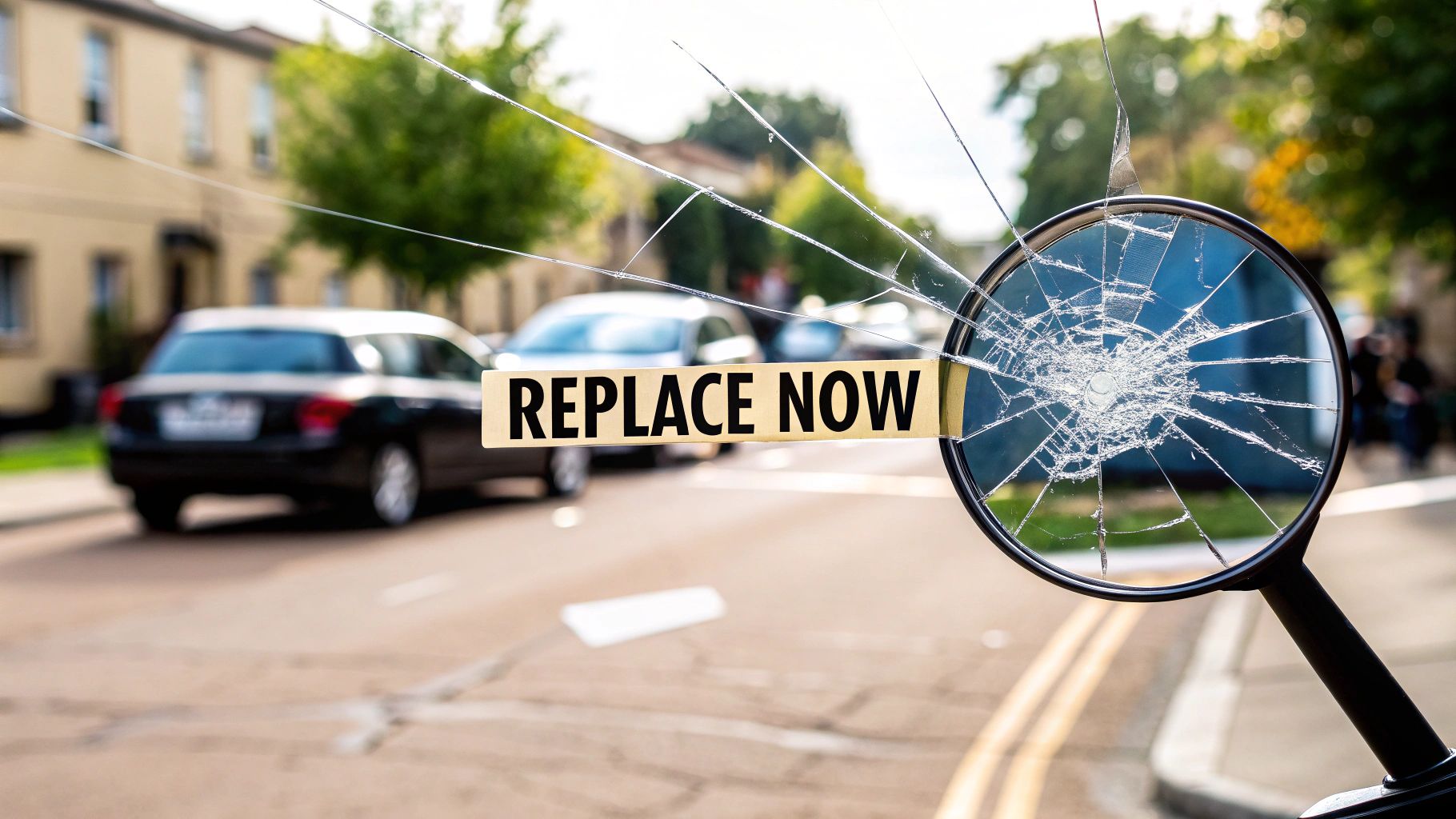
When you're staring at a fresh chip or a growing crack in your windshield, the big question is always the same: can this be fixed, or do I need a whole new one?
The answer really boils down to four things: the type of damage, its size, its location, and your car's technology. A massive crack, a chip right in your line of sight, or any flaw that weakens the glass usually means it's time for a full windshield replacement.
Your Quick Guide to Windshield Replacement Decisions
It’s easy to underestimate your windshield. We tend to see it as just a shield against wind and bugs, but it's a huge part of your car's safety system. It's a key piece of your vehicle's structural integrity, helping to support the roof if the car rolls over and making sure your airbags deploy properly in a crash.
When that integrity is compromised, you're compromising your safety. That’s why knowing the warning signs is so important.
Making the Right Call
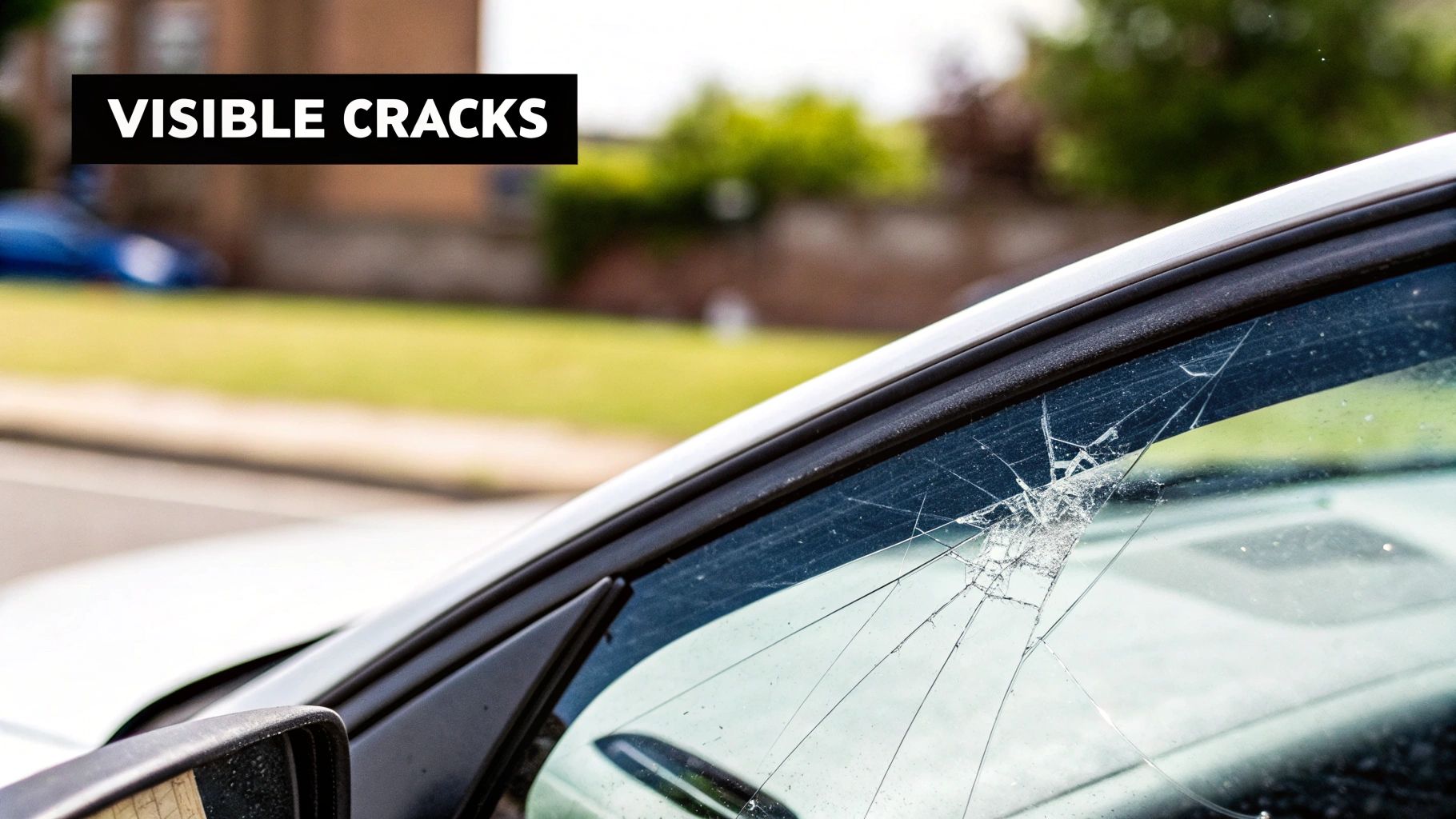
A good rule of thumb I always share with people is the "dollar bill test." If a crack is longer than a dollar bill, a replacement is almost always the only safe option. The same goes for chips—if it's bigger than a quarter, you're looking at a replacement.
Location is just as critical. Any damage directly in the driver's line of sight is a major red flag. Even a perfect repair can leave behind a small distortion, almost like looking through a ripple in water. That slight imperfection is enough to distract you at the worst possible moment.
Here's a straightforward chart to help you quickly size up the situation.
Repair vs Replacement Quick Reference Chart
Use this chart for a quick comparison of common windshield damage scenarios to help you decide between a repair or a full replacement.
Damage Factor | Repair is Likely Possible If... | Replacement is Necessary If... |
|---|---|---|
Size | The chip is smaller than a quarter. The crack is shorter than a dollar bill. | The chip is larger than a quarter. The crack is longer than 6 inches. |
Location | Damage is outside the driver's direct line of sight. | Damage is directly in the driver's line of sight, impairing vision. |
Depth | The damage hasn't penetrated both layers of the laminated glass. | The crack or chip is deep and has gone through the inner layer of glass. |
Placement | The damage is at least 2-3 inches away from the edge of the windshield. | The crack starts or ends at the edge of the windshield, weakening the seal. |
This chart is a great starting point, but always consult with a professional if you're unsure.
Your windshield provides up to 60% of your vehicle's cabin strength in a rollover accident. A compromised windshield significantly reduces this protection, making a timely replacement a critical safety decision.
Ultimately, knowing the difference between a minor inconvenience and a serious safety hazard puts you in control. The factors in the chart above are what technicians look at every day, and we'll dive deeper into each one to give you a complete picture.
It’s easy to think all windshield damage is the same, but that couldn’t be further from the truth. Learning to tell the difference between a simple pit and a serious break is the first step toward making the right call. It's a bit like a doctor assessing an injury; you wouldn't treat a minor scrape the same way you'd treat a deep fracture.
Getting a handle on the specific kind of damage you're facing is key. It helps you understand the real risk and how quickly you need to act, since each type has its own personality and a different tendency to spread across your line of sight.
What Do Those Chips and Cracks Actually Mean?
Most windshield problems start small, usually as a chip from a rock or some other road debris kicked up by the car in front of you. But even chips come in a few different flavors, and some are much more serious than others.
Bullseye: This is the classic rock chip. It looks exactly like its name implies—a dark, cone-shaped circle with a clear impact point, almost like a tiny target. If it's small and not directly in your view, a bullseye is often a straightforward repair.
Star Break: A star break is more concerning. You'll see a central impact point, but with little cracks, or "legs," shooting out from it in a starburst pattern. Those legs are a huge red flag because they're prone to spreading, especially when temperatures swing from hot to cold.
Combination Break: Think of this as the worst of both worlds—it’s a mix of a bullseye and a star break. You get the dark circle in the middle, but you also have those telltale cracks radiating outward. This complex damage creates a major weak spot, and more often than not, replacement is the only safe bet.
The Sneaky Threat of Stress Cracks
Beyond the obvious dings from flying debris, you also need to keep an eye out for stress cracks. These are fractures that seem to appear out of nowhere, with no clear point of impact. They usually creep in from the edge of the windshield. A sudden, extreme temperature change is a common culprit—think about pouring hot water on an icy windshield on a freezing morning.
Think of a stress crack like a tiny fault line in the glass. It might look harmless at first, but it’s under constant pressure from road vibrations and temperature shifts, making it a ticking time bomb that could suddenly race across the entire windshield.
Because stress cracks point to a fundamental weakness in the glass, they're almost always a sign that a full replacement is needed. Trying to ignore one is a big risk, as it seriously undermines the structural integrity that protects you in a crash. Once you can spot these different damage patterns, you’ll know exactly what you’re up against.
Size and Location: The Two Most Critical Factors
When you're staring at a new chip or crack in your windshield, two questions immediately determine what happens next: How big is it, and where is it? Everything else is secondary.
Think of your windshield as a single, cohesive unit. A small bit of damage in the wrong place can be far more dangerous than a larger one somewhere less critical. It’s not just about what looks bad; it’s about what compromises the safety and integrity of the glass.
The "Dollar Bill" and Quarter Test
Over the years, auto glass experts have developed a few simple, go-to rules to help drivers make a quick assessment. The most famous one is the "dollar bill rule." Just pull a dollar bill out of your wallet. If the crack is longer than that bill (which is about six inches), you're almost certainly looking at a replacement.
For smaller dings like chips or "bullseyes," the magic object is a quarter. If the damaged area is bigger than a quarter, a repair usually won't hold, and replacement is the safest bet. These aren't just arbitrary rules; they're based on the limits of what repair resins can reliably fix without weakening the glass.
The Driver's Line of Sight is a No-Go Zone
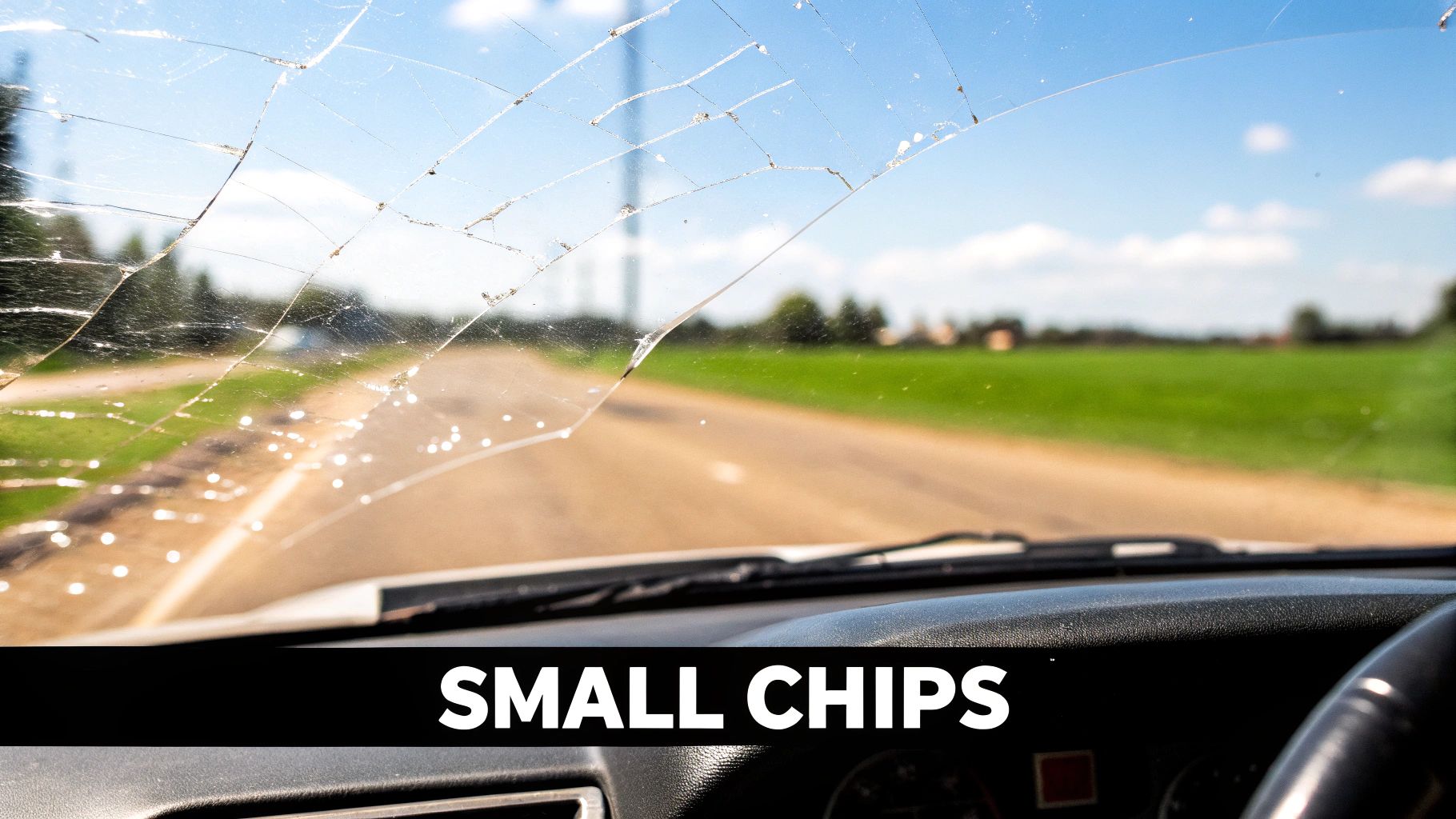
There's one patch of glass that's more important than any other: the Driver's Primary Viewing Area (DPVA). This is the rectangular section directly in front of your eyes, about the width of your steering wheel, that you look through 99% of the time you're driving.
Any damage here—no matter how small—is a major red flag.
Even the best resin repair will leave a tiny amount of distortion in the glass. It might look like a faint wave or a minuscule blur. While it seems harmless, that little imperfection can catch the sunlight and create a sudden glare, or momentarily obscure your view of a pedestrian or another car. It's a risk that's just not worth taking.
Because your vision has to be perfect, any chip, crack, or star break inside the DPVA is almost always an automatic replacement. When it comes to the driver's direct line of sight, there's zero room for compromise.
Damage That's Simply Beyond Repair
Putting the driver's view aside, some types of damage are just too severe to fix safely, regardless of where they are. While guidelines can vary slightly, most safety standards—like those detailed in this automotive glass market research report—point to replacement for cracks longer than 6 to 12 inches. The structural integrity is just too compromised at that point.
Here are a few other scenarios where a repair is off the table:
Cracks on the Edge: If a crack starts right at the edge of the windshield or runs all the way to it, the problem is bigger than the glass. This kind of damage weakens the crucial seal that holds the windshield in place, affecting the entire vehicle's structural stability.
Deep Pits or Internal Damage: Your windshield is made of two layers of glass with a plastic interlayer. If the damage goes through the outer layer and has started to affect that inner layer, it can't be repaired.
Dirty, Old Damage: A chip or crack that's been sitting there for weeks has likely collected dirt, road grime, and moisture. This contamination prevents the repair resin from bonding cleanly to the glass, making any fix unreliable and temporary at best.
How Modern Car Technology Changes the Rules
If you’re driving a car from the last decade, its windshield is much more than a simple piece of safety glass. Back in the day, a windshield's only job was to block wind and debris. Now, it's a core component of your car's most advanced safety features, completely rewriting the playbook on when to replace a windshield.
Think of your modern windshield as the eyes for your car's brain. Many new vehicles are packed with Advanced Driver Assistance Systems (ADAS). These are the smart features that watch your back, like lane-keeping assist, adaptive cruise control, and automatic emergency braking. The high-tech cameras and sensors that power these systems are usually mounted right on the windshield, peering through the glass to read the road ahead.
Why a Small Chip Is a Big Deal for ADAS
When damage lands in the direct line of sight of an ADAS camera, it's like getting a smudge on your glasses. A seemingly minor chip or a hairline crack can distort what the camera sees, causing it to misread lane markings, other vehicles, or even pedestrians. This could lead to the system failing at a critical moment or, worse, reacting when it shouldn't.
Even a high-quality repair can leave behind a tiny optical distortion in the resin. While the glass might be structurally sound, that slight imperfection is often enough to confuse the sensitive ADAS sensors. For this reason, any damage located in front of a camera almost always requires a full windshield replacement. It's the only way to guarantee your safety technology will work as designed.
The Critical Step of Recalibration
Putting in a new windshield on an ADAS-equipped car is a two-step process. The glass installation is just the first part. The second, and equally important, part is recalibration.
After a new windshield is fitted, the ADAS cameras and sensors have to be professionally recalibrated. This procedure essentially re-teaches the system, aligning its sensors to the precise position and optics of the new glass so its view of the world is perfectly accurate.
The data shows just how crucial this has become.
In 2022, the U.S. auto glass industry’s ADAS calibration market hit an estimated $959 million. That same year, about 3.8 million windshield replacements required recalibration, underscoring just how integrated this technology has become.
Skipping recalibration is like getting a new pair of prescription lenses but never having them set properly in the frames—you simply won't see clearly. It's a non-negotiable step to ensure your car's safety features are fully functional.
To get a deeper understanding of this vital procedure, take a look at our detailed guide on ADAS windshield calibration.
Understanding the Safety and Legal Implications
It’s easy to think of your windshield as just a barrier against wind and rain, but it’s so much more than that. It’s a highly engineered safety component, and many drivers don't realize it provides a huge chunk of your car's structural strength. Think of it as a main pillar holding up the roof.
In a serious rollover accident, a solid, properly installed windshield is what keeps the roof from caving in on you. It's designed to maintain that crucial space inside the cabin. A compromised windshield, on the other hand, can shatter and fail under that kind of pressure, dramatically increasing the risk of severe injury.
There’s another critical job your windshield has: airbag deployment. When your passenger-side airbag goes off, it actually bounces off the windshield to inflate correctly toward the passenger. If the glass is cracked or improperly sealed, it might not handle the explosive force. The airbag could deploy improperly, making it far less effective when you need it most.
Staying on the Right Side of the Law
Beyond the very real safety concerns, driving around with a damaged windshield can land you in legal hot water. The specific laws vary from state to state, but pretty much all of them have rules against driving with an obstructed view. That means a crack or chip right in your line of sight is a perfect reason for a police officer to pull you over and write a ticket.
A damaged windshield isn't just a cosmetic issue—it's a failure of a primary safety system. Delaying a necessary replacement means knowingly driving a vehicle that is structurally weaker and less prepared to protect you in a collision.
These rules aren't just enforced during traffic stops. A significant crack is often an automatic fail during routine vehicle inspections, forcing you to get a replacement before your car can be considered roadworthy. While the exact definition of illegal damage might differ, the principle is always the same: the driver needs a clear, unobstructed view of the road.
The Growing Importance of Windshield Integrity
With a global push for better vehicle safety, the integrity of windshields has become a major focus, and it’s driving serious market growth. In 2023, the automotive windshield market was valued at nearly USD 29.74 billion worldwide.
This growth isn't just a coincidence; it's fueled by increasingly strict safety regulations that require replacements for damage that goes beyond a certain point. You can dig into the numbers yourself by checking out this global automotive windshield market analysis.
At the end of the day, knowing when to replace a windshield is about protecting yourself, your passengers, and your driving record.
Making the Final Call: Repair vs. Replacement
So, you've looked at the chip, sized it up, and considered where it is on the glass. You now have everything you need to confidently decide whether it's time for a simple repair or a full-on windshield replacement. Think of it as your final diagnostic checklist before picking up the phone.
This simple decision tree lays out the key factors we've covered, showing how things like the size of the damage and its location point you toward a clear answer.
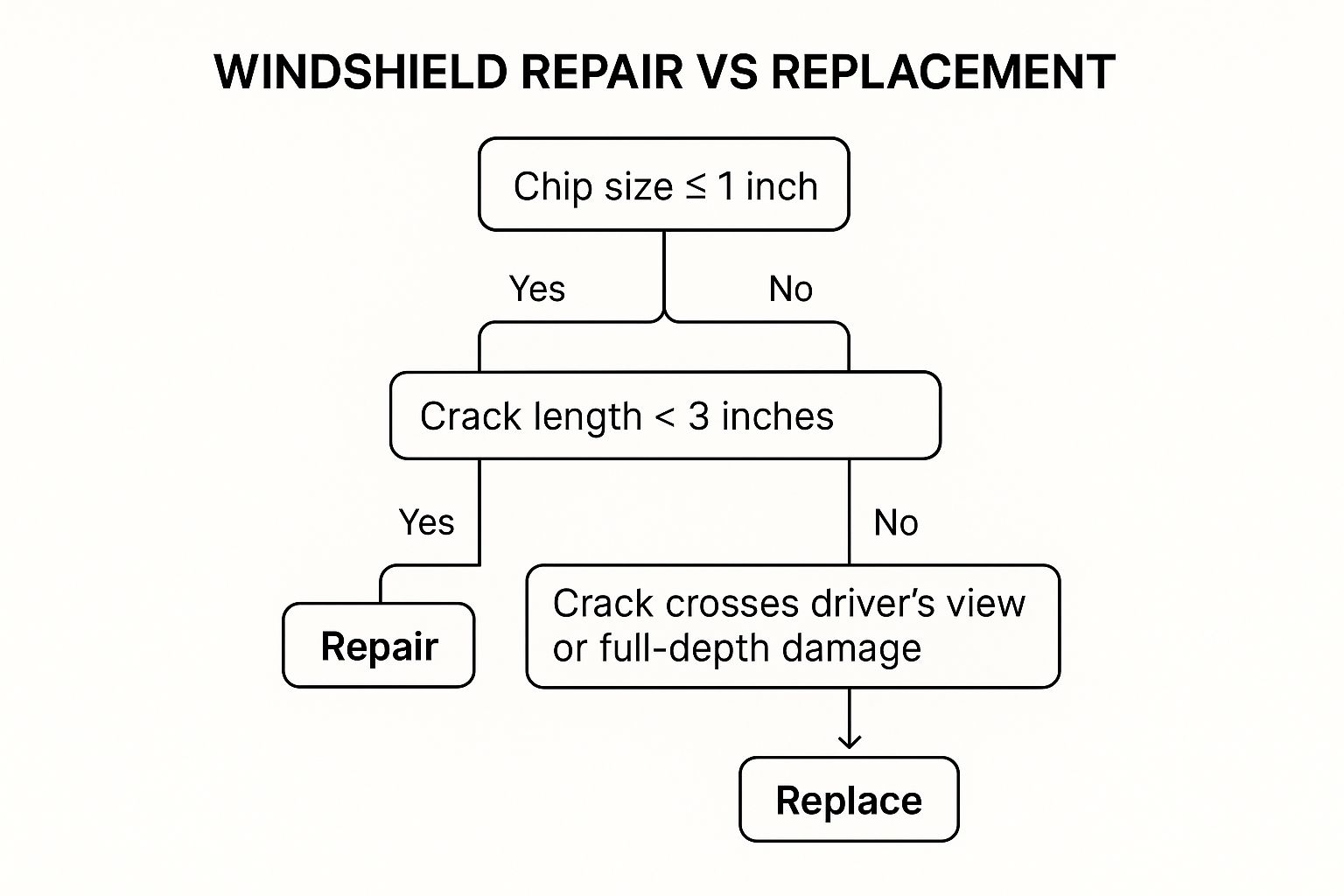
As you can see, a small chip or a short crack can often be repaired. But once that damage creeps into the driver's line of sight or goes deep into the glass, a replacement is almost always the only safe option.
Factoring in Cost and Insurance
Of course, cost is a big part of the equation. A full replacement will always cost more out-of-pocket than a quick fix, but your insurance can really change the math.
Many comprehensive insurance policies will cover the full cost of a repair, often waiving your deductible entirely. It's their way of encouraging you to fix small problems before they become big ones.
For a replacement, you’ll likely have to pay your comprehensive deductible. It's tempting to put it off, but that's a risky bet. An ignored crack can lead to a failed vehicle inspection, a ticket, or worse—a dangerous structural failure in an accident.
A prompt decision is always the most cost-effective one. A small, repairable chip can quickly grow into a large crack that demands a full replacement, turning a potentially free fix into a more significant expense.
If the damage is minor and ticks all the boxes for a safe fix, that’s a fantastic, affordable option. To see exactly what that involves, you can learn more about professional windshield repair.
Ultimately, you're now armed with the right information. You can call an auto glass expert with a clear idea of what your car needs, ensuring you get a solution that’s both safe and smart for your wallet.
Answering Your Top Windshield Questions
Deciding to replace your windshield is one thing, but it’s natural to have questions about what happens next. You're probably wondering about the time, the cost, and the type of glass being used. Getting straight answers to these questions will help you feel much more confident about the process.
Let's walk through some of the most common things people ask when they're in your shoes.
How Long Does the Process Take?
I get it—you need your car back. The big question is always, "How long will I be without my vehicle?" You'll be happy to know it’s usually a pretty quick turnaround.
The actual hands-on work of removing the old windshield and installing the new one typically takes a professional about 60 to 90 minutes.
The real waiting game, though, is for the adhesive to cure. This is the critical step. The urethane sealant needs time to fully set and bond the glass to your car's frame, which is essential for your safety. Depending on the type of adhesive and the day's weather, you'll need to wait at least another hour. Your technician will give you a specific "safe drive-away time" so there's no guesswork.
Will Insurance Cover the Cost?
The thought of an unexpected bill is stressful, but this is where your insurance can be a huge help. Most of the time, filing a claim for windshield damage won't make your premium go up.
Here's the breakdown:
It's a "No-Fault" Thing: Windshield damage usually falls under your comprehensive coverage. This is the part of your policy that handles incidents you can't control, like a rock flying up from the road or a tree branch falling.
Deductibles Might Not Apply: Many states actually have laws requiring insurance companies to waive the deductible for simple repairs. For a full replacement, you'll likely just have to cover your comprehensive deductible, which is often much less than the total cost.
You should always double-check your own policy, of course, but don't assume the worst. A quick call to your agent can clear things up.
Before you pay out-of-pocket for a new windshield, always check with your insurance provider. A single phone call could clarify your coverage and end up saving you hundreds of dollars.
Is OEM Glass Really Better?
You'll likely hear two terms thrown around: OEM and aftermarket. OEM stands for Original Equipment Manufacturer, which means the glass is made by the same company that supplied the windshield for your car when it was first built. Aftermarket glass is made by a different company but is designed to meet the same safety standards.
So, what's the difference? While a high-quality aftermarket windshield is perfectly safe, OEM glass is a guaranteed 1-to-1 match. It ensures the exact same fit, clarity, and quality as the original. This is especially important for modern cars loaded with ADAS (Advanced Driver-Assistance Systems), as the cameras and sensors mounted on the windshield demand the precise calibration that OEM glass provides.
Dealing with a damaged windshield can feel like a hassle, but it doesn't have to be a headache. For expert advice and convenient, reliable mobile service in the Bay Area, trust the team at Auto Renu Auto Glass LLC. We come directly to you and manage everything from the replacement itself to the insurance paperwork. Get your free quote today by visiting us at https://www.autorenu911.com.