
Replace auto glass windshield: Quick Guide to Repair and Replacement
Thinking about replace auto glass windshield? Learn when repair beats replacement, the steps involved, ADAS recalibration, costs, and insurance options.
Feb 4, 2026
generated
replace auto glass windshield, windshield replacement, mobile auto glass, adas recalibration, auto glass repair
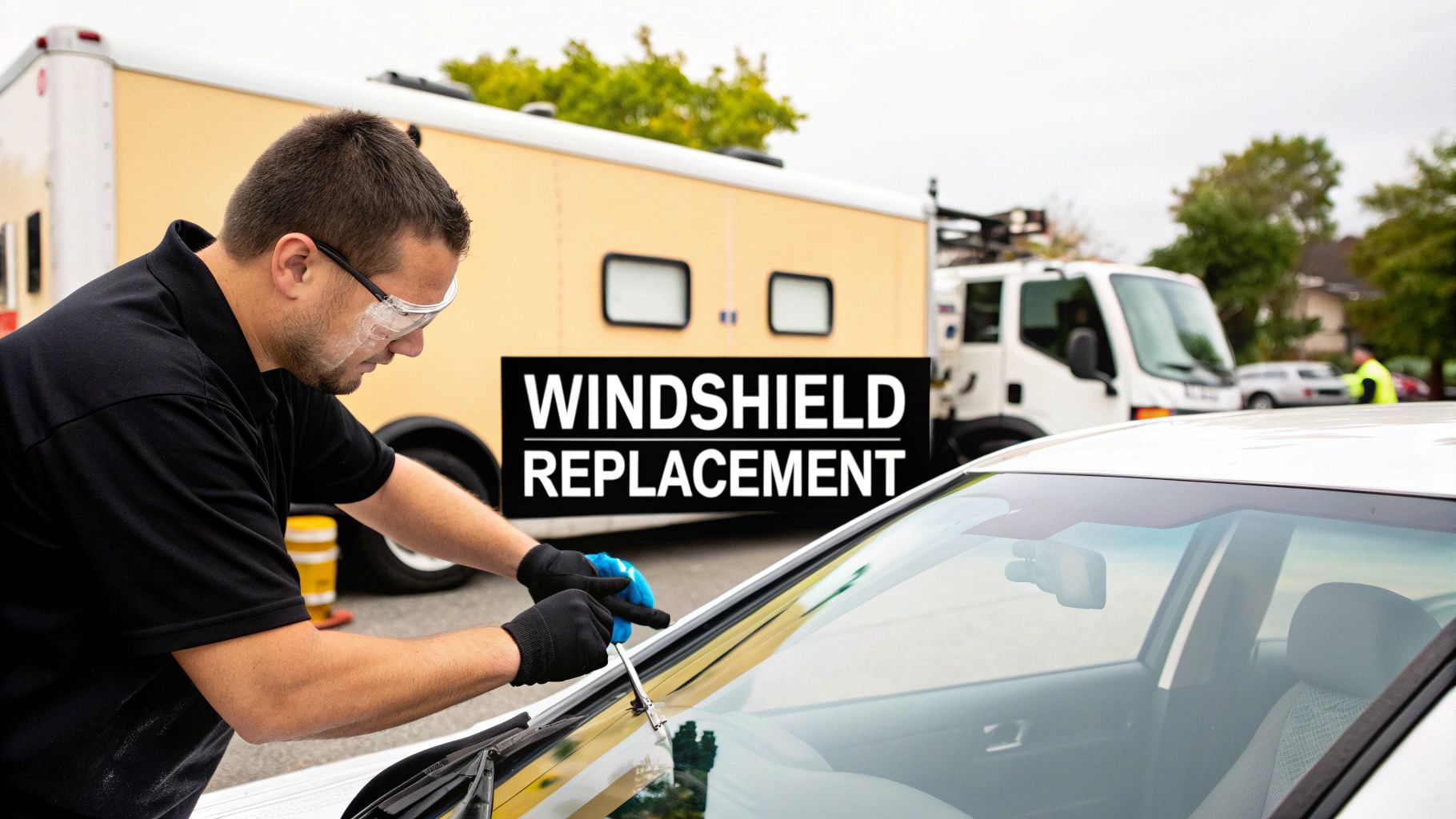
That little rock chip on your windshield can be a real headache. Is it a quick fix, or are you looking at a full replacement? Making the right call is about more than just looks—it’s a critical safety decision. A small chip might be an easy repair, but a larger crack often means you need to replace auto glass windshield to keep your car safe and structurally sound.
Deciding Between Windshield Repair and Replacement
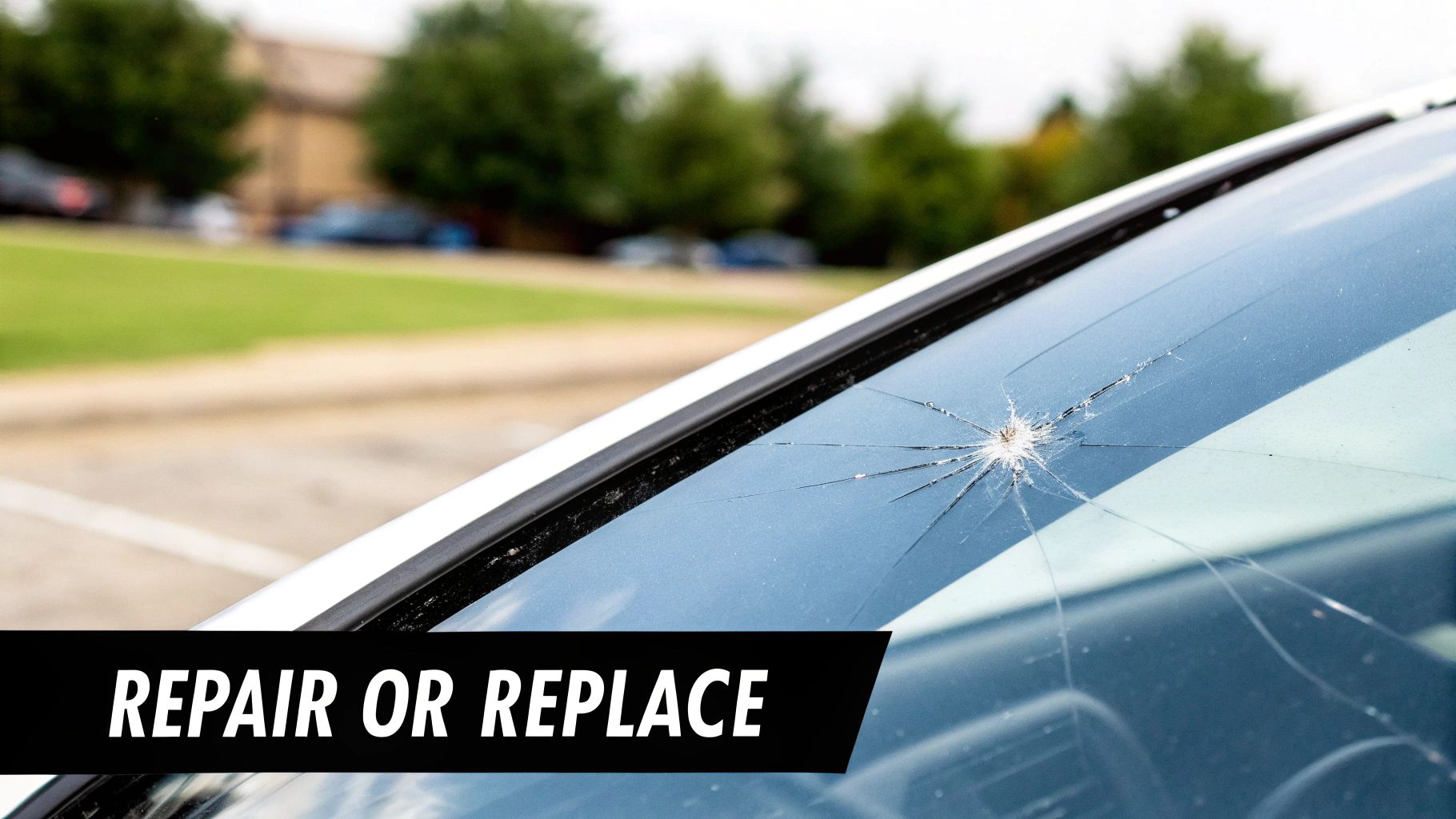
It’s tough to tell at a glance if that new damage is a minor issue or a major liability. Here’s a simple way to think about it: a small, contained chip is like a pothole. You can fill it, smooth it over, and you're good to go. But a long, spreading crack? That's more like a sinkhole forming under the road. A simple patch job just won't cut it; you need to rebuild to ensure it's safe.
Most people don't realize that their windshield does a lot more than just block the wind. It’s a key safety feature, providing up to 30% of your vehicle's structural strength in a rollover. It also ensures your airbags deploy correctly in a collision. That’s why getting the repair-or-replace decision right is so vital.
The Limits of Simple Repairs
You've probably heard of the "dollar bill rule"—if the damage fits under a dollar bill, it can be repaired. It's a handy guideline, but it’s not the whole story. The truth is, a tiny chip can be a big problem depending on its location and depth.
There are a few clear-cut situations where a full replacement is the only safe option:
Location: Any chip or crack directly in the driver’s line of sight is a deal-breaker. Even the best repairs can leave a slight distortion, and you can't afford any obstruction to your view of the road.
Size and Type: Cracks longer than a few inches, a cluster of multiple chips, or complex "star breaks" with legs spreading out have already weakened the glass too much for a simple resin fill to be effective.
Edge Cracks: If the damage starts at or runs to the edge of the windshield, its structural integrity is shot. These cracks are notorious for spreading quickly with temperature changes or even just from normal road vibrations.
A windshield's number one job is to protect you. While a repair is great for minor dings, it can't restore the original factory strength lost from a significant crack. Choosing to replace your auto glass windshield is the only way to guarantee your vehicle's safety systems will perform as they were engineered to.
Quick Guide Repair vs Replacement
This checklist can help you quickly assess whether your windshield likely needs a simple repair or a full replacement. Of course, a professional evaluation is always best, but this gives you a great starting point.
Damage Factor | Usually Repairable | Often Needs Replacement |
|---|---|---|
Size | Small chips (quarter-sized) or single cracks under 3 inches | Cracks longer than a dollar bill or multiple chips |
Location | Away from the driver's direct line of sight | Directly in the driver's line of sight or near ADAS sensors |
Position | Damage is not near the edge of the glass | Crack starts at or spreads to the edge of the windshield |
Depth | The impact did not penetrate both layers of glass | The damage goes through more than the outer layer of glass |
Understanding these factors helps clarify why a technician might recommend one solution over the other. For a more detailed breakdown, you can learn more about when to replace your windshield in our detailed guide.
So, What Really Happens During a Windshield Replacement?
Ever wondered what goes on behind the scenes when you get a new windshield? It’s a lot more involved than just popping out the old glass and sticking in a new one. Think of it more like a surgical procedure for your car—every single step is done with precision to make sure your vehicle is safe and structurally sound.
A true professional doesn't just rush through the job. They follow a detailed, methodical process to protect your car, prepare the frame, and install the new windshield so it’s as good as the factory seal. Let's walk through exactly how we get it done right.
Step 1: Your Car Gets Full Protection
Before a single tool comes out, our first job is to protect your vehicle. We carefully drape protective coverings over your hood, fenders, and the inside of your car, including the dashboard and seats. This isn't just for show; it guarantees that no stray adhesive, tools, or debris can cause an accidental scratch or stain.
This simple, upfront step is the hallmark of a team that respects your property. We're not just there to fix the glass; we're there to return your car to you in pristine condition.
Step 2: Carefully Removing the Damaged Windshield
Next, we get to work on removing the old, damaged glass. This is a delicate operation, not a demolition job. Our technicians use specialized tools to slice through the tough urethane adhesive that seals the windshield to the car's body. The main goal here is to get the old glass out without harming the pinch weld—that’s the metal frame your windshield sits in.
Why is this so important? Any damage, like a dent or a scratch, to the pinch weld can ruin the new seal. That's what leads to frustrating leaks and wind noise later on. A clean removal is the foundation for a perfect installation.
Your windshield isn't just a window. It’s a crucial safety feature that provides up to 60% of your vehicle's cabin strength in a rollover and helps your airbags deploy correctly. A professional replacement restores that critical structural bond, keeping you safe.
Step 3: Prepping the Frame for a Rock-Solid Bond
Once the old windshield is out, we shift our focus to preparing the frame. The technician meticulously scrapes away every last bit of the old urethane, cleaning the pinch weld until it's absolutely spotless. The surface has to be perfectly smooth and free of any dirt, dust, or moisture.
Then, we apply a special primer directly to the pinch weld. This does two things: it protects the bare metal from rust and helps the new adhesive form an incredibly strong bond. Any shop that skips this step is cutting a major corner, and that can lead to total installation failure.
Step 4: Applying a Professional-Grade Adhesive
Now for one of the most important parts of the whole process: the adhesive. We use a high-quality polyurethane, or urethane, and apply a thick, consistent bead all the way around the pinch weld. Our technicians control the height and shape of this bead with expert precision to create a seal that’s completely watertight and airtight.
The quality of this urethane is non-negotiable. Here at Auto Renu Auto Glass LLC, we only use adhesives that meet or exceed federal safety standards. This ensures your new windshield gives you the exact same structural support it had when it rolled off the assembly line.
Step 5: Setting the New Windshield with Precision
With the frame ready, it's time to place the new, OEM-quality windshield. Using powerful suction cups for a steady grip, our technicians carefully lower the glass into position, lining it up perfectly with your car's frame. It takes a steady hand and a trained eye, because even being off by a fraction of an inch can compromise the seal.
Once the glass is set, we apply gentle pressure to ensure it makes solid contact with the urethane all the way around. Then we get to work reinstalling your rearview mirror, any sensors, and the surrounding moldings.
Step 6: The Final Check and Curing Time
We’re not done until we've double-checked everything. The technician does a final, thorough inspection from inside and outside your car, making sure the seal is flawless and the glass is seated correctly. We'll also clean your new windshield and the interior of your car before we hand back the keys.
Finally, we'll give you the safe drive-away time. This is the minimum amount of time the urethane needs to cure before it's strong enough to handle the stresses of driving. It’s usually about an hour, but it’s absolutely critical for your safety that you wait for the adhesive to be ready.
Why ADAS Recalibration Is a Must-Do After Replacement
Your car's windshield isn't just a piece of glass anymore. In most modern vehicles, it’s a critical component of your safety system, acting as the mounting point for the cameras and sensors that run your Advanced Driver-Assistance Systems (ADAS). When you get a new windshield, you're not just swapping glass—you're temporarily unplugging your car's eyes.
Think of it like this: your car's forward-facing camera is like a high-powered telescope perfectly zeroed in on the stars. If you move the telescope even a millimeter, the view is thrown off completely. The same thing happens when a new windshield is installed. Even a perfect fit can slightly change the camera's position, and that tiny shift is enough to disrupt its perception of the road.
This is a bigger deal than it sounds. Safety features you rely on every day, like automatic emergency braking, lane-keeping assist, and adaptive cruise control, all depend on that camera's precise view. Without recalibration, these systems can get confused, fail to work when you need them most, or even make dangerous mistakes.
The Two Ways We Get Your Car's Vision Back to 20/20
Recalibration is simply the process of re-aligning the ADAS camera so it sees the world exactly as the manufacturer designed it to. Our technicians use two main methods, and the one we choose depends entirely on your vehicle's make and model.
Static Recalibration: This is done right here in our shop, in a controlled setting. We set up a specific target board in front of your vehicle at an exact distance and height. Then, we plug into your car's computer and tell the camera, "This is your new center point."
Dynamic Recalibration: This one involves a test drive. We take your vehicle out on clearly marked roads and drive at certain speeds, allowing the ADAS system to "re-learn" its surroundings by reading the lane lines in real-time. Sometimes, a vehicle requires both static and dynamic recalibration.
Here at Auto Renu Auto Glass LLC, our certified technicians are experts in both methods. We follow the manufacturer's specifications to the letter, ensuring every safety feature is brought back to its original factory settings. For us, this isn't an optional add-on; it's a critical part of the job.
Why You Can't Afford to Skip This Step
Putting off ADAS recalibration after a windshield replacement is a gamble you don't want to take. A misaligned camera could fail to see a stopped car ahead, causing your automatic braking to engage too late or not at all. It could also misread lane lines, causing the car to drift or jerk unexpectedly.
Skipping recalibration is like getting new prescription glasses but not having an eye doctor fit them to your face. You might be able to see, but everything will be a little off, and that distortion can lead to big problems.
The technology behind this is a big reason why the U.S. automotive windshield market is projected to hit $4.38 billion by 2026. Modern windshields with embedded tech are just more complex, which is why you need a specialist who knows how to handle the glass and the electronics behind it. You can read more about these market trends on Fortunebusinessinsights.com.
This diagram breaks down the key phases of a professional replacement, with recalibration being the essential final step.
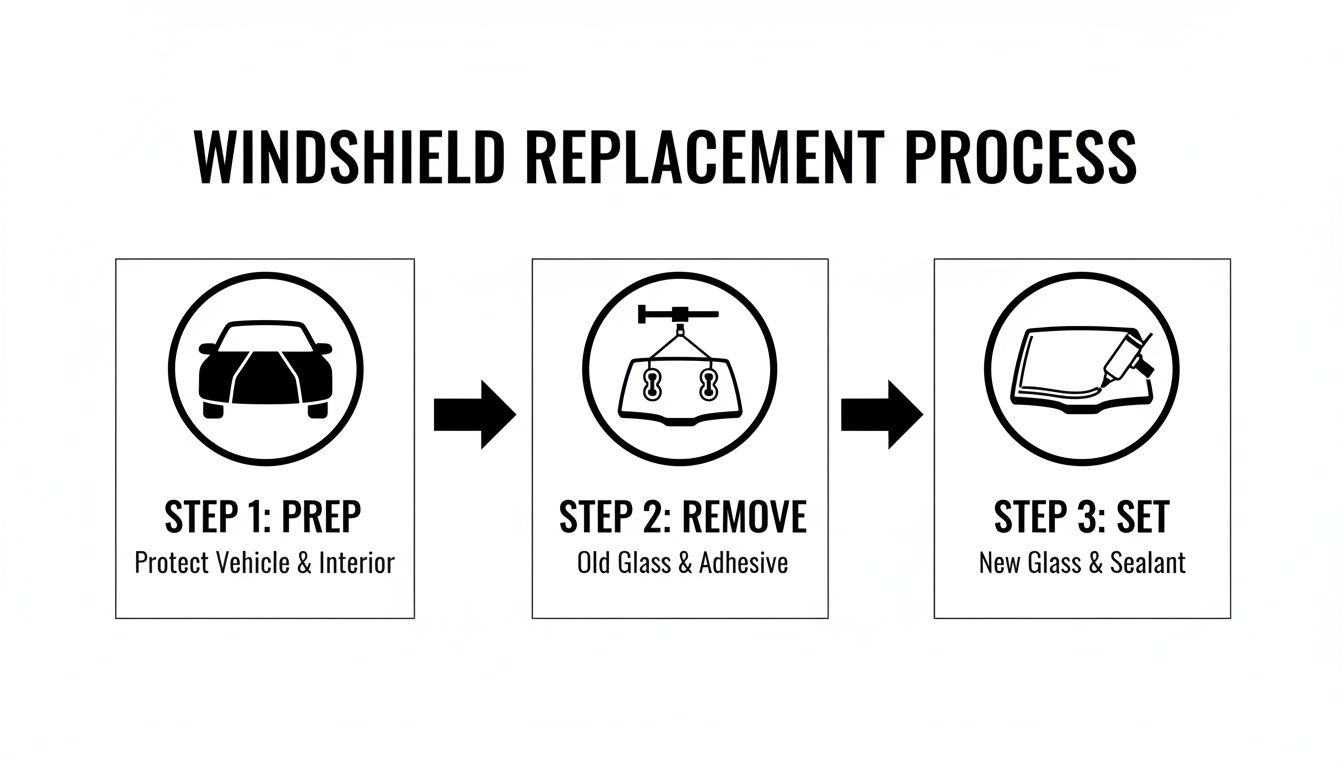
As you can see, prepping the vehicle and setting the new glass are just the beginning. The job isn't finished until we can verify that your car’s safety systems are working perfectly.
Making sure your ADAS is properly calibrated is a non-negotiable part of any modern windshield replacement. It's an investment in your safety, your peace of mind, and the technology you paid for when you bought your car. To learn even more, check out our in-depth guide on ADAS calibration after windshield replacement.
Navigating Windshield Replacement Costs and Insurance Claims
Figuring out the financial side of a windshield replacement can feel like a maze, but it’s actually pretty straightforward once you know what to look for. The final price isn't a random number. It’s a careful calculation based on your vehicle's specific technology, the materials we use, and the expert labor needed to get the job done right and keep you safe.
The cost to replace an auto glass windshield can swing from a few hundred dollars to well over a thousand. It’s not just about whether you drive a sedan or an SUV; it's about what’s inside the glass. Let's peel back the layers and look at what really goes into the final quote.
What Determines the Cost of a New Windshield
The price of a new windshield is so much more than just a piece of glass. A few key factors come together to determine the total cost, all aimed at getting your vehicle back to its factory-safe condition.
Vehicle Make and Model: It's no surprise that luxury brands like Mercedes-Benz or Tesla often use uniquely shaped or oversized windshields that simply cost more to manufacture.
Special Glass Features: Does your windshield have a rain sensor that automatically turns on your wipers? Or maybe a heating element for quick de-icing, or even a built-in radio antenna? Each of these features adds to the glass's complexity and price.
Heads-Up Display (HUD): If your car projects information like your speed directly onto the glass, you need a special kind of windshield. It has a unique coating that makes the display sharp and clear, and that technology comes at a premium.
This is why a windshield for a base model sedan might run you $250, while the glass for a high-end SUV loaded with tech could easily top $1,200. The more your windshield does, the more it will cost to replace.
The biggest cost factor in modern vehicles is ADAS recalibration. This step is non-negotiable for safety. It ensures your car's cameras and sensors work perfectly after we install the new glass and can add $200 to $500 or more to the final bill.
Understanding the Role of Insurance Coverage
Now for the good news: you probably won't have to pay for all of this yourself. With the right insurance policy, the cost can be far more manageable. The magic word here is comprehensive coverage.
Comprehensive coverage is the part of your auto policy that handles damage not caused by a collision. Think theft, falling branches, or, in this case, a rock kicked up on the highway that shatters your windshield.
Here’s how a typical insurance claim for a windshield plays out:
Start the Claim: The first step is to let your insurance provider know about the damage. We can even help you get this process started right here at Auto Renu Auto Glass LLC to make things easier.
Verify Your Coverage: Your insurer will check to see that you have comprehensive coverage and walk you through what your specific policy includes.
Pay Your Deductible: Most of the time, you'll pay your comprehensive deductible, which can be anything from $0 to $1,000. After that, your insurance company picks up the rest of the tab.
Zero-Deductible States: Some states actually have laws that require insurance companies to offer full glass coverage with a $0 deductible. This means the replacement costs you absolutely nothing out-of-pocket. It's worth checking your policy to see if this applies to you.
Working with an experienced shop like Auto Renu Auto Glass LLC takes the headache out of this whole process. We’re used to dealing with all the major insurance carriers. We handle the paperwork and the billing directly, so you don't have to. Our job is to get you back on the road safely, without the stress of navigating a complicated claim.
We Come to You: The Power of Mobile Windshield Replacement
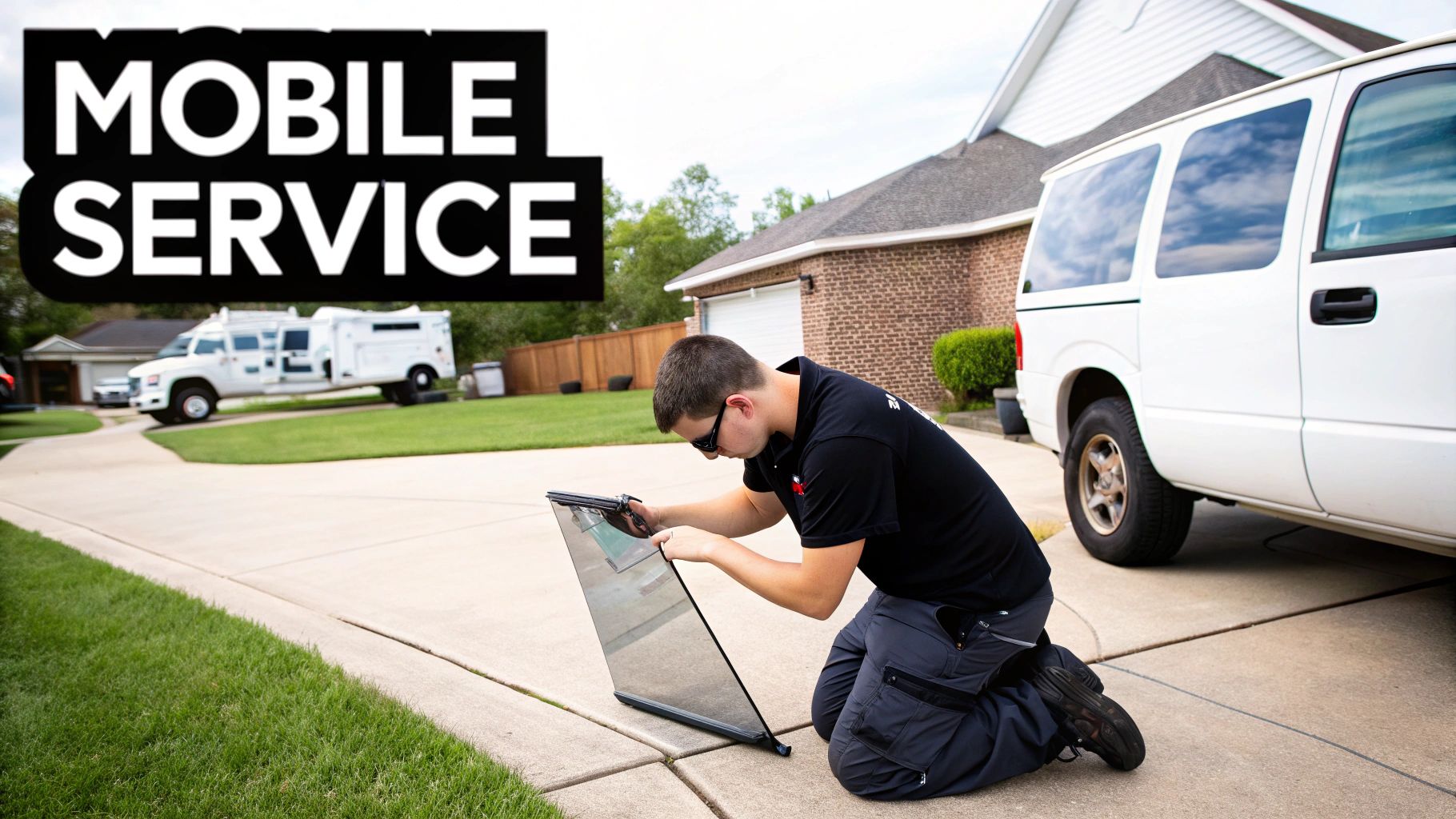
Let’s be honest, nobody has time to kill sitting in a repair shop waiting room. In a world where your time is the most valuable thing you have, taking half a day off for a windshield replacement just isn't practical. That’s exactly why mobile windshield replacement exists—we bring the entire auto glass shop right to your doorstep.
Think about it. For a busy professional, it means we can replace your windshield in the office parking lot while you’re in a meeting. For a parent, it means you don't have to wrestle with car seats and schedules to get across town. We turn a major hassle into a simple background task that works around your life, not the other way around.
Quality and Safety, Delivered
There's a common myth that a mobile service is somehow less thorough than an in-shop replacement. Nothing could be further from the truth. Our certified mobile technicians arrive in vans that are literally workshops on wheels, stocked with the very same OEM-quality glass, professional-grade adhesives, and precision tools you'd find at our shop.
From carefully protecting your vehicle’s interior to setting the new glass and running a final quality check, we follow the exact same rigorous, factory-approved standards. The quality of the work is identical. The only thing that changes is the address.
A professional mobile replacement guarantees the same safety, structural integrity, and flawless finish as any in-shop service. It's the technician’s skill and the quality of the materials that matter, not the building they work in.
This on-demand approach is what drivers want. The global windshield repair market was valued at an estimated $15 billion in 2025 and is on track to hit $23 billion by 2033. Here in North America, it's already a $4 billion industry, and that growth is fueled by people demanding services that fit into their busy lives. You can learn more about the windshield replacement service market trends on Marketreportanalytics.com.
Advanced Tech, Right in Your Driveway
Modern cars are packed with technology, and a simple glass swap isn't so simple anymore. With Advanced Driver-Assistance Systems (ADAS), recalibrating your car’s safety cameras is a critical final step. Many people assume this complex process has to be done in a specialized facility, but that's no longer the case.
The Auto Renu Auto Glass LLC team is equipped to perform mobile ADAS recalibration right on-site for most vehicles. We can handle both static (in-place) and dynamic (on-road) recalibrations, ensuring your vehicle’s life-saving safety features are perfectly aligned and working correctly before we hand you the keys.
Here’s what you get with our top-tier mobile service:
Complete Replacement: We handle every step, from removing the damaged glass to cleaning up and installing the new one.
OEM-Quality Materials: We only use glass and adhesives that meet or exceed your car manufacturer’s specifications.
On-Site ADAS Recalibration: No need for a second appointment. We realign your car’s safety cameras right then and there.
Direct Insurance Billing: We take the headache out of the paperwork by working directly with your insurance provider.
Choosing a mobile service means getting expert care on your terms—at your home, your office, or wherever you need us to be. It's the modern, seamless solution for a necessary repair. Find out more about the benefits in our post about our mobile windshield replacement service.
How to Choose the Right Auto Glass Professional
Let's be honest, not all auto glass shops are created equal. When it comes to something as critical as your windshield, picking the right professional is the single most important decision you'll make. A botched job isn't just an inconvenience—it can lead to frustrating leaks, annoying wind noise, and even dangerously malfunctioning safety systems.
Think of it like choosing a surgeon. You wouldn't just go with the cheapest option; you'd want someone with proven expertise, the right credentials, and a track record of success. Your windshield is a core part of your vehicle's structural integrity, so the same level of care is essential when you need to replace an auto glass windshield. A bargain price often means corners were cut somewhere, whether it's with cheap glass or by skipping vital safety protocols.
Your Checklist for Vetting a Technician
To protect your car and, more importantly, your safety, run through this simple checklist before committing to any auto glass company. A truly professional outfit will be happy to answer these questions.
Technician Certifications: The first question you should ask is about certification. Specifically, ask if their technicians are certified by the Auto Glass Safety Council (AGSC). This is the gold standard, proving they've been rigorously trained in the latest safety procedures and proper installation techniques.
Quality of Materials: What kind of glass and adhesive are they using? The answer should be Original Equipment Manufacturer (OEM) glass or a high-quality equivalent that meets the same strict standards. The urethane adhesive is just as crucial—it needs to be a professional-grade product to create a bond that lasts.
ADAS Recalibration Expertise: This is a deal-breaker for modern vehicles. If you have features like lane-keep assist or automatic emergency braking, you must confirm the shop can perform a precise ADAS recalibration. They need the right equipment and trained technicians who follow the exact specifications from your vehicle's manufacturer.
When you're looking for an auto glass professional, it's also smart to see how they're viewed within the wider automotive industry.
Red Flags to Watch Out For
Knowing what to look for is half the battle; knowing what to avoid is the other half. Keep an eye out for these warning signs that might indicate a provider doesn't prioritize quality or your safety.
A suspiciously low quote is often the biggest red flag. The price may be tempting, but it almost always means the provider is using substandard materials, rushing the job, or—most dangerously—skipping the critical ADAS recalibration step entirely.
Be very cautious if a company tries to downplay the importance of recalibration or suggests it's not really needed. That's a clear sign they don't understand how modern vehicle safety systems work. You should also be wary of any provider who can't readily provide proof of their insurance or their technicians' certifications.
Finally, look for a history of happy customers. At Auto Renu Auto Glass LLC, we stand by our work. We're proud of our certified technicians, our commitment to using only top-tier materials, and our proven expertise in ADAS recalibration. We believe in being upfront and are always ready to answer your questions, so you have total peace of mind.
Common Questions About Windshield Replacement
Even with a good handle on the process, you probably still have a few questions. It’s completely normal. Let’s walk through the most common things we get asked about windshield replacement to give you that last bit of confidence.
How Long Does the Replacement Process Take?
The actual hands-on part is quicker than most people think. A seasoned technician can usually get the old windshield out and the new one installed in about 60 to 90 minutes.
But the clock doesn't stop there. The real key is the "safe drive-away time." This is the time it takes for the powerful adhesive to cure enough to keep you safe in an accident. You'll need to add at least another hour for this critical step.
Can I Drive My Car Immediately After?
This is a big one, and the answer is always a firm no. After your new windshield is set in place, the urethane adhesive needs time to cure and create an unbreakable bond with your car's frame. Hitting the road too soon can completely compromise the installation.
The safe drive-away time isn't just a friendly suggestion—it's a non-negotiable safety standard. It guarantees the windshield can do its job supporting the roof and ensuring your airbags deploy correctly if you're ever in a crash. For most modern adhesives, that means waiting at least one hour.
Jumping the gun can cause leaks, annoying wind noise, or even a total failure in an accident. Always listen to your technician's specific instructions on this.
Is a Replacement Windshield as Safe as the Original?
Absolutely. As long as the work is done by a certified professional using top-notch materials, a replacement windshield brings your car right back to factory safety standards.
It all comes down to the quality of the installation. When done correctly, the new glass provides the same structural support for the roof and allows safety systems like airbags to work exactly as they were designed to.
OEM-Quality Glass: We use glass that meets the same strict safety and clarity specs as the one your car left the factory with.
AGSC Certified Technicians: Our team is trained on the latest safety procedures to ensure a perfect fit every single time.
Proper Curing: We strictly follow the safe drive-away time to make sure the adhesive bond is rock-solid.
Once your new windshield is in, you might even think about adding an extra layer of protection and performance by getting a ceramic coating for your windshield.
What Kind of Warranty Should I Expect?
Any auto glass company worth its salt will stand proudly behind its work. You should always look for a lifetime warranty that covers any defects in the materials or the installation for as long as you own the car. This protects you from problems like water leaks, wind noise, or issues with the molding that stem from the replacement job.
When you need a flawless, safe, and convenient windshield replacement, trust the certified experts at Auto Renu Auto Glass LLC. We bring dealership-quality service directly to you. Book your mobile service today.