How to Stop a Windshield Crack Before It Spreads
Discover how to stop a windshield crack with immediate fixes, DIY repair insights, and expert advice on when to call a professional for a lasting solution.
Jan 17, 2026
generated
stop a windshield crack, windshield repair, auto glass repair, DIY car repair, windshield chip
That loud thwack against your windshield is a sound no driver wants to hear. It's jarring, and what you do in the next few minutes can be the difference between a quick, affordable repair and a costly full replacement. The key is to protect the damaged area from contamination and stress right away.
What to Do the Moment a Rock Hits Your Windshield
When that rock hits, your first instinct might be to ignore it and keep driving, but quick action is your best bet. It’s all about preserving the integrity of the glass until you can get it fixed.
First, Assess the Damage
As soon as it’s safe, pull over. Before you even touch the glass, take a look from inside the car. Get a mental picture of the chip's size, shape (is it a star, a bullseye?), and where it's located. This is the exact information a repair technician will need.
Having a clear understanding of the initial rock chip in your windshield helps you explain the situation perfectly when you call for help.
Next, very gently wipe the area around the chip with a clean, dry microfiber cloth. The goal here is just to get rid of any loose road dust on the surface, not to scrub the chip itself. You don't want to accidentally push debris deeper into the break.
Crucial Tip: Resist the urge to use window cleaner or even water. Any moisture that gets into the crack can seriously mess with the repair resin's ability to bond, leading to a weak or failed repair down the line.
Protect and Stabilize the Area
Once the glass is dry and clear of dust, stick a piece of clear packing tape over the chip. This might seem overly simple, but it’s an incredibly effective temporary fix. The tape acts as a shield against the two biggest enemies of a successful repair:
Contamination: It blocks dirt, grime, and other gunk from getting pushed into the crack.
Moisture: It keeps rain and car wash water out, which is vital. Water trapped inside can freeze and expand, turning a tiny chip into a long crack overnight.
Minimize Stress on the Glass
Finally, you have to think about stress. Your windshield is under constant pressure from temperature changes and road vibrations. A fresh crack is a major weak point.
Try to park in a garage or, at the very least, in the shade. Direct sunlight can superheat the glass, causing it to expand and stretch the crack. On that same note, avoid blasting the AC or the defroster directly onto the windshield—that sudden temperature shock is a classic way to make a crack run.
Driving gently also helps. Avoid slamming your car doors and try to steer clear of potholes. Every little vibration can make the damage worse. Taking these immediate steps buys you time and keeps your repair options open.
Is It a Chip or a Crack? Sizing Up the Damage
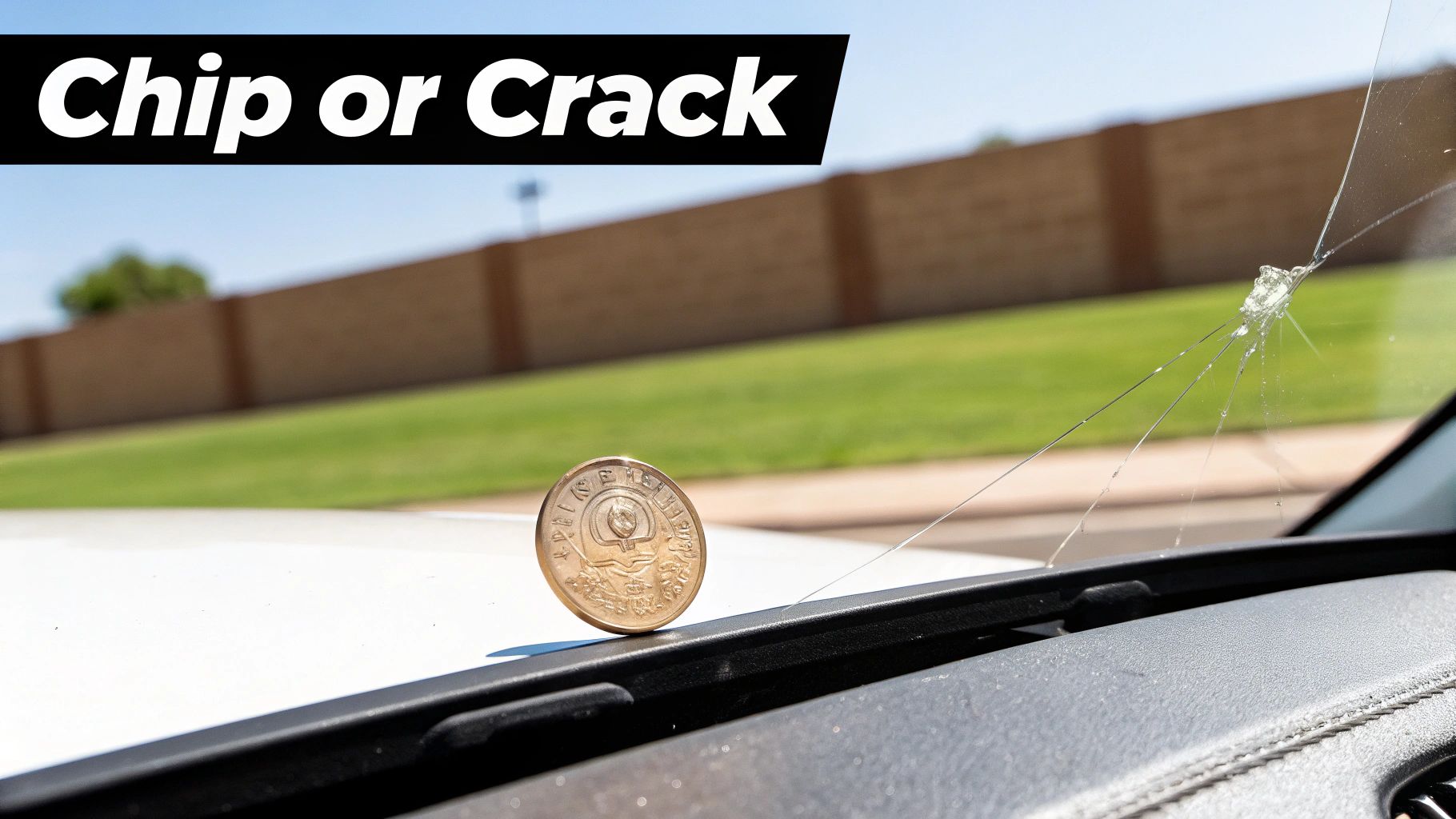
Not all windshield damage is created equal. Knowing exactly what you’re looking at is the first, most critical step in figuring out how to handle it. That tiny little mark might seem like nothing, but it’s a weak spot in the glass just waiting for the right bump or temperature swing to turn into a full-blown crack that snakes across your line of sight.
This initial look-see isn't just about curiosity; it’s a risk assessment. Being able to tell a simple chip from a spreading crack will help you decide on the right move to stop it in its tracks.
Common Types of Windshield Chips
Think of chips as the ground zero of windshield damage—small points of impact from a stray rock or piece of road debris. The trick is to catch them early before they have a chance to grow. Most of the time, you'll see one of a few common patterns:
Bullseye: This is that classic circular, darkish spot with a noticeable pit right in the middle where the object hit. They’re usually the most straightforward to repair if you get to them quickly.
Star Break: Just like it sounds, this one has little legs or cracks shooting out from the center impact point, kind of like a starburst. Those legs are notorious for spreading, so it needs attention.
Combination Break: This is simply a hybrid of the two—you'll see the circular shape of a bullseye but with little cracks radiating out from it as well.
If you're trying to get a better handle on what you're seeing, you can learn more about the various types of windshield damage here. The good news for drivers is that most of these chips are very fixable.
Believe it or not, data suggests that only about 5% of windshield chips ever spiderweb into long cracks that mean you need a whole new windshield. That really drives home how effective a quick chip repair can be for stopping a bigger, more expensive problem before it even starts.
When a Chip Becomes a Crack
A crack is different. It’s no longer a contained spot; it's a distinct line that has already started to travel across the glass. This is where things get more serious.
The ones to really watch out for are edge cracks. These are cracks that start within about two inches of the windshield's edge and are far more prone to spreading quickly. Why? The perimeter of the windshield is under constant tension from the vehicle's frame. Any damage there basically becomes a pressure release point, giving the crack an easy path to run right across the glass.
Grasping this difference is key. A tiny bullseye chip in the middle of your windshield might not be an emergency, but an edge crack, even a small one, is a ticking clock that needs professional attention right away to avoid a full replacement.
The Reality of DIY Windshield Repair Kits
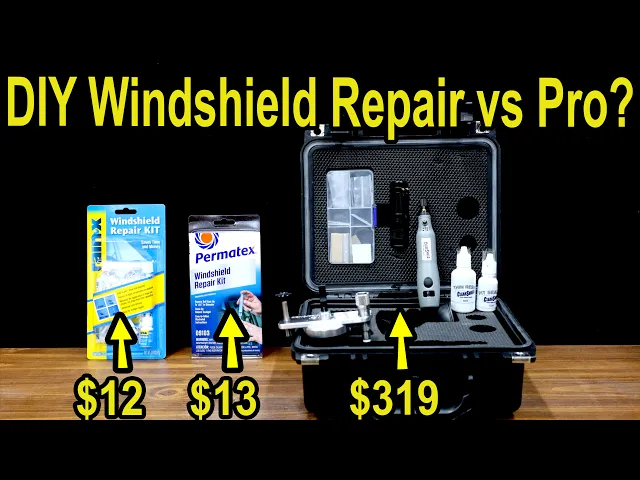
You’ve seen them sitting on the shelf at the auto parts store—those inexpensive DIY repair kits that look like the perfect, quick fix for that new rock chip. Before you toss one in your cart, it’s crucial to understand what they can actually do, and more importantly, what they can't. They’re not a magic wand for all windshield damage, and a misstep can turn a small problem into a big, expensive one.
These kits are designed for one very specific type of damage: a clean, simple bullseye chip that's smaller than a quarter. It also has to be well outside of your direct line of sight while driving. The basic idea is that you inject a special resin into the chip, which then hardens and helps stop the damage from spreading.
But it's their limitations where the real trouble begins.
Know When a DIY Kit Is Off the Table
Let's be clear: a DIY kit is completely useless on any crack longer than an inch. The resin and the simple plastic tools just aren't built to properly fill and seal that kind of linear damage. Trying to fix a crack with one of these is pretty much guaranteed to fail.
The real danger, though, is how a botched DIY attempt can slam the door on a professional repair later on. If the resin doesn't get into every single microscopic part of the chip, it can trap tiny air bubbles. Worse yet, if the resin hardens before it completely fills the void, it permanently contaminates the spot. No professional technician on earth can get that messed-up material out to try the repair again.
The Hard Truth: A failed DIY repair often leaves you with a single, much more expensive option: a full windshield replacement. The twenty bucks you saved upfront just vanished under the cost of a new piece of glass.
Weighing the Risks Against the Savings
The appeal of a DIY kit is obvious—it costs a tiny fraction of a professional service call. But you're trading that small savings for a pretty significant risk. A professional technician isn't just using better resin; they're using specialized equipment to inject it under high pressure, restoring up to 95% of your windshield’s original structural integrity. A DIY kit just can't compete with that level of strength or optical clarity.
Before you decide to take this on yourself, you need to be honest about the potential outcomes. For a more detailed look at the pros and cons, our guide on DIY windshield repair can help you weigh your options.
Ask yourself these questions before you even think about starting a DIY job:
What’s the damage? Is it a simple, small bullseye? If it’s a star break, a combination break, or any kind of crack, it’s a job for a pro.
How’s your skill level? This isn't a job you can rush. It takes a steady hand and you have to follow the instructions to the letter. Working in direct sunlight, for example, can cure the resin too fast and ruin the repair.
What's your goal? Are you just trying to get a temporary patch, or do you want a permanent solution that restores the safety of your vehicle? If it's the latter, a professional repair is the only way to go.
In the end, while a DIY kit might seem like a clever way to stop a chip from spreading, it’s a gamble. The safest and most reliable path is almost always to call in an expert.
When a Professional Repair Is Non-Negotiable
While a DIY approach has its place for tiny chips, knowing when to put down the kit and call a professional is a critical decision for your safety. Some types of damage are just too severe for a simple patch job; they demand specialized tools and expertise. Trying to fix them yourself isn't just a waste of time—it can seriously compromise your vehicle's structural integrity.
The moment a crack grows longer than a dollar bill, you're officially out of the DIY league. Same goes for any damage that sits directly in your line of sight. A professional repair restores optical clarity in a way that home-kit resins simply can't, preventing the kind of visual distortion that could be dangerous while driving.
If you're on the fence, this quick flowchart can help you decide if a DIY kit is even a possibility.
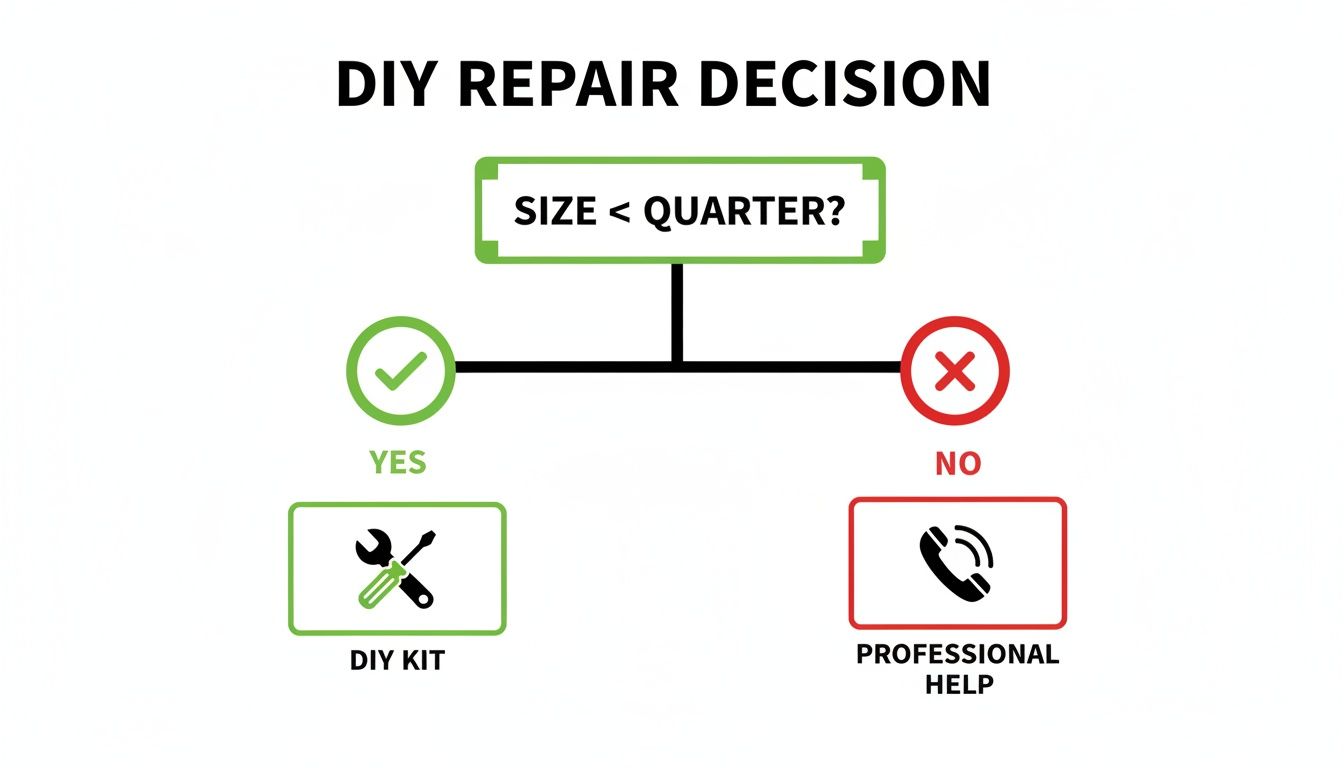
The dividing line is pretty clear: once the damage is bigger than a quarter or it's a crack instead of a simple chip, it's time to let a pro handle it.
To make it even simpler, here's a quick guide to help you decide whether you're looking at a repair or a full-on replacement.
Repair vs Replacement: A Quick Guide
Damage Characteristic | Likely Repairable | Requires Replacement |
|---|---|---|
Size | Chip smaller than a quarter, crack under 6 inches | Multiple cracks, cracks longer than 6 inches |
Location | Outside the driver's direct line of vision | Directly in the driver's line of sight |
Depth | Damage is only on the outer layer of glass | Crack has penetrated the inner layer of glass |
Type | Simple bullseye, star, or small combination break | Complex "spiderweb" cracks, damage on the edge |
ADAS | Minor repair may not require it (check with a pro) | Full replacement always requires recalibration |
Ultimately, a professional assessment is the only way to know for sure, but this table gives you a solid starting point for what to expect.
The Danger of Edge Cracks
One of the biggest red flags you can see is an edge crack. If the damage starts at or very close to the perimeter of your windshield, you have a serious problem on your hands. The edges of the glass are under immense tension from the vehicle's frame, which makes these cracks incredibly likely to spread—and spread fast.
Think about it: a small rock hits the very edge of your glass. It might seem minor, but research shows an astonishing 90% of all windshield cracks that need attention are these edge cracks, typically starting within 2 to 3 inches of the perimeter. Decades of data from parking lot surveys and shop repairs, which you can read about in these windshield crack surveys from Ultra Bond, confirm they're the most common and dangerous kind, far outnumbering those in the middle of the glass.
The ADAS Recalibration Requirement
Modern vehicles add another layer of complexity. If your car is equipped with Advanced Driver-Assistance Systems (ADAS)—things like lane-keep assist, adaptive cruise control, or automatic emergency braking—then a professional repair or replacement is non-negotiable.
These critical safety features rely on cameras and sensors that are precisely mounted to your windshield. Even a tiny change in the glass's position or thickness can throw their calibration completely off.
After a windshield replacement, a professional ADAS recalibration is mandatory. This isn't an upsell; it's a crucial safety procedure to realign the system's cameras to factory specifications. Skipping this can cause safety systems to malfunction or fail entirely when you need them most, turning a helpful feature into a dangerous liability.
A professional technician has the specific equipment needed to confirm these systems are working perfectly after the glass is serviced. They also use higher-grade resins and vacuum tools that pull every last bit of air out of the damage, creating a bond that restores both strength and clarity. It’s a level of precision and safety that a DIY kit just can't deliver.
Navigating Repair Costs and Insurance Coverage
That sinking feeling you get when you see a new crack on your windshield is often followed by a bigger worry: "How much is this going to cost me?" It’s a valid concern, but tackling a cracked windshield doesn't have to break the bank. In fact, understanding your options can save you a ton of money and hassle.
The financial difference between a quick repair and a full replacement is massive. Acting fast to fix a small chip or crack is the absolute best way to keep costs down. A professional repair for a small blemish is surprisingly affordable, usually running less than $100. Compare that to a full windshield replacement, which can easily climb from a few hundred to over a thousand dollars, especially if your car is loaded with modern safety tech.
Is Your Windshield Repair Covered by Insurance?
Here’s a piece of good news many drivers don't know about: if you have comprehensive coverage on your auto insurance policy, there's a very good chance your insurer will pay for the entire repair. Better yet, they often waive the deductible.
Why would they do that? It's simple math. Insurance companies would much rather pay for a small, inexpensive repair today than foot the bill for a massive replacement down the road. This approach not only saves them money but also keeps your vehicle’s original, factory-sealed windshield intact, which is always the best-case scenario. Before you even think about paying out-of-pocket, make a quick call to your insurance provider to see what your policy covers.
A common myth is that filing a windshield claim will automatically jack up your insurance rates. For a repair, that's almost never the case. Insurers typically view these as "no-fault" claims under your comprehensive coverage, so they shouldn't have any impact on your premiums.
Making the Call to Your Insurance Company
When you do call your insurer, having a few details ready will make the whole process go much smoother. It’s a simple conversation if you’re prepared.
Here's what you'll want to have on hand:
Your Policy Number: This lets them find your information right away.
A Quick Backstory: Just explain when and how it happened. "A rock hit my windshield on the highway yesterday" is all they need.
Damage Details: Be ready to describe the size, type (is it a chip or a crack?), and where it is on the windshield.
It’s worth noting that the majority of windshield damage is actually repairable. U.S. survey data shows that 74% of cracks are 14 inches or shorter and clean enough for a successful professional fix. This is exactly why insurers are so eager to repair—it can turn a potential $1,000 replacement bill into a much more palatable $200-$400 expense. You can dig deeper into these windshield repair findings from Insurance Journal.
When you speak to the representative, just tell them you have a small chip or crack you’d like to get repaired under your comprehensive coverage. They'll walk you through the rest, which usually just involves setting up an appointment with one of their approved auto glass shops. That one phone call could end up saving you the entire cost.
Common Questions About Windshield Cracks
The moment you see a crack in your windshield, a dozen questions probably pop into your head. It’s a frustrating, all-too-common problem for drivers. Getting clear, straightforward answers is the first step to making a smart, safe, and cost-effective decision. Let’s tackle some of the most frequent questions we hear from people dealing with unexpected glass damage.
How Long Can I Safely Drive with a Cracked Windshield?
Honestly, you're playing with fire. It's a gamble you really don't want to take. Your windshield isn't just a piece of glass; it’s a critical safety component, providing up to 30% of your vehicle's structural support in a rollover accident. Even a tiny crack weakens that integrity.
Every time you drive, you're putting stress on that damaged glass. Simple things like hitting a pothole, a sudden temperature change from using your defroster, or even just closing your door a bit too hard can make that crack spread in an instant. Plus, many states have laws against driving with anything that obstructs your line of sight. The best advice I can give is to get it fixed right away.
Will Filing a Windshield Claim Make My Insurance Rates Go Up?
This is a big worry for a lot of drivers, but you can usually breathe a sigh of relief. Most insurance companies classify windshield damage under your comprehensive coverage, which they treat as a "no-fault" incident. They actually want you to get it repaired quickly.
Think about it from their perspective: they’d much rather cover a small, affordable repair today than have to pay for an expensive full replacement down the road. Because of this, filing a single repair claim almost never affects your premium.
That said, it's always smart to double-check the specifics of your policy with your agent. While one repair is fine, some carriers might look at multiple replacement claims in a short period a little differently.
Can a Windshield Be Repaired in Bad Weather?
Yes, but this is one of those times you absolutely need to call a professional. Moisture is the biggest enemy of a solid windshield repair. If rain or humidity gets into the crack, the resin can't bond properly to the glass, and the fix just won't hold. Trying a DIY kit in the rain or snow is a recipe for failure.
A professional mobile technician, on the other hand, is ready for this. They come equipped with pop-up awnings or might ask if they can pull into your garage. They have the tools and experience to create a dry, controlled environment, ensuring the resin cures perfectly for a permanent repair, no matter what the sky looks like.
What Is ADAS Recalibration and Why Is It Necessary?
ADAS stands for Advanced Driver-Assistance Systems. These are all the high-tech safety features in modern cars—things like automatic emergency braking, lane-keep assist, and adaptive cruise control. The "eyes" for these systems are cameras and sensors mounted directly onto your windshield.
When a windshield is replaced, the position of that camera can shift by just a fraction of a millimeter. It sounds like nothing, but that tiny change is enough to throw the entire system off, making it unreliable or causing it to fail completely. Recalibration is the technical process of realigning those cameras to the manufacturer's exact specifications. It’s a non-negotiable safety step to ensure your car’s life-saving features work exactly as they should.
Don't let a small chip turn into a major expense. The experts at Auto Renu Auto Glass LLC offer fast, reliable mobile repair services that come directly to you, ensuring your windshield is fixed correctly the first time. Protect your vehicle and your wallet by scheduling your professional repair today.