A Complete Guide to Fast Window Chip Repair
Learn when to choose window chip repair over replacement. Our guide covers chip types, repair process, costs, and the benefits of mobile auto glass service.
Jan 13, 2026
generated
window chip repair, windshield repair, auto glass, mobile repair
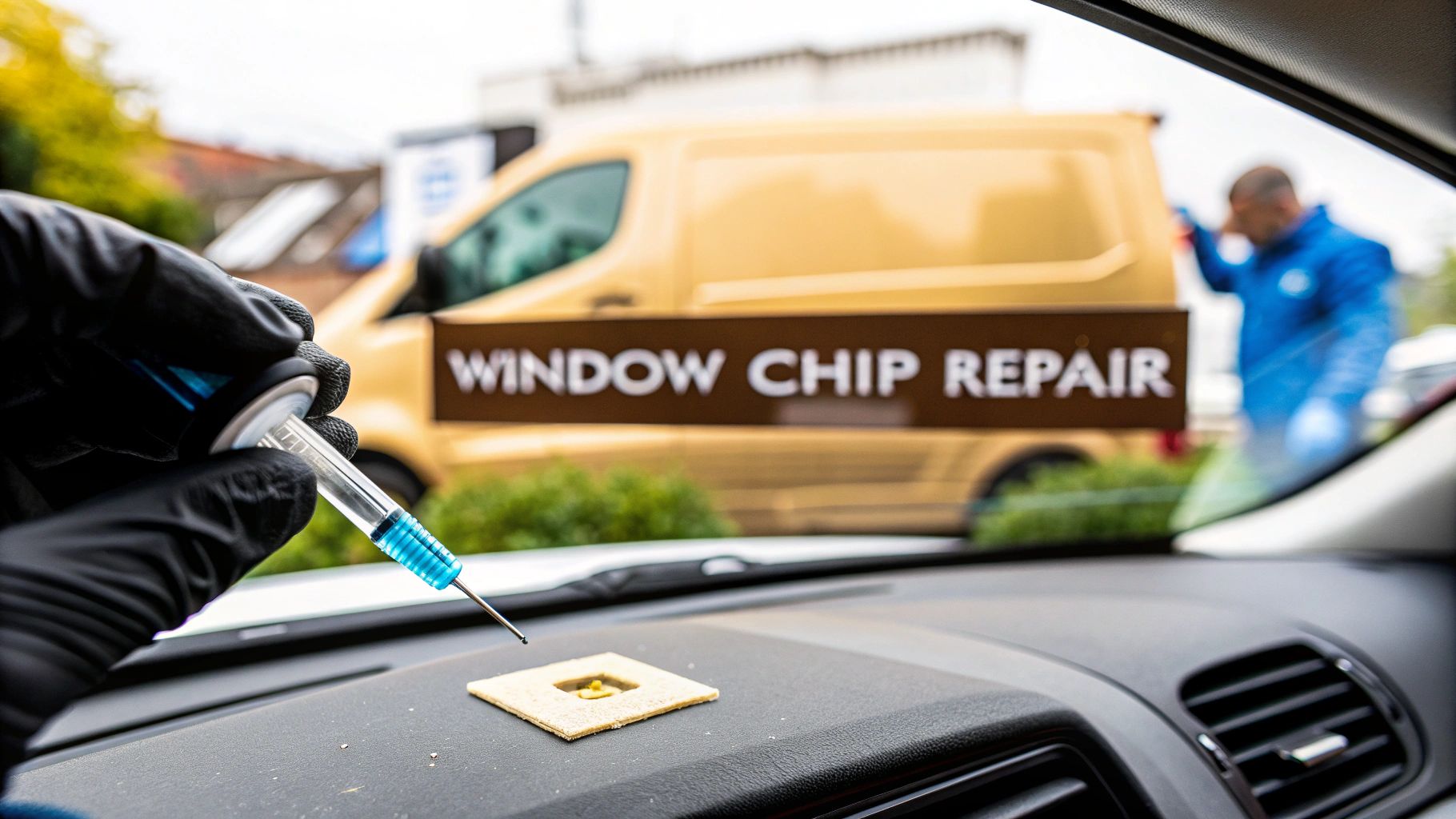
You’re driving down the highway when you hear it—that sharp, sickening thwack of a rock hitting your windshield. It’s a sound every driver knows and dreads. While it’s easy to dismiss that tiny new chip, that little blemish is a serious breach in your car's first line of defense. Luckily, professional window chip repair is a quick, safe, and surprisingly affordable fix that restores both the strength and clarity of your glass.
Why You Should Never Ignore a Windshield Chip
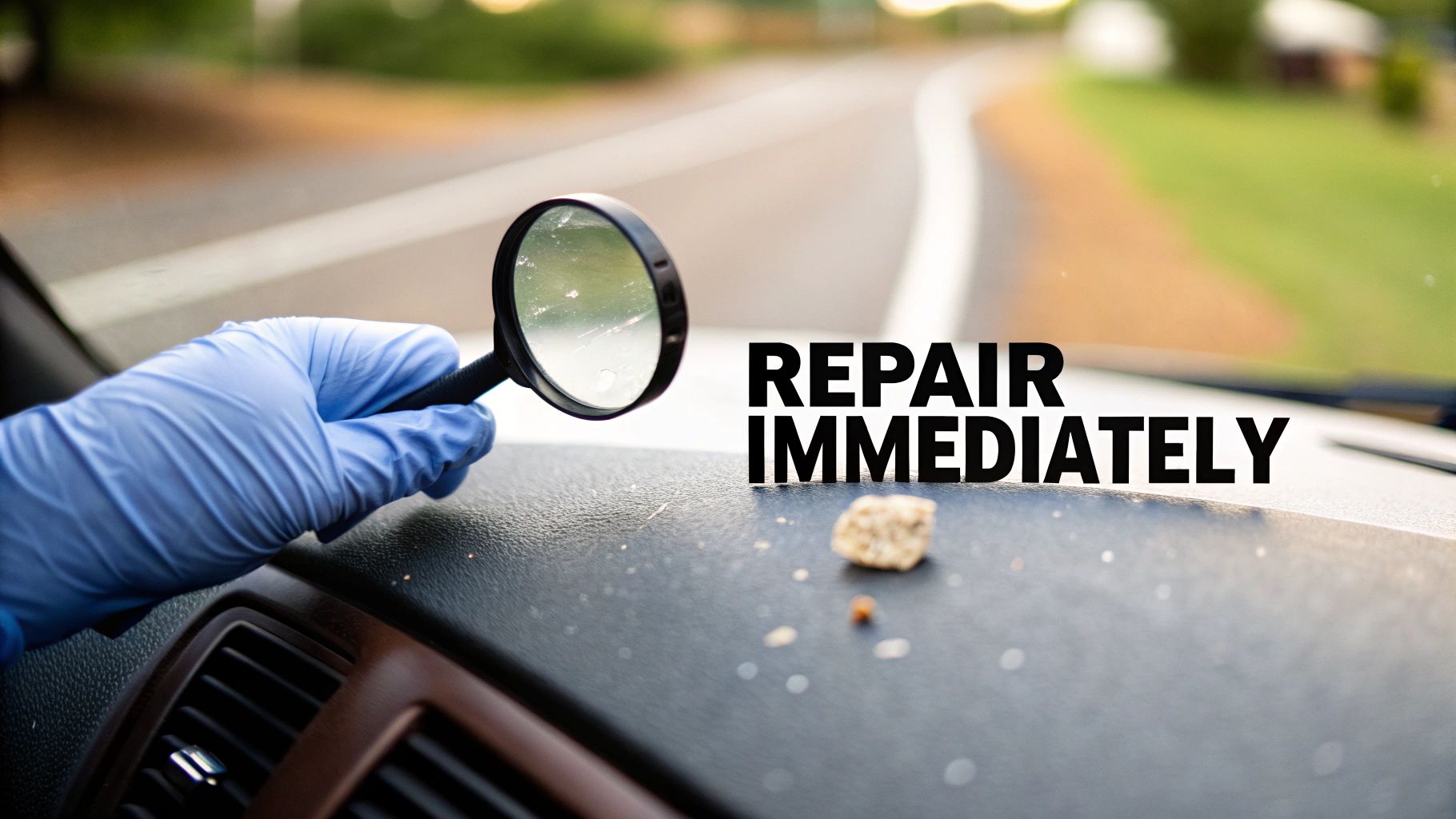
Think of that small chip like a tiny crack in a dam. It might seem harmless at first, but it’s a weak point. Under constant pressure, that little flaw can easily grow into a full-blown failure. Your windshield is under a similar kind of stress every single day, which is why a minor chip can quickly become a major safety hazard.
Your windshield does more than just keep the bugs and rain out. It’s a vital piece of your car's safety equipment, providing up to 60% of the structural strength to the cabin during a rollover. This is what keeps the roof from caving in. A chip compromises that strength, creating a weak spot that could give way when you need it most.
Common Triggers That Turn a Chip Into a Crack
Even your daily commute puts enough stress on a chip to make it spread into an unrepairable crack. The forces at work are often invisible but powerful, constantly testing the damaged glass. Knowing what these triggers are makes it clear why acting fast is so crucial.
Road Vibrations: Potholes, speed bumps, and even just rough pavement send constant vibrations through your car's frame. For the fragile edges of a chip, these little shocks are more than enough to cause it to splinter and grow.
Temperature Swings: Glass expands in the heat and contracts in the cold. Blasting the defroster on a frosty morning or cranking the AC on a blistering summer day creates a rapid temperature change that puts immense stress on that weak point, often forcing it to crack.
Washing Your Car: High-pressure water from an automatic car wash or a power washer can force its way into the chip. This can weaken the glass from the inside out and easily cause the damage to spread.
A small chip isn't just a cosmetic issue—it's an urgent safety problem with a simple solution. Getting a window chip repair done right away not only saves you from the much higher cost of a full windshield replacement but also keeps your car's protective shell intact.
The need for this kind of timely maintenance is huge. The automotive windshield market was valued at USD 29.74 billion in 2023 and is expected to grow as the average age of cars on the road continues to climb. You can find more insights about the growing demand for auto glass services from Fortune Business Insights.
Identifying Different Types of Windshield Damage

That tiny nick on your windshield from a stray highway rock might seem insignificant, but not all damage is created equal. The specific shape and size of that imperfection tell a story—and it's the key to figuring out if a simple window chip repair is on the table or if you're looking at a bigger problem.
Think of it this way: knowing the type of chip you have helps you speak the same language as the technician. It's the difference between calling and saying, "I have a spot on my glass," and confidently explaining, "I've got a small star break that I'd like to get fixed before it spreads."
Common Chip Types and What They Look Like
You don't need years of experience to spot the usual suspects. Most windshield chips fall into a few categories, and once you know what to look for, they’re pretty easy to identify.
Bull's-Eye: This is the one everyone pictures. It’s a clean, circular break with a dark pit in the center, looking just like a tiny target.
Star Break: This one has a main impact point, but with small cracks or "legs" shooting out from the center. It’s a sneaky one because those legs are notorious for spreading if you ignore them.
Half Moon: Very similar to a bull's-eye, but it's an incomplete circle, shaped exactly like its name suggests. Don't let its size fool you; it's still a weak spot.
Combination Break: A mix of two or more types, like a bull's-eye that also has a few star-like cracks radiating from it. These are more complex and always need a professional eye to assess.
Why does the type matter? A clean bull's-eye is usually a straightforward, stable repair. But a star break, with its tiny legs poised to run, is a ticking clock. A timely window chip repair is absolutely essential to stop it in its tracks.
The Critical Difference Between a Chip and a Crack
People often use "chip" and "crack" interchangeably, but in our world, they mean very different things. A chip is just the initial impact point where a small piece of glass is missing. A crack, on the other hand, is a distinct line that has already started traveling across the glass.
Now, you might have heard that long cracks always mean a full replacement. That's not always true anymore. While a single crack longer than a dollar bill is often a replacement candidate, technology has come a long way. The windshield repair market is projected to hit USD 2.5 billion by 2034, and a lot of that growth is in advanced crack repair. In fact, a surprising 74% of all crack repairs are performed on cracks 14 inches long or shorter.
When is a Window Chip Repair Possible?
So, how do we know if your windshield can be saved? We look at three critical factors: the chip's size, its location, and its depth.
Size: The classic rule of thumb is that if the chip is smaller than a quarter and any associated cracks are shorter than six inches, it's a great candidate for repair.
Location: If the damage is right in the driver's direct line of sight, it’s a tricky situation. Even a perfect repair can leave a slight distortion, so replacement might be the safer call. Chips near the edge of the windshield are also problematic, as they can weaken the entire structure.
Depth: This one is non-negotiable. The damage can't have gone all the way through both layers of glass. If it has, a replacement is the only safe option.
For a deeper dive into what can and can't be fixed, check out our guide on the different types of windshield damage. Knowing these basics helps you understand exactly what to expect when you give us a call.
The Professional Window Chip Repair Process
Watching a seasoned technician perform a window chip repair is a bit like watching a minor surgery. It’s a precise, multi-step process that uses specialized tools and advanced materials to restore both the strength and clarity of your windshield. This isn't just about plugging a hole; it’s a science-backed method of bonding the glass back together from the inside out.
It all kicks off with a careful assessment. A good technician doesn't just glance at the chip; they get up close to make sure it's a solid candidate for repair. They're looking at the size, depth, and location to guarantee a safe and lasting fix. This initial check is a crucial quality control step that you just don't get with a DIY kit.
Preparing the Damage for a Perfect Bond
Once the chip gets the green light, the prep work begins. The first order of business is cleaning the impact point meticulously. Using specialized tools, the technician carefully drills and clears out any loose glass fragments, dirt, and road grime from inside the chip. This leaves a clean, stable surface for the repair resin to grip onto.
Think of it like a dentist cleaning a cavity before a filling. If you leave any gunk behind, the filling won’t bond properly, and you’ll be back in the chair. It's the same principle here—any leftover dust or moisture will create a weak spot and compromise the entire repair.
After a thorough cleaning, the area is completely dried to get rid of any hidden moisture. This ensures the resin can flow into every microscopic crack without anything getting in its way.
Creating a Vacuum to Remove Trapped Air
This next step is what really sets a professional repair apart from any at-home attempt. The technician places a device, called a resin injector, right over the center of the chip. This tool creates a perfect, airtight seal against the glass.
Before a single drop of resin is used, the injector creates a strong vacuum within the damaged area. This suction pulls every last bit of air out of the tiny cracks that spiderweb out from the impact point. So, why is this so critical?
Air is the enemy of a strong repair. If air bubbles get trapped inside when the resin is injected, they create weak spots. This prevents a complete bond and can make the finished repair look cloudy or hazy.
By removing all the air, we clear the path for the resin to penetrate into the deepest parts of the damage, which is key for both maximum strength and visual clarity.
Injecting and Curing the Resin
With the vacuum holding steady, the real magic begins. The technician injects a high-quality, optically matched liquid resin into the injector. That vacuum we just created then does its job, pulling the resin deep into every nook and cranny of the chip until the void is completely filled. Professional-grade resin is specifically designed to have the same light-refractive properties as glass, which is how a great repair can become almost invisible.
Once the chip is fully saturated, it's time to lock it in. The technician uses a special UV lamp that emits ultraviolet light, which triggers a chemical reaction in the resin. This curing process hardens the liquid into a solid, durable material that’s as strong as the glass around it, permanently sealing the damage.
To finish things off, any excess resin is carefully scraped away with a razor blade, and the surface is polished until it's smooth to the touch. The result? A structurally sound windshield with a blemish that is often 85-95% less visible than the original damage. You’ve just saved your windshield and avoided a much more expensive replacement.
Why Mobile Service Is a Smarter Choice
Let's be honest, your time is the one thing you can't get back. A chipped windshield shouldn't be the thing that throws your whole day off schedule. The old way of doing things involved finding a repair shop, calling for an appointment, driving over, and then just… waiting. That whole process is a major hassle that just doesn't work for most of us anymore.
This is where mobile service completely changes the game. Instead of you taking your car to the repair, the repair comes straight to you. We can meet you at home, at the office, or even while you're at the gym. What used to be a major disruption becomes a minor task handled in the background of your day.
It's not just about saving a couple of hours; it’s about taking back control of your schedule. Think about all the little frustrations the traditional method creates: fighting traffic, burning up your lunch break, or taking time off work. Mobile service just wipes all of that away, making a critical safety repair feel seamless and easy.
Convenience That Fits Your Life
Picture this: you're driving to work and smack—a rock kicks up and leaves a chip right in your line of sight. The old way means your morning is shot, filled with phone calls and rescheduling your day. With a mobile service, you make one call. A technician shows up and fixes the chip in your office parking lot while you're in a meeting. You don't miss a beat.
This kind of convenience is a lifesaver for anyone juggling a packed schedule.
For the Working Professional: You don’t have to sacrifice billable hours or miss that important client call. The repair gets done while you're on the clock.
For the Busy Parent: Forget trying to entertain restless kids in a sterile waiting room. We can do the repair right in your driveway while you handle things at home.
For Fleet Managers: We can service multiple company vehicles at one location, slashing downtime and keeping your business moving.
Mobile window chip repair isn't just a service—it's a modern solution built for efficiency. It respects your time by fitting a necessary safety fix into your life, not the other way around.
This diagram breaks down the three core steps our technicians take, whether they're at our shop or at your location.
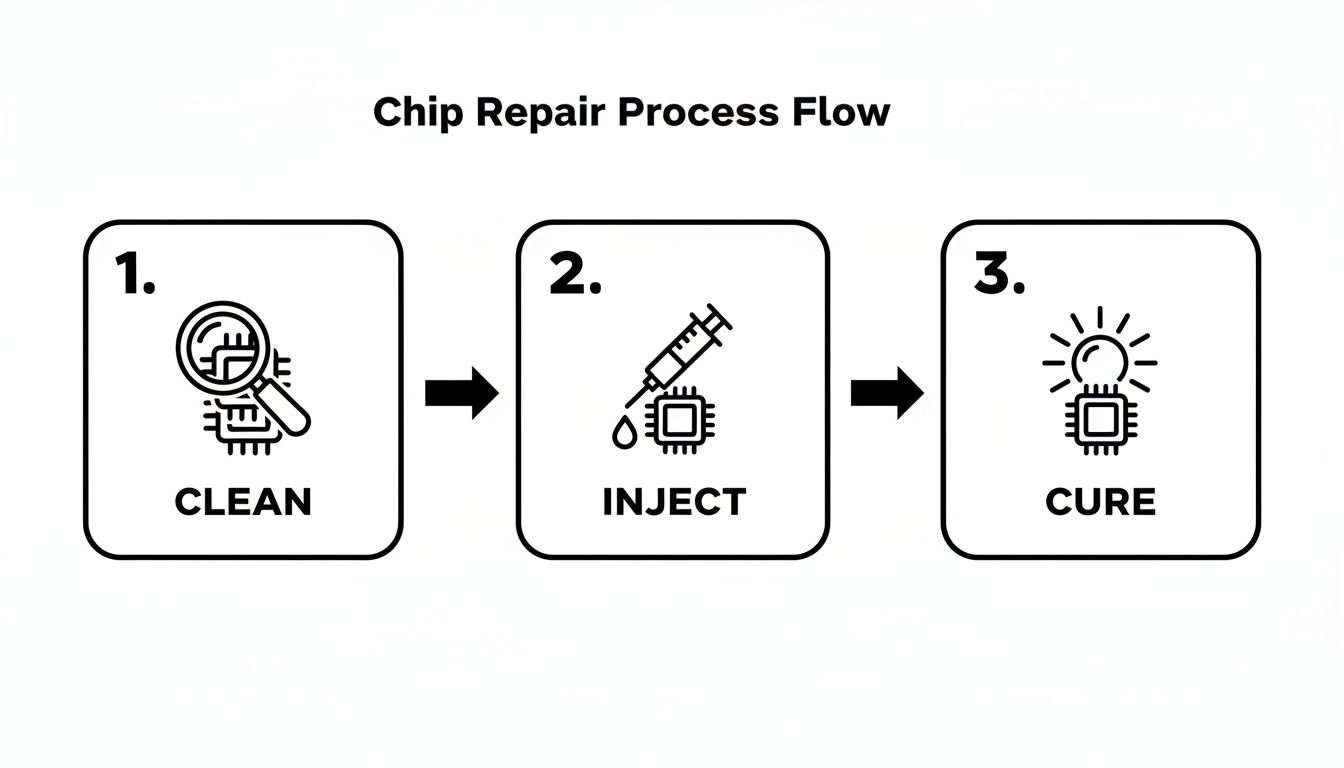
Every step—cleaning, injecting, and curing—is handled with the same professional precision.
Quality and Expertise, Delivered to Your Doorstep
One of the biggest myths we hear is that mobile service is somehow a "lesser" repair than what you'd get in a shop. Nothing could be further from the truth.
Our Auto Renu Auto Glass LLC technicians show up in fully equipped vehicles. They have the same professional-grade tools, high-quality resins, and extensive training as any technician working in a brick-and-mortar garage.
The technology used for window chip repair is designed to be portable without sacrificing an ounce of quality. The resin injectors, vacuum tools, and UV curing lights are all compact and powerful. You're getting the exact same durable, reliable, and nearly invisible repair—just without the headache of driving to a shop.
It's dealership-level quality without the logistical nightmare. If you want to know more about what separates a great service from a mediocre one, check out our guide on finding a dependable mobile windshield repair near me. Ultimately, choosing a mobile repair means you don't have to compromise between safety and convenience.
Costs, Insurance, and the Real Value of a Quick Fix
That sinking feeling when a rock hits your windshield is usually followed by two immediate questions: "What's this going to cost me?" and "Will my insurance help?" The good news is that the financial side of a window chip repair is a lot less painful than most people think, especially when you weigh it against the alternative.
First thing's first: a repair is always, always cheaper than a full windshield replacement. We're talking a small fraction of the cost. Think of it less as an unexpected expense and more as a smart, strategic move to head off a much bigger bill down the road.
How Insurance Companies See Chip Repairs
Your insurance provider looks at that little chip the same way a good technician does—as a small problem that needs to be fixed before it becomes a massive one. Since a tiny chip can easily morph into a giant crack, most insurers are more than happy to encourage you to get it repaired quickly. It saves them from paying out a much larger claim for a full replacement later on.
Because of this, many comprehensive auto insurance policies cover 100% of the cost of a window chip repair. The best part? They often waive your deductible for this specific service.
When your insurer covers the full repair cost without touching your deductible, they're basically rewarding you for being proactive. It's a win-win: you get a clear, safe windshield for free, and they avoid a much more expensive claim.
It's always a good idea to know your policy details, and being prepared for negotiating with your insurance company can help ensure you get the coverage you're entitled to.
The True Cost: Repair vs. Replacement
Let's get down to the brass tacks. The demand for quick, affordable solutions has fueled a massive on-demand windshield repair market, valued at USD 1.42 billion in 2024. That number alone shows how many drivers prefer fixing a chip over replacing the whole windshield.
Here’s where you see the real long-term value in a repair:
Dodging Replacement Bills: A successful repair stops a chip in its tracks, saving you from the hefty cost of new glass and the labor to install it.
Preserving the Factory Seal: The original seal around your windshield is the best defense against leaks and noise. A repair keeps that crucial factory seal perfectly intact.
Avoiding Recalibration Fees: If your car has modern safety features like lane-keep assist (ADAS), a replacement means recalibrating those cameras—a hidden cost that can add hundreds to the bill. A repair doesn't disturb them.
This simple math is why so many drivers call for a mobile repair service the moment they see a chip. For a more detailed look at the numbers, check out our guide on the cost of auto glass chip repair.
At the end of the day, spending a little bit now (or often, nothing at all if insurance covers it) protects both your wallet and your vehicle's integrity for the long haul.
The Risks of DIY Repair Kits
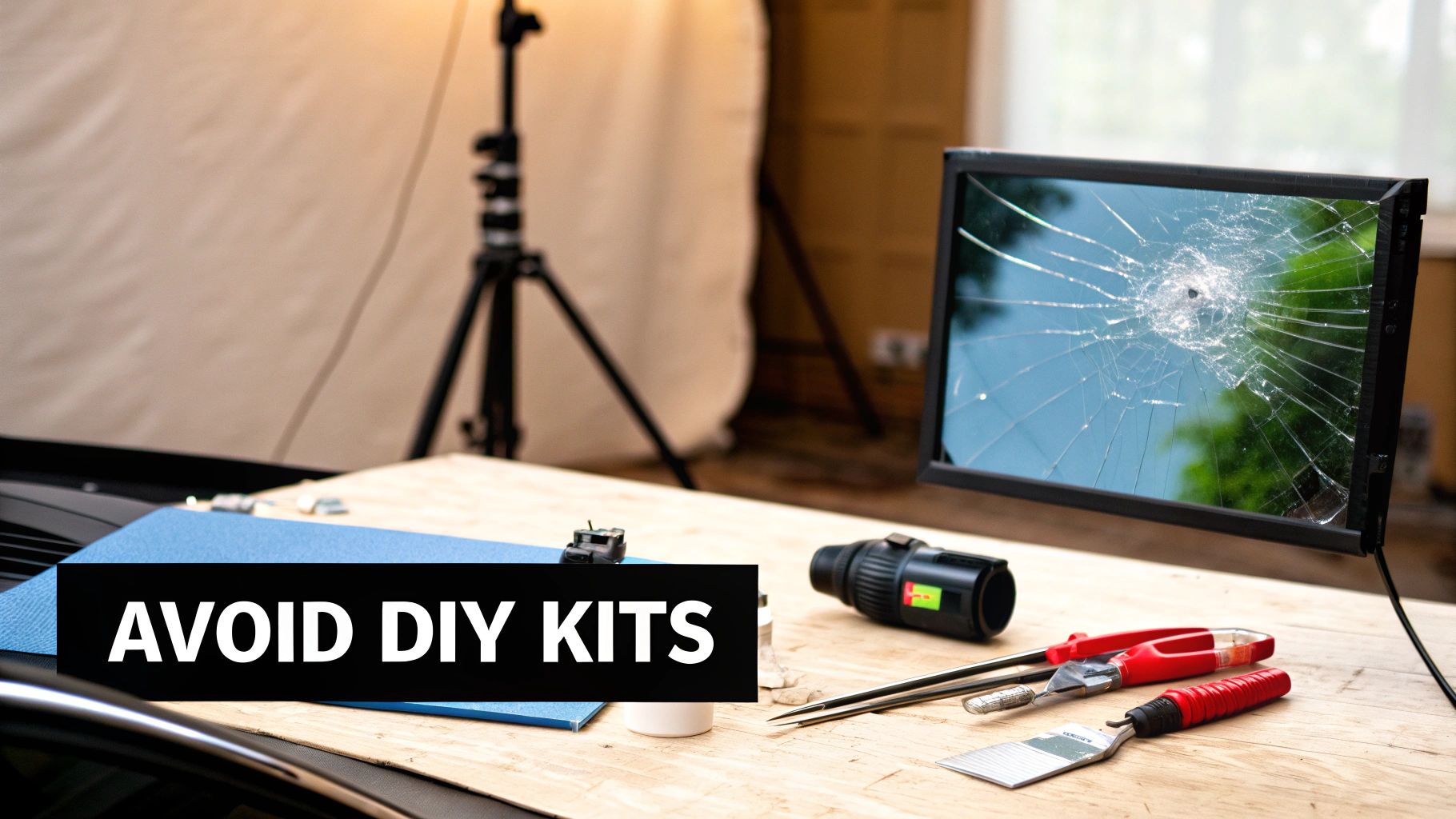
When you see a small chip on your windshield, those inexpensive DIY kits at the auto parts store can seem like a no-brainer. They promise a quick, cheap fix, but the reality is that trying to repair your own windshield is a massive gamble. It might feel like a savvy way to save a few bucks, but it often leads to bigger problems and much higher costs down the road.
Think of it like trying to do your own dental work. You might be able to patch a cavity, but without the right tools and expertise, you’re likely trapping decay underneath. That temporary fix will almost certainly lead to a much more painful and expensive problem later. It's just not a risk worth taking with one of your car's most critical safety features.
Why At-Home Kits Often Fail
A professional windshield repair is a precise, multi-step process that a consumer-grade kit simply can't match. The resins are lower quality, and the included tools just don't have the power to prep the damaged area correctly.
This usually leads to a few common failures:
Trapped Air and Moisture: Professional equipment uses a strong vacuum to suck every last bit of air and moisture out of the chip. The little plastic tools in a DIY kit can't do this, which means tiny air bubbles get trapped inside the resin, creating weak spots that are guaranteed to fail.
Incomplete Resin Flow: The flimsy injectors in DIY kits lack the pressure needed to push resin into every microscopic crack. The result is a partial fill that leaves the chip vulnerable and ready to spread.
Poor Curing: We use specialized UV lights to cure the resin until it's as hard as the original glass. Relying on sunlight, as most kits suggest, is a recipe for disaster. It leads to an inconsistent, weak bond that can turn yellow and break down over time.
A failed DIY repair doesn't just look bad; it can make the damage permanently unrepairable. Once a low-quality resin has been incorrectly cured inside the chip, a professional technician can no longer clean it out to perform a proper fix.
The Point of No Return
This is the biggest risk of all. By attempting a DIY fix, you can turn a simple, easily repairable chip into a problem that demands a full, expensive windshield replacement. The small amount of money you tried to save is gone, and now you’re stuck with a much bigger bill.
A professional window chip repair restores the structural integrity of your glass. A botched DIY job does the exact opposite, leaving behind a cloudy, weak spot that's just waiting to crack the next time the temperature changes or you hit a pothole.
What You Should Do Instead
So, what's the right move when you spot a chip? The most important thing is to protect the damaged area from dirt and moisture until a professional can get to it.
Don't Touch It: Resist the urge to poke at the chip or clean it out. You could easily push debris further in or make the crack worse.
Keep It Clean and Dry: The best temporary fix is simple: cover the chip with a small piece of clear packing tape. This creates a barrier against dirt, car wash soap, and rain, giving the technician a clean surface to work with.
Call a Professional: Get in touch with a mobile service like Auto Renu Auto Glass LLC as soon as you can. The quicker a chip is repaired correctly, the better the final result will be.
Your Top Questions About Window Chip Repair, Answered
It's completely normal to have a few questions, even after learning about the basics. Getting a window chip repair is a technical fix, and knowing a bit more about it can help you feel confident you're making the right call for your car. Here are some straightforward answers to the questions we get asked most often.
We want you to have total peace of mind, so let's clear up any lingering doubts you might have.
How Long Does a Window Chip Repair Take?
One of the best things about a professional chip repair is just how fast it is. Once our technician gets to you, the whole thing—from prepping the glass to injecting the resin and curing it—is usually done in just 20 to 30 minutes.
This is why our mobile service is such a game-changer. We can fix your windshield in the office parking lot while you grab a coffee or right in your driveway, so you don't have to rearrange your entire day.
Will I Still Be Able to See the Chip After the Repair?
Our goal is to make the repair as unnoticeable as possible. After the special resin cures, it brings back the windshield's strength and makes the glass much clearer. For most repairs, the damage becomes 85-95% less visible.
You might be left with a tiny, faint spot that you'd really have to hunt for to see. Remember, the main job is to stop that chip from turning into a crack and restore the glass's integrity—the fact that it looks so much better is a huge plus.
A successful window chip repair isn’t about making the damage completely vanish. It's about making it structurally sound and visually minimal. Think of it as a permanent fix that stops a crack before it ever gets a chance to start.
Is a Windshield Chip Repair a Permanent Solution?
Yes, it absolutely is. When a certified technician uses professional-grade materials, a window chip repair is permanent. The advanced resin we use is designed to bond with the glass at a molecular level, creating a seal that's just as strong as the rest of your windshield.
Once that resin is cured, it won’t shrink, turn yellow, or break down. It’s built to handle everything your windshield goes through, including:
Temperature Fluctuations: From icy winter mornings to blazing summer heat.
Road Vibrations: Handling all the bumps and potholes of daily driving.
Washing and Weather: Standing up to rain, snow, and car washes.
You can get back on the road knowing that the repaired spot is stable for good, so you won't have to worry about that chip spreading later on.
How Soon Can I Drive My Car After the Repair?
You can drive away the second we're done. The UV light we use hardens the resin in minutes, creating a solid, instant bond. There's no waiting around needed.
That said, we do have one small tip to ensure a perfect, long-lasting seal. We recommend holding off on any high-pressure car washes for at least 24 hours. This just gives the resin a little extra time to fully settle. Other than that simple precaution, you’re good to go as soon as our technician gives you the thumbs-up.
Don't let a small chip become a big, expensive problem. Protecting your car's structural integrity and your own safety is what matters most. For fast, reliable mobile service that comes right to your doorstep, you can count on the experts at Auto Renu Auto Glass LLC. Schedule your window chip repair today by visiting https://www.autorenu911.com.