Windshield Tint Laws California: Your Complete Guide to Compliance
Discover windshield tint laws california: learn VLT limits, exemptions, penalties, and stay compliant with up-to-date rules.
Jan 4, 2026
generated
windshield tint laws california, california tint law, legal window tint, car window tinting, automotive tint
When it comes to your car's windows in California, the rules are very specific, and they're all about driver safety. For your windshield, you can only apply a non-reflective tint to the very top section—typically the top 4 to 5 inches above the AS-1 line. As for your front side windows, the law is clear: they must let in at least 70% of the light. Your back windows? That's where you get some freedom; they can be as dark as you like.
Your Guide to California Tint Regulations
Figuring out California’s window tint laws can feel like a real headache. The rules are in place for good reason—mostly safety—but they often leave drivers wondering what's actually allowed. Is my tint too dark? Can I put anything on my windshield? What’s the penalty if I’m not compliant? This guide is here to clear up that confusion once and for all.
Think of this as your roadmap to staying legal. We'll break down the key terms you need to know, like VLT (Visible Light Transmission) and the AS-1 line, and explain exactly what you can and can't do for every window on your car. The goal is to give you the confidence to get your windows tinted without worrying about getting a ticket.
A Quick Look at the Rules
To make things easy, here’s a straightforward summary of what California law allows for a standard passenger vehicle. Getting these basics down is the best way to avoid a "fix-it" ticket down the road.
Here's a simple table that breaks down the core rules for each window.
California Window Tint Law At A Glance
Window Location | Legal VLT Percentage | Specific Rules And Notes |
|---|---|---|
Front Windshield | N/A (Clear) | Non-reflective tint allowed only on the top 4-5 inches, above the AS-1 line. |
Front Side Windows | 70% VLT | Must allow more than 70% of light to pass through. This is a crucial safety rule. |
Back Side Windows | Any Darkness | Can be tinted to any VLT percentage. |
Rear Window | Any Darkness | Can be tinted to any VLT percentage, but you must have dual side mirrors. |
In short, the front of your car needs to be mostly clear for visibility, while the back can be tinted for privacy and comfort.
The main reason for these regulations, especially the strict 70% VLT rule for the front side windows, is twofold. It guarantees the driver has a clear, unobstructed view, and it allows law enforcement officers to see inside the vehicle during a traffic stop, which is a critical part of their safety protocol.
For more details on state-specific vehicle laws and other helpful automotive topics, you can explore these Other California Vehicle Guides. Ultimately, staying compliant means you get all the perks of window tint—like UV protection, less heat, and more privacy—without the stress of breaking the law.
Decoding VLT Percentages And The AS-1 Line
If you want to stay on the right side of California's windshield tint laws, you first need to get familiar with two critical terms: Visible Light Transmission (VLT) and the AS-1 line. Honestly, getting these two concepts down is the biggest step you can take toward keeping your vehicle legal and avoiding a frustrating ticket.
Think of VLT like this: it’s the exact opposite of darkness. It doesn’t measure how much light a tint blocks, but how much light it lets through. A higher VLT percentage means the tint is lighter and more transparent; a lower number means it's much darker.
What VLT Means For Your Windows
California law uses VLT percentages to draw a clear, black-and-white line in the sand. The state’s number one priority is making sure the driver can see everything clearly and that law enforcement officers can see into the vehicle. That’s why the rules get so strict for the windows that matter most for visibility.
For your front side windows—the driver and front passenger windows—the law is crystal clear: they must allow at least 70% of visible light to pass through (70% VLT). This standard has been on the books for decades, all in the name of safety. When it comes to the windshield, you can only tint the top 4 inches.
The good news? You get a lot more freedom with the back half of your car. The rear side windows and the back windshield can be as dark as you want, provided your vehicle has side mirrors on both the driver and passenger sides.
This flowchart gives you a great visual breakdown of the rules for each window.
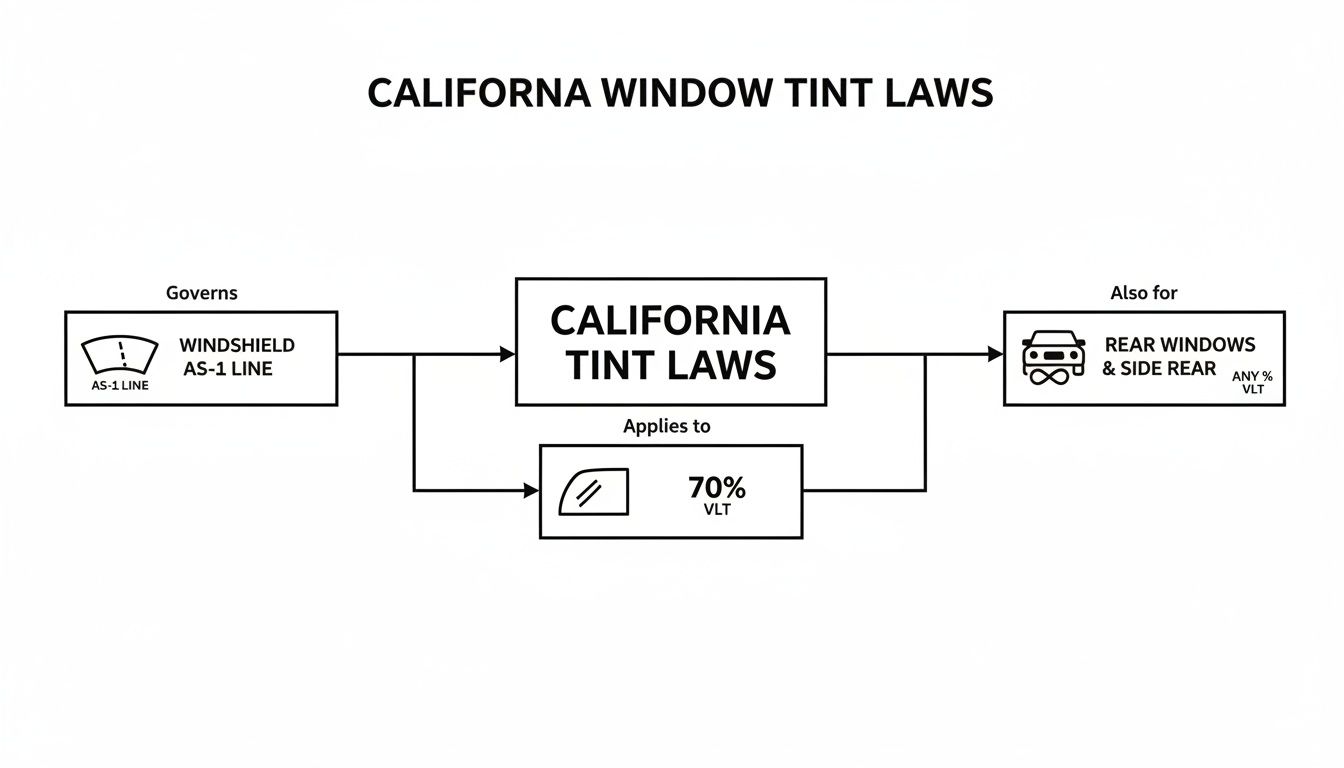
As you can see, there’s a major difference between the front of the car, where seeing out is everything, and the back, where you're allowed more privacy.
Understanding The AS-1 Line On Your Windshield
Alright, let's talk about the windshield. California law is very direct: you cannot apply any tint film to the main part of your windshield. Period.
However, the law does carve out an exception for a small, non-reflective strip at the very top. This is where the AS-1 line becomes so important.
The AS-1 line is a tiny marking you’ll find on the upper corners of most factory windshields. It’s usually labeled right on the glass as "AS-1" or "AS1." This mark, set by the American National Standard Institute (ANSI), shows the absolute highest point where a tint strip can be legally applied.
The rule couldn't be simpler: any non-reflective tint on your windshield must stay above this AS-1 line. If for some reason your windshield doesn’t have an AS-1 marking, the law defaults to a standard measurement—you can tint the top four inches. This strip is designed to act like a built-in sun visor, cutting down glare without getting in the way of your view of the road.
This isn’t just a guideline; it's a hard boundary. Putting any film below this line is an immediate violation, no matter how light the tint is.
By understanding VLT for your side windows and the AS-1 line for your windshield, you’re already ahead of the game. It turns a bunch of confusing legal text into a simple checklist you can use for your own car. Knowing these rules helps you find that sweet spot between style, comfort, and staying compliant.
If you’re curious about the science behind how these films actually block heat and UV rays, you can learn more from our guide on how window tinting works.
Understanding The Penalties For Illegal Tint
It’s one thing to know the rules, but it’s another to understand what actually happens when you break them. When it comes to California’s window tint laws, getting caught with illegal tint isn't a small slap on the wrist. It’s a real headache that can hit your wallet and your schedule pretty hard.
If a police officer pulls you over and finds your tint is too dark, you're not likely to get off with just a warning. The most common penalty is a "fix-it" ticket.
This isn't just a fine you pay and forget about. A fix-it ticket means you have to take action. You’re required to have the illegal tint professionally removed. After that, you need a law enforcement officer to verify the fix and sign off on your ticket. Only then can you clear the violation with the court, which still involves paying a fine.
The True Cost Of A Tint Violation
The base fine on the ticket might look small, but the total cost snowballs quickly. The initial citation is just the beginning.
Here’s a look at all the expenses you could be facing:
The Ticket Itself: The base fine for a correctable offense usually starts around $25.
Court Fees: This is where the cost really jumps. Various administrative and court fees can easily push the total past $100.
Tint Removal Service: You’ll have to pay a professional to strip the old film without damaging your glass, which can run anywhere from $50 to over $200.
Your Time: Don't forget the hassle factor—taking time off work, driving around to get the ticket signed, and dealing with the court system is a major inconvenience.
And whatever you do, don't ignore it. If you miss the deadline to fix the violation, the penalties get much worse. We're talking about substantially higher fines, a possible warrant for your arrest, and even a hold on your vehicle's registration from the DMV.
A lot of people think tint tickets are rare, but that's a huge myth. Excessively dark windows are an easy-to-spot violation and a major reason officers initiate a traffic stop, often due to officer safety concerns.
Violation Costs Breakdown
Here’s a simple table to show how a "small" ticket can become a big expense. These are just estimates, but they give you a clear idea of what you're up against.
Violation Type | Base Fine | Potential Court Fees | Total Estimated Cost |
|---|---|---|---|
First Offense ("Fix-It") | ~$25 | ~$170+ | ~$197 or more |
Failure to Correct | ~$197+ | Varies Widely | Can escalate significantly |
As you can see, the costs add up fast. It’s far cheaper and less stressful to get it right the first time. Investing in a professional, compliant tint installation from a trusted shop like Auto Renu Auto Glass LLC saves you from a much bigger, unexpected bill down the road.
Navigating Medical Exemptions For Darker Tint
California's window tint laws are notoriously strict, but they're not without compassion. The state recognizes that for some people, darker window tint isn't a cosmetic choice—it's a medical necessity. For those with certain health conditions, protection from UV rays and harsh sunlight is critical for their well-being.
This isn't some secret loophole. It's a clearly defined legal path laid out in California Vehicle Code Section 26708(d). But getting an exemption isn't as simple as asking your doctor for a note. It involves a specific process, and even with a legitimate exemption, some rules still apply.
Who Qualifies For a Medical Exemption?
Let's be clear: California doesn't hand these out easily. Medical exemptions are reserved for individuals with documented health issues where sun exposure presents a genuine, significant risk. You'll need a licensed physician, dermatologist, or optometrist to certify that darker tint is medically necessary for your specific condition.
Some of the most common qualifying conditions include:
Lupus: An autoimmune disease that can cause severe flare-ups when the skin is exposed to the sun.
Skin Cancers: For anyone with a history of melanoma or other skin cancers, blocking UV radiation is a top priority.
Photosensitivity Disorders: A range of conditions that cause an extreme and often painful sensitivity to sunlight.
Albinism: This genetic condition results in a lack of pigment, leaving the skin and eyes extremely vulnerable to sun damage.
This list isn't exhaustive, but it gives you a good idea of the seriousness required. Simply wanting darker windows for comfort or privacy won't cut it.
The Steps to Secure Your Exemption
If you have a qualifying medical need, getting the right paperwork is everything. A casual note from your doctor tucked in the glove box won’t work. You need an official, signed statement that stays in your vehicle at all times.
Here’s how the process generally works:
Consult Your Doctor: Schedule a visit and explain your situation. Your doctor will need to provide a signed letter on their official letterhead that clearly states your medical diagnosis and explicitly recommends darker window tint to protect your health.
Specify the VLT: The doctor's statement should ideally recommend a minimum Visible Light Transmission (VLT) percentage needed for your protection.
Keep It In Your Car, Always: This signed document is your proof. It must be kept in the vehicle whenever it's being driven. If a law enforcement officer pulls you over, this is the first thing you'll need to present to explain why your tint is darker than the standard legal limit.
Crucial Point: California law requires that any tint applied under a medical exemption must be removable. This is a non-negotiable part of the statute.
Important Limitations Still Apply
A medical exemption is not a free pass to tint your windows as dark as you want. The law strikes a balance between your medical needs and the safety of law enforcement officers who need to see inside the vehicle during a traffic stop.
Even with a valid doctor's note, these rules are absolute:
No Windshield Tint: The front windshield is still off-limits, except for the usual 4-inch non-reflective strip at the very top (above the AS-1 line).
No Reflective or Banned Colors: Your tint must be a neutral shade like gray, charcoal, or smoke. Mirrored, red, amber, or blue films remain strictly illegal for everyone.
Front Side Window Limits: While the law provides some flexibility, a common benchmark for medical exemptions is a VLT of no lower than 35% on the front side windows.
Following the process correctly means you can drive with the protection you need without worrying about tickets or fines. It's a system designed to provide real relief for people who truly depend on it.
The Story Behind California's Tint Laws
Ever wonder why California's tint laws are so specific? They weren't just pulled out of a hat. These rules have been shaped over decades, with one major goal in mind: keeping drivers and law enforcement officers safe. Looking back at how these laws came to be shows that they aren't just arbitrary numbers—they're based on real-world safety concerns.
The history of windshield tint laws in California really starts back when aftermarket tinting first took off. As more cars hit the road with heavily darkened windows, safety officials and police departments started seeing some serious problems.
Two major issues quickly became clear. First, super-dark tint dramatically cuts down on a driver's visibility, especially at night or in bad weather, which naturally leads to more accidents. Second, it created a huge officer safety problem during traffic stops. If an officer can't see inside a vehicle, they have no way to know what they're walking up to.
How the Law Evolved
These growing concerns kicked off a wave of legislative changes. Lawmakers gradually moved from a mostly hands-off approach to the detailed regulations we have today, tightening the rules step by step.
It started getting serious back in 1961, when the state legislature banned any material that could obscure a driver's clear view through the windshield. By 1967, the Vehicle Code was updated to forbid attaching anything to the windshield or front side windows, showing a much stricter stance. A huge moment came in 1973 when the modern framework was put in place. This made it illegal to both use and install prohibited tints, though it made an exception for factory-installed glass, a detail you can find in old news reports. The LA Times archives offer a fascinating look back at this legislative journey.
This timeline reveals a clear pattern: as car technology and trends changed, the law always adapted to put safety first.
For over 50 years, the guiding principle behind California's tint laws has been simple: unobstructed visibility. Every single rule, from the 70% VLT requirement on front side windows to the strict limits on the windshield, is there to make sure drivers can see the road and officers can see the driver.
This history really drives home why the state is so serious about compliance. It’s not just about how your car looks; it’s about a half-century commitment to public safety. When you understand that, it becomes crystal clear why working with a professional installer who knows these rules inside and out isn't just a smart move—it's essential for staying safe and legal on California roads.
How Professional Tinting Keeps You on the Right Side of the Law
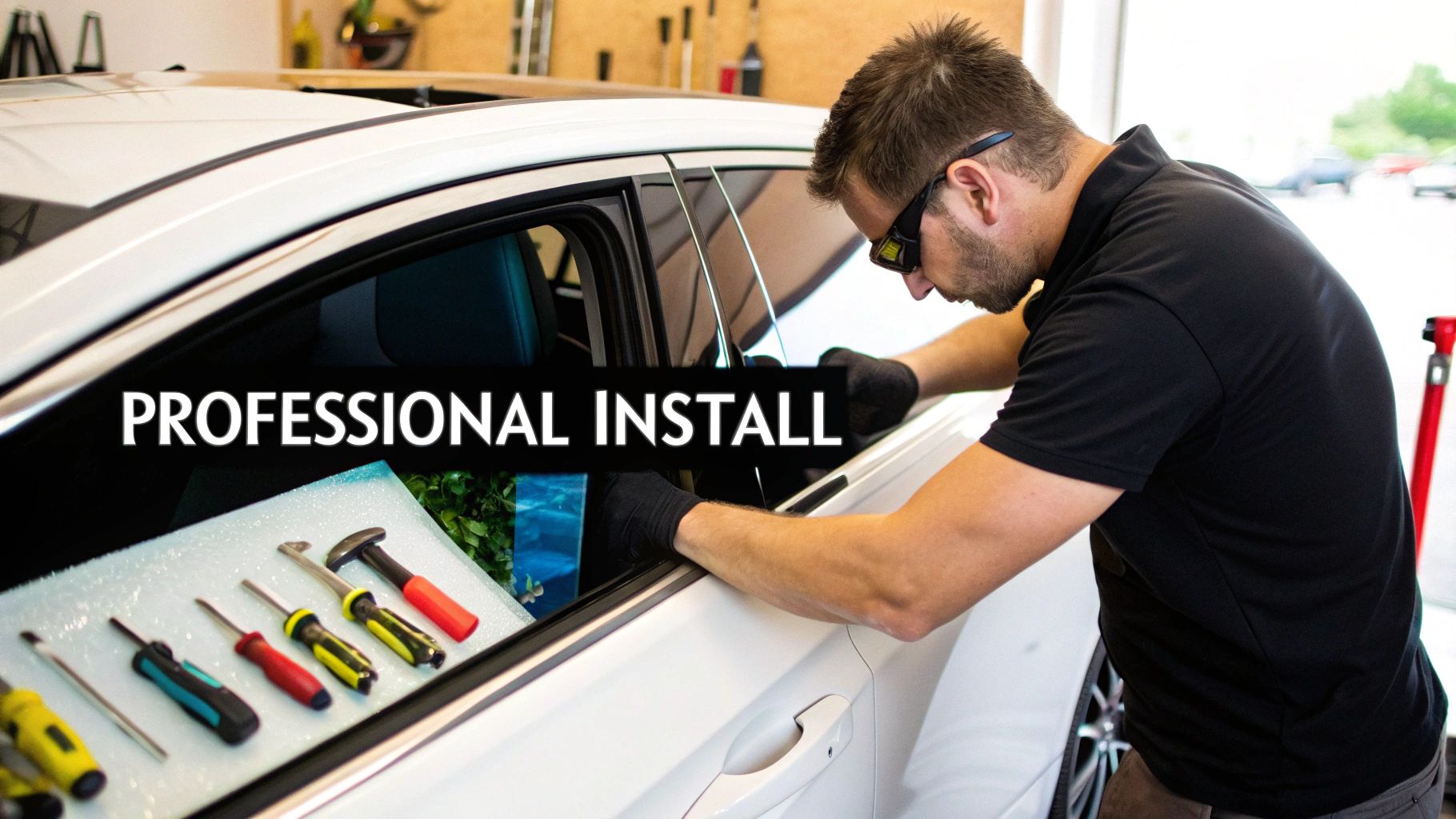
Trying to figure out windshield tint laws in California on your own can feel like a shot in the dark. It's easy to grab a DIY kit from a website claiming it's "legal," only to get it installed and realize you’ve crossed a legal line. This is where a professional installer isn't just a luxury—they're your best defense against legal headaches.
The goal is to get it right the first time and avoid that dreaded "fix-it" ticket. A pro doesn't just give you a clean, bubble-free finish. They're experts who live and breathe the regulations, making sure every inch of film on your car is compliant.
The Right Tools and Certified Materials
A huge part of a professional job comes down to using the right gear and high-quality materials. Reputable shops and technicians use films from top manufacturers that certify their products meet California’s specific VLT standards. That’s a crucial detail that most DIY kits just can’t guarantee.
Professionals also use a specialized tool called a VLT meter. It precisely measures the total amount of light passing through both the factory glass and the tint film. Your car’s windows aren't 100% transparent from the factory, and a pro knows how to account for that. They'll pick a film that keeps you safely above the 70% VLT limit on your front side windows once it’s all put together.
This isn’t about just getting close to the legal limit; it’s about making sure you’re comfortably and verifiably within it.
Mastering the Fine Print
An expert’s real value goes way beyond just applying the film. They know the ins and outs of the rules that most people miss, ensuring your entire vehicle is up to code.
This knowledge covers all the tricky spots:
The AS-1 Line: Professionals know exactly where to find the AS-1 line on your windshield and will cut the non-reflective top strip to fit perfectly within that boundary—never dipping into your direct line of sight.
Color Restrictions: They stock compliant, neutral-colored films like charcoal and gray. This keeps you far away from the illegal red, blue, or amber tints that instantly attract attention from law enforcement.
Reflectivity Rules: A pro uses films designed to be non-reflective, so you won't end up with that "mirror" finish that’s explicitly banned by the California Vehicle Code.
Proper Documentation: After the job is done, a professional installer can give you a certificate of compliance. This piece of paper can be a lifesaver if an officer ever questions your tint during a traffic stop.
Think of a professional tinter as a legal specialist for your car's glass. They stay current on every legislative update and are obsessed with making sure every installation is 100% compliant. It’s about protecting you from fines and hassles down the road.
The Auto Renu Auto Glass Advantage
For drivers who want both compliance and convenience, a mobile tinting service is the perfect solution. Forget about dropping your car off at a shop and killing time for hours. Instead, a skilled technician brings all the tools, materials, and expertise right to your home or office.
With a trusted mobile provider, you get the absolute certainty that your vehicle meets all windshield tint laws in California, with no shortcuts on quality. To see how a mobile service can give you a flawless, legal tint right in your own driveway, check out our mobile window tint solutions.
In the end, investing in a professional installation from a company like Auto Renu Auto Glass LLC is the smartest way to enjoy the perks of window tint—like less heat, UV protection, and more privacy—without ever worrying about getting pulled over. It's a one-time investment in peace of mind that pays for itself for years to come.
Frequently Asked Questions About California Tint Laws
Even when you know the basics of California's tint laws, some specific questions always pop up. It's the unique situations—like driving with out-of-state plates or wondering about certain colors—that can leave you guessing. Getting straight answers is the only way to make sure your car is 100% legal.
Let's dive into the most common questions we hear from drivers every single day. We'll clear up the confusion and help you steer clear of any unexpected and expensive tickets.
Can I Tint My Entire Front Windshield In California?
Absolutely not. The law is crystal clear on this: you cannot apply tint film to the whole front windshield. California's windshield tint laws are among the strictest, allowing only a non-reflective strip on the top 4 to 5 inches—above what’s known as the AS-1 line.
The main area of the windshield, your primary field of vision, must be left completely clear. Any film that darkens or adds color to this part of the glass is illegal for standard vehicles. The goal is to ensure nothing obstructs your view of the road.
Is My Out-Of-State Tint Legal In California?
This is a classic "gotcha" for visitors and new residents. The short answer is no. California law applies to every vehicle on its roads, regardless of where that car is registered.
If your front side windows are tinted darker than the 70% VLT that California requires, you're technically breaking the law and risk a ticket. You have to follow the rules of the state you're driving in, not the one your license plate is from.
The big takeaway here is that "I didn't know" won't get you out of a ticket. An officer can cite you for illegal tint, no matter what your home state allows.
Are Certain Tint Colors Illegal?
Yes, they are. California law specifically bans red, amber, and blue tint films on the front windshield and front side windows. These colors are restricted because they can mess with your ability to see traffic lights and emergency vehicle lights correctly, which is a major safety risk.
To stay safe and legal, stick with neutral colors like charcoal, gray, or bronze. You'll get all the benefits of tint without the legal headache. If you're curious about which films hold up best over time, check out our guide on how long window tint lasts.
Does A Tint Violation Add Points To My Driving Record?
Here’s some good news: a window tint ticket won't add any points to your DMV record. These citations are considered non-moving violations, putting them in the same category as a broken taillight or expired registration.
But don't ignore it. You still have to pay the fine. And if you get a "fix-it" ticket, you'll need to strip the illegal tint and get proof that you've corrected the issue, which is both a hassle and an extra expense.
Ready to get a professional, compliant tint job without the hassle? The experts at Auto Renu Auto Glass LLC bring top-tier mobile tinting services directly to you, ensuring your vehicle looks great and meets all of California's strict legal standards. Book your mobile appointment at https://www.autorenu911.com today.