Your Guide to Auto Glass Chip Repair Cost
What's the real auto glass chip repair cost? Our guide breaks down pricing, insurance, ADAS recalibration, and smart ways to save on windshield repair.
Oct 9, 2025
generated
auto glass chip repair cost, windshield chip repair, car glass repair, adas calibration, windshield repair cost

That sinking feeling when a rock kicks up and leaves a starburst on your windshield is all too familiar. Your first thought is probably, "How much is this going to set me back?" The good news is, a quick repair is far kinder to your wallet than a full replacement. Generally, you can expect the auto glass chip repair cost to be somewhere between $50 and $150.
Acting fast is the most important thing. What seems like a tiny, harmless chip today can quickly spiderweb into a massive crack tomorrow, especially with the stress of bumpy roads or a sudden temperature change.
What's The Real Cost of a Windshield Chip Repair?
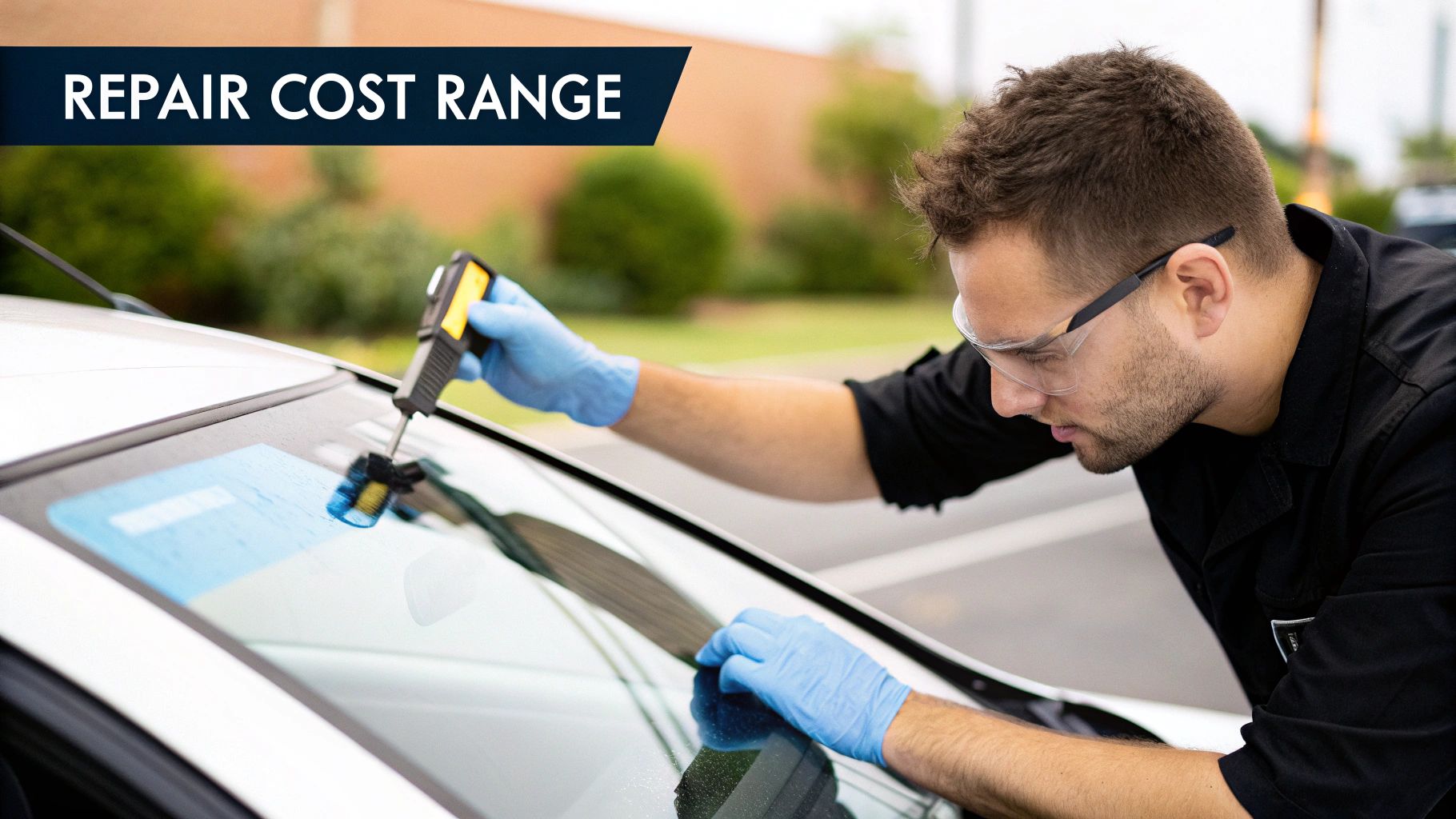
So, what goes into that final price tag? It’s not just a number pulled out of thin air. A proper repair is a skilled process that restores both the strength and clarity of your windshield. It’s about more than just squirting some glue into the hole.
A trained technician injects a high-tech, clear resin into the chip. This resin is specially formulated to bond with the glass on a molecular level, effectively sealing the damage. This stops the chip from spreading and makes it nearly invisible, restoring the critical structural integrity of your windshield.
A Quick Look at Repair Costs
To help you get a better idea of the cost, we've put together a simple table outlining common scenarios. Keep in mind, the final price really boils down to a few key variables. A simple, clean bullseye chip is much easier (and cheaper) to fix than a complex star break with little legs shooting out in every direction. If your car has advanced driver-assistance systems (ADAS) with cameras mounted behind the windshield, that can sometimes add a step or two to the process.
For a precise quote tailored to your vehicle and the specific damage, your best bet is always to have a professional take a look. You can learn more about what's involved in our guide to professional windshield repair services.
Estimated Auto Glass Chip Repair Costs at a Glance
This table summarizes typical cost ranges for various windshield chip repair scenarios, helping you quickly assess potential expenses.
Repair Scenario | Estimated Cost Range | Key Influencing Factor |
|---|---|---|
Single, Small Chip (e.g., bullseye) | $50 - $90 | Minimal resin and labor required. |
Complex Chip (e.g., star break) | $70 - $120 | Requires more skill and time to fill all cracks. |
Multiple Chips (same visit) | $80 - $150+ | Shops often discount the second or third chip. |
There's a strong preference in the industry for repair over replacement whenever possible. Why? Because repairing the chip keeps your windshield's original factory seal intact, which is the best seal you can have.
Insurance companies know this, too. They would much rather pay for a small repair than a massive replacement. That’s why many insurers will waive your deductible entirely for a chip repair, meaning it could cost you nothing out of pocket.
This approach isn't just about saving you a few bucks today; it extends the life of your auto glass and keeps your car safer. Industry data consistently shows that most repairs fall squarely in that $50 to $150 sweet spot, with insurance coverage often being the deciding factor that gets drivers to act quickly.
Understanding What You Actually Pay For
When you get a quote for a chip repair, it's easy to look at the price and think, "For a 30-minute job?" But that number represents a lot more than just a bit of time and resin. The auto glass chip repair cost is a blend of specialized materials, sophisticated tools, and, most importantly, the technician's hard-earned expertise.
Think of it like calling in a skilled electrician. You're not just paying for a few feet of wire; you're paying for their knowledge to do the job safely and correctly, preventing a much bigger problem down the road. It's the same with an auto glass technician—they're restoring a critical safety feature of your car.
The Two Main Cost Components
So, where does your money actually go? Every repair bill essentially boils down to two key areas. While the exact ratio can shift a bit, one part consistently makes up the bulk of the cost.
Materials (20-30%): This is the high-quality, optically clear resin that gets injected into the chip. It also includes the specialized cleaning agents and polishing compounds needed for a crystal-clear, smooth-as-glass finish.
Labor and Overhead (70-80%): Here's the big one. This covers the technician's time, their extensive training and certification, and the shop's investment in professional-grade equipment.
The tools of this trade aren't something you can just pick up at a hardware store. Technicians rely on professional injectors that create a powerful vacuum, pulling every last bit of air out of the chip. This step is crucial for allowing the resin to penetrate every tiny fissure. After that, a specific UV light is used to cure the resin, hardening it to bring back the windshield's original strength.
This isn't just about making a crack disappear. A proper repair restores the structural integrity of your windshield, which is a key player in protecting you during a rollover and ensuring your airbags deploy correctly. You're not just fixing a chip; you're investing in your safety.
The Value of Expertise and Convenience
A huge slice of what you're paying for is the technician's skill. An experienced pro knows exactly how to handle different types of damage, whether it's a simple bullseye or a tricky star break, all without making the crack spread. Their steady hand and deep knowledge are what make the repair virtually invisible and completely solid.
Plus, don't forget the convenience factor. Many services, including ours, are mobile. That price often includes a certified technician coming right to your driveway or office parking lot. This saves you the headache of rearranging your day to sit in a waiting room. You’re paying for a full-service solution that wraps up the physical repair, the technician's expertise, and the convenience of a job done right, right where you are.
Key Factors That Influence Your Repair Quote
Ever wonder why your friend’s chip repair was just fifty bucks, but your quote came in at double that? The final auto glass chip repair cost isn't a one-size-fits-all number. A few specific variables can really make the price swing, and knowing what they are helps you have a straight-up conversation with your repair shop.
Think of it like getting a quote from a painter. The price for a small accent wall is going to be way different than the cost for an entire room with high ceilings and tricky trim work. The same idea applies to your windshield—the specific details of the damage are what really drive the final cost.
This infographic breaks down where your money actually goes during a repair.
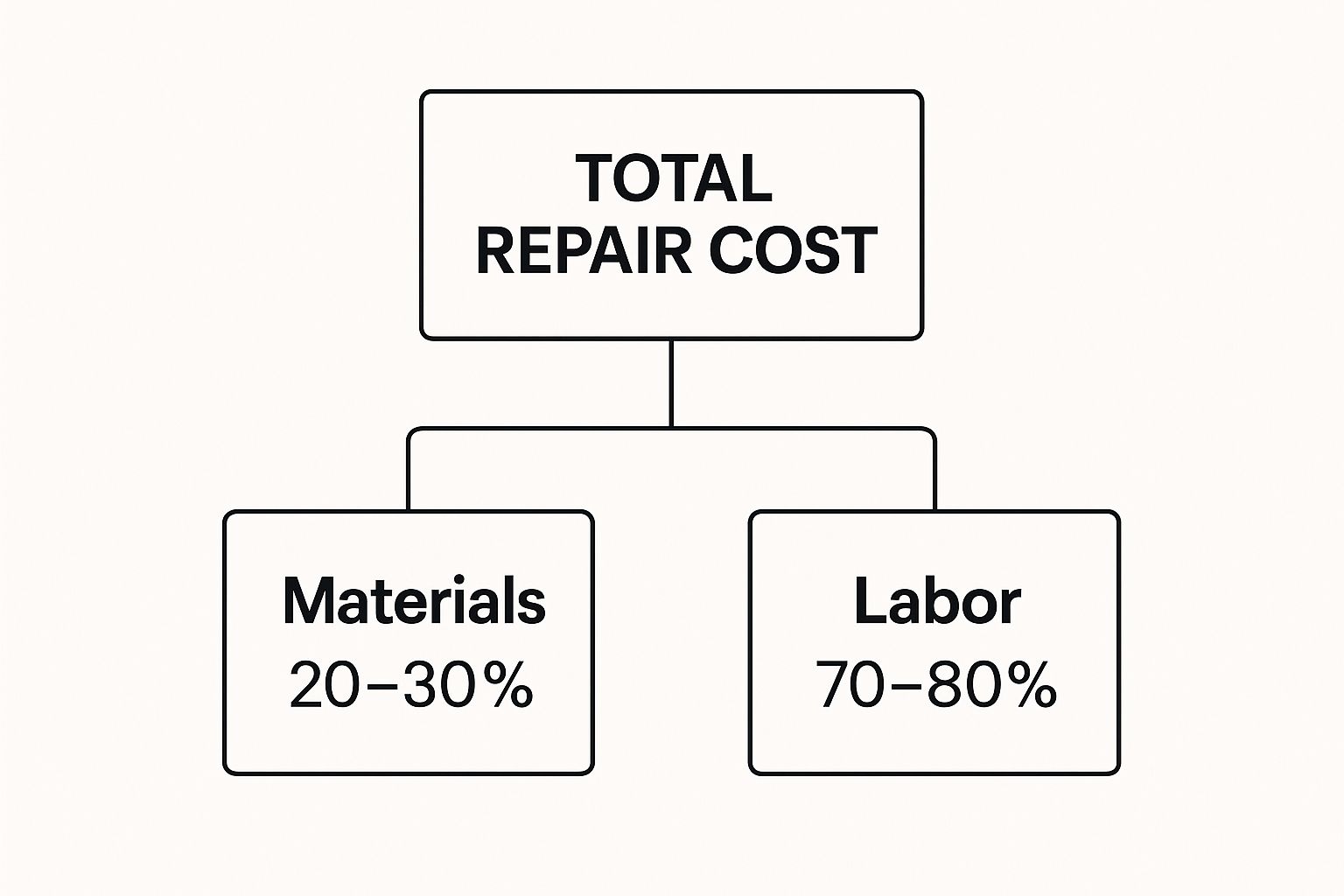
As you can see, you're mostly paying for the technician's skill and time, not just the little bit of resin they use.
The Damage Itself: Size and Type
Let's be clear: not all chips are created equal. The size and complexity of the damage are the biggest factors in what you'll pay. A tiny, clean bullseye chip—that classic circular break—is the easiest and cheapest to fix. It doesn't take much resin or time for a technician to get a perfect fill.
On the other hand, a star break, which has little cracks shooting out from the middle, is a whole different ballgame. Each of those "legs" has to be carefully filled to stop them from spreading later. That takes more precision, more skill, and more time, which naturally bumps up the labor cost.
Bullseye or Half Moon: This is simple, circular damage. It’s usually a quick and affordable fix.
Star Break: An impact point with cracks spreading out like a star. This one demands more detailed work.
Combination Break: A messy mix of a bullseye and a star break, often the trickiest and most expensive type of chip to repair.
Where the Chip Is Located
Where that chip landed on your windshield matters a ton, not just for the cost, but for whether it can even be repaired at all. A chip tucked away in a corner might not be a big deal, but one sitting right in the driver’s line of sight is a serious issue.
Any damage in this critical viewing area has to be repaired with extreme care to avoid leaving behind any visual distortion. A technician has to work meticulously to make sure the filled spot is as clear as possible for safety. If a perfect, non-distracting repair isn't guaranteed, a full windshield replacement becomes the only safe move.
Your Geographic Location
Finally, where you live plays a big role. Just like gas prices or a gallon of milk, labor rates for skilled technicians vary a lot from one place to another. The cost for a chip repair in a big city like San Francisco will almost certainly be higher than in a small, rural town.
This all comes down to the local market—things like the cost of living, how much it costs to run a business there, and the demand for good technicians. Because of these factors, the cost of auto glass chip repair can range anywhere from $40 to $100, which is always a better deal than a full replacement. For a deeper dive, you can find more insights about how market dynamics affect pricing on bearcreekautoglass.com.
How Modern Vehicle Technology Impacts Your Bill
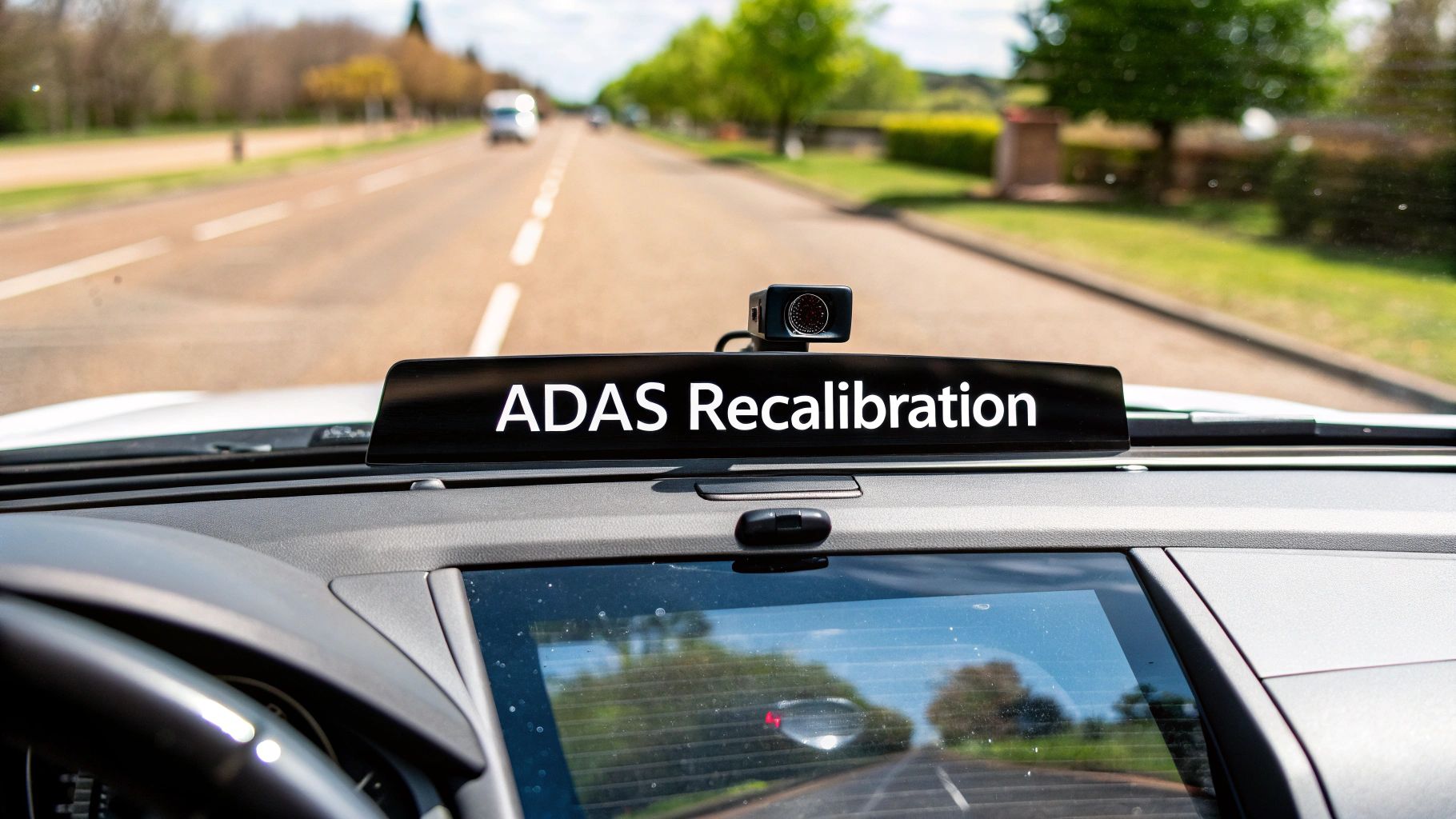
If you're driving a car that's only a few years old, you might be surprised to learn that your windshield is doing a lot more than just blocking the wind. It’s now a critical piece of technology, essentially serving as the eyes for your car’s most important safety features.
We’re talking about Advanced Driver-Assistance Systems (ADAS). These are the brains behind features like lane-keep assist, adaptive cruise control, and automatic emergency braking. All of them rely on a network of cameras and sensors mounted directly onto your windshield to see the road ahead. This new reality has added a layer of complexity to what was once a straightforward fix, and it can definitely influence your final bill.
Even a tiny chip repair, especially if it's anywhere near these sensors, can potentially interfere with their view. So, a technician's job isn't just about filling a chip anymore; it's about making sure these life-saving systems are still working perfectly after the fact.
The ADAS Calibration Requirement
Any time a windshield is worked on—and especially when it's replaced—those ADAS cameras have to be professionally recalibrated. This isn't an optional upsell; it's a critical safety procedure. The process ensures the cameras are aimed with laser precision, allowing them to accurately read lane lines and judge distances.
Think of it like getting a new pair of glasses. If the prescription is even slightly off, your whole world looks wrong. It’s the same with your car. A misaligned camera could cause your car to brake too late, swerve unnecessarily, or fail to react at all. This recalibration is a highly specialized job that requires specific tools and know-how, which is why it shows up as a separate charge on your invoice.
By 2025, it’s estimated that over 80% of new vehicles in the U.S. will have at least one ADAS feature tied to the windshield. As this tech becomes standard, so will calibration, adding an average of $100 to $200 to the cost of most glass services.
What This Means for Your Repair Cost
So, how does all this tech affect the auto glass chip repair cost? If you have a simple chip far away from the camera's line of sight, you might not need a recalibration. However, any work that gets close to the ADAS sensor housing—or anything that could cause the slightest shift in the glass—will probably require it.
A good technician will always assess the risk first. If there's even a small chance the repair could affect the system, a post-repair calibration check is the only way to guarantee your safety. This potential extra step is a major reason why getting a chip fixed on a newer, tech-packed vehicle can cost more than it would for an older car.
To get a better handle on the process, you can learn more about the details in our article on ADAS windshield calibration. It’s all about making sure every safety feature is working exactly as the manufacturer designed it to.
Using Insurance to Cover Your Repair Costs
https://www.youtube.com/embed/BApe9540XhE
That sudden thwack of a rock hitting your windshield is frustrating, but the bill doesn't have to be. What many drivers don't realize is that their car insurance policy can often turn that unexpected expense into a free, hassle-free fix. This completely changes the game when it comes to the auto glass chip repair cost.
The key is your comprehensive coverage. This is the part of your policy designed for damage that isn't from a collision—think theft, falling tree branches, or, in this case, a stray pebble kicked up on the highway. Insurance companies know that a full windshield replacement is a much bigger payout than a quick chip repair.
Because of this, they have a vested interest in fixing the small problem before it becomes a big one. To encourage you to act fast, most major insurers will completely waive your deductible for a chip repair. They'd much rather pay a small repair fee now than a massive replacement bill later on when that chip inevitably spreads into a long crack.
Navigating the Insurance Claim Process
Filing an insurance claim for a chip repair is surprisingly simple. In fact, you might not have to do much at all. Reputable auto glass shops (like our team here at Auto Renu) deal with insurance companies all day long and can typically handle the entire process for you.
Here’s how it usually works:
Call a qualified shop: The first step is to contact a professional repair service. You’ll just need your vehicle details and insurance policy number handy.
They verify your coverage: The shop will then contact your insurance provider on your behalf. They'll confirm you have comprehensive coverage and that your insurer will waive the deductible for the repair.
Schedule the fix: Once everything is confirmed, you just set up the appointment. The shop performs the repair and bills your insurance company directly. No money, no paperwork, no hassle for you.
One of the biggest questions we get is, "Will filing a glass claim make my rates go up?" The good news is that, in almost all cases, the answer is no. A comprehensive claim for a no-fault incident like a random rock chip doesn't label you as a risky driver, so it shouldn't affect your premiums.
Paying Out of Pocket vs. Filing an Insurance Claim
So, when does it make sense to pay yourself versus letting insurance handle it? For chip repairs, the answer is almost always to use your insurance, since the deductible is usually waived. The only time paying out of pocket really makes sense is if you don't have comprehensive coverage or if, for some strange reason, your deductible isn't waived and it's higher than the repair cost.
This table really puts the decision into perspective.
Paying Out of Pocket vs Filing an Insurance Claim
Payment Method | Your Immediate Cost | Potential Long-Term Impact | Best For |
|---|---|---|---|
Filing an Insurance Claim | $0 (Deductible often waived) | Typically none on premiums | Most chip repair scenarios with comprehensive coverage. |
Paying Out of Pocket | $50 - $150 | None | Drivers without comprehensive coverage or when the repair cost is below the deductible. |
At the end of the day, using your insurance is a savvy move. It takes what could have been an annoying out-of-pocket expense and turns it into a simple, free solution that keeps your car safe and your windshield intact.
Smart Strategies to Lower Your Repair Bill
Knowing what goes into the auto glass chip repair cost is one thing, but actively finding ways to shrink that bill is where you really save money. With a few smart moves, you can keep your costs down without ever sacrificing the quality or safety of the repair.
The most powerful strategy, by far, is to act immediately. A tiny, stable chip is usually a quick and inexpensive fix. But that little imperfection is under constant stress from road vibrations and temperature changes. Waiting just a few days can be all it takes for that chip to "spider" out into a long crack, instantly transforming a simple fix into a much more expensive windshield replacement.
Proactive Steps for Cost Savings
Beyond moving quickly, a little old-fashioned legwork can make a big difference. Don’t just take the first price you're quoted. Think of it like any other service—getting a few estimates from different shops will give you a much better sense of the going rate in your area.
Here are a few practical ways to keep more money in your wallet:
Shop Around for Quotes: Make a few calls to at least two or three local auto glass specialists. Not only will you find the best price, but you'll also get a feel for their customer service.
Ask About Cash Discounts: Some independent shops are willing to offer a small discount if you're paying out-of-pocket instead of going through insurance. It never hurts to ask.
Inquire About Multi-Chip Deals: Got more than one chip? Most companies will repair the second or third chip at a significantly reduced rate during the same visit.
The bottom line is that prevention is always cheaper than a cure. Addressing a chip immediately is the number one way to avoid a full replacement, which is the most expensive outcome.
Should You Consider a DIY Repair Kit?
You’ve probably seen them on the shelf at the auto parts store: DIY chip repair kits, often selling for under $20. They can look like a fantastic deal, but it’s really important to understand what you’re getting into.
For a very minor, perfectly round bullseye chip that isn't in your direct line of sight, a DIY kit might work as a stop-gap measure to keep it from spreading.
The catch is that these kits can't replicate what the pros use. They lack the powerful vacuum and injection tools needed to pull all the air out of the chip, which is critical for the resin to fill every microscopic crack. This can result in a weak repair that fails down the road. Worse yet, a botched DIY job can make it impossible for a professional to properly fix it later. For a permanent, safe, and nearly invisible repair, calling a pro is always the smartest investment.
Frequently Asked Questions About Chip Repair Costs
Even after breaking down the numbers, you probably still have a few practical questions. I get these all the time from customers, so let's walk through the most common ones.
Can I Get Multiple Chips Fixed at the Same Time?
Absolutely. In fact, it’s a smart move. Most auto glass shops can fix several chips in a single visit and will often give you a price break on the second or third repair. The technician is already there with all their tools, so it saves everyone time and money.
There's a catch, though. The location of the chips really matters. If two chips are too close to each other, or if the damage from multiple chips weakens the overall glass, the technician will likely recommend a full windshield replacement. Safety first, always.
How Long Will I Be Without My Car?
You won't be without it at all. A typical chip repair is surprisingly fast. For a single chip, the whole process usually takes just 20 to 30 minutes from start to finish.
The technician carefully cleans out the impact point, injects a clear, specialized resin, and then uses a UV light to cure it until it's rock-hard. It’s a quick and efficient fix you can have done in your driveway or office parking lot.
A big question I always hear is, "Will the repair last?" A good repair from a reputable company should. Most shops back their work with a lifetime warranty, guaranteeing the fix won't spread or yellow for as long as you own the car. It’s peace of mind built right in.
Don't wait for that small chip to become a big, expensive crack. The mobile pros at Auto Renu Auto Glass LLC can come to you for a fast, reliable repair. Get your free estimate today!