Auto Glass Windshield Replacement: Quick & Safe Guide
Your guide to auto glass windshield replacement: learn the process, ADAS calibration, insurance options, and costs for a safe, informed decision.
Dec 5, 2025
generated
auto glass windshield replacement, windshield repair, mobile auto glass, ADAS calibration, auto glass insurance
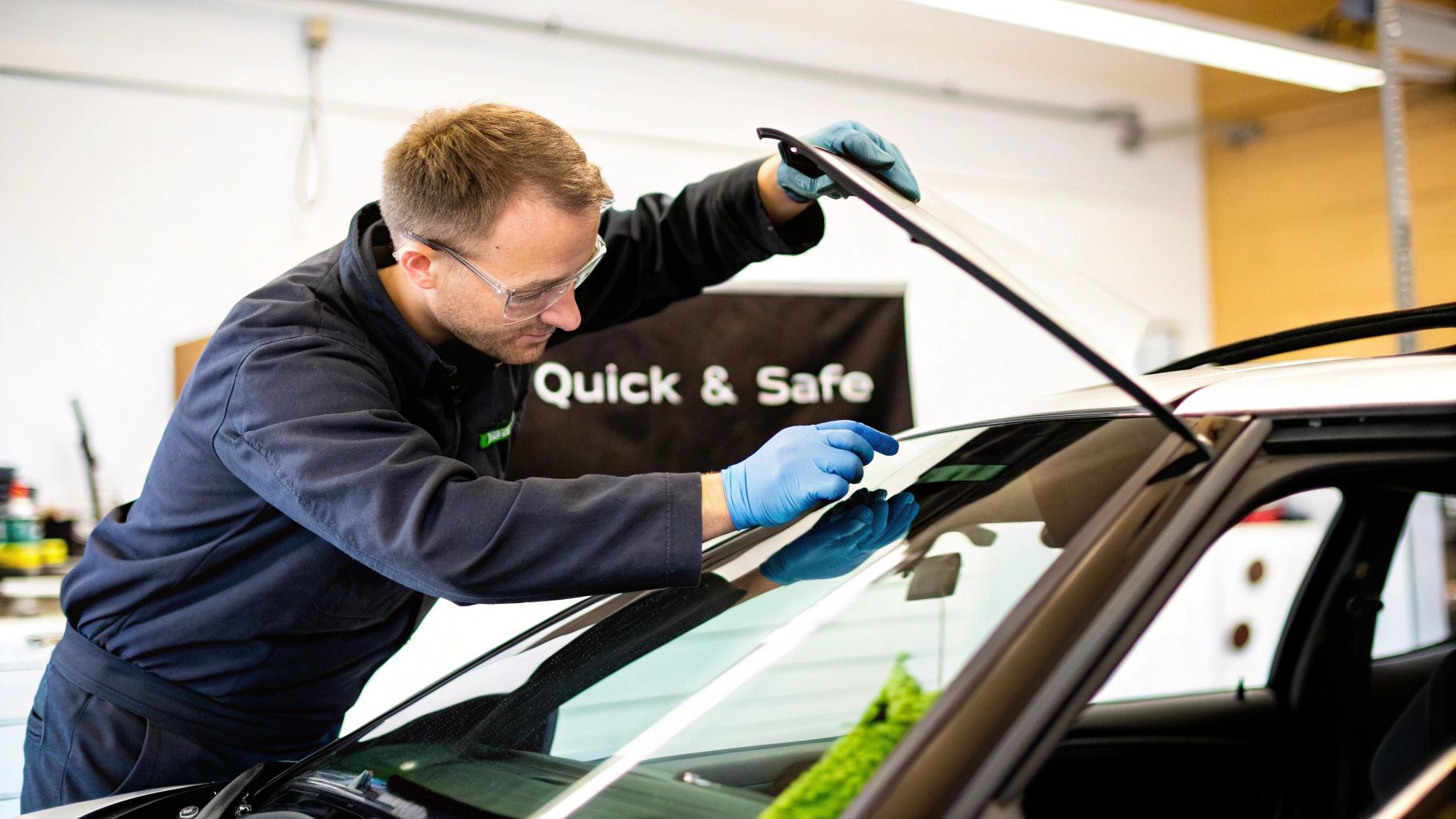
That chip in your windshield isn’t just annoying—it’s a real safety problem you can’t ignore. Whether you need a quick fix or a full auto glass windshield replacement comes down to a few key things: the size of the damage, where it’s located, and what kind of crack or chip it is. Making the right call, and making it quickly, is crucial for your car's safety.
Your Windshield Is Damaged Now What
A cracked windshield does more than just block your view. It seriously weakens one of your vehicle's most important safety features. Your windshield is a core part of your car's structural frame.
Think about it this way: in a rollover accident, a solid windshield can provide up to 60% of the strength needed to keep the roof from caving in. It also acts as a critical backstop for your passenger-side airbag, making sure it deploys correctly toward the passenger, not uselessly up toward the roof.
So, when you spot that damage, the first thing to do is figure out if it can be repaired or if the whole thing needs to be replaced. This isn't just about saving a few bucks; it’s about keeping you safe on the road.
Assessing the Damage Repair or Replace
Not all windshield damage is the same, and knowing the difference is the first step. Some small dings are an easy fix, but other types of damage mean a replacement is non-negotiable for safety's sake. If you're curious to learn more about the repair process, our guide on professional windshield repair breaks it down even further.
To help you figure out what you're dealing with, let's look at a simple way to size up the problem.
Quick Guide Repair vs Replace Your Windshield
Damage Type | Generally Repairable If... | Replacement Likely Needed If... |
|---|---|---|
Chip (Bullseye, Star) | It's smaller than a quarter and not in the driver's direct view. | It's larger than a quarter or directly in front of the driver. |
Crack | It's a single line shorter than a dollar bill (6 inches). | It's longer than a dollar bill, has multiple branches, or reaches the edge of the windshield. |
Location | The damage is outside the driver's primary line of sight. | The damage is in the driver's direct line of vision, as repairs can leave slight distortions. |
Depth & Complexity | The impact only affected the outer layer of glass. | The damage penetrates both layers of glass or has created a complex web of cracks. |
Basically, the decision comes down to restoring your windshield's strength and making sure your view is crystal clear.
A small, simple chip can usually be filled with a special resin that makes it strong again and stops it from spreading. But once you're dealing with a long crack or damage that has compromised the inner layer of glass, a repair just won't cut it.
A compromised windshield can fail during a collision, significantly reducing the effectiveness of your car’s most important safety features. Delaying a necessary replacement puts you and your passengers at unnecessary risk.
In those more serious cases, putting in a brand-new windshield is the only way to ensure your vehicle is as safe as the day it was made and will perform like it's supposed to in an accident.
The Windshield Replacement Process Step by Step
Replacing a windshield isn't like changing a tire. It’s a precise, multi-step process that requires a real craftsman's touch. You can think of it less like a simple parts swap and more like surgery for your car’s frame. Every single step is crucial for restoring your vehicle’s safety systems and structural strength, ensuring the new glass will protect you just like the original did.
From the moment one of our technicians shows up, their focus is on a perfect installation while treating your vehicle with the utmost care. This all starts before a single tool even comes out of the truck.
Step 1: Protecting Your Vehicle
First things first, a professional technician will prep the work area. This means carefully laying down protective covers over your hood, fenders, and the interior dashboard. It might seem like a small detail, but it’s a non-negotiable step that prevents any stray scratches, dings, or adhesive mishaps.
The goal is to make sure the only thing that changes about your car is the brand-new, crystal-clear windshield. With your car properly shielded, the real work of removing the old glass can begin.
Step 2: Removing the Damaged Windshield
Getting the old windshield out isn't a matter of brute force. Our technicians use specialized tools to carefully slice through the old urethane seal holding the glass to the car’s frame. They'll also meticulously disconnect anything attached to the glass, like your rearview mirror, rain sensors, or the camera mounts for your ADAS safety features.
The entire process is geared toward a clean removal that leaves the vehicle’s frame—what we call the pinch weld—completely clean and undamaged. This prepares the vehicle for the most critical part of the job.
This is the standard flow we follow: assess the damage, decide on the right course of action, and then get the job done right.
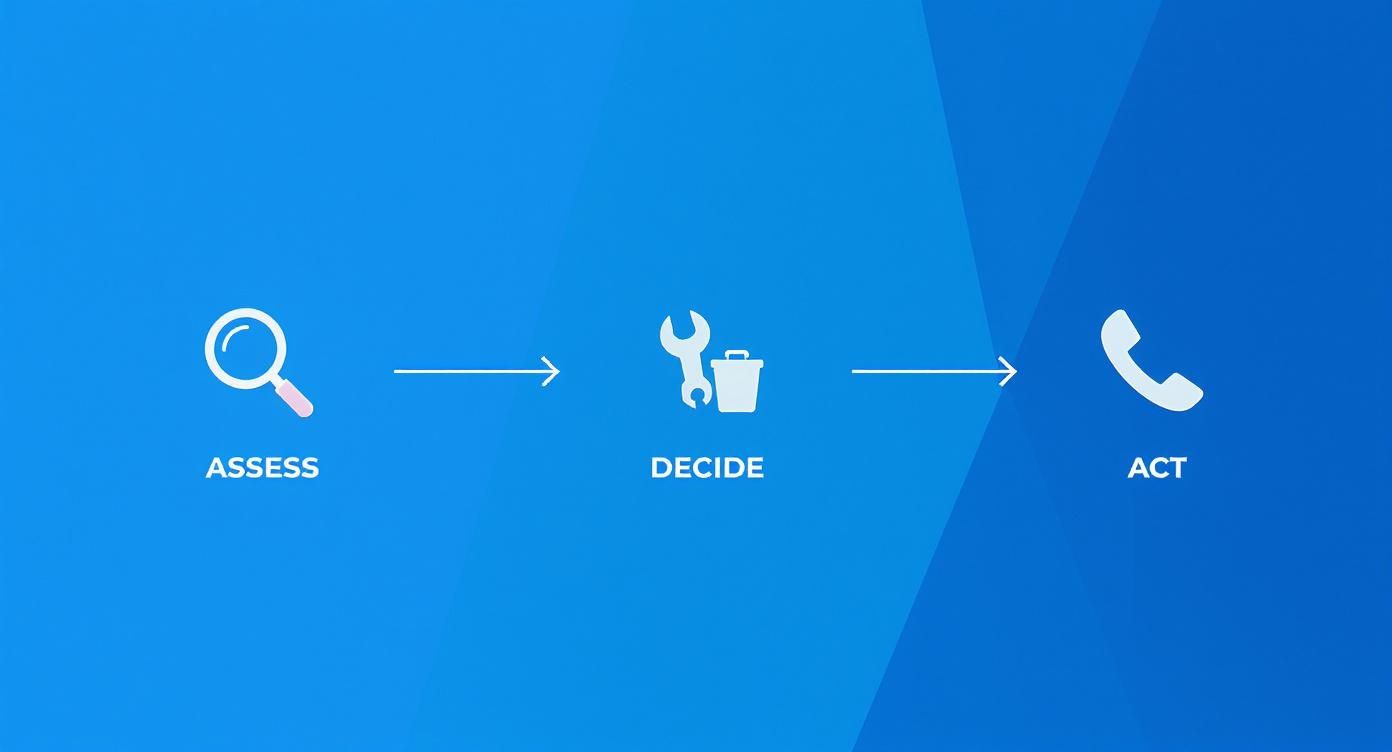
As you can see, a proper assessment is the foundation. It tells us whether a simple repair will suffice or if a full replacement is the only safe option for you and your family.
Step 3: Preparing the Pinch Weld
Once the old glass is out, all attention turns to the frame. The technician will trim the old urethane down to a tiny, flat strip, creating the perfect surface for the new adhesive to grab onto. This is one of those steps that absolutely cannot be skipped.
Any rust, leftover bits of old adhesive, or dirt left on the frame can seriously weaken the new windshield's bond. A perfectly clean and primed pinch weld is the secret to a watertight seal and the full structural support you need from your windshield.
After cleaning, a special primer is applied directly to the metal. This primer not only helps the new adhesive stick but also prevents rust from forming under the seal down the road, ensuring a bond that’s built to last.
Step 4: Applying Adhesive and Setting the New Glass
Now for the main event. Using a power caulking gun, the technician lays down a consistent, triangular bead of an industrial-strength adhesive called urethane. This isn’t just glue; it’s a structural bonding agent that holds the windshield in place, prevents the roof from crushing in a rollover, and ensures your airbags deploy correctly.
With the urethane applied, the new windshield is carefully guided into place using specialized suction cups. It has to be positioned perfectly on the first try, sinking into the fresh adhesive to create a solid seal. It takes a steady hand and a great eye to get this just right.
Step 5: Curing and Safe Drive-Away Time
The urethane needs a little while to cure before it’s strong enough to handle the stresses of driving. We call this the Safe Drive-Away Time (SDAT). Depending on the exact adhesive we use and the day's temperature and humidity, this can take anywhere from 30 minutes to a few hours.
Your technician will give you a specific SDAT for your vehicle, and it’s critical to follow it. Driving away too soon can cause the seal to fail, leading to annoying wind noise or water leaks. More importantly, it can result in a windshield that won’t perform correctly in an accident, putting you at serious risk.
Why ADAS Calibration Is Not Optional
If your car has safety features like lane-keeping assist, adaptive cruise control, or automatic emergency braking, your windshield is doing a lot more than just blocking the wind. It’s now the command center for your vehicle's Advanced Driver-Assistance Systems (ADAS), which all depend on a forward-facing camera mounted right on the glass.
Think of that camera as the eyes for your car's safety brain. It's constantly watching the road, feeding information to the systems that help you avoid a collision. When we replace your windshield, that camera has to be removed and then reattached to the new glass. Even the tiniest shift in its position—we're talking a single millimeter or a degree of tilt—can completely throw off its view of the world.
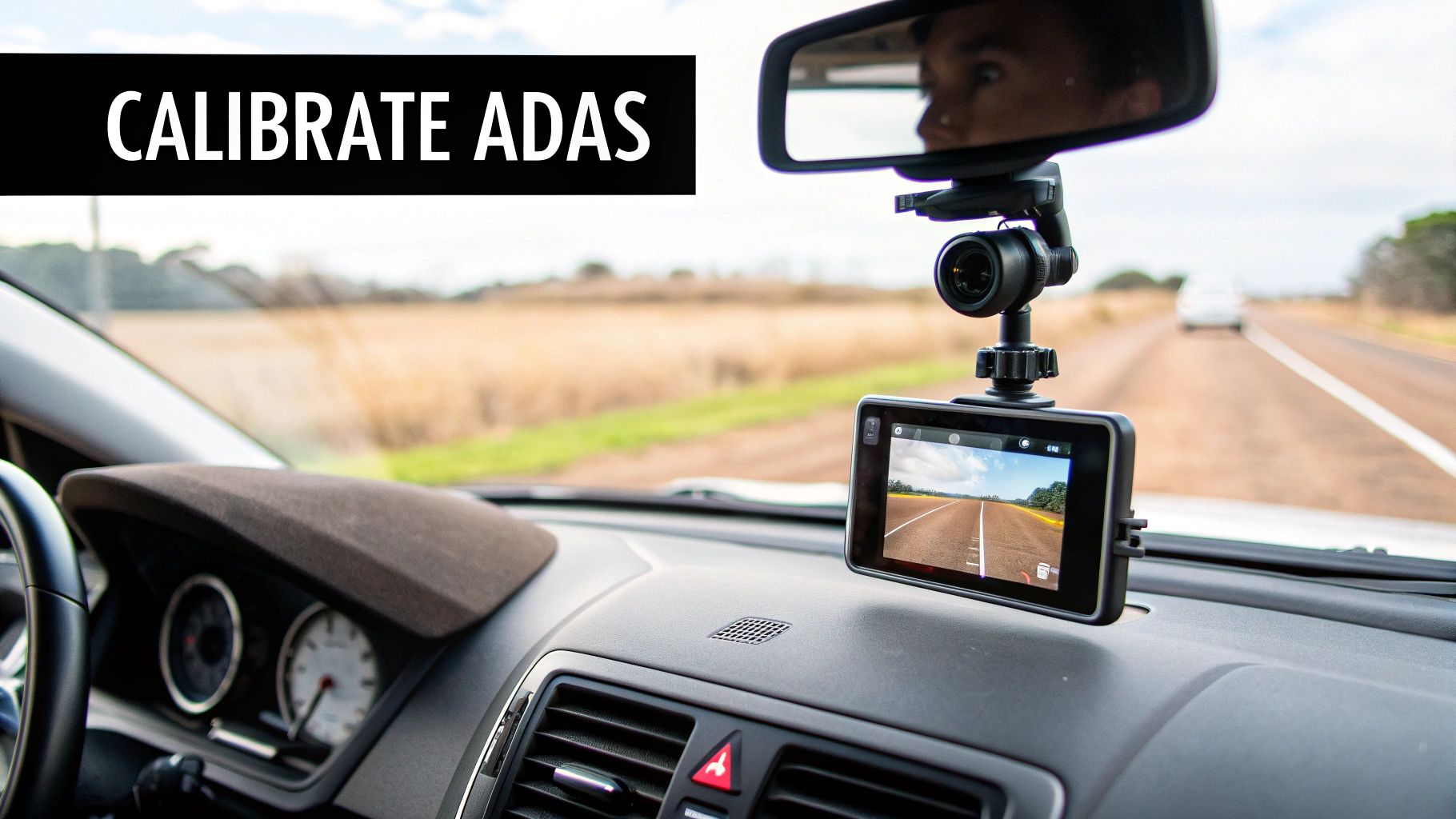
This slight misalignment could mean your car fails to "see" a stopped vehicle ahead or completely misreads the lane markings. This is exactly why a professional ADAS recalibration isn't just a suggestion—it's an absolutely critical final step to make sure your safety systems work the way they were designed to.
The Brains Behind the Glass
Windshields aren't just simple pieces of glass anymore; they've become high-tech hubs. Many modern vehicles now integrate things like Head-Up Displays (HUDs) and even Augmented Reality (AR) systems right into the windshield. At the center of this evolution is ADAS technology. The demand for these safety features has driven the need for specialized services like ours.
Without a precise recalibration after a windshield replacement, those advanced systems could fail you in a critical moment. Worse, they could react incorrectly and actually cause an accident. It's a risk that's simply not worth taking.
A study by the American Automobile Association (AAA) found that even minor windshield damage that requires a replacement can create ADAS camera problems. They concluded that post-replacement calibration is essential to get the system's performance back to factory specifications.
Static vs. Dynamic Calibration Explained
To get your ADAS camera seeing straight again, our technicians use one of two professional recalibration methods. The right one for the job depends entirely on your vehicle's make, model, and year.
Static Calibration: This is done in our workshop, a completely controlled environment. We park your vehicle on a perfectly level surface in front of a special target board. Using diagnostic tools, we reset the camera's angle, making sure it's perfectly aligned with the vehicle's centerline and the targets. It’s a very precise, stationary process.
Dynamic Calibration: This method involves actually driving the vehicle. A technician will take your car on well-marked roads at a specific speed for a certain distance. As the car moves, the ADAS camera essentially recalibrates itself by reading the lane markings and other road data in real-time.
Some cars only need one type of calibration, while others require a combination of both to be fully reset. Our trained technicians know exactly what procedure your vehicle needs. To learn more about this crucial service, check out our guide on the ADAS windshield calibration process. Skipping this step essentially makes your high-tech safety features unreliable, turning a valuable protection system into a potential liability.
Navigating Replacement Costs and Insurance Claims
https://www.youtube.com/embed/qetSFTlCs5A
Let's get straight to it—the first question on everyone's mind is, "So, what's this going to cost me?" When it comes to an auto glass windshield replacement, there’s no single price tag. The final bill really depends on a handful of key details about your specific vehicle.
The biggest factor by far is your car's make and model. Think about it: the glass for a high-end SUV packed with tech is going to be a different animal than the windshield for a simple, standard sedan. All those little extras built into the glass play a huge part in the final price.
What Determines Your Final Cost
So what exactly goes into the quote we give you? It helps to know what you’re paying for.
Vehicle Specifics: The year, make, and model dictate the exact size, curve, and type of glass your car needs.
Special Features: Does your windshield have a rain sensor, a heads-up display (HUD), or heating elements to melt ice? Each of these features adds complexity and cost.
Acoustic Glass: To keep the cabin quiet, many modern cars use a special laminated glass that dampens road noise. This is a premium material that costs more to replace.
ADAS Recalibration: As we touched on earlier, if your car has those advanced safety features, recalibrating the camera is a non-negotiable step that's factored into the total service cost.
All these pieces come together to determine the final price. But here’s the good news: you probably won't have to shoulder the entire cost yourself.
Making Insurance Work for You
This is where your car insurance policy can be a real lifesaver. For most people, a windshield replacement is covered under the comprehensive part of their auto insurance. This is the portion designed for damage that doesn't happen in a collision—things like storm damage, vandalism, or that stray rock that came out of nowhere on the highway.
It's always a good idea to check your policy specifics first, including understanding what comprehensive car insurance entails. Depending on where you live and the policy you chose, you might have a very low glass deductible or even a $0 deductible for windshield work.
A common worry is that filing a glass claim will make insurance rates go up. Thankfully, windshield damage is almost always considered a "no-fault" claim, which means it typically won't affect your premiums down the road.
The Claim Process Simplified
Dealing with insurance can feel like a chore, but it doesn't have to be. Here at Auto Renu Auto Glass LLC, we've got the process down to a science and handle the heavy lifting for you.
You Call Us: Just get in touch and have your vehicle and insurance info handy.
We Connect with Your Insurer: Our team gets on the line with your insurance company to open the claim and confirm your coverage.
We Handle the Paperwork: Forget about filling out forms. We manage all the documentation and billing directly with the insurer.
You Pay Your Deductible (If Any): Your only out-of-pocket expense is your deductible, if you have one. We bill the insurance company for the rest.
This direct billing approach takes the stress and guesswork out of the equation. We work with all major insurance carriers, making your auto glass windshield replacement as painless and affordable as possible so you can get back to your life.
OEM vs. OEE Glass: What's the Real Difference?
When you’re facing a windshield replacement, the quality of the new glass is just as critical as the technician’s skill. You'll likely hear a couple of terms thrown around by auto glass shops: OEM and OEE. Knowing what they mean is the key to making a smart decision for your car.
It’s easy to think of a windshield as just a big window, but it’s so much more. It's a key piece of your car's structural support, it's the backstop that allows your airbags to deploy correctly, and it's where your advanced safety system cameras are mounted. The glass has to be perfect, and understanding your options ensures your vehicle stays as safe as it was designed to be.
What Is OEM Glass?
OEM stands for Original Equipment Manufacturer. Simple enough—this is glass made by the exact same company that made the original windshield for your car's brand. It’s a perfect clone of the one installed at the factory, right down to the little automaker logo printed in the corner.
Because it comes straight from the car manufacturer's supply chain, OEM glass is almost always the most expensive option. While it guarantees a 100% identical match, it's not the only safe choice on the market. That’s where high-quality equivalent glass enters the picture.
Understanding OEE Glass
OEE means Original Equipment Equivalent. This glass is produced by world-class manufacturers—sometimes even the same ones that make OEM glass—and is engineered to meet the very same safety standards and precise specifications as the original. It will have the same thickness, strength, shape, and even color.
So what's the difference? The OEE version won't have the car manufacturer's logo on it. Since the glass company doesn't have to pay licensing fees for that logo, the savings get passed on to you. You get the same level of safety and performance for a much more reasonable price.
Here's the bottom line: both OEM and top-tier OEE glass are required by law to meet the same strict Federal Motor Vehicle Safety Standards (FMVSS). A professional installer makes sure the OEE glass used is a perfect match, giving you identical safety and structural integrity.
The Unsung Hero: Urethane Adhesive
Whether you go with OEM or OEE glass, the most important part of any windshield replacement is the urethane adhesive. This isn't just glue; it's an industrial-grade bonding agent that fuses the glass to your car's frame. Using a premium urethane is absolutely non-negotiable.
This adhesive does a few incredibly important jobs:
Structural Integrity: It turns the windshield into a structural component, preventing the roof from caving in during a rollover accident.
Airbag Support: It keeps the windshield firmly in place during a crash, providing the rigid surface your airbags need to inflate toward the passengers correctly.
A Perfect Seal: It creates a permanent, watertight seal that stops wind noise and water leaks for good.
The demand for high-quality auto glass is only growing as more cars hit the road and technology like ADAS becomes standard. To learn more about this trend, you can read about the growth of the automotive windshield market on sphericalinsights.com. Here at Auto Renu Auto Glass LLC, we keep it simple: we only use top-quality OEE glass and premium urethane adhesives to make sure every replacement is safe, secure, and built to last.
We Come to You: The Convenience of Mobile Windshield Replacement
Let's face it, a cracked windshield is more than just an eyesore—it's a major wrench in your already packed schedule. The thought of dropping your car at a shop, begging for a ride, and then waiting hours for the job to be done is enough to make anyone put off the repair. But what if the shop could come to you?
That’s exactly what modern auto glass windshield replacement is all about. We’ve designed our service to fit your life, not the other way around.
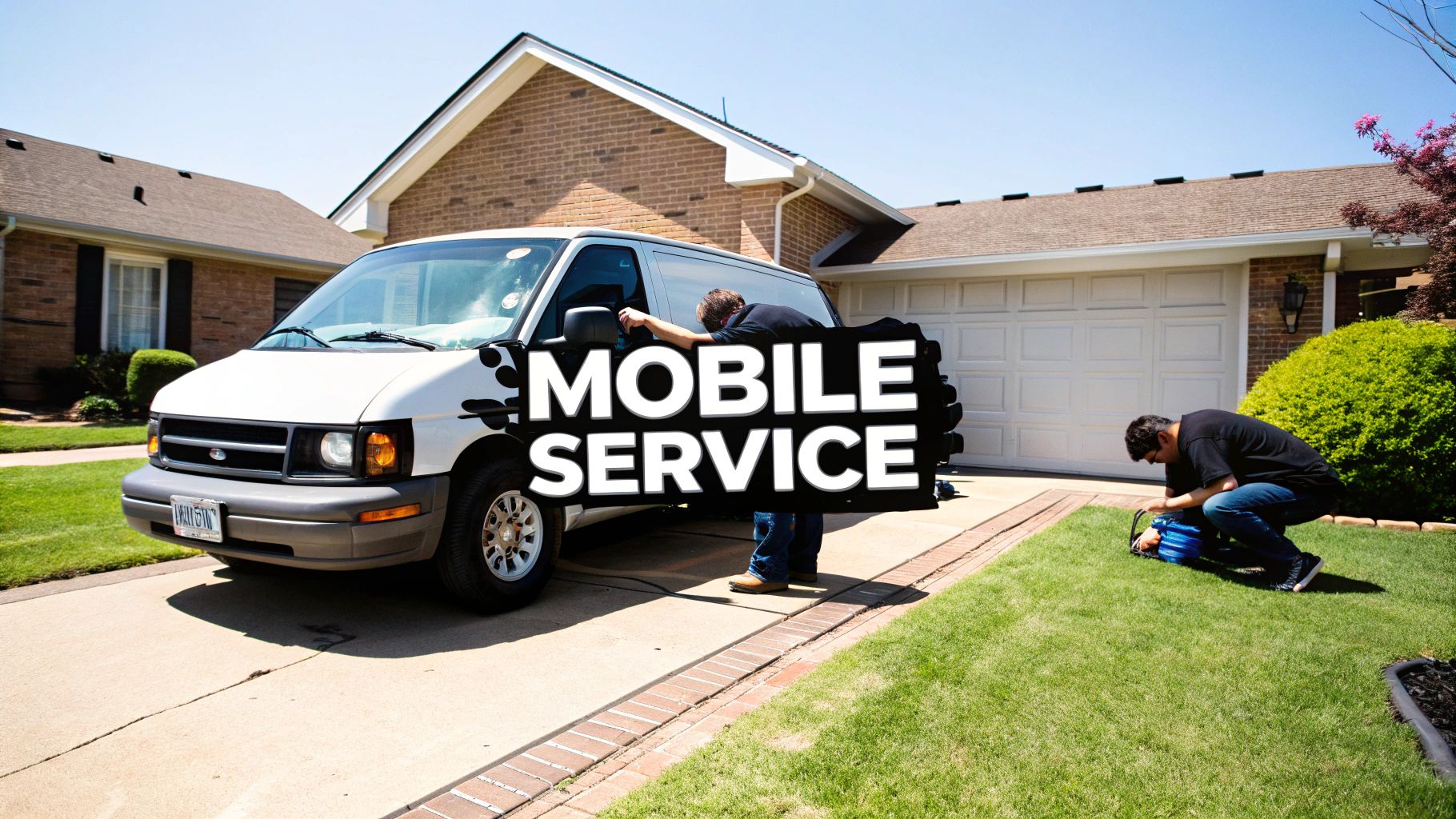
Our mobile service brings a fully equipped workshop and a certified technician right to your location. Whether you're at home, stuck in a meeting at the office, or even out on a job site, we can handle the entire replacement on the spot. This saves you a huge amount of time and completely cuts out the logistical nightmare.
How Does On-Site Service Actually Work?
It’s a surprisingly straightforward process, built for total efficiency. Our mobile service van is essentially a specialized auto glass shop on wheels, stocked with every tool, high-quality OEE glass, and premium urethane adhesive we need to do a perfect job.
When our technician shows up, they follow the exact same meticulous, step-by-step process we use in our shop. They’ll protect your vehicle, carefully remove the damaged windshield, prep the frame for a clean bond, and then install the new glass with precision. The only thing that changes is the address.
People often ask if the quality of a mobile repair can really match what you'd get in a traditional shop. The answer is a resounding yes.
The quality of a mobile windshield replacement is identical to an in-shop service. This holds true as long as two crucial conditions are met: the work is done by a certified, experienced technician, and the weather is cooperative (no rain, with temperatures in the right range for the adhesive to cure properly).
Meeting these conditions guarantees the urethane adhesive sets perfectly, forging a factory-spec bond that restores your car’s structural integrity and safety. No compromises.
The Clear-Cut Advantages of Mobile Replacement
Opting for a mobile service takes a major headache and turns it into a simple fix. The benefits are tangible and make a real difference in getting you back on the road safely and quickly.
Saves Your Precious Time: This is the big one. You completely eliminate the travel time and the hours spent in a waiting room. You can keep working or stay with your family while we handle the repair.
Fits Your Schedule: We come to you, wherever that may be. Schedule the service for your driveway, your office parking lot—whatever spot is most convenient for you.
Keeps Your Day Intact: Forget about arranging for a backup ride or shuffling your entire day around a single appointment. We work on your clock.
Restores Safety Sooner: A compromised windshield is a safety risk. Mobile service gets it fixed faster, ensuring your vehicle is safe to drive as soon as possible.
At Auto Renu Auto Glass LLC, bringing this high-quality, convenient service to our community is what we do best. If a damaged windshield has thrown a wrench in your plans, let us bring the solution right to your door. You can easily schedule your mobile auto glass replacement with us and see just how much we value your time.
Got Questions About Windshield Replacement? We Have Answers.
Even when you know a replacement is the right call, it's totally normal to have a few questions about how it all works. Getting the facts on the timeline, safety, and what to expect can set your mind at ease. Let's tackle some of the most common things we hear from drivers.
Sometimes, just getting ahold of a shop can be a hassle. That’s why many professional auto glass companies use specialized tools to manage calls and appointments, like a dedicated Glass Repair Answering Service. It's all about making sure you get a quick, clear answer and can get your service booked without any runaround.
So, How Long Does This Actually Take?
It’s a common myth that replacing a windshield will have your car stuck in the shop all day. The truth is, a skilled technician can get the hands-on work done pretty quickly, usually in about 60 to 90 minutes.
But the clock doesn't stop there. The most important part of the timeline is what we call the Safe Drive-Away Time (SDAT). This is the crucial period where the powerful urethane adhesive cures and hardens, locking the windshield firmly in place. Depending on the type of adhesive and the weather, this can take anywhere from 30 minutes to a few hours.
Your technician will give you a specific time when it's safe to hit the road. Following this advice isn't just a suggestion—it's a critical safety step.
Can I Drive My Car Right Away?
In a word: no. Driving off before that SDAT is up is a serious risk. The adhesive is still setting, and the bumps and flexes of the road can easily break the seal. Best case, you end up with annoying wind noise or a water leak.
Worst case? A windshield that hasn't fully cured can't do its job in a crash. It's a key part of your car's structural safety, helping the airbags deploy correctly and preventing the roof from caving in during a rollover. That wait time is non-negotiable.
Is a New Windshield as Strong as My Original One?
Yes, absolutely—as long as it’s installed by a certified professional using top-notch materials. The strength of your new windshield really boils down to two things:
The Glass Itself: We only use Original Equipment Equivalent (OEE) glass. This means it's manufactured to meet the same tough Federal Motor Vehicle Safety Standards (FMVSS) as the glass that came with your car from the factory.
The Installation: The quality of the glass doesn't matter without a perfect installation. The technician's expertise and the use of premium urethane adhesive are what truly restore your vehicle’s structural integrity back to factory-perfect condition.
When the job is done right, your new windshield offers the exact same protection you had before. There’s zero compromise on safety.
For a professional and safe auto glass windshield replacement that answers all your questions with clarity and expertise, trust the team at Auto Renu Auto Glass LLC. We ensure every installation meets the highest safety standards. Schedule your mobile service today and let us bring the solution directly to you.