How Much Does Car Window Repair Cost?
Wondering how much does car window repair cost? Get a clear breakdown of chip repair vs. replacement, insurance claims, and factors that affect your final bill.
Dec 4, 2025
generated
how much does car window repair cost, windshield repair cost, auto glass replacement, mobile auto glass, car window insurance
So, you’ve got a chip in your windshield and you're wondering, **how much is this car window repair going to cost me?So, you’ve got a chip in your windshield and you're wondering, how much is this car window repair going to cost me? The short answer is: it really depends. A quick fix for a small chip might only set you back $60 to $150, but a full windshield replacement could run anywhere from $300 to well over $1,000.
That’s a huge difference, I know. The final price tag all comes down to your specific car, the type of glass it uses, and any high-tech safety features that are built right into the windshield.
Your Guide to Car Window Repair Costs
Think of getting your auto glass fixed like ordering a custom pizza. The basic dough and sauce have a set price, but every topping you add—pepperoni, mushrooms, extra cheese—bumps up the final bill. It’s the same with your car.
The base cost for the glass is just the starting point. The make and model of your vehicle, which window is actually broken, and all the technology embedded in the glass are the "toppings" that determine what you'll really pay. Fixing a simple stone chip on an older Honda Civic is one thing; replacing the entire windshield on a new Subaru with driver-assist cameras is a whole different ballgame.
Understanding the Price Variables
To really get a handle on the costs, you need to see how these different factors play out in the real world. Every service tackles a different type of damage, requiring unique materials and labor, which is what ultimately shapes your out-of-pocket expense.
Here's the biggest game-changer for modern cars: Advanced Driver-Assistance Systems (ADAS). If your windshield has cameras for features like lane-keeping assist or automatic braking, a replacement isn't just about swapping glass. It requires a meticulous recalibration to make sure those safety systems work perfectly, and that process alone can easily add $200 or more to the job.
Let's look at some typical scenarios to give you a clearer idea. The table below is a great starting point for finding the service that matches your problem and getting a solid estimate of the cost.
Estimated Car Window Repair Costs At a Glance
This table gives you a quick overview of what you can generally expect to pay for common auto glass services here in the Bay Area.
Service Type | Average Cost Range | Best For |
|---|---|---|
Windshield Chip Repair | $60 – $150 | Small, isolated chips or "bullseyes" smaller than a quarter. |
Windshield Crack Repair | $100 – $200 | Single cracks less than six inches long that haven't reached the edge. |
Standard Windshield Replacement | $300 – $600 | Widespread damage on vehicles without advanced safety cameras. |
ADAS Windshield Replacement | $600 – $1,200+ | Damaged windshields on modern cars requiring camera recalibration. |
Side or Rear Window Replacement | $250 – $550 | Shattered or cracked side or rear windows (tempered glass). |
These ranges should help you budget and understand why one quote might be very different from another. As you can see, the complexity of the job—from a simple resin injection to a full replacement with recalibration—is what really drives the price.
Repair or Replace? Making the Right Call for Your Windshield
The first question you need to answer is whether you're looking at a quick patch-up or a full-blown replacement. This is the biggest factor determining your final cost, and it all comes down to the kind of damage you have, how big it is, and where it's located on your glass.
Think of a small rock chip as a tiny pothole in your windshield. It’s a localized weak spot, but a skilled technician can fill it with a specialized resin to make it strong again. This is a quick, affordable, and incredibly effective fix that stops the damage from spreading.
But a long crack? That's a different story entirely. A crack is like a fracture in a structural beam—it has seriously weakened the entire windshield. Your windshield does more than just keep the wind out; it supports the roof in a rollover and ensures your airbags deploy correctly. When its integrity is shot, replacement isn't just a suggestion; it's a critical safety requirement.
When to Repair and When to Replace
As professionals, we use a clear set of criteria to make this decision, and you can use the same logic to get a good idea of what your windshield needs. It boils down to three things: size, location, and the type of damage.
A great rule of thumb is the "dollar bill rule." Can you cover the entire chip or ding with a dollar bill? If so, it's almost always a perfect candidate for a repair. On the flip side, if you have a crack that's longer than six inches, a replacement is pretty much a given.
Location matters just as much as size. If that chip—no matter how small—is right in the driver's line of sight, we almost always have to replace the whole thing. The repair process can leave a tiny bit of distortion, and you can't have anything, even a minor imperfection, messing with your view of the road.
This flowchart gives you a good visual of how a small problem can quickly become a big one.
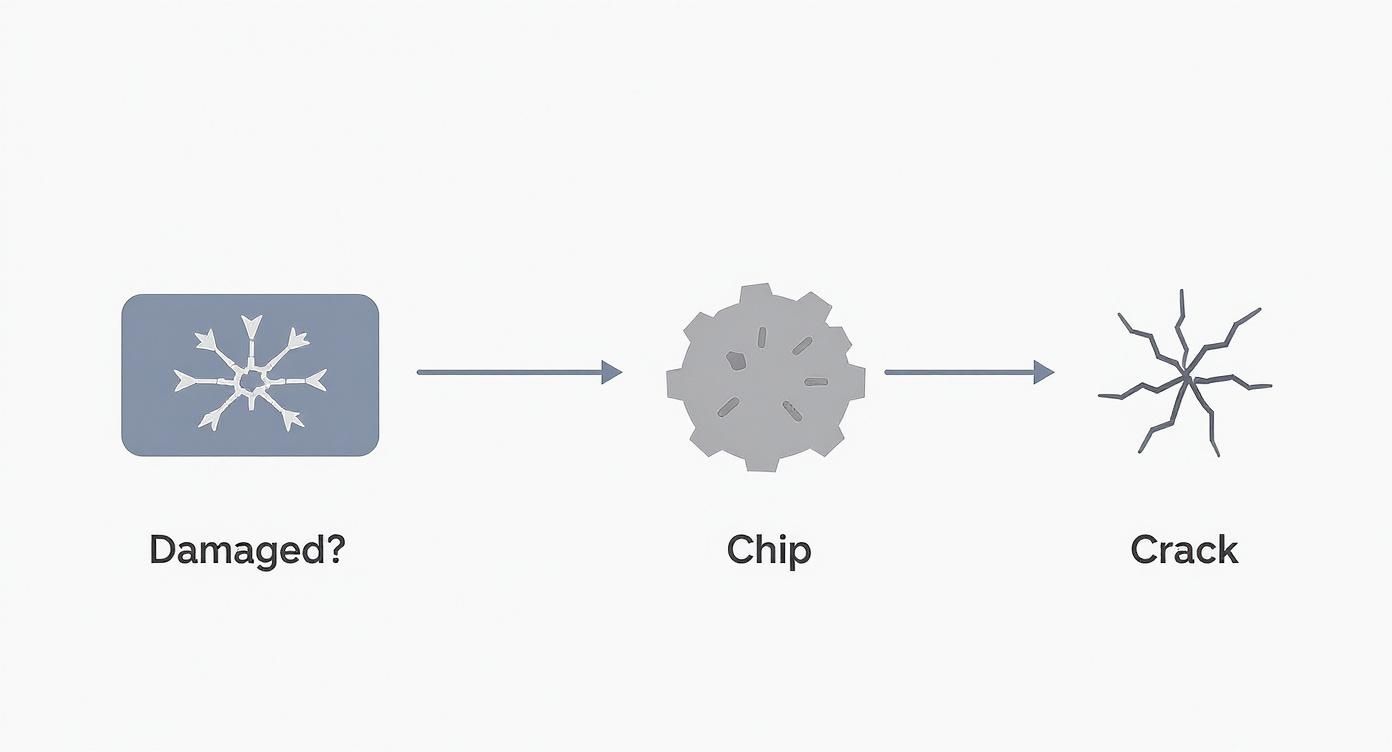
As you can see, jumping on a small chip right away is your best bet for avoiding the much higher cost of a full replacement down the road.
What's the Difference in the Work?
The actual process for a repair versus a replacement couldn't be more different. For a chip repair, we inject a clear, high-strength resin into the break. Then, we cure it with a UV light, which hardens the resin and bonds the glass back together, restoring its strength. You can see the full breakdown in our guide to windshield repair.
A full replacement is a much bigger job. It involves meticulously cutting out the old windshield, scraping the frame clean of old adhesive, applying a new, powerful bonding agent, and carefully setting the new piece of glass. For newer cars with driver-assist features, we also have to recalibrate the ADAS cameras, which adds time and complexity to the job.
Key Factors That Influence Your Final Bill
If you've ever wondered why a windshield replacement quote can swing so wildly, you're not alone. A simple sedan might run a few hundred dollars, while a newer SUV could easily top $1,000. This isn't just random pricing—it all comes down to a few specific factors that determine the real cost of the job.
Think of it like getting a new suit. You can grab one off the rack for a reasonable price, and it'll do the job. But a custom-tailored suit, made with premium fabric and a perfect fit, will naturally cost more. Auto glass works the same way; the more specialized the glass and the car it's going into, the higher the price.
Glass Type: Original vs. Aftermarket
One of the biggest forks in the road is deciding between Original Equipment Manufacturer (OEM) glass and an aftermarket alternative. OEM glass is the real deal—it’s made by the same company that supplied the original windshield for your car when it rolled off the assembly line. This guarantees a perfect match in every way: fit, quality, and clarity.
Aftermarket glass, sometimes called OEE (Original Equipment Equivalent) or ARG (Aftermarket Replacement Glass), is made by third-party companies. While it has to meet federal safety standards, the quality can be a bit of a mixed bag. It's usually the more budget-friendly choice, but you might run into minor issues with fit or optical clarity.
To help you decide, here's a quick comparison of what you're getting with each option.
Cost Breakdown: OEM vs. Aftermarket Glass
Feature | OEM Glass | Aftermarket Glass |
|---|---|---|
Manufacturer | Made by the same company that produced the car's original glass. | Made by a third-party manufacturer. |
Fit & Quality | Guaranteed to be an exact match for your vehicle. | Fit can vary; quality may not be as consistent. |
Cost | Typically the most expensive option. | More affordable and budget-friendly. |
Clarity & Tint | Matches the original perfectly. | May have slight variations in clarity or color. |
Availability | Sometimes requires special ordering from the dealer. | Generally more widely available. |
Best For | Newer vehicles, luxury cars, and cars with ADAS systems. | Older vehicles or when budget is the primary concern. |
Ultimately, the right choice often depends on your vehicle and your budget. For a brand-new car, especially one loaded with tech, sticking with OEM is almost always the best bet to ensure everything works exactly as it should.
Your Vehicle Make and Model
It's no surprise that the car you drive plays a huge role in the final price. Luxury brands like Mercedes-Benz or Tesla often use specialized acoustic glass to keep the cabin quiet or have unique curvatures that cost more to manufacture. It's a massive industry—windshield repair is a key part of the global glass services market, valued at around $14 billion in 2024.
Even within the same brand, the model makes a difference. A big SUV windshield requires a lot more glass and labor than one for a compact sedan. The location matters, too. A small, fixed quarter glass panel is a relatively simple swap, whereas a large, curved rear window with built-in defroster lines is a much more complex and expensive job.
The ADAS Recalibration Factor
Here's the single biggest reason why modern windshield replacement costs have gone up: Advanced Driver-Assistance Systems (ADAS). These are the high-tech safety features—like lane assist and automatic braking—that rely on cameras and sensors mounted directly to your windshield.
Common ADAS features that depend on the windshield camera include:
Lane-Keep Assist: Nudges you back into your lane if you start to drift.
Adaptive Cruise Control: Adjusts your speed to keep a safe distance from the car ahead.
Automatic Emergency Braking: Can hit the brakes for you to prevent a collision.
When we replace the windshield, those systems must be recalibrated. This isn't an optional add-on; it's a critical safety procedure. A camera that's off by even a single millimeter could fail to see a pedestrian or misjudge the distance to another car. This process requires specialized tools and trained technicians, which adds a significant cost—often $250 or more—to the final invoice. You can learn more about this crucial step in our guide to professional ADAS windshield calibration.
Understanding this recalibration process is key, as it's often the "surprise" cost that pushes the price higher on newer vehicles.
Navigating Insurance for Window Damage
So, you’ve got a chip or a crack in your windshield. The big question is, should you call your insurance company or just pay for it yourself? It's a dilemma every driver faces eventually, and the answer usually hinges on one key number: your comprehensive insurance deductible.
https://www.youtube.com/embed/Cn5w8uJNRjw
Think of your deductible as your share of the repair bill. It's the amount you have to cover before your insurance policy kicks in to pay the rest. Most glass damage—from rock chips to vandalism—falls under your comprehensive coverage, which is designed for these kinds of non-collision incidents.
Your Deductible Is the Deciding Factor
Let’s break it down with a real-world example. Say your deductible is $500. You get a quote for a small chip repair, and it’s only $150.
In this situation, filing a claim doesn’t make any sense. The repair cost is far below your deductible, so you’d be paying the full $150 out-of-pocket anyway. It's simpler and faster to just handle it directly.
But what if you need a complete windshield replacement and the total cost comes to $900? Now the math looks very different. You'd pay your $500 deductible, and your insurance company would cover the remaining $400. Filing a claim here clearly saves you a good chunk of money.
Will a Glass Claim Increase Your Insurance Rates?
This is the worry that stops most people from calling their agent. For the most part, a single comprehensive glass claim is considered a "no-fault" incident and is unlikely to cause your rates to spike. You didn't cause a tree branch to fall, after all.
The catch is when it becomes a recurring issue. Insurance data suggests that filing two or more glass claims in a three-year period could be a red flag for insurers, potentially leading to a premium increase of around 15%. With the average vehicle repair cost after a collision hitting $5,038 in 2022, insurers are watching all claims closely.
Pro Tip: Check for Full Glass Coverage Some insurance policies offer an amazing add-on called "full glass coverage" or a "zero-deductible" option for glass. If you have this, you can get your windshield repaired or replaced without paying a dime out-of-pocket. It’s definitely worth checking your policy to see if you have it!
When you do decide to file a claim, being prepared is your best bet. Understanding how to negotiate with an insurance adjuster can help you get a fair settlement. The best first step is always to pull up your policy documents or give your agent a quick call to confirm your coverage before making a decision.
Practical Ways to Save on Car Window Repair
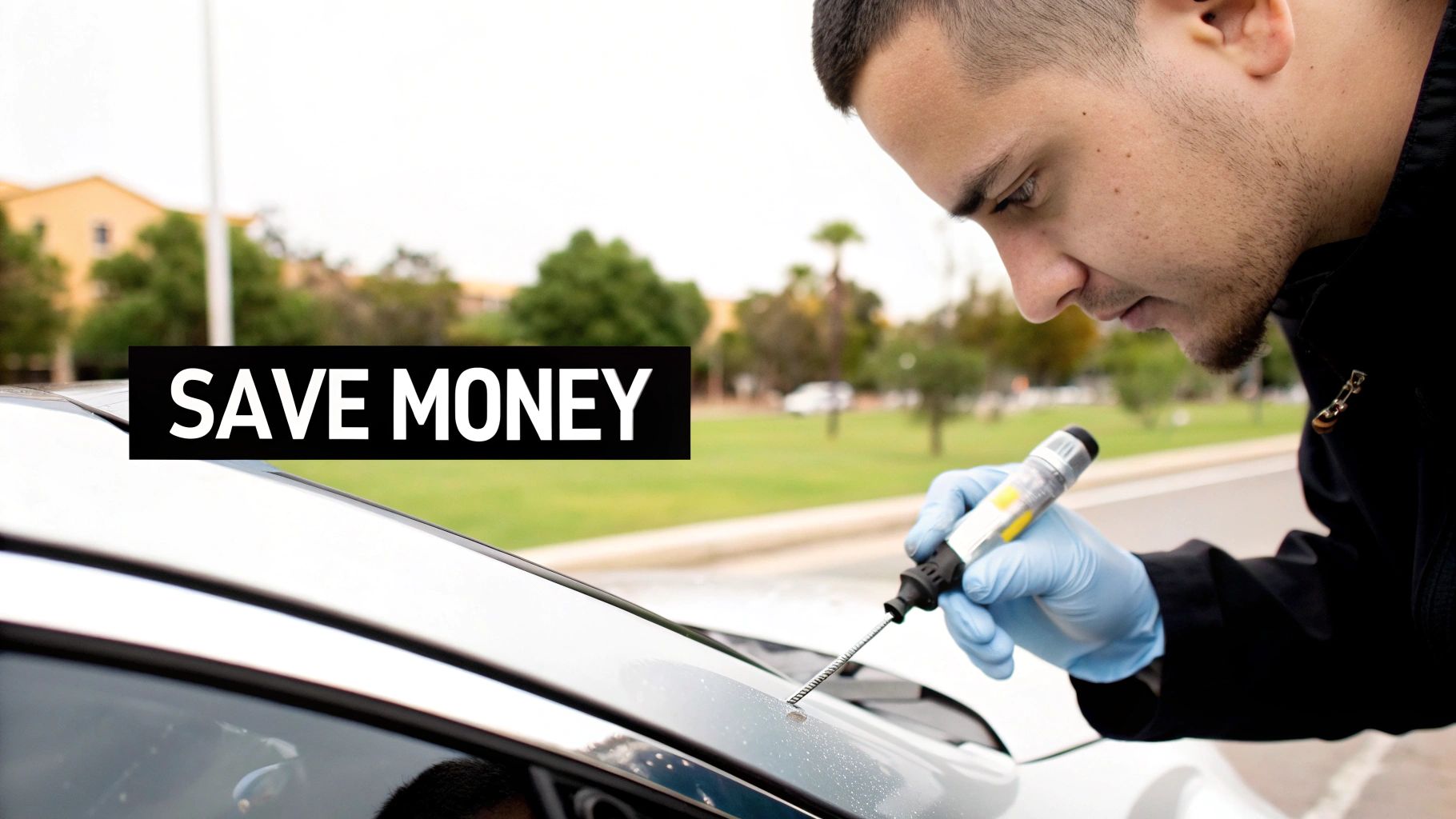
Knowing what drives up the price of auto glass work is one thing, but using that knowledge to keep more money in your wallet is the real win. Thankfully, you can make a few smart moves to lower your final bill without ever sacrificing safety or quality.
The most powerful money-saving tactic? Act fast. A tiny rock chip is a quick and relatively cheap fix. But if you ignore it, daily driving is all it takes for that chip to spiderweb into a massive crack. Simple temperature shifts, road vibrations, or even a car wash can turn a fix under $150 into a full replacement that easily tops $1,000.
Be a Savvy Consumer
Even when a full replacement is your only option, you aren't powerless over the final price. The key to getting a fair deal lies in making informed choices about both the glass and the company you hire.
Here are a few practical steps to take:
Consider Aftermarket Glass: If you have an older car without sophisticated ADAS cameras, high-quality aftermarket glass is a fantastic alternative to pricey OEM parts. It's safe, reliable, and can save you a bundle. Just make sure it’s from a reputable manufacturer to guarantee a perfect fit.
Shop Around for Quotes: Never take the first price you're given. It's always a good idea to call at least three different auto glass shops to get a feel for the market. Make sure you’re comparing apples to apples, though—ask if their quote includes labor, all materials, and the necessary ADAS recalibration.
Always Ask About Warranties: A good shop will always stand behind its work. Ask about the warranty on the glass itself (for defects) and on the installation labor (for leaks or wind noise). This is your safety net against future problems and expenses.
A lifetime warranty on workmanship is a strong indicator of a company's confidence in its technicians and materials. It’s your assurance that the seal will hold and the installation was done right, saving you from costly rework down the line.
Don't Overlook Small Details
Finally, a couple of simple questions can help you avoid surprise fees and lock in the best value. When you're trying to nail down how much your car window repair cost will be, insist on a fully itemized quote. This creates transparency and lets you see exactly what you're paying for.
You should also ask if they offer a mobile service for free. Here at Auto Renu, we bring our shop right to your driveway or office parking lot anywhere in the Walnut Creek area. It saves you a ton of time and hassle. Little things like these really add up, ensuring you get a great deal without cutting any corners.
Common Questions About Auto Glass Repair
Even with the costs laid out, you probably have a few more questions about how the whole process works. That's a good thing. Your windshield is a major safety feature, so it pays to be informed. We've gathered a few of the most common questions our customers in Walnut Creek ask to help give you some clarity.
How Long Does a Windshield Replacement Actually Take?
The hands-on work of removing the old windshield and setting the new one usually takes about 60 to 90 minutes. But the real waiting game begins after the glass is in place. The specialized adhesive we use needs time to cure properly to create a rock-solid, watertight seal.
This critical curing period is called the safe drive-away time. Depending on the adhesive we use and the day's weather, you'll need to wait at least one to three hours before hitting the road. This isn't just a suggestion—it’s essential for ensuring the windshield can support the airbags and maintain your car's structural integrity if you were ever in an accident.
Will a Repaired Chip Be Completely Invisible?
The primary goal of a chip repair is to restore the structural integrity of the glass and, most importantly, to stop that little chip from turning into a massive crack. While the repair makes the damage far less noticeable, you might still see a tiny blemish if you look for it up close.
Think of it this way: the goal is to stabilize the structure first and foremost. The fact that it looks significantly better is a huge bonus, but safety is always the top priority over perfect aesthetics.
Does My New Windshield Have All the Same Features?
Absolutely. When we do a replacement, we ensure the new windshield is an exact match for the one that came out of the factory. That includes all the technology your car depends on.
We'll make sure every feature is a perfect match, including:
Rain Sensors: The little sensor that tells your wipers to turn on automatically.
Heating Elements: Those fine lines that help you defrost in a hurry.
ADAS Camera Brackets: The mounting point that’s crucial for getting your safety systems recalibrated correctly.
We double-check that every feature is there, so your car works exactly the way it's supposed to.
When you need fast, reliable mobile service in the Bay Area, trust the experts. For a transparent quote on your repair or replacement, contact Auto Renu Auto Glass LLC today. Schedule your mobile service now