Your Guide to Windshield Replacement Price
What's the real windshield replacement price? Our guide breaks down ADAS costs, insurance claims, and what to expect for a safe, affordable repair.
Dec 3, 2025
generated
windshield replacement price, ADAS recalibration, auto glass cost, car window repair, Bay Area auto glass
It's a question we hear all the time: "How much is this going to cost me?" The answer for a typical windshield replacement price used to be simple, but not anymore. For an older car without any fancy tech, you might be looking at a bill between $300 to $600. But for a newer vehicle loaded with modern safety sensors, that cost can easily jump past $1,000, turning a straightforward fix into a pretty serious investment.
Your Quick Guide to Windshield Replacement Costs
Figuring out the price of a new windshield isn't as clear-cut as it was ten or fifteen years ago. Back then, it was just a piece of glass. Today, your windshield is a critical component of your car's safety system, packed with integrated technology. This evolution is the single biggest reason for the huge price variations you'll see.
It's no exaggeration to say that windshield replacement costs have skyrocketed. Modern replacements often break the $1,000 barrier, especially for vehicles with advanced driver-assistance systems (ADAS). If you're driving an older car with basic glass, an aftermarket replacement usually lands somewhere in the $300 to $600 range if you're paying out-of-pocket. You can read more about these rising costs in these key automotive insights on kbb.com.
Price Ranges by Vehicle Type
The biggest things that will move the needle on your final bill are your vehicle's make, model, and the technology built right into the glass. A 15-year-old sedan is going to be far less expensive to work on than a brand-new SUV with cameras for lane-keeping assist or sensors for rain-sensing wipers.
Of course, sometimes you don't need a full replacement. A small chip or crack can often be fixed, and understanding the difference between a total replacement and our approach to windshield repair could save you a lot of money.
To give you a better feel for the numbers, here's a general breakdown of what to expect.
Estimated Windshield Replacement Price Ranges
This table gives a snapshot of typical price ranges, showing just how much of an impact ADAS features have on the final cost.
Vehicle Type | Standard Windshield (No ADAS) | Windshield with ADAS Features |
|---|---|---|
Sedans/Compact Cars | $300 – $500 | $700 – $1,200+ |
SUVs/Trucks | $350 – $600 | $800 – $1,500+ |
Luxury/High-End Vehicles | $500 – $800 | $1,200 – $2,500+ |
Important Note: These figures are just estimates. Your final price will depend on the specific features in your vehicle, the type of glass we use (OEM vs. aftermarket), and the local labor rates. The complexity of recalibrating all those ADAS cameras and sensors is now one of the biggest cost drivers.
As you can see, a "one-size-fits-all" answer to the windshield replacement price question just doesn't exist anymore. The technology in your car is the wild card that can easily double, or even triple, the cost. In the next few sections, we'll break down exactly what goes into these numbers.
So, What Am I Actually Paying For? Breaking Down the Bill
Let's be honest, looking at an invoice for a car repair can feel like you're trying to decipher a secret code. When it comes to your windshield replacement price, every single line item is there for a reason, covering everything from the piece of glass itself to the expert who’s making sure it’s installed safely. Let’s pull back the curtain and see exactly where your money goes.
Once you understand what goes into the job, the final cost makes a lot more sense. Think of it this way: your bill is built on three main pillars—the glass, the labor, and any extra bits and pieces needed to do the job right.
The Glass Itself: OEM vs. Aftermarket
The biggest chunk of your bill is, unsurprisingly, the windshield. You'll generally have two options here, and your choice makes a big difference in the final price.
OEM (Original Equipment Manufacturer) Glass: This is the "name brand" stuff. It’s made by the same company that supplied the original windshield for your car when it was built. You're getting a genuine part, which means a guaranteed perfect fit, identical quality, and the same visual clarity you had when the car was new. It's the top-shelf choice, and it comes with a top-shelf price.
Aftermarket Glass: This glass is made by companies other than your car's original manufacturer. It’s built to meet federal safety standards, so it's perfectly safe, but you might notice tiny differences in thickness, tint, or overall fit. It’s like buying the store brand instead of the name brand—it gets the job done safely and saves you some money. This is a very popular, budget-friendly route.
So, which one is right for you? It really comes down to your budget and your vehicle. If you're driving a leased car or a newer model still under warranty, you might be required to use OEM glass. For older cars, a high-quality aftermarket windshield is often a smart, cost-effective solution.
What Goes into the Labor Charges?
Next up is the labor cost. This isn't just paying someone to swap out a piece of glass; you're paying for their time, training, and specialized skill. Modern windshield replacement is a highly technical job that's critical to your safety on the road.
The make and model of your car play a huge role here. A simple windshield on an old pickup truck might be a one-hour job, easy peasy. But a new luxury SUV loaded with sensors, delicate trim, and complex wiring? That requires a lot more time, patience, and specialized know-how.
It's crucial to remember that labor isn't just about how long the job takes—it's about the technical skill involved. A properly installed windshield is a structural part of your car. It helps keep the roof from caving in during a rollover and ensures your airbags deploy correctly. You’re paying for a certified technician’s expertise to keep you safe.
The complexity really drives the time commitment. If a vehicle's frame needs a lot of prep work to clean off the old adhesive (a super-strong glue called urethane), or if it has tricky moldings, the labor costs will naturally be higher. This fee ensures the work is done meticulously to create a perfect, leak-proof seal that maintains your car's structural integrity.
What Other Costs Might Pop Up?
Beyond the glass and the main installation work, you might see a few other small items on your invoice. These are the supporting players that are essential for a solid, long-lasting replacement.
Moldings and Seals: These are the rubber or plastic strips that frame your windshield, giving it a finished look and creating a weatherproof seal. More often than not, the old moldings get brittle or damaged during removal and can't be reused. A new set is a must.
Adhesives: We don't just use any old glue. The special urethane adhesive that bonds the windshield to the car's frame is a critical safety product. We only use high-quality, industry-approved adhesives to guarantee the strongest bond possible.
Mobile Service Fee: Want us to come to you? For the sheer convenience of having a technician fix your car at your home or office, a mobile service fee might be included. This simply covers our technician’s travel time and the cost of maintaining a fully-equipped service van. It's a service we're proud to offer all over the Bay Area here at Auto Renu.
By seeing how the glass type, the detailed labor, and the necessary materials all come together, the windshield replacement price becomes much clearer. It’s not just one charge, but a combination of quality parts and expert service designed to get you back on the road safely.
The ADAS Factor in Modern Windshield Costs
If you've noticed the average windshield replacement price creeping up over the years, you're not imagining things. The single biggest reason for this increase isn't the price of the glass itself, but the sophisticated technology now built right into it. Welcome to the world of Advanced Driver-Assistance Systems, or ADAS.
These are the features that make modern driving so much safer and more convenient—think lane-keeping assist, adaptive cruise control, and automatic emergency braking. But what does all that have to do with your windshield? Everything, as it turns out. The "eyes" of these systems, which are actually highly sensitive cameras and sensors, are often mounted directly onto your windshield.
This tight integration means replacing a windshield is no longer just a physical swap. It's now a two-part job that involves both the glass and the car's electronic brain.
What Is ADAS Recalibration and Why Is It Essential?
Think of it like this: if you moved a grand piano into a new room, you wouldn't just start playing. You'd have it professionally tuned to make sure every key hits the right note. ADAS recalibration is the exact same idea, but for your car's safety systems.
When a new windshield goes in, the ADAS cameras are physically in place, but their alignment is off by millimeters. That might sound tiny, but it can have huge consequences on the road.
Recalibration is the technical process of re-aiming these cameras and sensors with absolute precision, making sure they "see" the road, lane markings, and other cars just as the manufacturer intended. If you skip this step, your car's safety features could malfunction. They might fail to work when you need them most, or even worse, engage at the wrong time.
Key Takeaway: Skipping ADAS recalibration is like having a bodyguard with blurry vision. The very systems you count on to keep you safe might not work correctly in a critical moment, turning a helpful feature into a serious liability.
The whole process is meticulous. It demands specialized equipment, a controlled environment, and technicians who really know their stuff. This technical need is a major reason why the modern windshield replacement price is what it is. To get a better handle on the specifics, take a look at our guide on the importance of ADAS windshield calibration.
How Recalibration Impacts Your Final Bill
This critical safety procedure adds both time and money to the job. There's no getting around it—the integration of ADAS has completely changed the economics of auto glass work.
Today's windshields are part of a complex system. They hold cameras and sensors that must be recalibrated perfectly after installation to keep you safe, which adds significant cost to what used to be a simpler repair. This complexity demands expensive equipment and ongoing technician training that just wasn't necessary for older vehicles. The industry has seen a massive shift, and you can discover more insights about auto glass trends on prnewswire.com to see the bigger picture.
So, where does that extra cost come from? A few places:
Specialized Equipment: Shops have to invest in expensive, vehicle-specific targets, scanners, and diagnostic software to do the job right.
Technician Training: Our technicians need continuous training to keep up with the constantly evolving technology across hundreds of makes and models.
Time: A proper recalibration can easily add one to two hours to the total service time. That extra time directly impacts the labor component of your bill.
This infographic gives you a clear look at the different parts that make up your final bill.
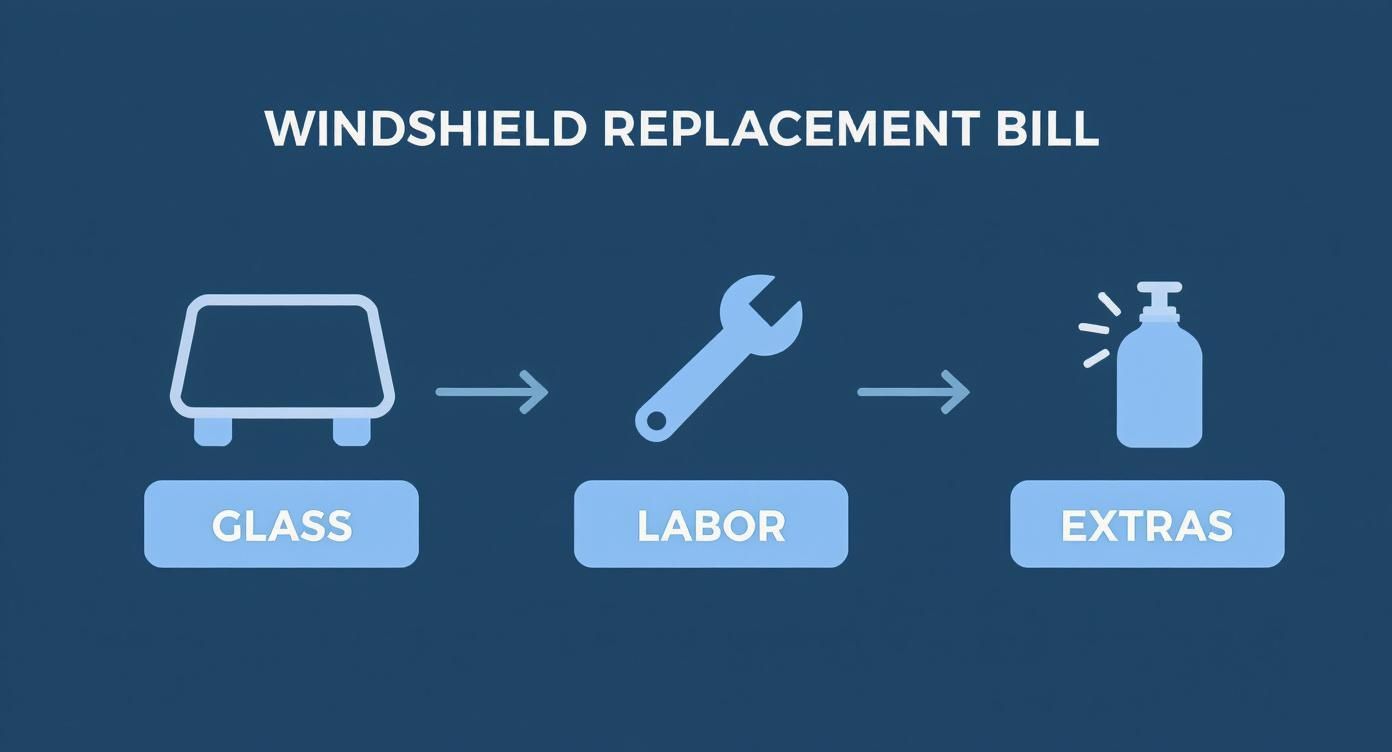
While glass and labor have always been the core costs, that "extras" slice of the pie now often includes the critical and non-negotiable ADAS recalibration service.
Types of ADAS Recalibration
Not all calibrations are the same. The right method depends entirely on your vehicle's manufacturer, and a trained technician will know exactly which one your car needs. There are two main approaches.
1. Static Recalibration
This process is done inside the shop in a highly controlled setting. The technician sets up specific targets or patterns in front of the vehicle at exact distances and heights laid out by the manufacturer. Then, using a diagnostic tool, they put the car's ADAS system into a "learning mode," which allows the camera to lock onto the targets and recalibrate its position perfectly.
When it's used: Very common for European and Asian brands like Volkswagen, Honda, and Subaru.
Requirements: A large, perfectly level floor with consistent lighting and zero obstructions.
Cost: It's generally more time-consuming and can be the more expensive of the two, simply because the setup is so precise.
2. Dynamic Recalibration
This method happens out on the road. A technician plugs a diagnostic tool into the car and then drives it at a certain speed for a set distance on a road with clear, visible lane markings. As the car moves, the ADAS camera actively reads the markings and recalibrates itself in real time.
When it's used: Often required for domestic brands like Ford, GM, and Chrysler.
Requirements: You need clear weather and a road with crisp, easy-to-read lane markings.
Cost: This can be a bit faster and slightly less expensive, but it's totally dependent on having the right road and weather conditions.
It's also worth noting that some vehicles actually require both static and dynamic recalibration to get the system back to 100%. This complexity is a perfect example of why the ADAS component has such a big impact on the final windshield replacement price. It’s not an upsell; it’s an essential investment in your car’s safety and performance.
Using Insurance for Your Windshield Replacement
https://www.youtube.com/embed/CQkYqmZXUH8
The thought of shelling out for a windshield replacement, especially on a newer car with all its built-in tech, is enough to make anyone wince. That's where your auto insurance can be a huge help. But figuring out the claims process can feel like a maze, so let's break it down and see how you can keep your out-of-pocket costs to a minimum.
A lot of drivers think their insurance covers absolutely everything, but it’s not that simple. Your policy is actually made up of different parts, and only one of them deals with a shattered windshield.
Comprehensive vs. Liability Coverage
Knowing the difference between your policy's coverages is key. It's the first step in determining if you'll pay for this yourself or if your insurer will pick up the tab.
Liability Coverage: This is the legal minimum. It’s designed to pay for damage you cause to other people or their property in an accident. Unfortunately, it does nothing for your own car, including a cracked windshield.
Comprehensive Coverage: This is your safety net for just about everything else that isn't a collision. Think theft, vandalism, fire, or a tree branch falling on your roof. And, most importantly for us, it covers glass damage. If you have comprehensive, your windshield replacement is almost certainly covered.
Most of the time, you'll have to pay a deductible first. For instance, if your deductible is $500 and the total replacement cost is $1,200, you’d handle the first $500. Your insurance company would then cover the remaining $700.
Some policies include a "full glass coverage" or "zero deductible glass" option. It's always a good idea to check your policy details or give your agent a quick call to see if you have this perk. It could mean the replacement costs you absolutely nothing.
The Claims Process Demystified
Filing an insurance claim for your windshield doesn't need to be a headache. When you're ready to use your coverage, the first step is to follow a step-by-step guide on how to file an auto insurance claim to make sure everything goes smoothly.
Here’s a quick look at what the process usually involves:
Document the Damage: Before you call anyone, grab your phone and take clear pictures of the crack or chip from a few different angles. This visual proof is gold when you file your claim.
Contact Your Insurer: Give your insurance company a call or use their mobile app to get the ball rolling. Have your policy number handy and be ready to explain what happened and when.
Pick a Quality Glass Shop: Your insurance company might suggest a shop they work with, but in most states, the choice is yours. At Auto Renu, we have experience working with every major insurance provider, so we can handle all the direct billing and paperwork for you.
Schedule the Work: We'll get in touch with your insurer to verify your coverage and get the green light. Once that’s done, we’ll set up a mobile appointment to come to you at your convenience.
Will a Glass Claim Raise My Insurance Rates?
This is the big question, and the answer is usually a relief. For the most part, a single comprehensive claim for a windshield will not cause your insurance premiums to go up.
Why? Because insurers see it as a "no-fault" incident. A rock flying up on the freeway isn't your fault; it's just bad luck. That’s very different from a collision you caused. That said, filing a bunch of claims in a short time might get your policy flagged. If the cost to replace the glass is only slightly more than your deductible, it might be smarter to just pay out of pocket and save your claim for a bigger issue down the road.
A Realistic Look at Windshield Prices in the Bay Area
You might see national averages for a windshield replacement price, but those numbers often don't tell the whole story, especially here in the Bay Area. Our local market has its own unique set of factors that can really shift the final cost. Knowing what goes into that pricing is the best way to understand what a fair quote actually looks like.
Let's be direct: the cost of doing business here is simply higher than in most other places. That reality touches everything from the wages our expert technicians earn to the cost of running our service vans. These operational costs are a necessary part of the equation and naturally get reflected in the price for top-tier auto glass work.
Why Is It More Expensive Here?
When you get a quote from us at Auto Renu, it's based on the real-world economics of serving this region. A few key things really shape the pricing.
Higher Labor Rates: To keep the best certified technicians on our team in a place with a notoriously high cost of living, we have to pay competitive wages. That means the labor portion of your invoice will almost certainly be higher than it would be in, say, a small town in another state.
Day-to-Day Operations: The rent on a shop, business insurance, and even the gas for our mobile service vans all cost more in the Bay Area. These are just the basic expenses required to operate, and they have to be factored into our pricing.
The Convenience Factor: Running a top-notch mobile service that can get to you anywhere across the sprawling Bay Area is a serious logistical and financial commitment. We've invested heavily in our fleet and equipment to bring the shop to you, and that specialized convenience is part of the value we provide.
It's a massive industry. The global automotive windshield market was valued at around $32.21 billion in 2024, with the front windshield making up a huge piece of that pie. This isn't surprising when you consider how many new cars are being built and the complex technology now integrated into the glass. You can take a deep dive into the automotive windshield market to see just how big it is.
What Does This Mean for Your Car? Sample Price Estimates
Okay, let's get down to brass tacks. To give you a clearer picture, here are some ballpark estimates for a few of the most common vehicles we see on Bay Area roads. These figures include the all-important ADAS recalibration that modern cars absolutely require.
Honda Civic (2019+): Newer Civics are almost always equipped with Honda Sensing® ADAS features. Getting the windshield replaced and the system properly recalibrated will usually land somewhere between $800 and $1,300.
Toyota RAV4 (2020+): As one of the most popular SUVs out there, the modern RAV4 is loaded with Toyota Safety Sense™ tech. For a full replacement and recalibration, you can expect the windshield replacement price to be in the $900 to $1,500 range.
Tesla Model 3: Teslas are essentially computers on wheels. Their large, specialized windshields and the critical, high-precision recalibration for Autopilot cameras push the replacement cost to between $1,200 and $1,800. Sometimes, it can be even more depending on glass availability.
As you can see, the vehicle's built-in technology is the biggest variable, while our local market conditions set the foundation for that price. Here at Auto Renu, we believe in being completely transparent with our pricing. Our goal is to provide dealership-level quality with the unmatched convenience of mobile service across all our Bay Area service locations. We deliver a service built specifically for the needs of our community, right where you are.
Why Safety and Quality Matter More Than Price
We all want a good deal, and it’s tempting to shop around for the lowest windshield replacement price. But when it comes to this repair, focusing only on the price tag can be a costly mistake. Your windshield does a lot more than just block wind and rain—it's one of the most important safety features on your vehicle, engineered to protect you in a crash.
Going with the rock-bottom cheapest quote often means corners are being cut, and that can have some seriously dangerous consequences. An improperly installed windshield can fail when you need it most, compromising your car’s entire safety system.
The Windshield's Role as a Structural Pillar
It helps to think of your car's body as a protective shell. Your windshield is a crucial part of that shell, acting as a support beam that connects the roof to the frame. In a rollover accident, it's responsible for providing up to 60% of the cabin's structural strength, preventing the roof from caving in.
A shoddy installation, whether from rushing the job or using cheap materials, creates a critical weak point in that structure. This puts you and your passengers at a much higher risk of injury.
Your windshield is one of the most important safety features in your vehicle. It is a vital part of its structural integrity. A quality installation isn’t just about a clear view—it’s about ensuring the car performs as designed in a worst-case scenario.
This mindset of prioritizing durability and reliability is why it's always smart to seek out quality auto repair services for any work done on your vehicle, not just glass.
Why Quality Adhesives and Proper Curing Matter
The glue holding your windshield in place is what does all the heavy lifting. A professional will use a high-quality urethane adhesive, which is the only material strong enough to create a bond that meets federal safety standards. Budget shops might skimp here, using inferior products that can degrade, leak, or fail completely during an impact.
Just as critical is the curing time—the time the adhesive needs to fully harden and bond the glass to the frame. If you drive away too soon, that seal can be compromised, leading to wind noise, water leaks, and a windshield that could pop out in a collision. A true pro will always provide a clear safe-drive-away time, which is usually at least an hour.
When you pay for a quality installation, you're paying for the technician to do it right.
Workmanship Warranty: A reputable shop will always offer a lifetime workmanship warranty. This is their promise that the installation is free from defects and covers issues like leaks or wind noise caused by their work.
Airbag Deployment: Here’s something most people don’t know: the windshield also serves as a backboard for your passenger-side airbag. In a crash, the airbag inflates against the glass to properly cushion the occupant. If a weak bond causes the windshield to detach, the airbag won't deploy correctly.
At the end of the day, choosing a trusted, certified technician isn't just a repair—it's an investment in your safety and your peace of mind on the road.
Got Questions? We've Got Answers
When you're facing a windshield replacement, a few questions always pop up. It's completely normal. To make things easier, we've pulled together the straight-up answers to the things we get asked most often by drivers just like you.
Think of this as the final, practical details you need to know before moving forward.
How Long Will This Actually Take?
For most cars, we can have the new windshield installed in about one to two hours. It's a pretty streamlined process. However, if your car is loaded with modern safety features (ADAS), we'll need extra time for the recalibration, which can add another one to two hours to the job.
Heads Up on Safety: The most important part of this whole process is letting the adhesive cure. You absolutely must wait at least one hour after we're done before you can drive the car. This ensures the bond is solid and your windshield is secure.
So, Can I Drive Off Immediately After?
Nope, and this is a big one. You have to let the adhesive cure properly. Hitting the road too soon can mess up the seal, causing annoying wind noise or water leaks down the road. Worse, it could mean the windshield fails to do its job in an accident.
Our technician will always give you a specific "safe drive-away time." Following that advice is key to making sure the windshield becomes a strong, structural part of your car again.
Is It Always Cheaper to Just Repair a Chip?
Yes, without a doubt. Repairing a small chip or crack is way more budget-friendly than replacing the whole windshield. A typical repair can be under $100, whereas a full replacement will easily run into the hundreds, if not more.
Here’s a quick way to think about it:
Go for a Repair: If the damage is a chip smaller than a quarter or a crack shorter than a dollar bill, we can almost always fix it. It's the smart, cost-effective choice.
Time for a Replacement: If the damage is directly in your line of sight, if a crack is longer than six inches, or if it runs to the edge of the glass, a replacement is the only safe option.
At Auto Renu Auto Glass LLC, our goal is to bring clarity and convenience right to your doorstep. Whether you have more questions or you're ready for a no-nonsense quote, our mobile experts are ready to help. Get in touch with us today at https://www.autorenu911.com.