How to stop windshield crack from spreading: Quick fixes
Discover how to stop windshield crack from spreading with quick, proven DIY fixes and tips to protect your glass today.
Dec 2, 2025
generated
stop windshield crack, windshield crack repair, DIY auto glass repair, car maintenance tips, auto glass care
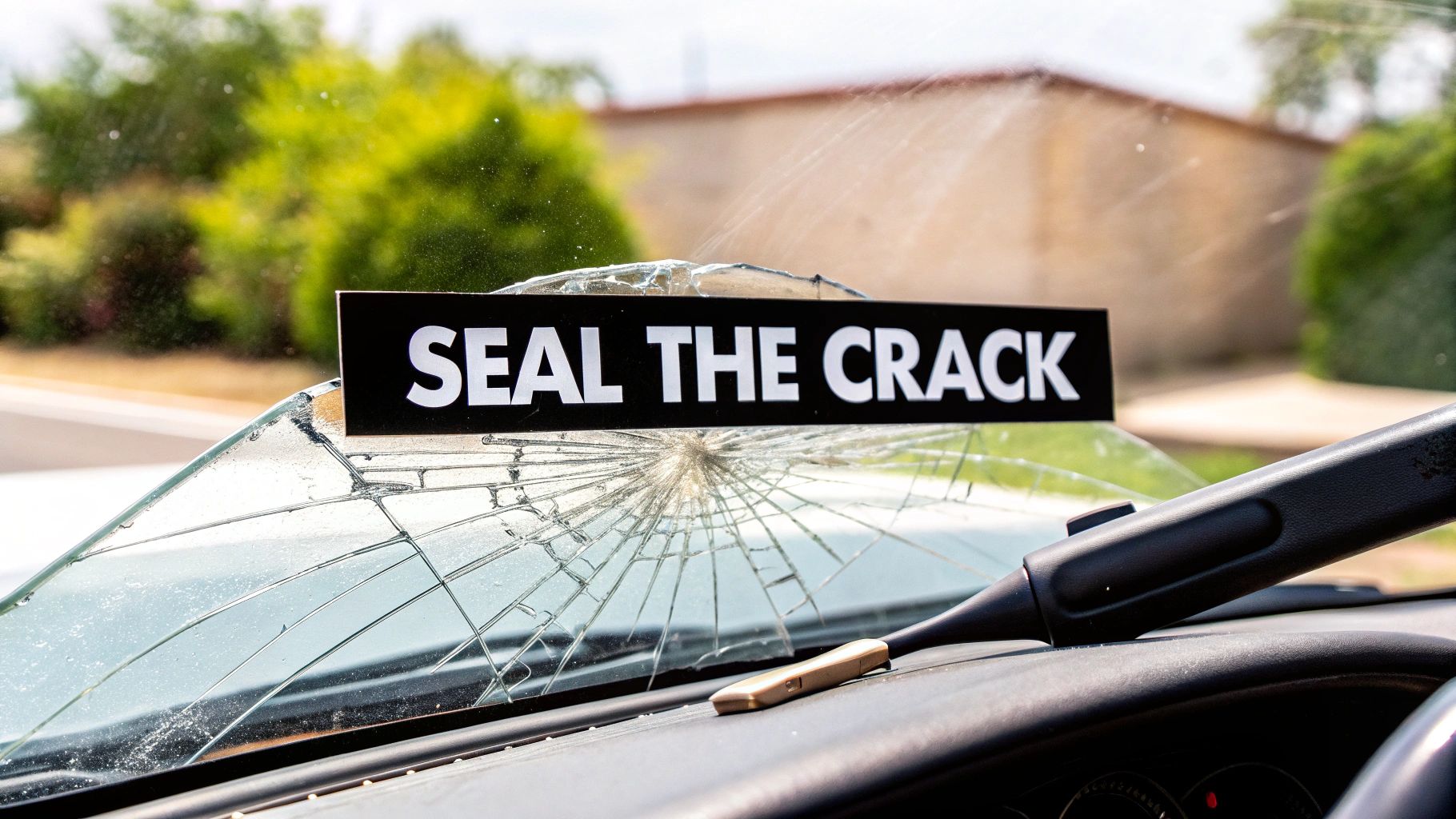
That tiny ding on your windshield from a stray pebble on the highway is incredibly easy to ignore. But trust me, it's a ticking time bomb. A small chip is a weak point, and your windshield is under constant stress—from road vibrations, temperature swings, and even just shutting your car door a little too hard.
Think of it like a small tear in a piece of fabric. It doesn’t take much for that little snag to run, and the same principle applies to your auto glass. Every bump you hit or sudden temperature change puts pressure on that compromised spot. A scorching hot day causes the glass to expand, while a cool night makes it contract, literally pulling the crack open bit by bit. Even something as innocent as a high-pressure car wash can force water into the fissure, weakening it from the inside and making it spread faster.
What Kind of Damage Are You Dealing With?
First things first, you need to know what you’re looking at. Not all windshield damage is created equal, and figuring out the type helps you understand how quickly you need to act.
Chips: These are the small, circular impacts you often see. They might look like a bullseye or a starburst. The good news? Chips are usually a straightforward fix if you catch them early.
Cracks: These are the lines that can start small and quickly snake their way across your field of vision. Pay special attention to edge cracks—any crack that starts within two inches of the windshield's border. The edge is a high-stress area, making these particularly prone to spreading.
The moment you spot any damage, there are a few immediate things you can do to keep it from getting worse.
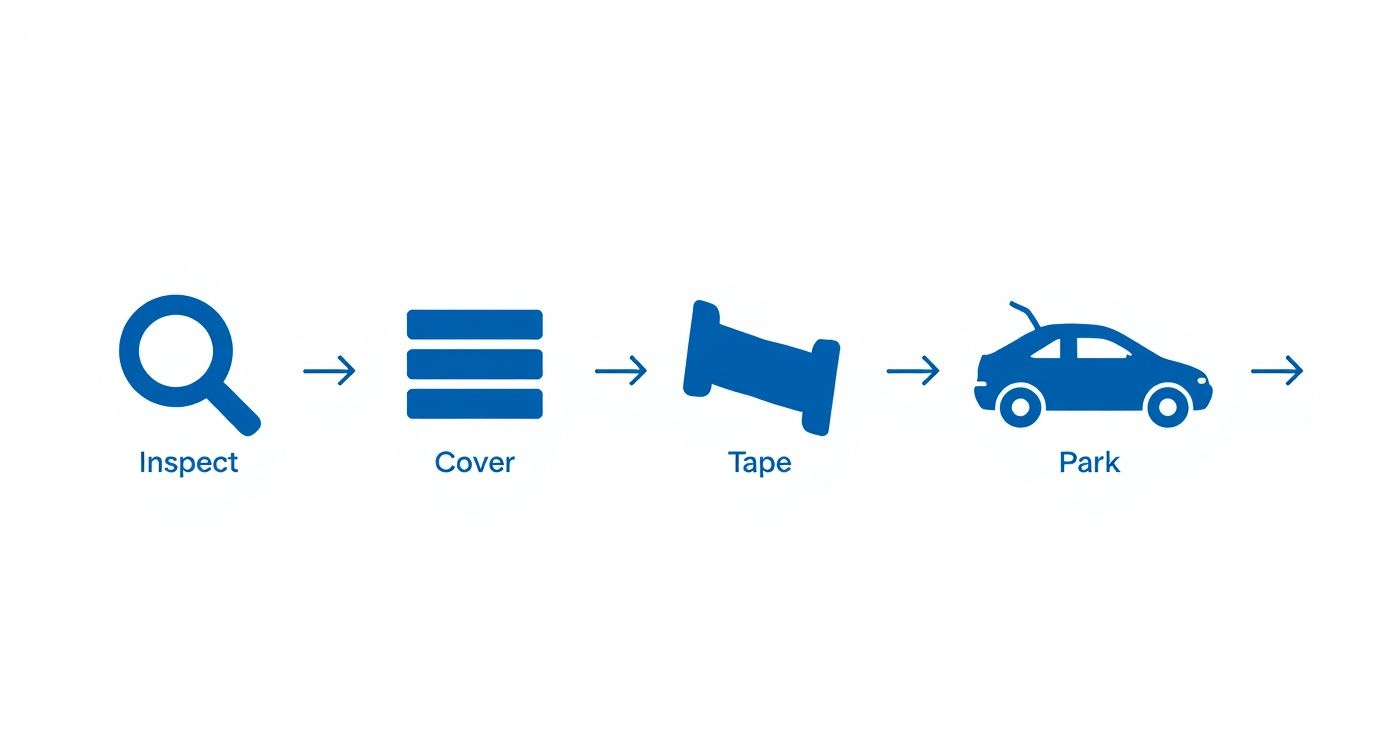
Following these simple steps—inspecting the damage, covering it up, and being smart about where you park—is your best first line of defense before you can get a permanent fix.
When you notice a new chip or crack, your immediate actions can make the difference between a simple repair and a full replacement. This table breaks down what to do right away.
Your First Response to a New Windshield Crack
Action | Why It Matters | What to Avoid |
|---|---|---|
Clean the Area Gently | Removes debris so a temporary seal (like tape) or a permanent resin can bond properly. | Don't use harsh chemicals or a power washer, which can force the crack to expand. |
Apply Clear Tape | Keeps dirt, moisture, and debris from getting into the crack, which ensures a cleaner, stronger repair later. | Avoid colored or opaque tape (like duct tape) that obstructs your vision. |
Park in the Shade | Minimizes drastic temperature swings from direct sunlight, which cause the glass to expand and contract. | Leaving the car in direct sun on a hot day or blasting the defroster on a cold one. |
Drive Carefully | Reduces vibrations and jarring impacts from potholes or speed bumps that can stress the damaged glass. | Slamming doors, driving on rough roads, or taking bumps too quickly. |
These are, of course, temporary measures. Their goal is to buy you time and preserve the integrity of the damage so it can be properly repaired.
Why Edge Cracks Are a Big Deal
The location of the damage is just as important as the type. Industry data shows that a staggering 90% of windshield repairs are for edge cracks. Why? Because they start near the weakest points of the glass and are far more susceptible to spreading from the constant vibrations and temperature fluctuations that hit the frame of your car.
Key Takeaway: Your windshield isn't just for looking through; it provides up to 30% of your vehicle's structural strength. A spreading crack is more than a cosmetic flaw—it's a serious safety issue that can affect how your airbag deploys and compromise the roof's stability in a rollover.
Ignoring a small chip almost guarantees it will turn into a large, unrepairable crack. What could have been a simple, affordable fix quickly becomes a costly full replacement. If you have any doubt about the severity of the damage, getting a pro to take a look is always your safest bet. You can learn more about professional options by exploring our guide to windshield repair services. Acting within the first few hours really can make all the difference.
Temporary Fixes to Buy You Some Time
Let's be realistic—a rock chip doesn't care if you're on your way to an important meeting or just starting a road trip. Your schedule doesn't just stop. While the only real, long-term solution is a professional repair, you're not powerless while you wait for the technician to arrive.
Think of the next steps as first aid for your windshield. These are quick, temporary measures you can take to stabilize the damage and keep a small, repairable chip from turning into a full-blown crack that requires a costly replacement.
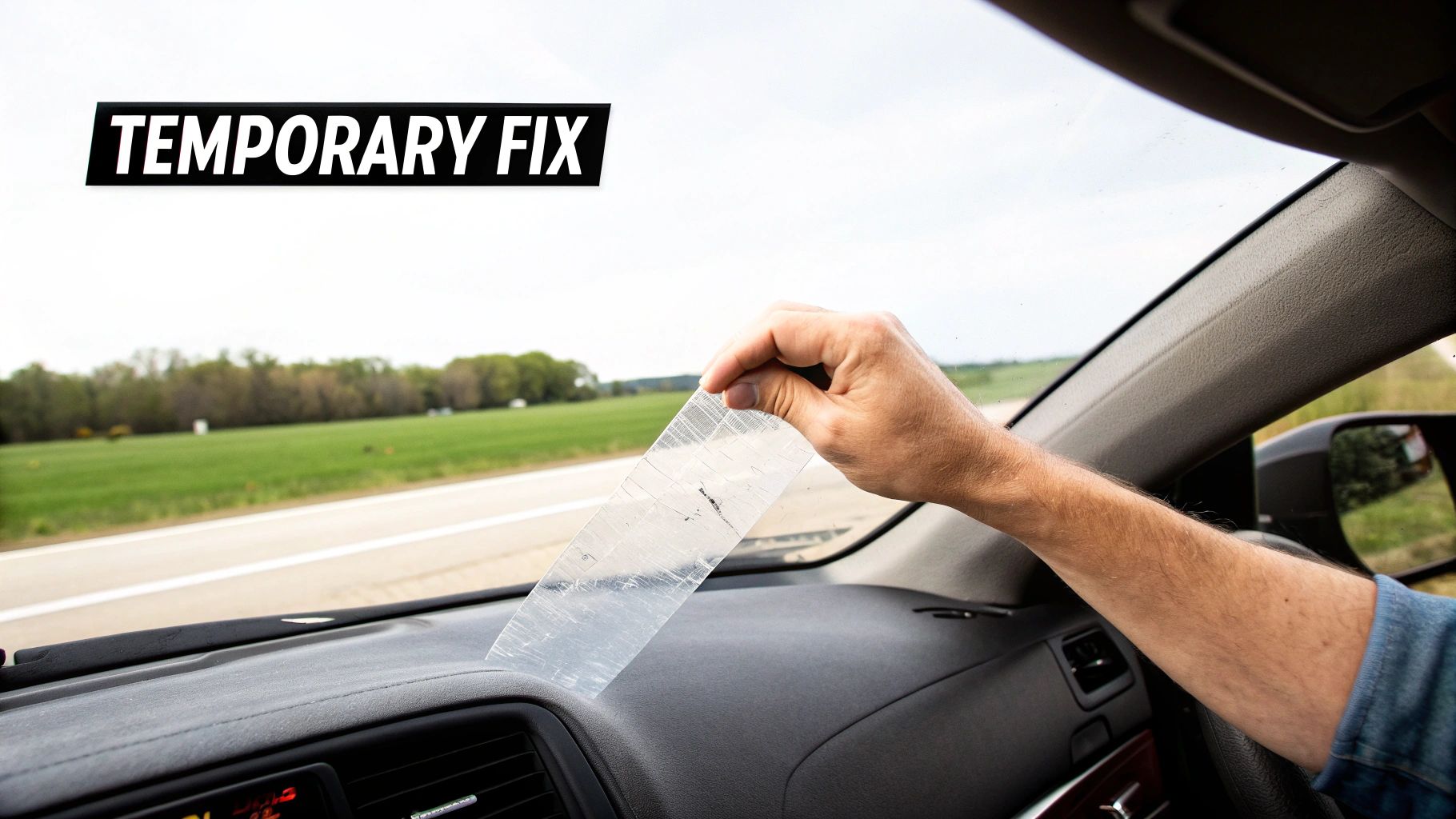
The number one goal here is simple: keep contaminants out. Dirt, moisture, and road grime are the enemies of a good repair. If they get into the crack, they can prevent the professional repair resin from bonding correctly, which can compromise the fix and the clarity of your glass. A clean break is a repairable break.
The Clear Tape Trick
One of the easiest and most effective temporary fixes I've seen is just a simple piece of clear packing tape. It won't magically stop a stress crack from spreading, but it’s fantastic at sealing the damage from the outside world.
Clean the Area First: Gently wipe around the chip or crack with a dry, clean microfiber cloth. Don't use any glass cleaners—the residue they leave behind can cause problems for the professional repair later.
Apply the Tape Smoothly: Take a piece of clear packing tape and place it over the entire crack on the outside of your windshield. Press it down firmly, smoothing out any air bubbles to create a good seal.
This simple barrier does wonders, especially in colder weather. It keeps water from seeping in, freezing, and expanding the crack overnight, which is a very common way for small chips to get much, much worse.
Using Sealants Like Super Glue or Nail Polish
I get asked about this a lot. Can you use super glue or clear nail polish? In an absolute pinch, yes, but I advise caution. While they can create a temporary seal, they often do more harm than good and can seriously complicate a professional repair if you're not careful.
Expert Insight: Honestly, I consider these a last resort. They might keep some debris out, but they don't have the right optical clarity or strength of a professional resin. If you're stuck and have no other choice, use a tiny amount and try to get it into the crack, not smeared on the glass around it.
No matter what you do, remember that these are just temporary patches. They’re meant to buy you a day or two until you can get a proper repair. Your windshield’s structural integrity is compromised, and only a pro can restore it safely. Think of these fixes as a bridge to get you to that appointment, not the final destination.
DIY Repair Kits vs. Professional Service
So, you’ve got a crack and you're wondering how to stop it from spreading. This is where you hit your first major fork in the road: do you grab a DIY repair kit from the auto parts store, or do you call in a pro? The right answer really boils down to the specific damage, your own comfort level with this kind of work, and whether you're looking for a quick patch or a long-term solution.
A do-it-yourself kit can be really tempting. I get it. It’s cheap, you can do it right now, and you feel like you're taking control of the problem. For a very specific kind of damage—I’m talking a tiny, fresh bullseye chip that's smaller than a quarter—these kits can sometimes be a decent stopgap measure. They give you a little bottle of resin and a basic applicator to push it into the chip, hopefully keeping it from getting worse for a little while.
But let's be honest about the limitations here. The resin in those kits is rarely the same quality a professional uses, and the plastic applicators just can't create the strong vacuum needed to suck all the air out of the crack first. This almost always results in an incomplete fill, leaving behind weak spots and a cloudy blemish that, unfortunately, a pro can't fix later.
Understanding the Professional Advantage
Calling a mobile glass technician is a whole different ball game. These guys show up with serious equipment, like vacuum-injection tools that forcefully pull every last bit of air out of the damage before injecting a high-viscosity, optically matched resin. This is the crucial step that ensures the resin gets into every microscopic part of the crack.
The difference in the final result is night and day. A professional repair doesn't just plug the hole; it actually bonds the glass back together on a chemical level, restoring the windshield's structural integrity. An experienced tech also knows how to work with temperature changes and apply just the right amount of pressure for a permanent fix that’s almost invisible.
The numbers don't lie. Professional repair techniques have about a 70% success rate at stopping a crack in its tracks for good. DIY kits? They're closer to a 40% success rate. Sure, a professional repair costs more upfront—usually between $50 and $150—but it’s a smart investment to avoid the much higher cost of a full windshield replacement down the road. For a deeper dive into these options, you can explore these insights on windshield services.
DIY Kit vs. Pro Repair Head-to-Head
To make the decision a little easier, here’s a direct comparison of the key factors you should be weighing. This should help you figure out which path makes the most sense for your specific situation.
Factor | DIY Repair Kit | Professional Service |
|---|---|---|
Best For | Tiny, fresh bullseye chips (smaller than a quarter) | Any chip; cracks up to 6 inches long |
Effectiveness | Low to moderate. Around a 40% success rate. | High. Around a 70% success rate in stopping cracks. |
Cost | $10 - $25 | $50 - $150 (often covered by insurance) |
Visual Result | Often leaves a visible, cloudy blemish. | Nearly invisible, optically clear finish. |
Structural Integrity | Minimal improvement. A temporary patch. | Fully restores the windshield's strength. |
Risk Factor | High. A failed attempt makes pro repair impossible. | Low. Guaranteed work from a trained technician. |
In short, while a kit might seem like a bargain, a professional repair is an investment in a permanent, safe, and visually clean solution.
When Is a DIY Kit a Bad Idea?
While a DIY kit might be okay for a super minor chip, there are definitely times when you should just put the kit down and pick up the phone. If your windshield has any of the following, your only truly safe bet is to call a professional.
Cracks Longer Than a Dollar Bill: Anything longer than about six inches is just too big and complex for a basic kit to handle. The structural risk is too high.
Damage in the Driver's Line of Sight: A botched DIY repair in this critical spot can leave a permanent distortion right where you need to see clearly. It’s not worth the risk.
Edge Cracks: Cracks that start at or run to the edge of the windshield are under a ton of stress. They require specialized tools and techniques to stabilize properly.
Key Takeaway: A failed DIY attempt often makes a professional repair impossible. Once that low-grade resin cures inside the crack, it can't be removed. At that point, your only option is a full—and much more expensive—windshield replacement.
Ultimately, while that little kit on the shelf looks like a quick win, a professional service is an investment in your car's safety and long-term health. If the damage is already past the point of repair, it’s a good idea to know what comes next. Take a look at our guide on what to expect during a windshield replacement to get fully prepared.
The Science of a Permanent Windshield Repair
https://www.youtube.com/embed/5eupXcI8hH8
Ever wondered what a technician is actually doing when they come to fix that chip in your windshield? It's not just a fancy way of squirting in some superglue. A professional repair is a precise, multi-step process that uses specialized tech to chemically rebond the glass, bringing back its original strength and making the damage disappear. It's a fascinating bit of science that keeps you safe on the road.
The whole thing starts by creating a vacuum over the damaged spot. This is a critical first move, as it pulls every last bit of air and moisture out from deep inside the crack or chip. If you skip this, the repair will eventually fail, leaving behind weak spots and a cloudy, ugly finish. You have to get a perfect vacuum before the real magic can happen.
Next, a technician injects a very specific, optically clear resin directly into the break. This isn't just any old adhesive; it's a liquid polymer engineered to have the same refractive index as glass. In plain English, that means once it hardens, light passes right through it without any distortion, making the repair practically invisible. The technician carefully forces this resin into every single microscopic nook and cranny.
The Curing Process
With the resin completely filling the void, it's time for the final step: curing. We use a handheld tool that emits a specific wavelength of ultraviolet (UV) light to kick off a chemical reaction. This process, called polymerization, transforms the liquid resin into a rock-solid polymer that forms an incredibly strong, permanent bond with the glass around it.
This technology is incredibly reliable. Windshield crack repair technology has demonstrated robust safety and durability, with resin-based repairs exhibiting less than a 1% failure rate according to manufacturers. The repaired area often regains strength exceeding 100% of the original glass's integrity, ensuring a safe and lasting solution. You can learn more about how these repairs meet federal safety standards on ChipProUtah.com.
More Than Just a Cosmetic Fix
Once you understand the process, you see why a professional repair is a true structural fix, not just something to make the crack look better. Your windshield provides up to 30% of your vehicle's structural strength in a rollover and is crucial for your passenger-side airbag to deploy correctly.
A properly repaired windshield performs these safety functions just as well as it did before the damage. This is especially vital for modern vehicles equipped with advanced driver-assistance systems (ADAS), since their cameras and sensors are often mounted right on the windshield. For a deeper dive, check out our guide on the importance of ADAS windshield calibration after any glass service.
Smart Habits to Prevent Future Windshield Cracks
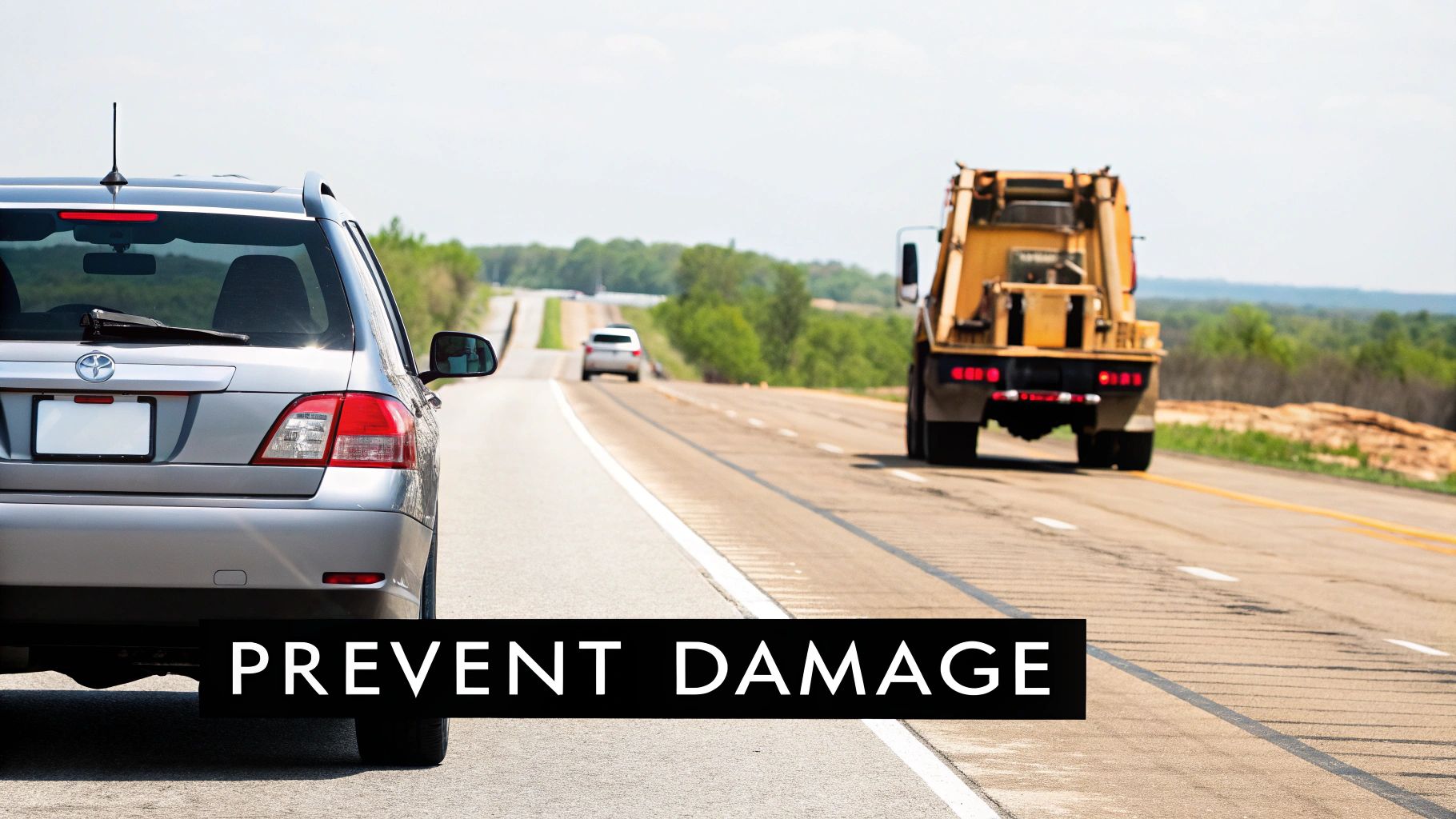
Knowing how to stop a crack in its tracks is a great skill to have, but let's be honest—the best-case scenario is never getting that crack in the first place. You can save yourself a ton of money and headaches just by tweaking a few daily habits. It’s all about being proactive.
Think about your daily drive. Road debris is, without a doubt, the top cause of windshield damage. Your biggest defense is simply space. We've all been stuck behind a big dump truck or a construction vehicle. Instead of tailgating, drop back. Increasing your following distance from the standard three seconds to five or six gives those flying rocks a chance to hit the pavement before they hit your glass.
Adjusting for Environmental Risks
Your driving habits are only half the battle. Where you park and how you deal with the weather are just as important for your windshield’s health. Glass expands and contracts with temperature swings, and a sudden, extreme change can turn a tiny, invisible chip into a massive crack overnight.
The easiest way to manage this is to park in a garage or under some shade whenever you can. This keeps the intense sun from baking the glass in the summer and protects it from the brutal freeze-thaw cycles in the winter.
Pro Tip: Whatever you do, never, ever pour hot water on a frozen windshield. That sudden temperature shock is a surefire way to crack it. Use a proper de-icing spray or just let your car's defroster do its job on a low setting, warming the glass up slowly.
Routine Maintenance for Long-Term Health
Keeping your windshield in good shape isn't just about dodging rocks and extreme temperatures; it’s also about basic upkeep. A little routine care goes a long way.
Replace Worn Wiper Blades: Once wiper blades get old and hard, they don't just leave streaks. They drag grit across the glass, creating tiny scratches that weaken the surface over time. Plan on swapping them out at least once a year.
Keep It Clean: A clean windshield is a stronger windshield. Washing away abrasive dirt and grime is a simple but effective preventative measure. Beyond just preventing damage, a little extra effort in maintaining streak-free car windows improves visibility and contributes to the overall health of your glass.
Use the Right Washer Fluid: Stick to proper washer fluid. Plain water can freeze and lacks the cleaning agents to cut through road grime, which can be surprisingly abrasive.
Folding these simple practices into your regular routine is more than just smart driving; it's actively protecting one of the most critical safety features on your vehicle.
Your Top Questions About Windshield Cracks Answered
It's completely normal to have questions even after you understand the basics of a repair. Windshield damage can feel like a gray area, especially once you start thinking about insurance policies and state laws.
Let's cut through the confusion and tackle the most common questions I hear from drivers who are trying to figure out what to do about a spreading windshield crack.
Will My Insurance Cover Windshield Repair or Replacement?
This is almost always the first question on everyone's mind, and for good reason. The short answer is: yes, probably.
If your auto policy includes comprehensive coverage, the cost of a repair is almost always covered. In fact, most insurance companies will happily waive your deductible for a simple repair. Why? Because it saves them from paying for a much pricier full replacement down the road.
A few things can complicate this, though:
Your Deductible: Let's say your windshield replacement costs $600 and you have a $500 deductible. It might make more sense to just pay for the whole thing out of pocket rather than filing a claim.
State-Specific Rules: Some states, like Florida, Kentucky, and South Carolina, have laws that mandate zero-deductible windshield replacements under certain policies. It's worth checking your local regulations.
Claim History: A single glass claim is highly unlikely to raise your rates. However, if you've filed several claims in a short amount of time, your insurer might take notice.
My best advice? A quick call to your insurance agent is the fastest way to get a clear answer. They can look at your specific policy and tell you exactly what’s covered and what, if anything, you'll need to pay.
How Long Can I Really Drive with a Cracked Windshield?
Honestly, this depends entirely on the crack's size, location, and type. A tiny chip out of your line of sight on the passenger side isn't an emergency, but you should still get it fixed sooner rather than later. A crack that's actively growing? That's a whole different ballgame.
Here's a good rule of thumb I use: if the crack is longer than a dollar bill (about 6 inches), you need to treat it as an immediate safety hazard. At that size, the structural integrity of your windshield is seriously weakened.
A Quick Word on Safety: Never, ever drive with a crack that obstructs your direct line of sight. It's not just incredibly dangerous—it’s also a surefire way to get a ticket. The risk just isn't worth it.
Is It Actually Illegal to Drive with a Cracked Windshield?
The laws can vary from state to state, but they all boil down to one thing: visibility.
Pretty much every state has a law prohibiting you from driving if windshield damage blocks your clear view of the road. You probably won't get pulled over for a tiny chip in the corner, but a long crack spidering across your field of vision is a clear violation.
Even if there isn't a specific law about crack size where you live, a police officer can still issue a citation if they believe the damage makes your vehicle unsafe to operate. The smartest and safest move is always to get the damage fixed right away.
Don't let a small chip become a big problem. A minor crack can quickly turn into a major safety issue and a costly replacement. If you've got damage, it's time to act. The expert mobile technicians at Auto Renu Auto Glass LLC come directly to you, providing dealership-quality repairs and replacements for all makes and models. Get your free quote and schedule your convenient mobile service today.