
How to handle rock chip on windshield: fast fixes
Dealing with a rock chip on windshield? Learn risks, repair options, and how insurance can cover a fix before it worsens.
Dec 1, 2025
generated
rock chip on windshield, windshield chip repair, auto glass, car safety, windshield damage
That startling thwack against your windshield is a sound every driver dreads. It’s the tell-tale sign of a rock chip—a small point of impact from a stray stone or piece of road debris. It might look small, but don’t be fooled. That little chip is a weak spot in the glass, and it needs to be fixed right away before it spiders into a huge, unrepairable crack.
The Urgent Truth About That Tiny Windshield Chip
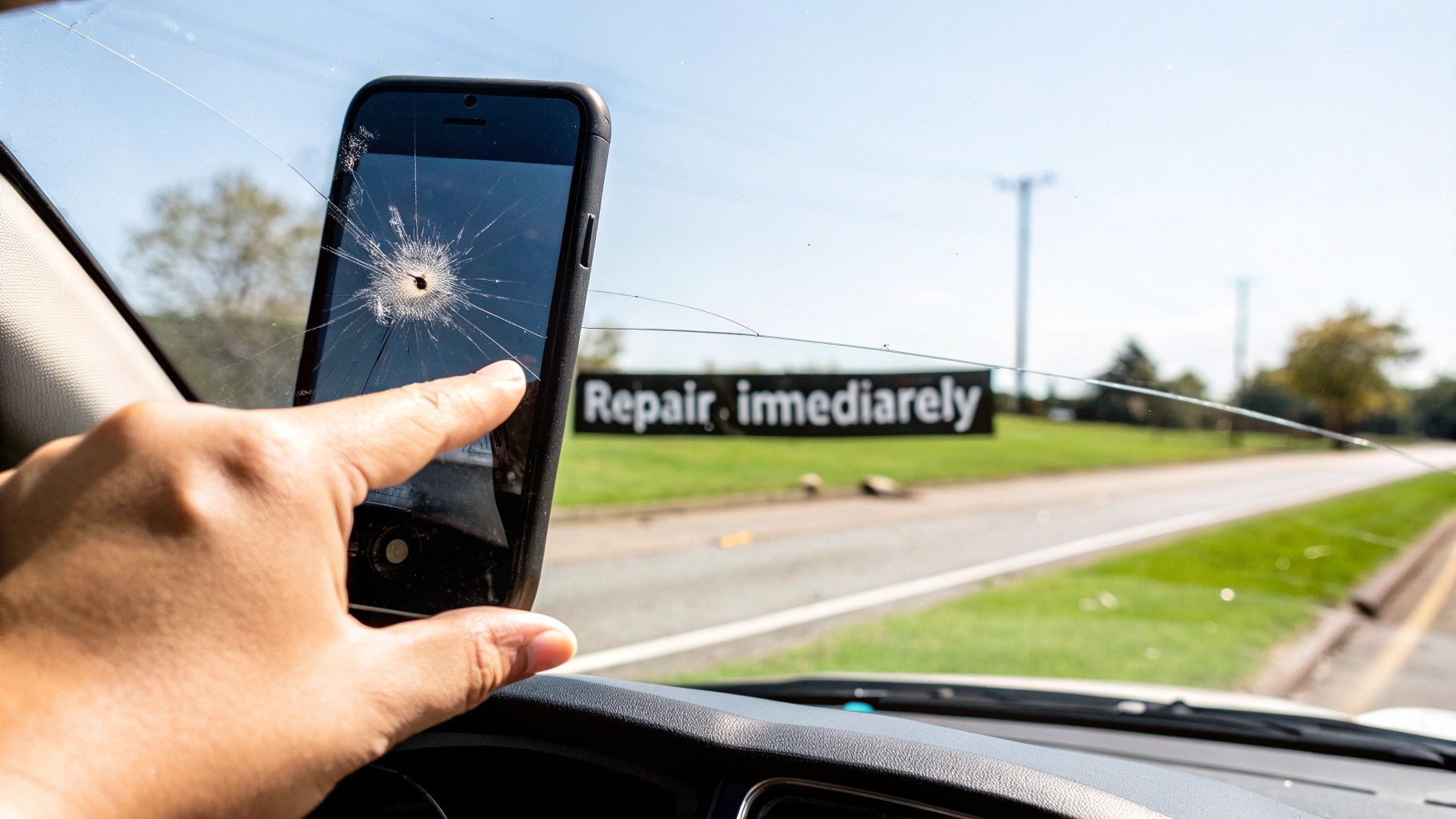
It happens in a split second, leaving a maddening little blemish right in your line of sight. It's easy to shrug it off and tell yourself you'll deal with it later. But that tiny mark is a ticking clock—a structural flaw that’s bound to become a much bigger headache.
Think about your windshield as a single, solid unit. That chip is a fracture in its structural integrity. Every time you drive, you're putting that weakness to the test. The subtle vibrations from the road, the jarring slam of hitting a pothole in Dallas—it all puts stress right on that damaged spot.
Common Triggers That Make Rock Chips Spread
The real culprits that turn a small chip into a giant crack are often things you do every day without a second thought. These simple actions can be the final straw, forcing you into a full, expensive windshield replacement.
Here’s what you need to watch out for:
Temperature Changes: Blasting the defroster on a cold Texas morning or cranking the AC on a blistering summer afternoon creates thermal shock. The glass expands and contracts unevenly, putting immense pressure on the chip until it pops and runs.
Washing Your Car: The sudden change in temperature from a cold water hose or the force from high-pressure jets at a car wash can easily turn that chip into a long, snaking crack.
Moisture and Debris: Rain, dirt, and grime work their way into the chip. This contamination not only makes a future repair less clean, but if that moisture freezes, it will expand and force the glass apart from the inside.
These aren't just isolated incidents. A detailed survey across 12 U.S. states revealed that of the 14% of windshields with long cracks, a massive 79% were edge cracks. These are the exact type of cracks that almost always start as a small, ignored rock chip. You can discover more insights about these windshield damage findings to see just how common this is.
To help you figure out what you're looking at, here’s a quick guide to the most common types of rock chips you’ll see on your windshield.
Quick Guide to Rock Chip Damage Assessment
Use this table to quickly understand the type of rock chip on your windshield and the recommended next step.
Chip Type (Visual) | Description | Risk Level | Recommended Action |
|---|---|---|---|
Bull's-Eye | A circular, dark shape with a clear impact point, like a target. | Moderate | Repair immediately. High risk of contamination from dirt and moisture. |
Star Break | A central impact point with several small cracks radiating outward. | High | Repair ASAP. These cracks are very likely to spread quickly. |
Combination Break | A mix of a bull's-eye and a star break. | Very High | Get this repaired now. The multiple fracture points make it unstable. |
Half-Moon | A semi-circular break, similar to a bull's-eye but not a full circle. | Moderate | Repair promptly to prevent it from cracking out or becoming a full bull's-eye. |
Recognizing the type of damage is the first step, but the next step is always the same: get it looked at by a professional.
Your windshield provides up to 60% of your vehicle's structural strength in a rollover accident. A small chip weakens this critical safety feature, making a fast repair a non-negotiable for your protection.
At the end of the day, fixing a rock chip right away isn't just about keeping your view clear. It's the smartest, safest, and most budget-friendly choice you can make.
It’s easy to glance at a tiny rock chip on your windshield and think, "I'll get to that later." It seems like a minor cosmetic issue, an annoying little blemish. But that small spot is a major weak point in one of your car's most important safety features.
Think of it like a tiny puncture in a high-pressure tire. It might seem insignificant at first, but it compromises the integrity of the whole structure. Your windshield isn't just a window—it's an engineered piece of safety equipment, and that chip is a serious problem waiting to happen.
The Hidden Strength of Your Windshield
Most people are shocked to learn that their windshield provides up to 60% of the vehicle's structural strength in a rollover crash. It acts like a critical support beam, keeping the roof from caving in on you and your passengers.
When a windshield is chipped, its ability to bear that load is drastically reduced. The extreme forces of a collision can cause a compromised windshield to shatter or even pop out of its frame entirely. In that crucial moment, the roof support is gone, leading to catastrophic failure.
It doesn't stop there. The passenger-side airbag is designed to fire upwards and deflect off the windshield to properly protect the passenger.
A chipped windshield might not be strong enough to handle the force of a deploying airbag.
The airbag inflates at up to 200 mph, and that impact can easily shatter a weakened spot.
If the glass breaks, the airbag won't deploy correctly, which can cause serious injury instead of preventing it.
How a Small Chip Becomes a Giant Crack
That little chip is under constant stress, even when you're just parked. The physics are simple: small problems love to grow, and a chip can spread into a huge, vision-blocking crack with alarming speed.
Temperature changes are the biggest culprit.
Picture this: it's a cold morning, and you turn on your defroster. The inside of the glass heats and expands quickly, while the outside stays cold and contracted. This tug-of-war creates immense pressure, and it all focuses on the weakest point—your rock chip—forcing it to crack.
The same thing happens in reverse on a hot day when you crank up the AC. This thermal stress is why a tiny chip you ignored on Monday can easily become a 12-inch crack by the end of the week.
The Silent Killer: Contamination
There's another sneaky problem at play: contamination. That little crater left by the rock acts like a tiny bowl, collecting everything the road throws at it.
Moisture, dirt, road grime, and even car wash soap work their way deep into the chip's microscopic cracks. This causes two big issues:
It Worsens the Damage: Water can seep into the chip and freeze, expanding like a tiny wedge and prying the glass apart from the inside out.
It Can Ruin a Repair: A proper repair involves injecting a special resin into the chip to bond the glass. But if the area is full of dirt and oil, the resin can't stick properly. The repair will be weak, visible, and might fail completely.
Putting off a rock chip repair doesn't just raise the odds of it spreading. It also lowers the chances of a clean, successful fix down the road. What starts as a quick and simple repair can quickly escalate into a dangerous situation that demands a full, expensive windshield replacement.
Choosing Between Windshield Repair and Replacement
You’re driving down the highway, you hear that dreaded thwack, and now you're staring at a new chip in your windshield. The first question that pops into your head is always the same: Can this be fixed, or am I looking at a full replacement?
It’s a great question, and the answer isn't always cut and dry. A professional technician will look at a few key factors to make the right call—a decision that saves you money and, more importantly, keeps your car's critical safety features intact.
Key Factors for Assessing Windshield Damage
Deciding whether to repair or replace really comes down to a professional evaluation of the chip itself. A small, clean ding is almost always a perfect candidate for repair. But if the damage is too big, too complex, or in the wrong spot, replacement becomes the only safe option.
Here are the three main things we look at:
Size of the Damage: The rule of thumb is pretty simple. If the chip is smaller than a quarter, we can usually repair it. For a single long crack, the limit is generally around six inches. Anything bigger, and you're likely looking at a replacement.
Location on the Windshield: Where the chip is matters. A lot. Any damage directly in the driver’s line of sight is a major problem because even a flawless repair can leave a tiny distortion. Chips and cracks near the edge of the windshield are also bad news, as they can weaken the entire structure of the glass.
Type and Depth of the Chip: Not all chips are created equal. Clean, simple breaks like a bullseye (a small circle) or a star break (short cracks radiating from a central point) are ideal for repair. Our resin can easily fill these patterns and create a strong, lasting bond. On the other hand, complex breaks or deep impacts that have reached the inner layer of glass are often too severe to fix reliably.
This visual guide breaks down the thought process for figuring out if a chip is a minor nuisance or a major safety risk.
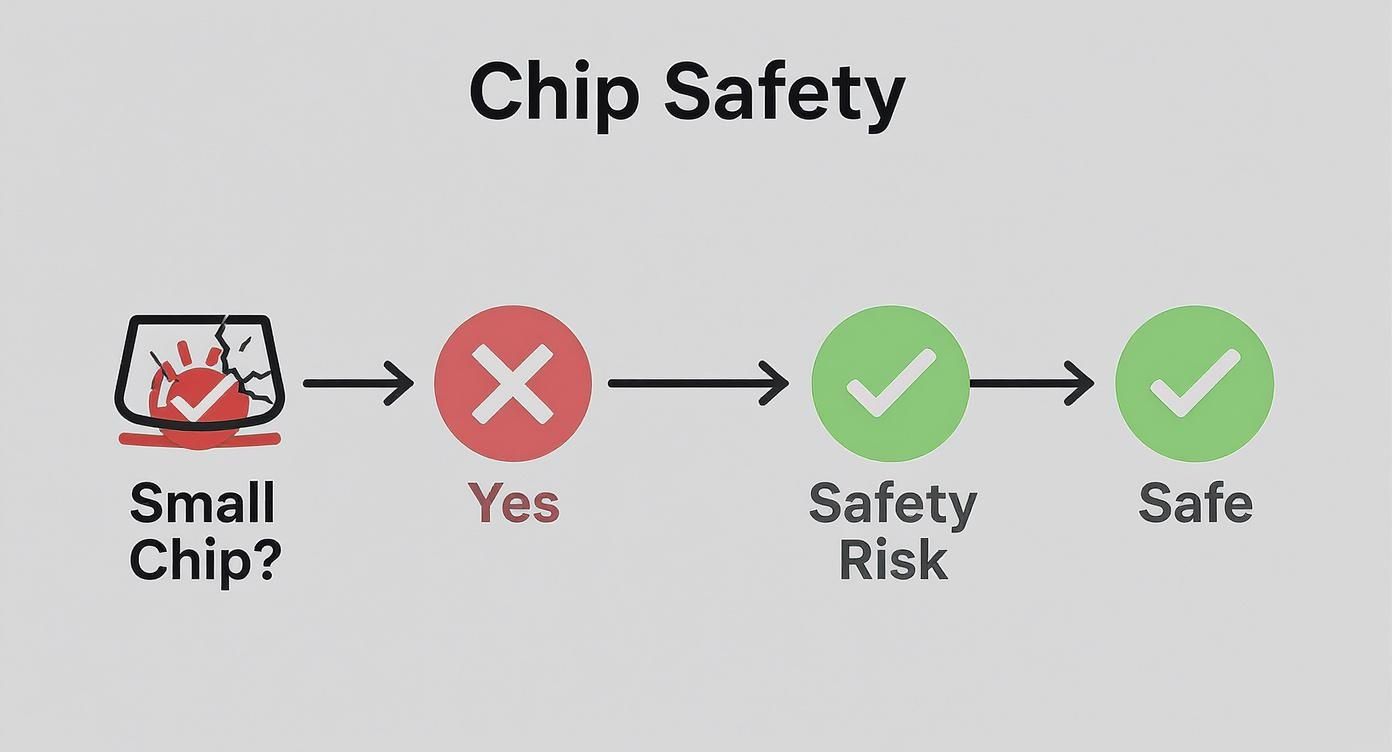
As you can see, even a small chip can compromise your safety, which is why getting it checked out quickly is so important.
Windshield Repair vs Replacement A Head-to-Head Comparison
To make things clearer, let's compare the key aspects of repairing a rock chip versus replacing the entire windshield. This will help you see exactly what’s involved with each option.
Factor | Windshield Repair | Windshield Replacement |
|---|---|---|
Cost | Typically low-cost, often fully covered by insurance. | Significantly more expensive, usually involves a deductible. |
Time | Fast. Usually done in under an hour. | Can take several hours, plus cure time for the adhesive. |
Safety | Preserves the original factory seal of the windshield. | The factory seal is broken and a new one is applied. |
ADAS | No effect on ADAS cameras. No recalibration needed. | Requires mandatory ADAS recalibration, adding cost and time. |
Convenience | Highly convenient, can be done anywhere with mobile service. | Requires a shop visit or more complex mobile setup. |
Original Glass | Keeps the original, factory-installed OEM glass. | The original glass is replaced, possibly with an aftermarket version. |
Ultimately, while replacement is sometimes necessary, a repair is almost always the preferred path if the damage allows for it due to its speed, cost-effectiveness, and safety benefits.
Why Repair Is Often the Better Choice
Whenever it’s an option, repairing the original windshield is the way to go. The single biggest reason is to maintain the original factory seal.
That seal isn’t just a line of glue; it’s a perfect, weatherproof bond between the glass and your car’s frame, applied by precise machinery in a sterile factory environment. It’s a huge part of your car’s structural integrity, keeping you safe in a rollover and ensuring your airbags deploy correctly.
A replacement, no matter how well it's done, can never truly replicate that original factory seal. It also brings up questions about glass quality, which is why understanding the difference between OEM and aftermarket parts is so crucial if you do need a new windshield.
Preserving your vehicle's factory windshield seal is one of the most important reasons to opt for a repair over a replacement. This original seal ensures maximum structural integrity and is a key component of your car's overall safety system.
It's no surprise that more and more drivers are choosing to repair instead of replace. With up to 80% of windshield repairs being for chips caused by road debris, it's become the go-to solution for smart car owners.
The ADAS Recalibration Factor
There’s another huge piece to this puzzle, especially in newer cars: your Advanced Driver-Assistance Systems (ADAS).
These are the high-tech safety features like lane-keeping assist, adaptive cruise control, and automatic emergency braking. They rely on cameras and sensors mounted directly to your windshield.
If you get your windshield replaced, those systems must be recalibrated. This is a non-negotiable, highly precise process that can easily add hundreds of dollars and several hours to the job.
A simple rock chip repair, however, doesn't touch the ADAS cameras or their alignment. That means no extra cost, no extra time, and no worries about your safety features working properly. If a replacement is unavoidable, it’s good to know what’s involved with the https://www.autorenu911.com/windshield-replacement.
How Professionals Repair a Rock Chip on a Windshield
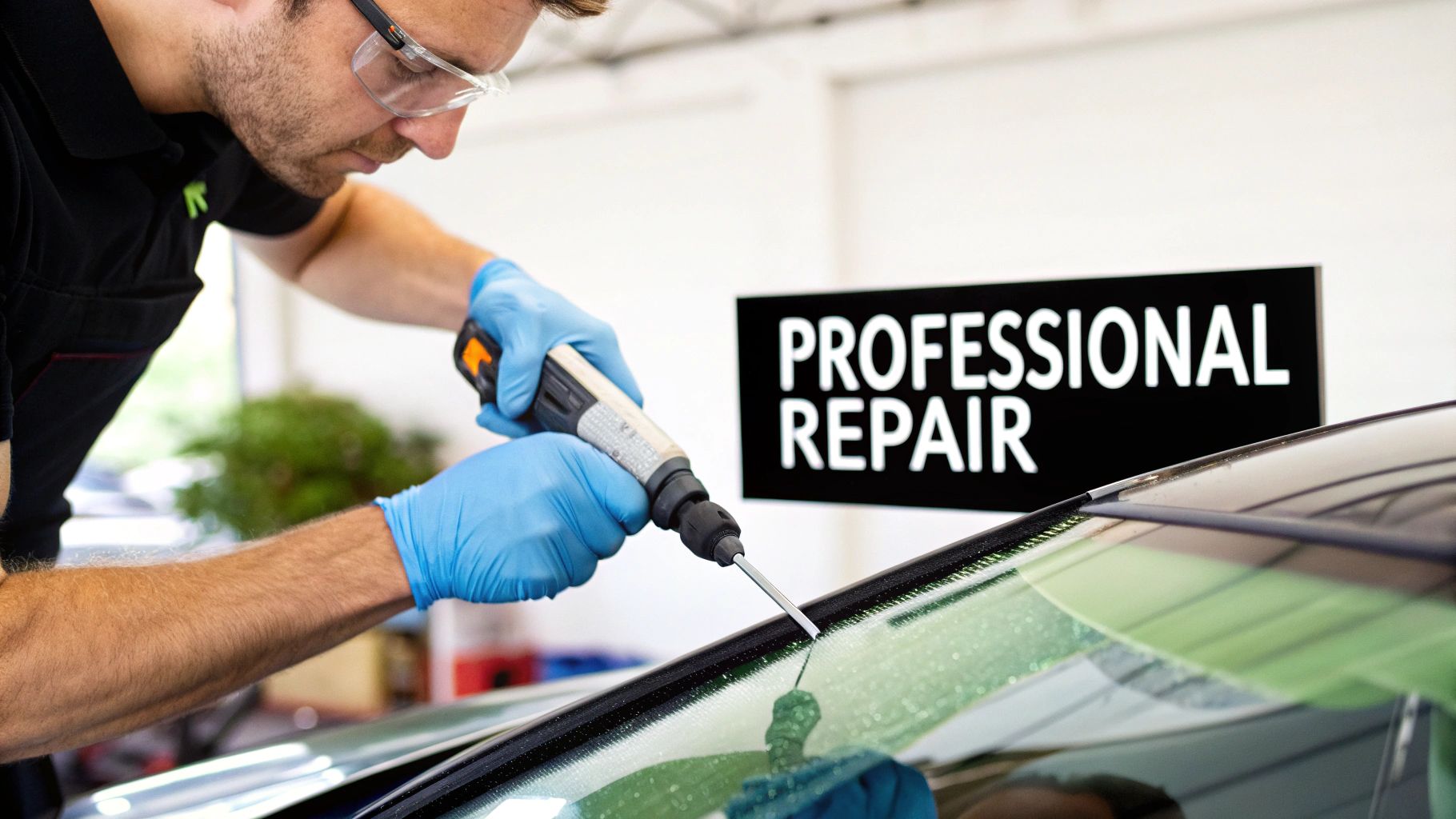
Watching an expert fix a rock chip is a pretty neat process. It's less about patching a hole and more like performing a small, precise operation on your windshield. The goal isn't just to make the chip disappear; it's about restoring the glass's strength from the inside out using some very specific tools and chemistry.
The entire repair revolves around one key principle: getting all the air and moisture out of the damaged spot so a special resin can get in and bond with the glass. This is what restores the windshield’s integrity and makes the chip practically invisible. It's a delicate balance, and it’s why a pro's touch makes all the difference.
Step 1: Meticulous Cleaning and Preparation
The first thing a certified technician does is thoroughly clean the impact point. They use a special probe to gently pick out any loose glass fragments, road grime, or dirt lodged deep inside the chip.
This step is non-negotiable. If any contaminants are left behind, the resin can't form a perfect bond, which results in a weak repair that sticks out like a sore thumb.
Step 2: Creating a Perfect Vacuum
With the chip cleaned out, the technician places a special tool directly over the damage. This device creates an airtight seal against the glass and then generates a powerful vacuum. This is probably the most important part of the whole repair.
The vacuum literally sucks all the air out of the microscopic cracks that spread out from the initial impact. This is the single biggest advantage of a professional repair over a DIY kit—without a vacuum, you're trapping tiny air bubbles inside, which is a guaranteed way to get a failed, ugly-looking fix.
A professional repair can restore 80% to 95% of the windshield's optical clarity at the damage site. This is only possible when a vacuum is used to completely clear the fractures before the resin is introduced.
This prep work ensures the resin can penetrate every last nook and cranny.
Step 3: Injecting and Curing the Resin
While the vacuum holds those tiny fractures open, a high-quality, optically matched resin is injected under pressure. This isn't just any glue; it's a professional-grade resin designed to have the same light-refractive properties as your windshield glass, which is the secret to making the damage vanish.
Once the resin has filled every void, a UV light is placed over the area. This cures the resin, hardening it into a permanent, rock-solid bond with the surrounding glass.
The result is a seamless fix that brings back the windshield's original strength and stops the chip from ever spreading. The best part is how fast it all happens—this professional windshield repair gets you safely back on the road in under an hour.
Understanding Repair Costs and Insurance Coverage

After the frustration of getting a rock chip fades, the next question is always the same: "How much is this going to cost me?" The good news is that fixing a small chip is one of the most affordable bits of preventative maintenance you can do for your car. It’s certainly a lot cheaper than the alternative.
Choosing to repair a chip is always going to be easier on your wallet than a full windshield replacement. The out-of-pocket cost for a professional repair is just a fraction of what you'd pay for new glass, the labor to install it, and the mandatory ADAS recalibration that most modern cars need.
This isn't just a local problem, either. The global market for windshield services is a massive $15 billion industry, and it's expected to hit $23 billion by 2033. That’s a testament to how many vehicles are on the road and how common it is to get hit by flying debris.
How Insurance Makes Repairs Even More Affordable
Here’s where it gets even better for most drivers. If you have the right insurance coverage, that rock chip repair will likely cost you absolutely nothing out of pocket. Many people are surprised to find out their policy is set up to encourage these quick, proactive fixes.
In fact, most comprehensive auto insurance policies cover 100% of the cost of a rock chip repair. On top of that, they almost always waive your deductible for this specific service.
Why would they do this? It's simple math for them. Paying a small amount now for a quick repair saves them from a much bigger payout for a full windshield replacement down the road. It’s a true win-win for both you and your insurance company.
To really get a handle on your glass coverage, it’s a good idea to understand what full coverage car insurance is and what it usually includes. This will help you confirm whether your policy covers glass damage without you having to pay a deductible.
Navigating Your Insurance Policy and Filing a Claim
Figuring out your policy and filing a claim sounds like a headache, but a good auto glass shop will make the whole process incredibly simple. At Auto Renu, we take the entire insurance hassle off your plate.
Here’s a quick look at how we handle it for you:
Check Your Policy: We start by quickly verifying if your comprehensive coverage includes a zero-deductible option for windshield repair.
File the Claim: Our team contacts your insurance provider directly, files the claim for you, and submits all the required paperwork.
Schedule the Repair: As soon as the claim gets the green light (which is usually instant), we schedule your mobile repair.
Get It Fixed: We come right to you—whether you're at home, the office, or somewhere else—and get the repair done, typically in under an hour.
This streamlined approach means you don’t have to waste your time on the phone with insurance agents or deal with confusing forms. We manage all the details so you can get on with your day, stress-free. Plus, our mobile service means you don't risk the chip spreading while driving to a shop. And if a full replacement is unavoidable, it’s crucial to understand the complexities of ADAS recalibration in our detailed guide.
Your Windshield Chip Questions Answered
So, you know a rock chip is bad news and you've got the gist of how it's fixed. But what about the nitty-gritty details? Most drivers have a few more practical questions before they pick up the phone. Let's get you some clear answers so you can make a confident decision.
How Long Does a Windshield Chip Repair Take?
You'll be surprised at how fast a professional can handle this. We're not talking about an all-day affair. Most rock chip repairs are done and dusted in about 20 to 30 minutes.
That’s the whole shebang—cleaning the chip, injecting the high-tech resin, and using a special UV light to cure it rock-solid. The best part? You can drive away the second the technician is finished. It’s a world away from a full replacement, which can take hours and often requires you to wait even longer for the new adhesive to cure safely.
Will I Still See the Chip After It's Repaired?
The number one goal of any repair is to make your windshield strong again and stop that chip from turning into a massive crack. But let's be honest, you also want it to look better, right?
A top-notch repair makes the damage practically disappear. Realistically, you might see a tiny, faint blemish where the rock first hit, but a good tech can restore 80% to 95% of the optical clarity. You’ll have to look really hard to find it.
Think of it this way: the repair prioritizes strength first and aesthetics second. You get a safe, secure windshield, and the old damage is reduced to a tiny imperfection that won’t catch your eye while driving.
Is It Safe to Go Through a Car Wash with a Chipped Windshield?
This is a big one. Our strong advice is to avoid automatic car washes if you have a chip that hasn't been fixed yet. Why? The sudden temperature shifts from the water and the force from high-pressure jets are the perfect recipe for turning a small chip into a long, unfixable crack.
Get the chip repaired first. Once that resin is cured, your windshield's strength is back to normal. Then you can take it through any car wash you like without a second thought.
Don't let a small chip become a big headache. The expert team at Auto Renu Auto Glass LLC brings fast, mobile rock chip repair right to your doorstep, and it's often free with your insurance. Schedule your convenient mobile repair today and protect your windshield.