Chips in windshield repair: Costs, Fixes & Tips
Chips in windshield repair guide: learn causes, typical costs, and quick fixes. Find tips to save time and money on chips in windshield repair.
Nov 2, 2025
generated
chips in windshield repair, windshield repair cost, auto glass repair, car maintenance tips, diy windshield repair
That little nick on your windshield from a stray pebble might seem like nothing, but trust me, ignoring it is a gamble you don't want to take. It’s like a tiny tear in a fabric—over time, with enough stress, that small flaw can turn into a massive, unfixable rip. Before you know it, a simple chip repair becomes an expensive full windshield replacement.
Why a Small Windshield Chip Is a Big Problem

A small chip is so much more than a cosmetic issue; it’s a genuine weak point in one of your car’s most important safety features. Your windshield isn't just there to keep bugs out of your teeth. It’s a key part of your vehicle's structural frame, providing critical support in a rollover and ensuring your airbags deploy properly in a crash.
When a rock smacks your windshield, it creates a fracture that weakens the entire piece of glass. That initial damage might look small and harmless, but it's a ticking time bomb. The everyday stress of driving can—and often will—turn that tiny chip into a huge crack without any warning.
The Real Dangers of Waiting
If you put off a repair, you're basically letting your windshield take a constant beating. Every bump in the road and change in weather acts like a tiny hammer, working away at that weak spot until the glass gives out.
Here are the most common culprits that turn a chip into a crack:
Temperature Fluctuations: Glass expands in the heat and shrinks in the cold. A sudden, drastic change—like blasting the defroster on a frozen windshield or spraying cold water on hot glass—puts enormous pressure on the chip. That’s often all it takes for a crack to shoot across your line of sight.
Road Vibrations: Think about all the potholes, speed bumps, and rough roads you drive over. Each one sends vibrations through your car's frame, and that energy zeros in on the weakest point: the chip. Those little shudders slowly but surely force the damage to spread.
A compromised windshield can reduce the structural support of a vehicle's roof by up to 60% in a rollover accident. Promptly addressing chips is a direct investment in your safety.
Why Repairs Are More Common Than Ever
The need for quick chips in windshield repair is a big reason the auto glass industry is growing so fast. In fact, the global automotive windshield market is expected to jump from $20.4 billion in 2025 to $46.2 billion by 2034.
This growth is driven by more cars being on the road and new glass technologies. With more road debris causing minor damage, getting a chip fixed is a smart, cost-effective choice compared to a full replacement. For a closer look at the numbers, check out the full automotive windshield market analysis.
Know Your Enemy: A Guide to Different Windshield Chip Types
Walk out to your car and spot a new blemish on the glass? It’s frustrating, but not all chips are a death sentence for your windshield. The first thing any good technician does is identify the type of damage, because that tells us everything about how to treat it and how urgently it needs attention.
Think of it this way: a small cut needs a bandage, but a deep gash needs stitches. It's the same with your windshield. Knowing what you're looking at helps you understand the risk and why a technician might recommend a certain kind of chips in windshield repair. Let's break down the usual suspects.
The Bull's-Eye Chip
This one is the classic. A bull's-eye looks just like its namesake—a small, dark, circular cone shape with a neat impact point right in the middle. It’s the kind of mark you get from a pebble hitting the glass head-on.
The good news? Bull's-eye chips are generally the easiest to fix. Their simple, contained shape allows the repair resin to flow in and fill the void perfectly. But don't let that fool you into waiting; a sudden temperature drop can make that little circle sprout a long, ugly crack overnight.
The Star Break Chip
A star break is a bit more dramatic. You'll see a clear impact point, but with little "legs" or cracks radiating outwards, like a starburst. This type of damage is a bigger deal than a bull's-eye because it's inherently less stable.
Each one of those little legs is a weak point, just waiting for the right bump or temperature swing to start running across your line of sight.
A star break is a ticking time bomb. With multiple fracture points, the glass is already compromised. It's not a matter of if it will spread, but when.
Combination Break and Half-Moon
Sometimes, you get the worst of both worlds. A combination break is just that—a mix of a bull's-eye and a star break. It has that central circular damage, but with cracks shooting out from the edges. This makes it a more complex and urgent repair.
A half-moon chip is essentially a partial bull's-eye, looking like a little semi-circle in the glass. It might not look as severe, but it’s still a structural flaw that can easily expand if you ignore it.
To make things simpler, here’s a quick rundown of what you might be looking at.
Windshield Chip Types and Repairability
Chip Type | Appearance | Risk of Spreading | Typically Repairable? |
|---|---|---|---|
Bull's-Eye | A clean, circular cone shape in the glass. | Low to Moderate | Yes, highly repairable. |
Star Break | A central impact point with cracks radiating outward. | High | Yes, but time-sensitive. |
Combination | A bull's-eye with cracks extending from it. | Very High | Yes, if addressed quickly. |
Half-Moon | A semi-circular shape, like a partial bull's-eye. | Moderate | Yes, usually repairable. |
No matter what kind of chip you have, it has compromised the structural integrity of your windshield. The single best thing you can do is get a professional opinion. It’s the surest way to prevent a small, fixable annoyance from turning into a major—and much more expensive—replacement.
The Professional Windshield Repair Process Step-by-Step
Ever wondered what a technician is actually doing when they show up to fix that chip in your windshield? It’s not just a matter of squirting some superglue into the crack and calling it a day. A professional repair is a meticulous process, a lot like a dentist filling a cavity—it's all about cleaning, stabilizing, and restoring the structural integrity of the glass.
This careful, step-by-step approach is what makes a pro repair so effective. Technicians use specialized tools and resins to make sure the fix is permanent, safe, and nearly invisible. Let's break down exactly what happens.
Step 1: Meticulous Cleaning and Preparation
First things first, the technician gives the chip a thorough inspection. They need to figure out the type of break, how deep it goes, and whether any debris has gotten inside. Dirt, moisture, or tiny glass fragments can ruin the repair, so this part is crucial. They'll use a small probe to carefully pick out any loose glass from the point of impact.
Next, they clean the surrounding area to get rid of any road grime or oils. This step ensures the equipment gets a perfect seal and the resin forms an unbreakable, airtight bond with the glass.
Step 2: Creating a Vacuum and Removing Air
With the area prepped, a special tool called a resin injector is mounted right over the chip. This device creates a powerful vacuum against the windshield, and its job is simple but vital: to suck every last bit of air out of the chip and its tiny, branching cracks.
Think of it like trying to fill a bottle that’s already full of air—you can't get much liquid in. By removing the air first, the technician creates a perfect void, making sure the repair resin can flow into every microscopic fissure.
This vacuum step is one of the biggest differences between a professional job and a basic DIY kit. Without it, you'd end up with trapped air bubbles that create weak spots and ugly distortions, which often leads to the repair failing down the road.
Step 3: Injecting and Curing the Resin
While the vacuum holds, the technician injects a highly specialized, optically matched liquid resin into the device. The injector then uses pressure to force that resin deep into the break, completely filling the void where the air used to be. A complete fill is absolutely essential for restoring your windshield’s strength.
Once the chip is filled, a UV light is placed over the area. This cures the resin in about a minute, hardening it into a substance that has the same strength and light-refractive properties as glass. The bond is now permanent and waterproof, making the windshield strong again.
The infographic below shows some of the common chip types a technician will identify before even starting the repair.
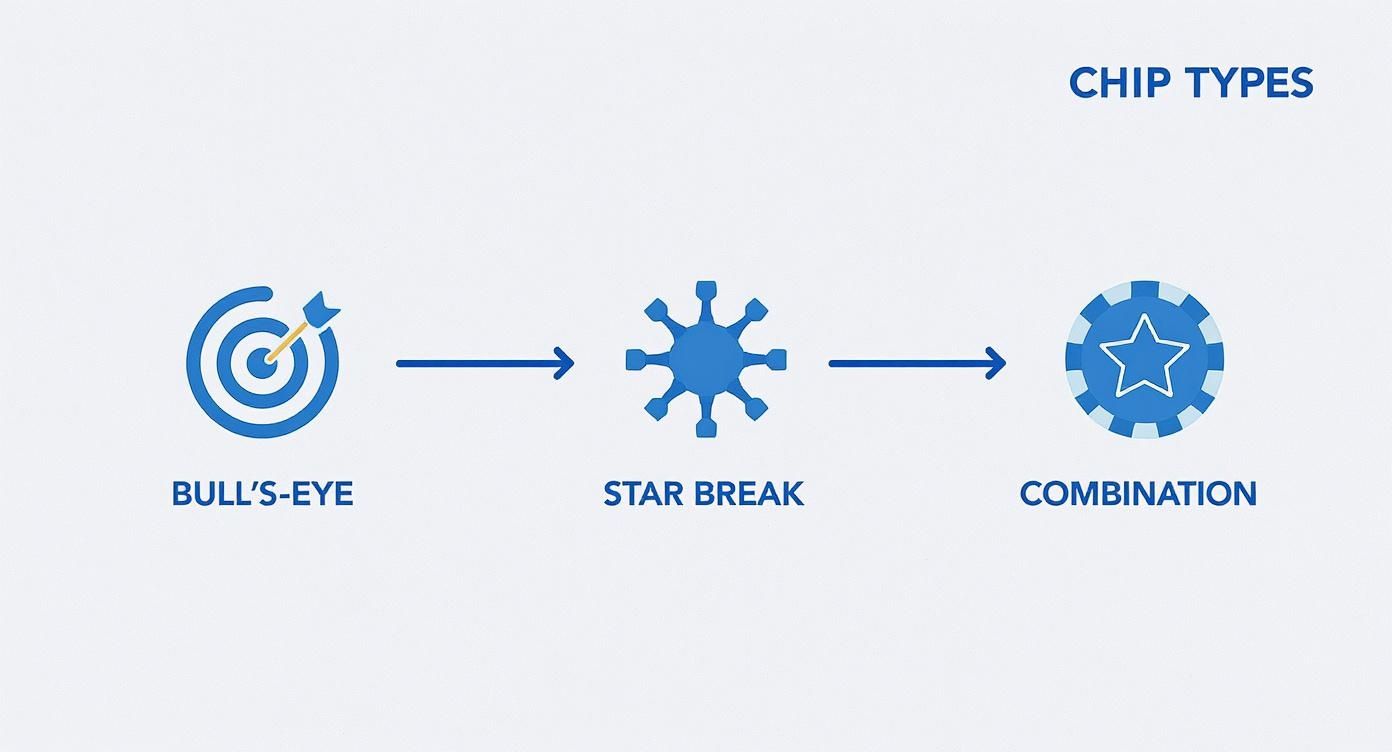
As you can see, different kinds of impacts create unique fracture patterns, and each one requires a slightly different technique to guarantee a successful repair.
Step 4: Finishing and Polishing
To finish the job, the technician scrapes off any excess resin with a razor blade and polishes the surface until it’s perfectly smooth and clear. The goal is to restore about 85-95% of the original optical clarity, making the damage practically vanish. To see our specific methods in action, you can check out our complete windshield repair process.
The whole procedure is a testament to how far the auto glass industry has come. In fact, the global market for these services is projected to shoot past $23 billion by 2033, all thanks to innovations like these that make repairs so incredibly effective. This growth means that high-quality, convenient options are easier to find than ever before.
Choosing Between DIY Kits and Professional Repair
https://www.youtube.com/embed/567YZ7S6x2o
So you've found a chip in your windshield. Now what? You're at a crossroads, facing a choice that plenty of drivers have to make: grab a do-it-yourself kit from the local auto parts store, or call in a pro? While both options aim for the same outcome, the road you take can make a huge difference in the quality, longevity, and safety of the repair. Your decision really boils down to the specific damage, your budget, and how much risk you're willing to take.
There's no denying the appeal of DIY kits—they're cheap and convenient. For a handful of dollars, you can try to tackle the problem right in your own driveway, on your own time. It's a massive market for a reason; the global windshield repair kits market was valued at around $1.5 billion in 2025 and is projected to keep climbing. This trend is driven by folks looking for a quick, low-cost alternative to a professional service call.
But before you try to handle those chips in windshield repair yourself, you need to understand the trade-offs. The convenience can come at a steep price.
The Temptation and Trouble of DIY Repair
For a very small, simple chip—like a tiny bull's-eye that isn't in your line of sight—a DIY kit might seem like a perfectly reasonable solution. The instructions look simple enough: clean the spot, drip in some resin, and let it cure. And sometimes, for a minor blemish, it might just be enough to stop it from spreading right away.
The problem is, the risks are significant. The resin in those consumer kits is rarely the same quality that professionals use, which can lead to a cloudy, discolored patch or a bond that just doesn't hold. The real challenge, though, is the application itself. Professionals use special tools to create a vacuum, sucking every last bit of air out of the chip before injecting the resin. Without that equipment, you're almost guaranteed to trap air bubbles, leaving weak spots that can easily crack under stress later on.
A botched DIY repair can slam the door on a professional one. Once a low-grade resin cures inside the chip, a technician can't get it out. At that point, a simple repair is off the table, and a full windshield replacement becomes your only safe option.
Why Calling a Pro Is Usually the Wiser Move
Choosing a professional repair is more than just paying for a service; it's an investment in your safety and peace of mind. A skilled technician brings years of experience and highly specialized equipment to the job—things you simply can’t get in a box off the shelf. They work with commercial-grade resins that are optically matched to your glass, which means the final result is not only strong but also crystal clear.
Here’s what sets a professional repair apart:
Superior Equipment: Technicians use injectors that pull a vacuum to clear all air and moisture from the damage before forcing the resin deep into every tiny fracture under pressure.
High-Quality Materials: The resins are stronger, clearer, and formulated to resist yellowing from UV exposure, ensuring the repair holds up for the long haul.
Guaranteed Results: Reputable shops stand by their work. Most professional repairs come with a warranty, so if the chip ever spreads, they'll often redo the repair or credit the cost toward a replacement.
Beyond the technical skills, a good repair experience also involves efficient communication in glass repair. At the end of the day, if the chip is bigger than a quarter, has cracks spreading from it, or is directly in your line of sight, a professional isn't just the better choice—it's the only responsible one. And if the damage is too far gone for a repair, you can learn more about our complete windshield replacement services.
Understanding Repair Costs and Insurance Coverage

When you spot a chip in your windshield, the first thought that probably pops into your head is, "Great, how much is this going to set me back?" It's a fair question, but you might be pleasantly surprised. The cost of a professional windshield chip repair is often much more manageable than most people think, especially once you factor in your insurance.
The final bill for a repair isn't just a number pulled out of thin air. It's calculated based on how complex the job is. For instance, a small, clean bull's-eye is a far simpler fix than a sprawling combination break with cracks shooting out in every direction.
Breaking Down the Cost Factors
When a technician gives you an estimate, they're looking at a few specific things. Each element helps them determine how much time, skill, and specialized resin the repair is going to need.
Size and Depth: Bigger and deeper chips need more resin and a more delicate touch to fill properly, which can nudge the price up.
Chip Type: Those tricky star breaks and combination chips are more involved fixes than a simple bull's-eye because they have so many little fracture points to address.
Location: If the chip is right on the edge of the glass or directly in the driver's line of sight, the repair becomes a more delicate, time-consuming procedure.
Here's something that surprises a lot of drivers: a chip repair often costs nothing out of pocket. Insurance companies would much rather pay for a small fix now than foot the bill for an expensive full windshield replacement down the road.
Leveraging Your Insurance Policy
This is where the good news really kicks in. If your auto policy includes comprehensive coverage, there's a strong likelihood your insurance will cover 100% of the repair cost. In many states, they're actually required to waive the deductible for repairs because it's so much cheaper for them in the long run.
Look at it from their point of view: a quick repair today prevents a huge claim for a full replacement tomorrow. This is a massive deal for newer cars loaded with Advanced Driver-Assistance Systems (ADAS). Replacing one of those windshields means a pricey camera recalibration is also needed. To see what that involves, you can check out our guide on what ADAS windshield calibration entails.
Your first move should be to call your insurance agent. Let them know what happened and ask about your "no-fault glass repair" coverage. They'll walk you through the next steps and usually point you toward an approved auto glass shop that can bill them directly, keeping the whole process simple and paperwork-free for you.
Got Questions About Windshield Chip Repair? We've Got Answers
Even after you get the rundown on the repair process, it's totally normal to have a few more questions pop up. We get it. Practical things like timing, weather, and what the final result will look like are on everyone's mind. Getting straight answers helps you feel confident before you book the service.
Let's walk through some of the most common questions we hear every day. Our goal is to make this whole process as clear and simple as possible, so you know exactly what to expect.
Can a Windshield Chip Be Repaired in the Rain?
This is a big one, and the short answer is a hard no—at least not without some cover. For the repair to work, the chip and the glass around it have to be bone dry. If any moisture gets trapped in that tiny crack, the resin simply won't bond correctly to the glass.
Think about trying to stick a band-aid on wet skin. It’s not going to work, right? The same logic applies here. Water trapped inside the chip creates a weak repair that's almost guaranteed to fail, which means that crack will start spreading again. Mobile techs are pros at working in all sorts of situations, but they'll need a dry spot like a garage or carport to do the job right if it's raining.
Pro Tip: If your windshield gets chipped during a downpour, grab a small piece of clear tape and stick it over the damage. This will help keep it clean and dry until a professional can take a look.
How Long Does a Chip Repair Take?
One of the best things about getting a chip fixed professionally is how quick it is. The whole process is incredibly efficient, designed to get you back on your way without messing up your whole day.
Most standard chip repairs are done in just 20 to 30 minutes. That's it. In that time, the technician will:
Prep the Area: They'll carefully clean out any tiny glass shards or road grime from the chip.
Inject the Resin: Using a special tool, they'll create a vacuum over the chip to pull out any air and inject the resin deep into every part of the break.
Cure It Solid: A powerful UV light hardens the resin in about a minute, creating a permanent, waterproof seal.
Because the resin is cured instantly with the light, there's no waiting around. You can hop in your car and drive off as soon as the technician is finished.
Will the Chip Completely Disappear After the Repair?
The number one reason to repair a chip is to restore the windshield's structural integrity and—most importantly—stop the damage from spreading into a massive crack. While the repair makes a huge difference cosmetically, it probably won't make the chip 100% invisible.
A professional repair typically restores 85-95% of the original optical clarity. What you're usually left with is a tiny, faint blemish that's much, much harder to see than the original damage. The final result can depend on the type of chip, how big it was, and how long it's been there. For instance, a fresh, clean bull's-eye chip is going to look a lot better after a repair than an old star break that's full of dirt.
Is It Safe to Go Through a Car Wash Afterward?
Absolutely. Once that UV light hits the resin, it creates a permanent bond that's just as strong as the glass itself. The hardened resin is completely waterproof and won't be bothered by the soap, high-pressure water, or detergents used at a car wash.
You can head straight to the car wash right after the repair is done. There's no "curing time" or waiting period needed. That's the beauty of using professional-grade materials and techniques—you get a durable fix you can count on.
At Auto Renu Auto Glass LLC, we believe you deserve clear answers and service you can trust. If you have any other questions or need a fast, professional repair, don't hesitate to reach out for a free estimate. Visit us at https://www.autorenu911.com to schedule your mobile service today.