The Real Cost of Windshield Replacement Explained
What's the real cost of windshield replacement? Our guide breaks down pricing factors, from ADAS calibration to insurance, so you know what to expect.
Nov 26, 2025
generated
cost of windshield replacement, windshield replacement cost, adas calibration cost, auto glass replacement, car maintenance costs
When you start looking into the cost of replacing a windshield, you'll see a pretty wide range. Nationally, you can expect to pay anywhere from $250 to $500 for a basic replacement. But for newer cars packed with technology, that number can easily jump past $1,000.
Think of that initial range as just a ballpark figure. The real price tag comes down to the specifics of your car—its make, model, and all the tech it’s carrying.
Understanding the Real Cost of Windshield Replacement
A quote for a new windshield isn't just for a piece of glass. It’s for a vital piece of your car's safety equipment, and these days, that equipment is more complex than ever. A windshield used to be a simple barrier against the elements. Now, it’s a high-tech hub that integrates with your car’s most important safety features.
This evolution is the single biggest reason why replacement costs can be all over the map. A small, simple chip might be a good candidate for a fast, affordable fix, which you can read about in our guide to windshield repair. But when the damage is bad enough to need a full replacement, a whole new set of cost factors comes into play.
A Quick Price Overview
Looking at nationwide data, it's clear how much pricing can swing. A standard replacement might average around $250, but it’s not uncommon to see prices ranging from $200 all the way up to $1,000 or more for trickier jobs.
To give you a clearer picture of what you might pay, we’ve put together a quick breakdown based on common vehicle types. Think of this table as a starting point before we get into the nitty-gritty details that shape your final bill.
Estimated Windshield Replacement Cost at a Glance
This table provides a quick summary of typical cost ranges for windshield replacement based on the vehicle's age and embedded technology.
Vehicle Category | Typical Cost Range (Without Insurance) |
|---|---|
Older Vehicle (Pre-2015, No ADAS) | $200 – $400 |
Modern Sedan or SUV (With ADAS) | $450 – $900 |
Luxury Vehicle (Advanced Features) | $800 – $1,500+ |
Electric Vehicle (e.g., Tesla) | $1,000 – $2,000+ |
As you can see, the newer and more advanced the car, the higher the potential cost.
Key Takeaway: The technology embedded in your windshield—like sensors for automatic braking or lane-keep assist—is now the biggest driver of replacement costs. A simple glass swap on an older car is a fundamentally different job than replacing and recalibrating the sophisticated systems in a new one.
Why Not All Windshields Are Created Equal
Let's get one thing straight: a windshield is so much more than a simple pane of glass. Think of it this way—you wouldn't put the same tires on a Toyota Camry as you would on a Porsche 911. They both do the same basic job, but the technology, materials, and performance are worlds apart. And so is the price tag.
The same exact principle applies to your windshield. A stone chip on a 15-year-old car might mean a pretty straightforward, affordable fix. That same chip on a brand-new SUV? That could kick off a complex technical process involving cameras and sensors, sending the final bill much higher. Understanding what goes into that final price is key.
Your Vehicle Is the Starting Point
The make, model, and year of your car are the biggest factors driving the cost. A windshield for a super common car, like a Honda Civic, is made by the thousands, which naturally keeps the price reasonable. On the other hand, the glass for a luxury vehicle like a Mercedes-Benz or a less common model is more specialized, and the cost reflects that.
The shape and size of the glass matter, too. The huge, curved windshields on modern trucks and SUVs simply use more material and are trickier to manufacture than the smaller, flatter glass on a compact car. A Ford F-150 windshield replacement, for instance, can run anywhere from $350 to over $1,400, depending on all the bells and whistles it has.
OEM vs. Aftermarket Glass: What's the Difference?
When it’s time for a replacement, you’ll have a choice between two main types of glass, and it's a decision that directly hits your wallet.
Original Equipment Manufacturer (OEM) Glass: This is the real deal—the exact same glass that was installed on your car at the factory, made by the same company. It’s a guaranteed perfect match for fit, quality, and clarity. As you’d expect, it's also the priciest option.
Aftermarket Glass (OEE): This glass is made by third-party companies. While it has to meet strict federal safety standards, the quality can vary from brand to brand. A top-tier aftermarket windshield is a fantastic, cost-effective alternative, but it’s vital to use a reputable brand to avoid issues with fit or distortion.
It's a lot like buying a brand-name medication versus the generic version. The generic one works, but the brand name offers that extra peace of mind that it’s identical to the original. For most everyday cars without complex tech, a quality aftermarket windshield is a perfectly smart choice.
Expert Insight: If your vehicle has advanced safety systems, we almost always recommend—and sometimes car manufacturers require—using OEM glass. It ensures the cameras and sensors can be recalibrated to factory specifications without any hitches.
The Rise of High-Tech Glass
Modern windshields are no longer just passive barriers; they're active components packed with technology. These features are integral to how your car operates safely and comfortably, and they all add to the cost.
Some of the most common features driving up windshield replacement costs include:
Heated Windshields: These have a grid of nearly invisible wires that melt ice and snow in minutes.
Acoustic Glass: A special layer of sound-dampening vinyl is sandwiched between the glass layers to give you a quieter ride.
Rain Sensors: A small sensor detects moisture and automatically turns on your wipers, adjusting their speed as the rain picks up or lets off.
Heads-Up Displays (HUD): This projects your speed, navigation, and other info right onto the glass, requiring a special coating to be visible.
Each one of these requires a more sophisticated—and expensive—piece of glass. The global automotive windshield market has exploded in recent years, largely because this kind of tech is becoming standard. You can learn more about the trends shaping the auto glass market and its projected growth.
But the single biggest game-changer is the integration of Advanced Driver-Assistance Systems (ADAS). These systems are the "eyes" of your car, relying on a forward-facing camera mounted right on the windshield. This camera powers critical safety features like automatic emergency braking, lane-keeping assist, and adaptive cruise control.
When we replace a windshield with an ADAS camera, it stops being a simple glass swap. It becomes a precise technical installation that sets the stage for the most critical part of the job: recalibration.
The Hidden Cost in Modern Windshields: ADAS Calibration
If you're driving a car made in the last several years, you might get a bit of sticker shock when you see your windshield replacement quote. The biggest surprise often isn't the glass itself, but a line item called ADAS recalibration. This single service can sometimes double the total cost, leaving many drivers wondering what it is and why it costs so much.
Let's break it down. Think of your car's Advanced Driver-Assistance Systems (ADAS) as its digital co-pilot. These are the brains behind safety features like automatic emergency braking, lane-keeping assist, and adaptive cruise control. The main camera that feeds information to these systems is mounted right on your windshield.
When we install a new windshield, that camera’s viewpoint can shift—even by a fraction of a millimeter. It might not seem like much, but it's like knocking the sights on a rifle out of alignment. It might look like it’s pointing straight, but it’s actually aimed at the wrong target. Recalibration is simply the process of re-aiming this camera with incredible precision, getting it back to the manufacturer's exact specifications so your safety features work correctly.
Why You Can't Afford to Skip Recalibration
Trying to save money by skipping ADAS recalibration is a gamble you don't want to take. It’s an essential safety procedure, not an optional add-on. Without it, the very features designed to prevent an accident could fail when you need them most. Your car might not brake in time to avoid a collision or could misread the lane markings on the highway, creating a genuinely dangerous situation.
A study by the American Automobile Association (AAA) revealed that even a tiny misalignment in ADAS sensors could lead to major problems. For example, a lane-keeping system could actually steer the car into the next lane. This is exactly why a professional, by-the-book recalibration is absolutely critical for your safety on the road.
The image below gives you a good idea of how these advanced systems play into the overall cost of a replacement.
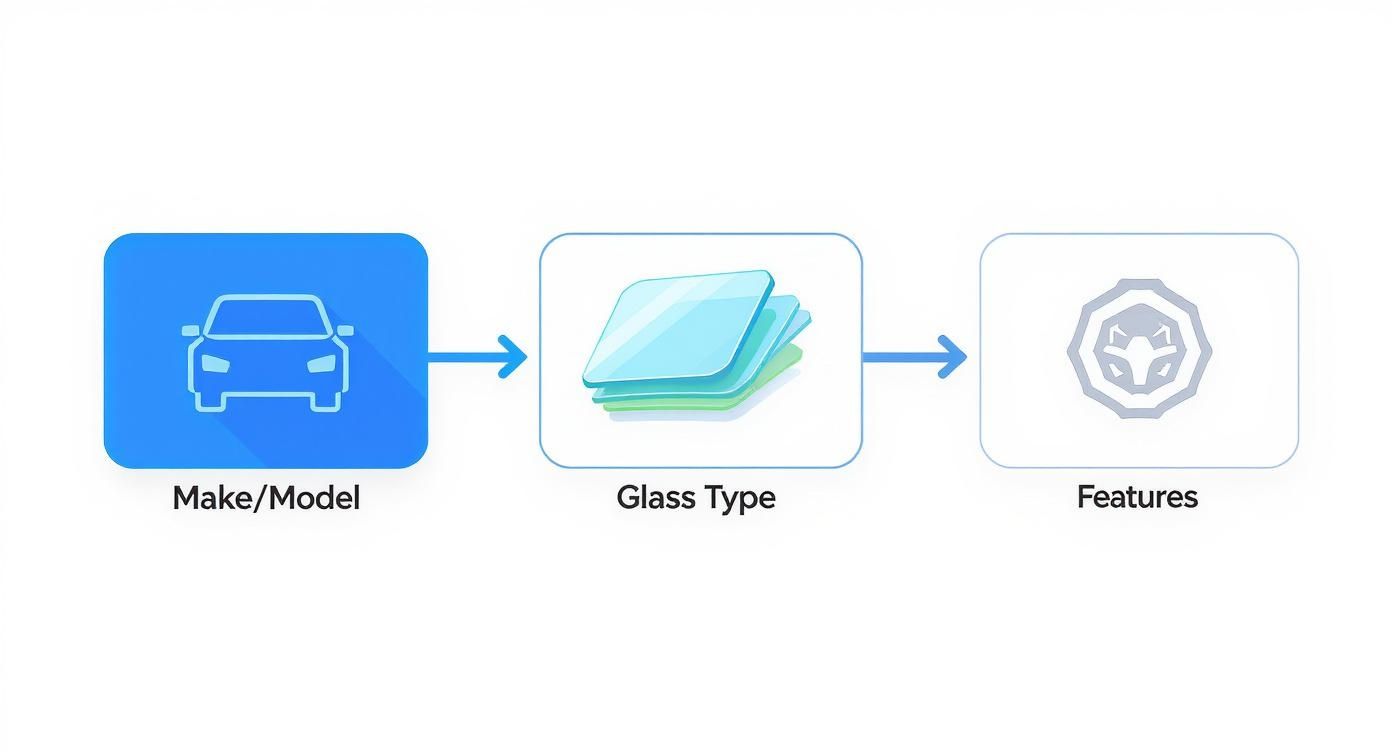
As you can see, the more tech is built into the windshield, the more complex—and costly—the job becomes. It's not just about swapping glass anymore; it's about correctly integrating sophisticated electronics.
Two Paths to Perfect Alignment: Static vs. Dynamic Recalibration
Recalibration isn't a one-size-fits-all job. There are two primary methods, and the right one for your car is determined by the vehicle manufacturer.
Static Recalibration: This is a meticulous, in-shop procedure. It's done in a controlled environment where technicians place specialized targets and patterns at exact distances and heights around the vehicle. This allows them to precisely re-aim the ADAS camera. It's highly accurate but requires a specific setup and takes time.
Dynamic Recalibration: This method involves a road test. A technician drives the vehicle on clearly marked roads at a set speed, allowing the ADAS system to "relearn" its surroundings and calibrate itself using real-world conditions. Some cars only need this, while others require a combination of both static and dynamic procedures to be fully and safely calibrated.
This is a specialized skill that requires expensive, high-tech equipment and technicians who know how to use it. That’s why it adds anywhere from $150 to $400 or more to your final invoice. It’s a significant cost, but it's a non-negotiable investment in your car's safety systems. To dive deeper into how this all works, check out our detailed guide on ADAS windshield calibration.
Decoding Your Insurance for Glass Replacement
https://www.youtube.com/embed/GJBByhhWJ9I
The final bill for your new windshield doesn't always have to come straight from your wallet. Your auto insurance policy can be a huge help, often cutting down or even completely covering the cost of windshield replacement. But the key is knowing what your policy actually says.
Most of the time, windshield damage is handled by your policy's comprehensive coverage. This is the part of your insurance that deals with damage from things other than a collision—think theft, a tree branch falling on your car, or that stray rock that came out of nowhere on the highway. If you only have the bare-minimum liability coverage, glass damage typically isn't included.
The Role of Your Deductible
The single most important factor here is your deductible. It’s simply the amount you have to pay out of pocket before your insurance company steps in to cover the rest. It’s your share of the repair bill.
Let's break it down with a quick example:
The total replacement cost for your windshield is $800.
Your comprehensive deductible is set at $500.
You pay the first $500, and your insurance takes care of the remaining $300.
Now, if the total replacement cost was only $450—less than your deductible—you would cover the entire amount yourself. Your insurance doesn't start paying until the bill exceeds your deductible amount. Getting a handle on how your car insurance rates are determined can offer more clarity, and a useful tool like this Car Insurance Rate Estimator can give you a bigger picture of your policy costs.
State-Specific Rules and Full Glass Coverage
Where things get interesting is that insurance rules for auto glass can change quite a bit depending on what state you're in. Some states have what are called "zero deductible" or "full glass" laws, which force insurance companies to waive the comprehensive deductible for any windshield repair or replacement.
Pro Tip: If you live in a state with full glass coverage, you could get a brand-new windshield installed with $0 out-of-pocket cost. It’s a fantastic perk that many drivers don't even realize they have.
Even if it's not mandated by your state, many insurers offer an optional add-on called full glass coverage. For a small bump in your premium, this add-on gets rid of the deductible for any glass claim. It's a great choice if you drive in areas with a lot of road debris or just want that extra peace of mind.
Your best first move is always to pull up your policy documents or just give your insurance agent a call. Ask them point-blank about your comprehensive deductible for glass damage and if you have any special glass coverage. Knowing exactly what you’re covered for empowers you to make a smart financial decision about your auto glass replacement.
Comparing Real-World Replacement Scenarios
It’s one thing to read about all the factors that go into a windshield replacement bill, but it’s another to see how it all plays out in the real world. To give you a better feel for how wildly the final price can swing, let’s walk through three common vehicle examples.
We’ll start with a straightforward replacement for an older, no-frills car. Then, we’ll move up to a modern SUV where safety tech adds a new layer of complexity. Finally, we'll look at the high-end, where a luxury car’s windshield is a piece of advanced technology in its own right.
Scenario 1: The Basic Commuter Car
Think about a trusty 2008 Honda Civic. It gets you from A to B, but it was built before advanced driver-assistance systems (ADAS) became standard. Its windshield is just a solid piece of glass—no cameras, no sensors, no special coatings.
For a car like this, the job is about as simple as it gets. You’re mainly paying for the aftermarket glass and the technician’s time to pop the old one out and seal the new one in. Because there are no fancy electronics to recalibrate, the process is quick and lands squarely on the most affordable end of the spectrum.
Scenario 2: The Modern Family SUV
Now, let's jump to a 2021 Toyota RAV4. This is one of the most popular SUVs on the road, and it comes standard with Toyota Safety Sense, a suite of ADAS features that runs off a camera mounted right on the windshield.
This is where things get more involved. The replacement now has two big-ticket items: the ADAS-compatible glass itself and the mandatory recalibration of that forward-facing camera. Skipping the recalibration is not an option—it’s what ensures your lane-keeping assist and automatic braking work correctly. That crucial step requires special equipment and expertise, adding a significant amount to the final bill.
Scenario 3: The High-End Luxury Vehicle
Finally, picture a 2022 Mercedes-Benz S-Class. This car is a showcase of automotive engineering, and its windshield is a critical part of that system. It's not just glass; it's an integrated electronic component.
The glass is almost certainly OEM and could include a heads-up display (HUD), infrared coatings for night vision, and multiple mounts for rain, light, and humidity sensors. The job requires a highly skilled technician to perform a precise ADAS recalibration and handle the delicate glass and interior trim. The sheer cost of the specialized glass, plus the intensive, high-stakes labor, pushes this scenario to the very top of the price range.
Key Insight: The biggest single factor that escalates a windshield replacement cost is ADAS recalibration. This one step can easily add hundreds of dollars to the job, turning what seems like a simple glass swap into a complex technical service.
To bring these examples to life, the table below provides a side-by-side cost breakdown. You can see exactly how the price builds for each type of vehicle.
Sample Windshield Replacement Cost Breakdowns
This table gives a clearer picture of how the final estimate is calculated based on the vehicle's age and technology.
Cost Factor | Scenario 1: Basic Sedan | Scenario 2: Modern SUV with ADAS | Scenario 3: Luxury Vehicle |
|---|---|---|---|
Glass Type | Aftermarket | Aftermarket (ADAS-Compatible) | OEM (HUD, Multi-Sensor) |
Glass Cost | $150 - $200 | $300 - $450 | $900 - $1,400 |
Labor Cost | $100 - $150 | $125 - $175 | $200 - $300 |
ADAS Recalibration | Not Required | $250 - $400 | $350 - $550+ |
Estimated Total | $250 - $350 | $675 - $1,025 | $1,450 - $2,250+ |
As you can see, the difference is dramatic. The final price tag on a windshield replacement has less to do with the size of the glass and everything to do with the technology embedded within it.
Answering Your Top Questions About Windshield Costs
When you're facing a cracked windshield, a few big questions immediately pop into your head. Getting straight answers to these can make the whole process feel less daunting and help you make a smart call. Let's break down the most common things drivers ask.
Is It Cheaper to Repair or Replace a Windshield?
Nine times out of ten, repairing a small chip is going to be your most budget-friendly option. We often use the "dollar bill test" in the shop: if you can cover the entire chip or crack with a dollar bill, it’s usually a great candidate for a quick and inexpensive repair.
But once that crack starts to spiderweb across the glass, or if the damage is sitting right in your line of sight, replacement is the only safe bet. Trying to patch up major damage just isn't worth the risk—it seriously compromises the windshield's strength.
Will a Glass Claim Increase My Insurance Premium?
This is a huge worry for a lot of people, but here's the good news: probably not. Most insurance carriers treat comprehensive glass claims differently from collision claims. A random rock flying up from the highway is seen as a "no-fault" event, much like getting caught in a hailstorm.
One thing to keep in mind: While a single glass claim is unlikely to budge your rates, filing several claims in a short timeframe might trigger a review from your insurer. It's always a good idea to double-check your specific policy or have a quick chat with your agent.
How Long Does the Entire Process Take?
The actual hands-on work of swapping out the glass usually takes about an hour. But that's not the whole story. Two other critical steps add to the total time.
Curing Time: The powerful adhesive that seals your new windshield needs to set properly. This creates the waterproof, structural bond that keeps you safe. You absolutely can't drive the car for at least an hour after the installation is finished.
ADAS Recalibration: If your car has modern safety features like lane-keep assist or automatic braking, recalibrating those cameras and sensors is non-negotiable. This crucial safety step adds another 30 to 60 minutes to the job.
All in, you should block out about two to three hours from start to finish. Of course, once you have that new glass, you'll want to keep it looking great. Simple maintenance, like knowing how to effectively remove water spots from your windshield, can make a big difference.
Ready to get a clear, upfront quote for your windshield replacement? The expert mobile team at Auto Renu Auto Glass LLC provides dealership-quality service at your home or office. We handle everything from the glass to the ADAS recalibration and can even assist with your insurance claim. Get your free, no-obligation estimate today at https://www.autorenu911.com.