Guide: cost to replace windshield—what you pay
Wondering about the cost to replace windshield? Our guide breaks down ADAS calibration, glass options, and how insurance affects the final price.
Nov 14, 2025
generated
windshield replacement cost, auto glass repair, adas calibration, car maintenance tips
When a rock chips your windshield, that dreaded spiderweb crack is often followed by one big question: "How much is this going to cost me?" The answer isn't as simple as it used to be. For a basic car, you might be looking at a bill between $250 and $600. But if your car is loaded with modern safety tech, that number can easily climb past $1,000.
The final price tag really boils down to your car's specific technology, the kind of glass you choose, and even where you live.
Your Quick Guide to Windshield Replacement Costs
It helps to think about how much windshields have changed. On an older car, the windshield was just a passive barrier—a simple pane of glass designed to keep the weather out. Today’s windshield is more like the screen of a smart device, woven directly into your car's electronic nervous system.
This evolution is the main reason for the huge price gap. A standard replacement for an older sedan or truck might land in that $250 to $600 range. But if your vehicle has Advanced Driver Assistance Systems (ADAS), the cost can soar to $1,000 or more. That’s because replacing the glass is only half the job; the cameras and sensors mounted to it need to be professionally recalibrated to work correctly. You can get more insights on modern vehicle repair costs to see how these features affect the bottom line.
To give you a clearer picture, here's a quick breakdown of what you can generally expect to pay.
Estimated Windshield Replacement Cost at a Glance
This table provides a quick summary of potential costs based on vehicle type and technology.
Vehicle Type | Estimated Cost Range (Without ADAS) | Estimated Cost Range (With ADAS Calibration) |
|---|---|---|
Standard Sedan (e.g., Honda Civic) | $250 - $450 | $700 - $1,100 |
SUV/Crossover (e.g., Ford Explorer) | $350 - $550 | $850 - $1,300 |
Luxury Vehicle (e.g., Mercedes GLE) | $500 - $800 | $1,200 - $1,800+ |
Keep in mind these are just ballpark figures. The final cost will always depend on the specific factors we're about to cover.
Key Factors Influencing Your Quote
So, what exactly goes into that final number on your estimate? It’s not just one thing. Understanding these core components will help you ask the right questions and spot a fair quote when you see one.
Vehicle Make, Model, and Year: It's simple supply and demand. A windshield for a super-common, older model like a Honda Civic is easy to find and relatively cheap. One for a brand-new Mercedes-Benz GLE? Not so much.
Type of Glass: You have a choice here. OEM (Original Equipment Manufacturer) glass is the same stuff your car had from the factory. Aftermarket glass is made by a third party and is usually a bit more budget-friendly.
Integrated Technology: Does your windshield have a rain sensor, heating elements for de-icing, or a heads-up display (HUD)? Each of these features adds to the material cost.
ADAS Recalibration: This is the big one for modern cars. If you have lane-keeping assist or automatic emergency braking, that forward-facing camera attached to your windshield must be recalibrated with painstaking precision after the new glass goes in. It’s a non-negotiable safety step.
A windshield is no longer a passive component. It's an active part of your vehicle's safety system, providing structural support in a rollover and housing the critical 'eyes' for your car's ADAS features.
This guide is here to demystify all these moving parts. We’ll walk through each cost, from the glass itself to the essential labor and high-tech calibration. By the end, you'll know exactly what goes into a windshield replacement quote, empowering you to make the best choice for your car and your wallet.
What Goes Into the Cost of a New Windshield?
When you get that first quote for a windshield replacement, the total can feel like a bit of a shock. It’s never just the price of the glass itself. Several different factors get rolled into that final number, and understanding what you’re paying for helps you see the true value in a professional job.
Think of it less like buying a part off the shelf and more like getting a custom-tailored suit. A generic one might do the job, but it won’t fit perfectly. Your car's specific needs dictate the price and complexity, ensuring everything is safe, secure, and works exactly as it should. Let’s pull apart a typical invoice and see where the money goes.
It All Starts With Your Car
The single biggest driver of your replacement cost is the make, model, and year of your vehicle. The windshield for a 2010 Honda Civic is a completely different beast than one for a new Ford F-150 or a luxury SUV, and the price reflects that.
So, why the big difference? A couple of reasons.
First, simple supply and demand. Windshields for common cars are produced in huge numbers, which naturally keeps the price down. But for newer models, luxury brands, or less common vehicles, the glass is often made in smaller batches and is harder to get, which pushes the cost up.
Second, the glass itself has gotten bigger and more complex. A massive, curved windshield for a modern truck like the F-150 simply uses more material and requires more engineering than a small, relatively flat one on an older compact car. For a popular truck like that, you could be looking at anywhere from $350 to over $1,400, depending almost entirely on the tech packed inside it.
A basic windshield is just a window. But a modern windshield is a critical piece of your car’s structural and electronic systems. It provides essential support in a rollover and serves as the mounting point for safety sensors that protect you on the road.
Not All Glass Is Created Equal
The specific type of glass your car requires is the next major line item on the invoice. Almost every car on the road today uses laminated safety glass, but it's the features baked into that glass that make the price climb.
Standard Laminated Glass: This is your baseline, found on older vehicles without any fancy bells and whistles. It's made of two layers of glass fused to a plastic interlayer that keeps it from shattering into sharp pieces.
Acoustic Glass: If you’ve ever noticed how quiet a newer car is, this might be why. It has an extra sound-dampening layer in the middle to cut down on wind and road noise.
Heated Windshields: A lifesaver in cold climates, this glass has a grid of nearly invisible wires that can quickly defrost or defog the surface.
Heads-Up Display (HUD) Glass: This is highly specialized stuff. It's built with a special wedge shape in the laminate that reflects information from your dashboard—like your speed or navigation—onto the windshield without creating a blurry double image.
Each of these upgrades adds complexity to the manufacturing process, which in turn increases the cost. You can't just slap a standard windshield into a car that has a HUD; the display would be completely unreadable. This need for a perfect match is a huge part of the final cost to replace windshield.
The Price of a Professional Installation
Beyond the glass, your bill covers the skilled labor and specialized materials needed to do the job right. This isn’t something you can tackle on a Saturday afternoon with a tube of silicone; it takes training and the right tools to guarantee your safety.
The most important material is the urethane adhesive. This is the industrial-strength glue that bonds the windshield to the car's frame. It’s what keeps the glass in place during an accident and actually contributes to the roof's structural strength. The entire safety of the installation hinges on this adhesive being applied correctly.
Your labor charge pays for the technician’s expertise and time, which is spent on a few critical steps:
Removing the Old Glass: The damaged windshield has to be carefully cut out without scratching your paint or bending the metal frame it sits in.
Prepping the Frame: The frame is thoroughly cleaned and primed to create a perfect surface for the new urethane to bond to. A clean bond means a watertight, airtight seal.
Setting the New Windshield: The new glass is meticulously set into place. If the alignment is off by just a few millimeters, you could end up with leaks, wind noise, or misaligned safety sensors.
Allowing for Cure Time: Once the new windshield is in, the urethane needs time to cure and harden. This usually takes at least an hour before the car is safe to drive away.
These steps are non-negotiable for a safe, long-lasting replacement. Trying to save a few bucks by cutting corners here can seriously compromise your vehicle's safety and lead to much bigger headaches later on.
Why ADAS Calibration Is a Non-Negotiable Cost
In today's cars, the windshield isn't just a piece of glass anymore. It’s become mission control for your vehicle's safety features, acting as the mounting point for the cameras and sensors that run your Advanced Driver Assistance Systems (ADAS). This is why what used to be a simple glass swap is now a high-tech procedure, and recalibration is an absolutely essential step.
Think of the ADAS camera as your car's eyes. These systems are in charge of critical safety functions like automatic emergency braking, lane-keeping assist, and adaptive cruise control. When a new windshield goes in, the camera's position can shift by a tiny fraction of a millimeter—a change you'd never see, but one that makes a massive difference to the camera.
Even that slight misalignment can throw everything off. The system might misjudge distances, fail to see lane markings, or react a split second too late in an emergency. Skipping calibration is like getting a new pair of prescription glasses but never having them fitted properly. They might look fine, but they won't help you see clearly, and in your car, that could have serious consequences.
The infographic below breaks down the key parts that add up to your final bill, from the vehicle and glass to the all-important labor.
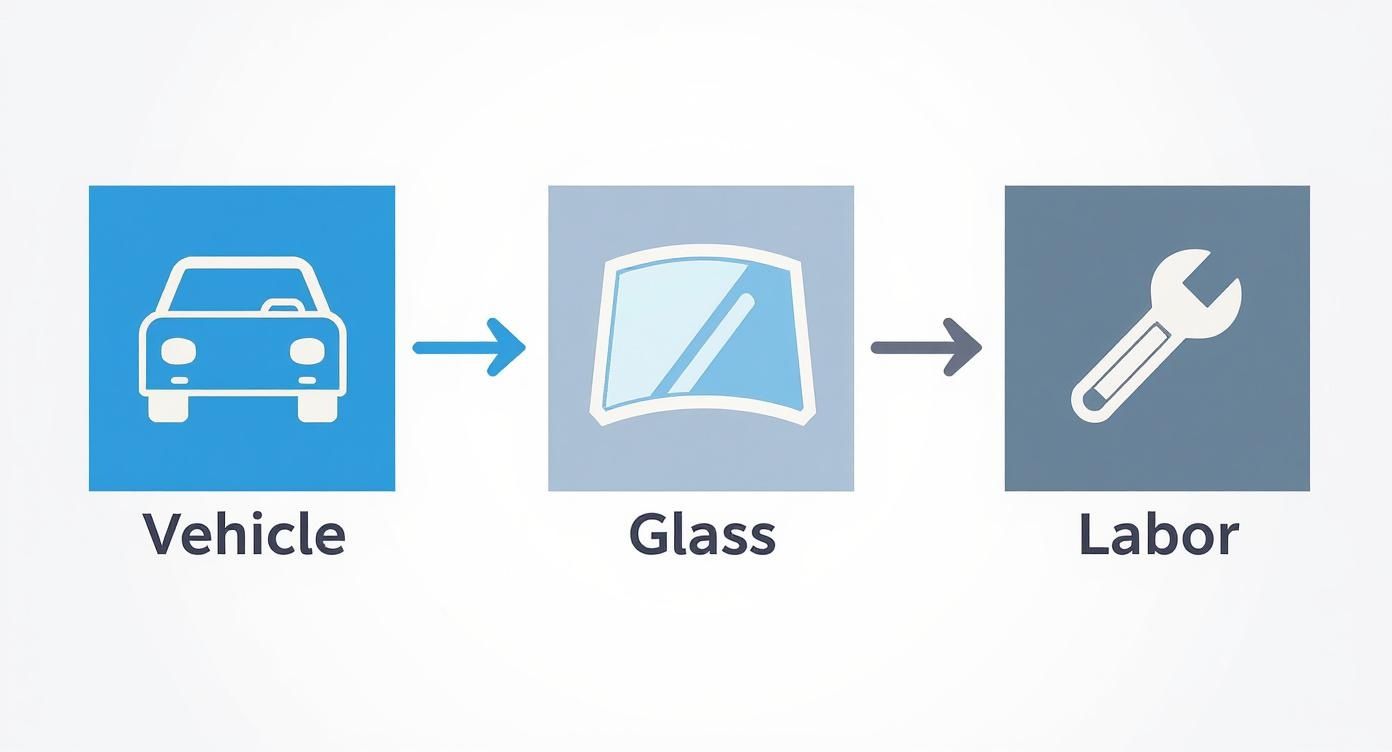
As you can see, ADAS calibration is a major component of the labor cost—it's just as critical to getting the job done right as the glass itself.
The Two Types of ADAS Calibration
Recalibration isn't a one-size-fits-all job. Technicians use two main methods, and the right one for your car is dictated by the manufacturer's specific guidelines. Both require specialized tools and a controlled setting to guarantee perfect accuracy.
Static Calibration: This is done in the shop while the car is parked. Technicians set up specific targets and patterns at exact distances and heights in front of the vehicle. The car's computer then uses these targets to relearn the camera's precise position and angle, making sure its view of the road ahead is perfectly aligned.
Dynamic Calibration: This method is a bit different—it requires the technician to actually drive the car on clearly marked roads at certain speeds. As they drive, the ADAS camera scans the lane markings and other road features to recalibrate itself in real-world conditions. This road test can take anywhere from 15 minutes to over an hour.
Some vehicles even need both. A technician might have to perform a static calibration in the bay and immediately follow it up with a dynamic one on the road to get the system working correctly. It's this meticulous process that really adds to the overall cost to replace windshield for newer cars.
A study found that even a one-degree error in a forward-facing camera's alignment can cause the system to misinterpret data by a significant margin at distances over 100 feet, potentially rendering automatic emergency braking ineffective.
Why Does Calibration Cost So Much?
That $250 to $400 (or more) that calibration adds to your invoice really comes down to three things: specialized equipment, extensive training, and time.
First, the gear needed for a static calibration is a serious investment for an auto glass shop. We're talking about the targets, laser-guided stands, and advanced diagnostic computers that plug directly into your car. The shop floor itself has to be perfectly level and have consistent lighting to avoid any chance of error.
Second, the technicians. They have to go through constant training to stay current with the ever-changing technology across dozens of car brands. Every manufacturer has its own unique procedure, and doing it right requires real expertise. You’re paying for a skilled technician's know-how, not just their time.
Finally, the process itself just takes time. A static calibration can easily add an hour or more to the job, while a dynamic one requires a dedicated road test. All that time is spent making sure your safety systems are back to factory standards, which makes it an indispensable part of any modern windshield replacement. If you want to dive deeper into the technical side, you can learn more about professional ADAS windshield calibration and see why it's so vital for your safety on the road.
Choosing Between OEM and Aftermarket Glass
When you get an estimate for your windshield replacement, one of the biggest decisions you'll face is the type of glass to use. The choice usually boils down to two options: OEM or aftermarket. This isn't just a simple good-vs-bad comparison; it's the classic trade-off between guaranteed quality and saving a bit of money.
Think of it like buying a new screen for your phone. You can get one directly from the manufacturer, knowing it’s a perfect match, or you can grab a third-party screen that gets the job done but might have tiny differences in color or touch sensitivity. Both fix the cracked screen, but they come with different price tags and levels of assurance.
Your choice here will have a direct impact on your final bill and, more importantly, your vehicle's performance—especially if it’s loaded with modern safety features.
Understanding OEM Glass
Original Equipment Manufacturer (OEM) glass is exactly what it sounds like. It's made by the same company that produced the original windshield for your car when it first rolled off the assembly line. This means it’s identical in every way to the one you're replacing, from its thickness and curvature to its tint and durability.
Because it's built to the carmaker's precise standards, OEM glass has some major upsides:
A Perfect Fit: There’s no "close enough" here. It slots into your vehicle's frame perfectly, guaranteeing a proper seal that prevents annoying wind noise and water leaks.
Guaranteed Quality: You’re getting the exact same quality and materials that passed your car’s original, rigorous safety and performance tests.
Flawless Sensor Compatibility: This is the big one for cars with ADAS. The brackets and mounting points for cameras and sensors are in the exact same spot, which is critical for an accurate recalibration.
The only real downside is the cost. OEM glass is almost always the more expensive option because you're paying a premium for the brand name and that factory-perfect guarantee.
Exploring Aftermarket Glass
Aftermarket glass, sometimes called Original Equipment Equivalent (OEE), is made by companies that didn't produce the original windshield. These manufacturers reverse-engineer the original part to create a version that fits and functions in a similar way.
This is where you can find some serious savings. Aftermarket glass is often significantly cheaper than its OEM counterpart, making it a very popular choice for drivers watching their budget. But that lower cost can come with a few potential trade-offs.
While all aftermarket glass sold in the U.S. must meet federal safety standards, there can be minor variations in thickness, curvature, and clarity compared to the original. A good technician can steer you toward a high-quality aftermarket brand that keeps these differences to a minimum.
The main things to keep in mind with aftermarket glass are:
Potential for Fit Issues: While most are excellent, some aftermarket windshields might have slight imperfections in their shape. This could lead to a tougher installation or even minor wind noise down the road.
Optical Clarity: Some lower-quality aftermarket brands might have small distortions or waves in the glass, which could be noticeable in your line of sight.
ADAS Complications: If the camera brackets are off by even a millimeter, it can make a successful ADAS recalibration difficult, if not impossible.
How to Make the Right Choice
So, which one is for you? It really depends on your car, your budget, and what you value most. A side-by-side look can make the decision a lot clearer.
Comparison of OEM vs. Aftermarket Windshield Glass
Here’s a side-by-side look at the key differences to help you decide which glass is right for your vehicle and budget.
Feature | OEM Glass | Aftermarket Glass |
|---|---|---|
Cost | Higher initial price | More budget-friendly |
Fit & Seal | Guaranteed perfect fit | Generally good, but slight variations can occur |
Quality & Clarity | Identical to factory original | Can vary by brand; some are nearly identical, others less so |
ADAS Compatibility | Perfect match for sensors and cameras | High-quality brands are good, but there's a higher risk of issues |
Logo | Includes the vehicle manufacturer's logo | Does not include the manufacturer's logo |
Ultimately, the choice is yours, but here’s a good rule of thumb:
For a newer vehicle with complex ADAS features, most experts and manufacturers strongly recommend sticking with OEM glass. The guaranteed fit ensures those sensitive safety systems can be recalibrated correctly. For an older car without that tech, a high-quality aftermarket windshield can be a perfectly safe and smart way to save money.
To get a better sense of what your specific vehicle needs, exploring professional auto glass replacement services can give you expert guidance on all your options.
Using Insurance to Cover Your Replacement
When that rock flies up and leaves a spiderweb crack across your windshield, your first thought is probably, "Is my insurance going to pay for this?" The short answer is: most likely, yes. But getting your insurer to cover the bill instead of paying entirely out of pocket means knowing a little bit about how your policy works.
It all comes down to a specific part of your policy called comprehensive insurance. This isn't the basic liability coverage everyone is required to carry. Instead, it's an optional add-on that covers damage to your car from things other than a collision—think hail, a falling tree branch, or, you guessed it, a rock kicked up from the road.
If you've got comprehensive coverage on your policy, you're in a good position. This is a huge deal in an industry where consumers and fleets spend a massive amount of money. The global windshield repair and replacement market was recently valued at around $15 billion, with full replacements accounting for a whopping 40% of that. You can discover more insights about the auto glass market on marketreportanalytics.com to see just how big this part of the auto industry is.
Your Deductible: The Deciding Factor
Even with the right coverage, you might still have to pay something yourself. This is where your deductible enters the picture. Think of a deductible as the portion of the bill you agree to pay before your insurance company steps in to cover the rest.
Let's break it down with an example. Say your total replacement bill comes to $800, and you have a $500 comprehensive deductible. You would pay the first $500, and your insurance company would handle the remaining $300. Simple enough.
But what if the total replacement only costs $450? Since that's less than your $500 deductible, you haven't met the threshold for your insurance to kick in. In that case, filing a claim doesn't make much sense because you'd be paying the entire amount yourself anyway.
State Rules and Full Glass Coverage
Here’s a little-known tip that can save you a lot of money: some states have special laws that might make your windshield replacement completely free. States like Florida, Kentucky, and South Carolina mandate what’s known as “full glass coverage” or have “zero deductible” rules for windshields.
In these states, if you carry comprehensive insurance, the law requires your insurer to waive your deductible for any windshield repair or replacement. That means you could get a brand-new windshield without paying a dime.
This is a massive perk for drivers in those states, so it's always smart to check the specific auto glass laws where you live.
How to Navigate Your Insurance Claim
Filing a claim might sound like a headache, but it doesn't have to be. A little preparation and a few key questions can make the whole process go smoothly.
Contact Your Insurer First: Before you book any appointments, give your insurance agent or claims department a call. They'll confirm your coverage, tell you what your deductible is, and explain their preferred steps.
Ask About Preferred Shops: Most insurance companies have a network of approved auto glass shops they work with regularly. You usually have the right to go anywhere you want, but using a shop from their network can often make the approval and payment process much faster.
Inquire About OEM Glass: If you have a newer car or one with advanced safety systems, ask your insurer about their policy on covering OEM (Original Equipment Manufacturer) glass. Many policies default to less expensive aftermarket parts, but you can often get OEM approved if it’s needed for your safety systems to work correctly.
Confirm ADAS Calibration Coverage: This one is critical. Be upfront and tell them your vehicle requires ADAS recalibration after the windshield is replaced. You need to make sure the cost for this service is included in the approved claim, otherwise, you could be stuck with an unexpected bill for hundreds of dollars.
Finally, it never hurts to ask if a glass claim will impact your future rates. For the most part, a single comprehensive claim for a windshield won't cause your premiums to go up, but it's always best to get that confirmation directly from your insurance provider.
Should You Repair or Replace Your Windshield?
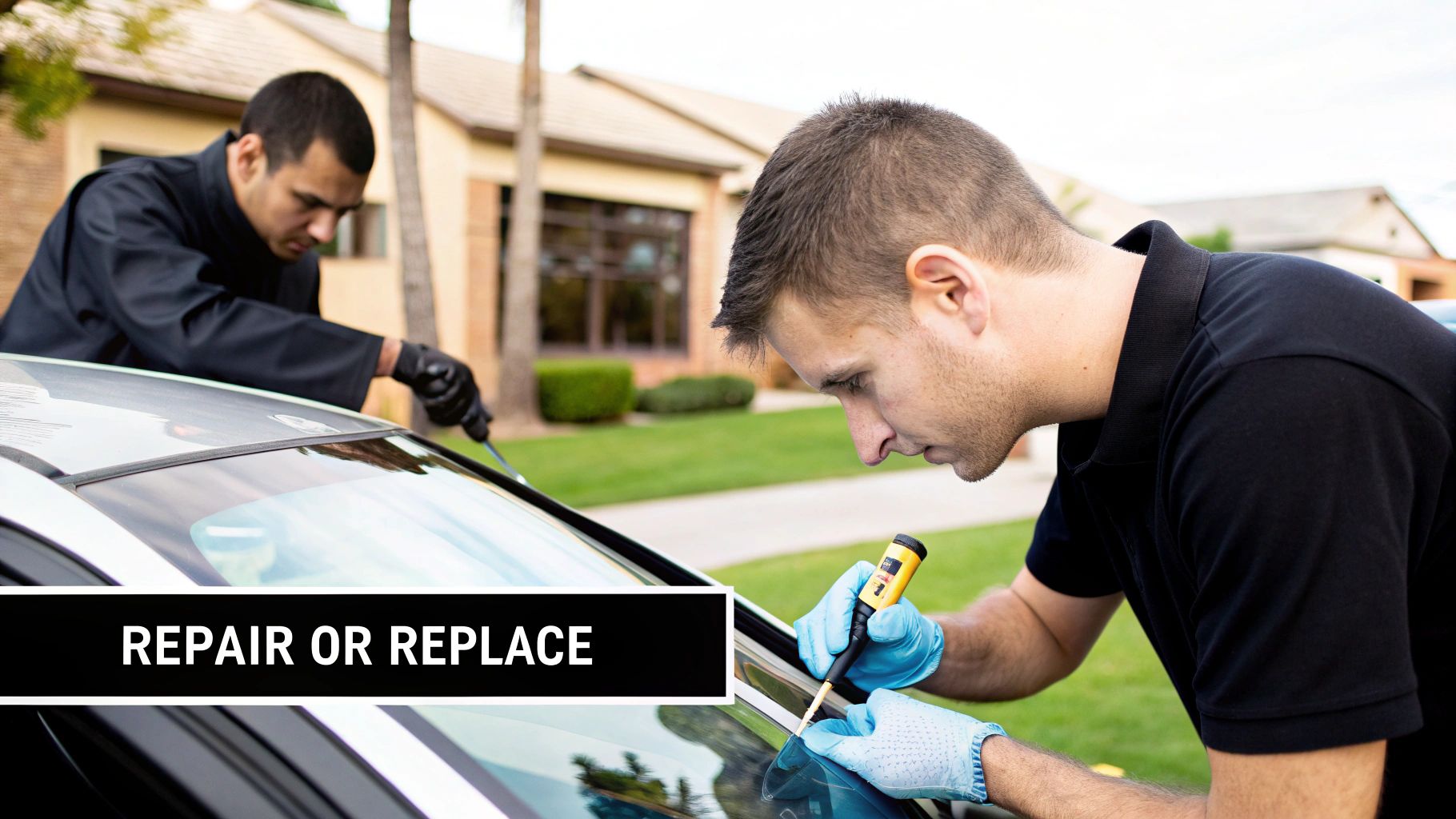
Before you jump to booking a full replacement, take a moment and ask the most important question: can this thing just be repaired? Knowing the answer can be the difference between a quick, inexpensive fix and a bill that runs into the hundreds. It all boils down to three things: the size, type, and location of the damage.
Figuring this out is more important than ever. The global automotive glass replacement market is already huge—valued at around $28.87 billion—and it's still growing. Making the smart call saves you money, but it also does something more important: it preserves your windshield's original factory seal. That seal is crucial for your car's structural integrity, so keeping it intact is always the best-case scenario.
Assessing the Damage Size
When it comes to size, professionals have a simple trick up their sleeve that you can use, too. It’s often called the "dollar bill rule," and it's a surprisingly effective way to see if a repair is even on the table.
The Dollar Bill Rule: If you can completely cover the chip or crack with a dollar bill, there’s a very good chance it can be repaired. If the damage peeks out from behind the bill, it’s likely too large and has compromised the glass, making a full replacement the only safe bet.
This rule of thumb works well for the two most common types of damage:
Chips: Those small, circular dings are prime candidates for repair, provided they're smaller than an inch across.
Cracks: A single, clean crack can often be filled and sealed if it’s shorter than six inches.
Damage Type and Location Matter
Size isn't the whole story, though. A tiny chip might seem like a simple fix, but where it’s located can immediately take repair off the menu.
The type of break is just as critical. A clean "bullseye" chip is far simpler to repair than a "star break," which has little legs spidering out from the center. Those complex breaks are unpredictable and can keep spreading even after a resin injection.
Here are the other deal-breakers to look for:
Driver's Line of Sight: Any damage, no matter how small, that sits directly in the driver’s view means an automatic replacement. The repair process can leave behind a slight distortion, which is a dangerous distraction.
Edge Cracks: If a crack starts right at the edge of the windshield or has spread to it, the entire pane of glass is compromised. These can't be repaired and require immediate replacement.
Multiple Cracks: Got three or more separate chips or cracks? The overall stability of the glass is in question. At that point, a replacement is the only safe and reliable solution.
By taking a close look at these factors, you can get a pretty clear idea of what to expect. If you want to get into the nitty-gritty, you can check out our specific windshield repair criteria to see if your damage qualifies for a fix.
Answering Your Lingering Questions
Even with a full cost breakdown, you've probably still got a few questions buzzing around. Let's be honest, replacing a windshield isn't something you do every week, so it's totally normal to wonder about the little things.
Think of this as the final, practical part of the guide. We'll cover the details you need to know for the day of the replacement, helping you plan your time and get your car back on the road safely.
How Long Will This Actually Take?
A lot of people think a windshield replacement will eat up their entire day, but the actual hands-on work is faster than you'd expect. A seasoned technician can usually get the old, damaged glass out and the new one fitted in about 60 to 90 minutes.
But—and this is a big but—that’s not the whole story. The real waiting game is the curing time for the urethane adhesive. This super-strong glue needs at least an hour to set up and create a solid bond. If you rush this part, you risk a leaky seal or, in a worst-case scenario, the windshield failing to hold up in an accident.
If your car needs ADAS recalibration, tack on another 30 to 60 minutes. So, all told, a realistic time to block out for the entire process is anywhere from 2.5 to 3.5 hours.
Can I Just Drive Off Right After?
Absolutely not, and this is one rule you don't want to bend. You have to give that urethane adhesive time to cure. Most reputable shops will tell you to wait a bare minimum of one hour after the new glass is installed.
Hitting the road too early means wind pressure and vibrations are pushing against a seal that hasn't fully bonded to your car's frame. This can lead to annoying leaks or, far more seriously, it could mean the windshield won't stay in place during a collision, gutting your car's structural safety. Always listen to the technician's instructions on the safe drive-away time.
Waiting for the adhesive to cure isn't just a suggestion—it's essential for your safety. The windshield provides up to 30% of a vehicle's structural strength in a rollover, and a proper bond is what makes that possible.
Will the Replacement Mess Up My Car's Paint?
When you have a true professional on the job, your paint is perfectly safe. Technicians use specialized tools that are specifically designed to slice through the old adhesive without ever touching the painted metal frame underneath.
They also take extra steps to protect the hood and fenders around the work area. A good shop knows that part of doing the job right is leaving your car looking just as good as it did when you dropped it off. If you're worried, just ask them about their process for preventing paint damage—they should be happy to explain it.
At Auto Renu Auto Glass LLC, we bring the expertise directly to you. Our mobile service ensures your windshield replacement is handled safely and efficiently, including full ADAS recalibration, so you can get back on the road with confidence. For a transparent quote and convenient scheduling, visit us at https://www.autorenu911.com.