How Much Is a New Windshield? A Complete Cost Guide
Wondering how much is a new windshield? Our complete guide breaks down replacement costs, factors like ADAS calibration, and how insurance can help you save.
Dec 8, 2025
generated
how much is a new windshield, windshield replacement cost, auto glass repair, adas calibration, car maintenance costs
So, you've got a cracked windshield. The first question on your mind is probably, "How much is this going to cost me?"
For a standard vehicle, you're typically looking at a bill between $200 and $700. But if your car is packed with modern safety features, that number can easily climb past $1,500 once you factor in the necessary recalibration.
Your Windshield Replacement Cost at a Glance
That initial price range gives you a ballpark idea, but the final invoice for a new windshield is rarely a simple, flat fee. It's less like buying a part off the shelf and more like a custom service. Several different factors all play a role in the total cost.
The days of a windshield being just a simple piece of glass are long gone. Modern windshields are often a critical part of the complex technology that runs your car's safety systems. This means a quick swap-out usually isn't the whole story. Before you jump to a full replacement, it's a good idea to look into alternatives that could save you a headache and some cash, like exploring the pros and cons of windshield protection film vs. replacement.
Understanding the Cost Spectrum
Let's get down to brass tacks. In the United States, what you'll pay really depends on your vehicle and how bad the damage is. If you catch a small chip early, a simple repair might only cost $40 to $180—a much more palatable option.
However, when a full replacement is the only way to go, the costs can shoot up, especially for luxury cars or those with Advanced Driver Assistance Systems (ADAS).
To give you a clearer picture, here’s a quick summary of what you can generally expect to pay for different windshield services.
Estimated Windshield Service Costs at a Glance
This table breaks down the typical cost ranges for various windshield services. Think of it as a quick reference to help you gauge the potential expense before you even get a quote.
Service Type | Vehicle Type | Estimated Cost Range |
|---|---|---|
Chip or Crack Repair | All Vehicles | $40 – $180 |
Standard Replacement | Sedans & Compact Cars | $200 – $700 |
ADAS Windshield Replacement | Vehicles with Safety Tech | $700 – $1,500+ |
Luxury Vehicle Replacement | High-End Models | $1,000 – $2,000+ |
These numbers are a great starting point, but remember, they're just a baseline. In the next sections, we'll dig into the specific details—from the type of glass to labor costs—that will ultimately determine your final bill.
The 7 Factors Driving Your Windshield Replacement Cost
So, you've seen the ballpark figures, but what makes one windshield replacement cost $250 and another soar past $1,500? It's never just one thing. Think of it like buying a plane ticket—the destination is the same, but the final price depends on the airline, seat choice, time of year, and baggage fees.
Two cars that look nearly identical on the outside can have wildly different windshield replacement quotes. Let's break down the seven key variables that determine exactly what you'll pay.
1. Your Car's Make And Model
This is the big one. The single most significant factor in your final bill is the car you drive.
Windshields for popular, high-volume vehicles like a Toyota Camry or Ford F-150 are mass-produced. That high supply keeps the cost down. On the other hand, if you drive a luxury vehicle like a BMW, a specialty sports car, or even just a less common model, the glass is made in smaller batches, making it inherently more expensive.
2. The Type Of Glass You Choose
Not all glass is created equal. You’ll generally have two options, and your choice here directly impacts the price tag.
OEM (Original Equipment Manufacturer) Glass: This is the real deal—the exact same glass that was installed at the factory, made by the same company. It's a guaranteed perfect match for fit, tint, and quality, but you'll pay a premium for it.
Aftermarket Glass (OEE): This glass is made by a different company to the same federal safety specifications. While the quality used to be a mixed bag years ago, today's reputable installers use high-quality aftermarket glass that offers a fantastic, budget-friendly alternative without sacrificing safety.
3. All The Bells And Whistles (Special Features)
These days, a windshield is far more than a simple pane of glass; it’s a high-tech command center. Every piece of integrated technology adds complexity and cost.
A basic windshield is just a window. A modern one is more like a smart display for your car. It does a lot more than just keep the wind out, and replacing it is a far more delicate operation.
Here are a few common features that bump up the price:
Heads-Up Display (HUD): This requires specially treated glass so the projection from your dashboard shows up crisp and clear.
Rain Sensors: The little gel packs that automatically turn on your wipers? They're mounted right on the glass.
Heated Windshield: Microscopic heating elements are embedded within the glass to melt ice and snow in a flash.
Acoustic Glass: A special vinyl layer is sandwiched between the glass panes to dampen wind and road noise, giving you a quieter ride.
This chart quickly shows how these different needs—especially the high-tech ones—stack up in terms of cost.
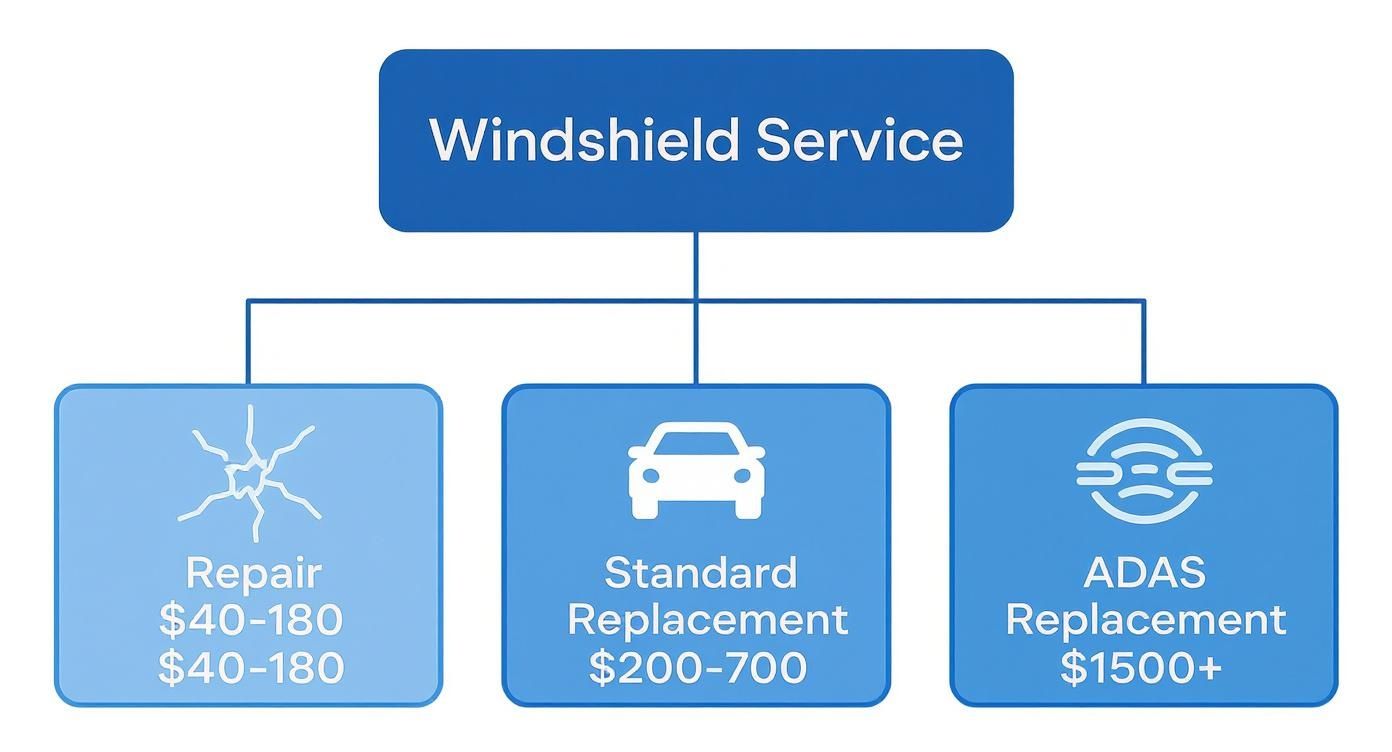
As you can see, a straightforward repair is always the cheapest route, while a replacement that involves modern ADAS safety systems will be on the higher end of the scale.
4. ADAS Recalibration (The Modern Game-Changer)
If your car was made in the last few years, this is arguably the most critical—and costly—part of the job. Advanced Driver-Assistance Systems (ADAS) include features like Lane-Keep Assist, Adaptive Cruise Control, and Automatic Emergency Braking.
The cameras for these systems are mounted on your windshield. When we replace the glass, those cameras must be professionally recalibrated. It’s a meticulous, technical process that ensures your safety features work exactly as they were designed to. This step is non-negotiable for your safety and adds a significant cost to the service.
5. Labor Costs
A windshield replacement isn't just about the glass; it's about the skilled technician putting it in. Labor rates are a key part of your quote and can fluctuate based on your location and the job's complexity. A newer vehicle with lots of delicate trim and sensors simply takes more time and care to work on than an older, more basic car.
6. Mobile Service vs. In-Shop
We get it—life is busy. That's why mobile service, where a technician comes to you, is so popular. While it’s incredibly convenient, some shops may add a small fee to cover the technician's travel time and fuel. If you're looking to shave a few dollars off the final price, bringing your car into the shop might be a slightly more affordable option.
7. How Bad Is The Damage?
Finally, the nature of the damage itself is a major factor. Is it a tiny rock chip or a crack that runs from one side to the other?
A small chip can often be fixed with a simple resin injection, which is far cheaper than a full replacement. If you have a minor chip, you should always see if a repair is possible first. Check out our guide on windshield repair to see how it works. Catching small damage early can save you from a much bigger bill down the road.
Why ADAS Recalibration Is a Non-Negotiable Safety Step
If you drive a car made in the last decade, your windshield isn't just a piece of glass. It’s the eyes for your car's brain, and that's why replacing it has gotten a lot more complicated—and often, more expensive. This is all because of something called ADAS, or Advanced Driver-Assistance Systems.
Most of us don't even notice the small camera tucked away behind the rearview mirror. But that little lens is a powerhouse, running critical safety features like your Lane Keep Assist, Automatic Emergency Braking, and Adaptive Cruise Control. When we replace your windshield, that camera has to be detached and then mounted onto the new glass.
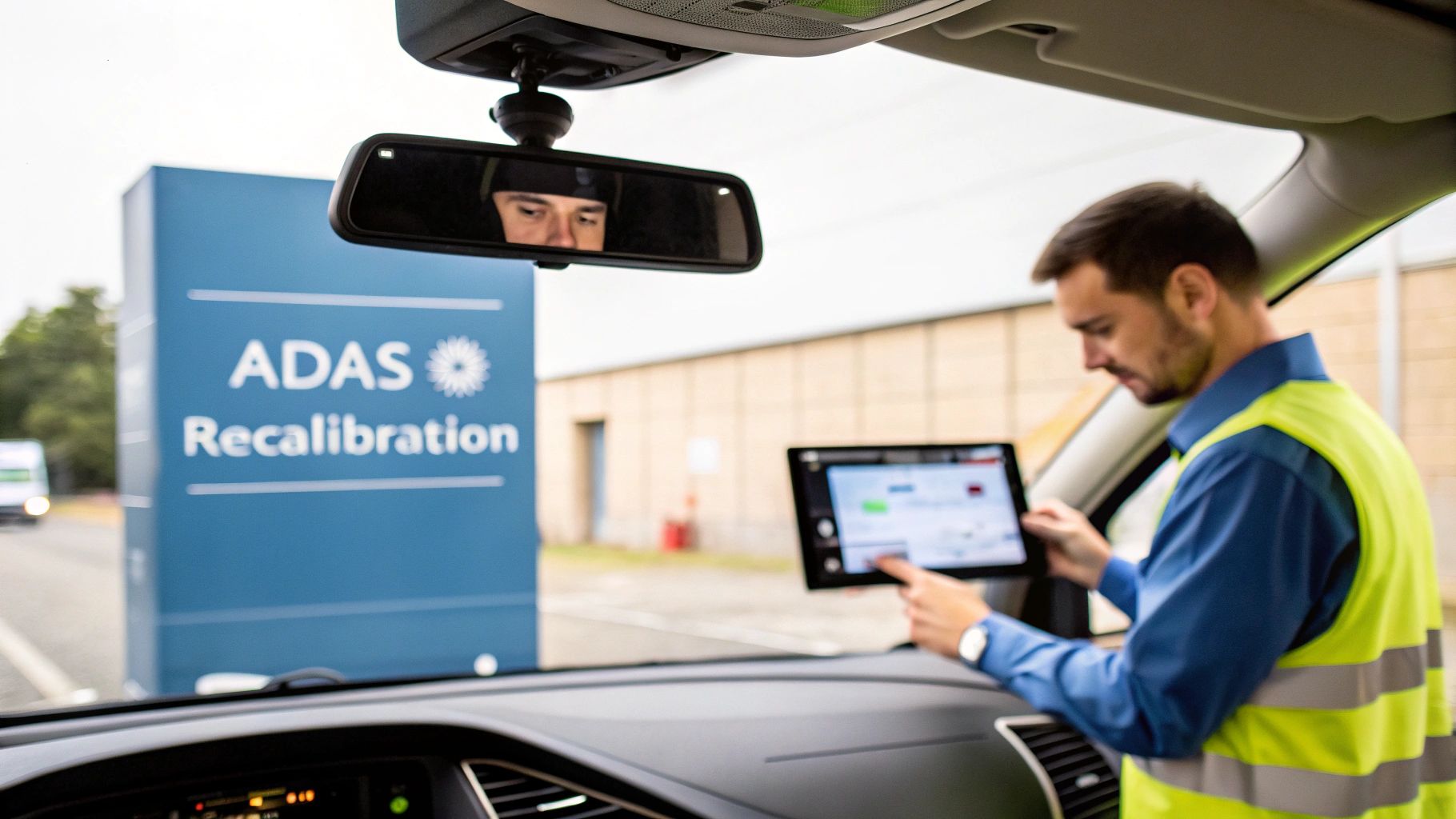
Think of It Like a Rifle Scope
Here’s a good way to picture it. Imagine you’re putting a new scope on a high-powered rifle. You wouldn't just bolt it on and hope for the best, would you? Of course not. You’d take it to the range to "sight it in," making tiny adjustments until your aim is dead-on.
It’s the exact same principle with an ADAS camera. The slightest shift—even just a single millimeter—in its new position can throw off its calculations dramatically down the road. That tiny difference at the windshield could mean the system misjudges the distance to another car by several feet, which is more than enough to cause an accident. An uncalibrated system is a major safety risk.
Why You Simply Can't Skip Recalibration
Let me be clear: skipping this step is not an option. It's a mandatory safety procedure, and most automakers require it after every single windshield replacement. If you don't do it, you're looking at system malfunctions, warning lights popping up on your dash, and a dangerously false sense of security.
Recalibration isn't an "upsell" from your auto glass shop. It's the final, essential step in ensuring your vehicle’s safety systems perform exactly as the manufacturer intended, protecting you and your passengers.
This leap in technology is a huge reason why auto glass costs have been climbing. The global automotive windshield market was valued at around $20.4 billion in 2025, and it's expected to more than double by 2034. That growth is driven almost entirely by complex tech like ADAS. If you want to dive deeper, you can learn more about these automotive glass market trends in this industry report.
Static vs. Dynamic Recalibration
To get these systems perfectly aligned, technicians use two main methods. Understanding the basics of ADAS windshield calibration helps you see just how precise the work is.
Static Recalibration: This is done in the shop under controlled conditions. We place a specific target board in front of the vehicle at an exact distance and height, then use lasers and specialized software to reset the camera to its original factory settings.
Dynamic Recalibration: This one requires actually driving the car. A technician takes the vehicle on a road with clear lane markings, driving at a set speed while the onboard system recalibrates itself by reading the road.
Some cars even need a combination of both to get everything dialed in perfectly. It’s a detailed process, but it’s the only way to ensure your safety features are back online and ready to protect you.
Working with Insurance for Your Windshield Replacement
https://www.youtube.com/embed/wrXjtKIKGGE
That spiderweb crack spreading across your windshield is bad enough. The last thing you need is a headache trying to figure out if your insurance will foot the bill. The good news? It often does, but the devil is always in the details of your specific policy.
First things first, your basic liability or collision coverage won't touch this. Windshield damage is almost always handled under your comprehensive coverage—the part of your policy that covers you for things other than a car accident. Think falling tree branches, vandalism, or that stray rock that came out of nowhere on the freeway.
Your Coverage and Deductible: The Two Key Pieces
If you have comprehensive coverage, the next thing to look at is your deductible. This is simply the amount you have to pay yourself before the insurance company steps in. Let's say your new windshield costs $800 and your deductible is $500. You'd pay the $500, and your insurance would cover the remaining $300.
Now, some states make things even easier for drivers. Places like Florida, Kentucky, and South Carolina require insurance companies to offer "full glass coverage" or zero-deductible options for windshields. If you live in one of these states and have comprehensive, you might not pay a single penny out-of-pocket. Getting a clear understanding of your auto insurance policy is the best way to know for sure.
Pro Tip: Many insurance companies will waive your deductible completely for a small chip repair. They’d much rather pay for a quick, cheap fix now than risk you needing a full, expensive replacement later when that tiny chip turns into a giant crack.
The Big Question: Will a Glass Claim Make My Rates Go Up?
Everyone worries about this, and it's a fair question. Generally speaking, filing one comprehensive claim for a windshield won't jack up your rates. Insurers see it as a "no-fault" claim since a flying rock is completely out of your control.
However, a history of frequent claims can get their attention. Filing multiple auto glass claims in a short period, say within three years, could signal to them that you're a higher risk. In those cases, some drivers might see their premiums rise.
The best move is always to check your policy or make a quick call to your agent. They can tell you exactly what your deductible is and if there are any rate implications. Here at Auto Renu Auto Glass LLC, we take that burden off your shoulders. We work directly with your insurance provider, manage all the paperwork, and make the entire process completely seamless for you.
What to Expect During the Replacement Process
So, you’ve scheduled your windshield replacement. What actually happens when the technician shows up? Knowing the game plan can take a lot of the mystery out of the process, making you feel much more comfortable and confident in the work being done. It's a surprisingly systematic job that our pros have down to a science.
For most cars, the entire replacement is done and dusted in about 60 to 90 minutes. Now, if your vehicle is loaded with advanced sensors or has tricky trim pieces, it might take a little longer, but that's not typical. Whether we come to you or you're at our shop, our goal is to get it done efficiently without disrupting your day.
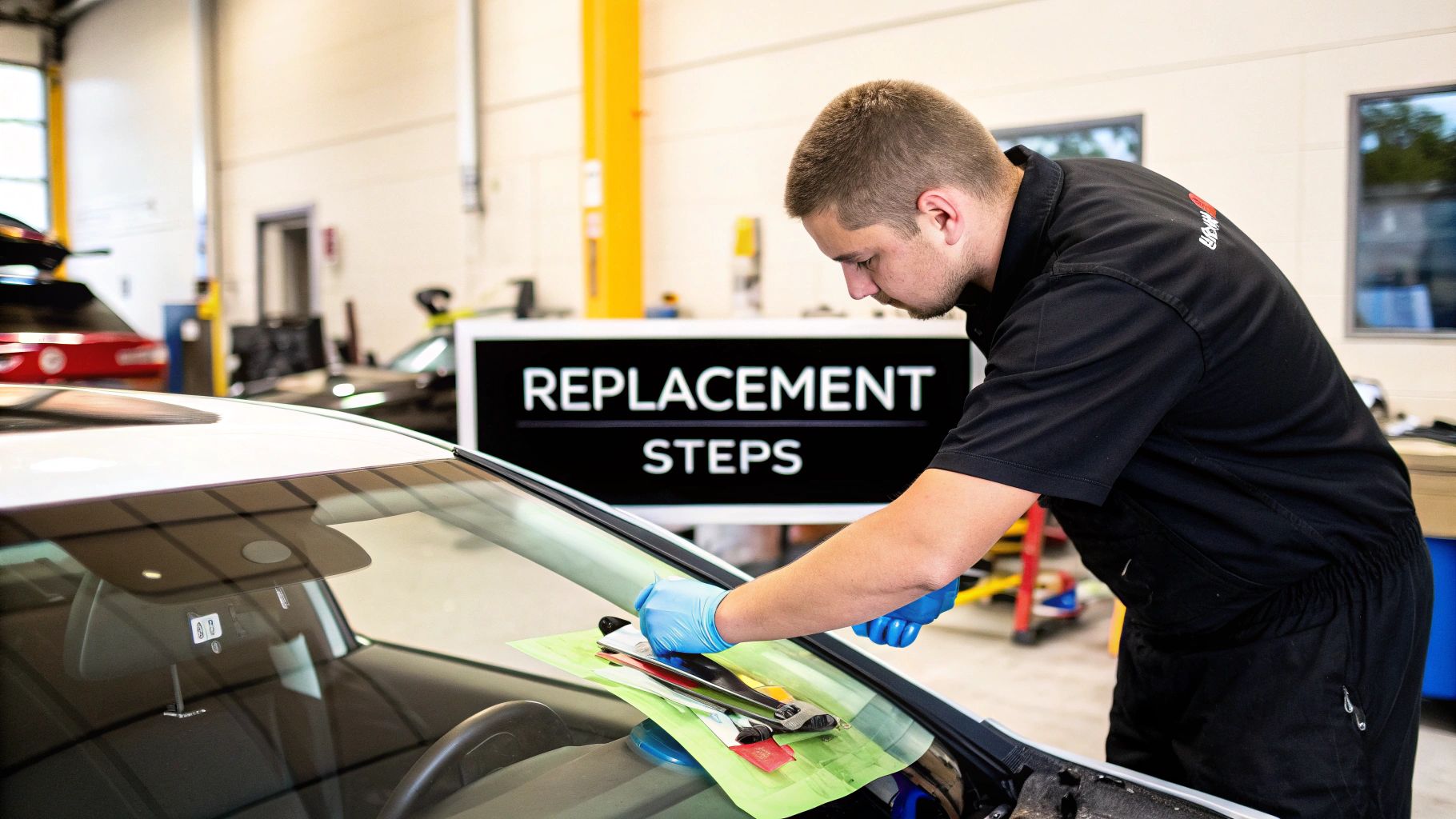
Step by Step Windshield Installation
A professional replacement isn’t just about swapping glass; it’s a detailed procedure to ensure a perfect, factory-quality seal. While you sit back and relax, here’s what our technician will be doing:
Vehicle Protection: The very first thing we do is prep your car. We carefully cover your dashboard and front seats to keep your interior spotless and protected from any debris or adhesive.
Old Windshield Removal: Using specialized tools, we’ll cut through the old urethane seal holding the damaged glass in place. We then safely lift the old windshield right out of the vehicle’s frame.
Frame Preparation: This is arguably the most important step. The technician meticulously cleans the frame, scraping away every last bit of the old adhesive. This creates a pristine surface, which is absolutely essential for a strong, lasting bond.
Adhesive Application: We apply a bead of high-strength, industrial-grade urethane adhesive evenly around the frame. This isn't just glue; it's a structural component that holds the glass tight and reinforces your car's body.
New Glass Installation: With the adhesive ready, the new windshield is carefully guided into place. We ensure perfect alignment and a tight seal all the way around.
Understanding Safe Drive-Away Time
Once the new glass is in, there’s one final, crucial waiting period. That powerful adhesive needs time to cure and fully bond the windshield to your car. We call this the safe drive-away time.
This isn't just a friendly suggestion—it’s a non-negotiable safety requirement. Your windshield provides critical structural support. It's vital for proper airbag deployment and helps prevent the roof from caving in during a rollover.
Your technician will tell you exactly how long you need to wait, which can be anywhere from 30 minutes to a few hours. It all depends on the specific adhesive we used and the day's weather. It’s also a good idea to skip the high-pressure car wash for a day or two. A little patience right after installation ensures your new windshield will keep you safe for years to come.
Your Go-To Partner: Auto Renu Auto Glass LLC
Figuring out what a new windshield costs is one thing, but finding the right people to install it is what truly matters for your safety. After wading through all the details—from different glass types to ADAS recalibration and insurance paperwork—the final step is picking a team you can actually trust. That's where we come in.
At Auto Renu Auto Glass LLC, we're your local Bay Area pros, and our entire goal is to make this process smooth and stress-free. We’ve built our service around what works best for you.
Why Bay Area Drivers Choose Us
Free, No-Surprise Estimates: We believe in being upfront from the get-go. You’ll receive a clear, detailed quote before we ever touch your car. You’ll know the exact cost, with no hidden fees or last-minute surprises. Just honest, straightforward pricing.
We Come to You: Your schedule is already packed. That’s why our mobile service brings our expertise directly to you, whether you’re at home, at the office, or anywhere else. We perform the full replacement on-site, saving you a trip to the shop.
Insurance Headaches? We've Got You: Let’s be honest, dealing with insurance can be a real pain. Our team has done this a thousand times. We’ll work directly with your insurance company, handling the claim and the paperwork so you don’t have to.
Your safety on the road is our number one job. We don't just see ourselves as a glass company; we're your partners in making sure your vehicle is as safe as the day it rolled off the lot.
Ready for a windshield replacement without the hassle? You can learn more about our professional windshield replacement process or reach out today for your free, no-obligation quote.
Still Have Questions About Windshield Replacement Costs?
Even with a full breakdown, a few questions always pop up. It’s completely normal. Let's walk through some of the most common things drivers ask us to make sure you feel confident about the process.
Is It Really Cheaper to Repair a Chip Than Replace the Whole Thing?
Without a doubt. Fixing a small chip is almost always the smarter financial move. A quick repair usually costs between $40 and $100, which is a fraction of the several hundred dollars you’d spend on a brand-new windshield.
Here’s a little insider tip: most insurance companies would rather pay for a repair than a replacement. They’ll often waive your deductible entirely to get it done. Why? Because they know that a tiny chip can quickly spiderweb into a massive crack, forcing them to cover a much bigger bill later. If the damage is smaller than a quarter and not right in your line of vision, a repair is the way to go.
Key Takeaway: Don't ignore small chips! Getting them fixed right away is the single best way to avoid a full—and much more expensive—windshield replacement down the road.
What's the Real Difference Between OEM and Aftermarket Glass?
When it comes to the glass itself, you've got two main choices, and knowing the difference helps you understand exactly what you're paying for.
OEM (Original Equipment Manufacturer): This is the same glass your car had when it rolled off the assembly line. It’s made by the same manufacturer, so you know the fit, tint, thickness, and overall quality are a perfect match.
Aftermarket Glass (OEE): This glass is made by a different company. While it has to meet federal safety standards, the quality can be a bit of a mixed bag. It's a solid budget-friendly option, but it might not be identical to the original.
For any car with modern safety features (ADAS), we always recommend sticking with OEM glass. The cameras and sensors that control things like automatic braking and lane-keep assist are incredibly sensitive. Even a slight difference in the glass curvature or clarity can throw them off, which is a risk you don't want to take.
How Long Am I Stuck Without My Car?
The actual hands-on work of swapping out the glass is faster than most people think—usually just 60 to 90 minutes. But that’s not the whole story. The most critical part of the job is letting the adhesive cure.
We use a powerful industrial urethane to bond the new windshield to your car's frame. This isn't just glue; it's a structural component that keeps you safe in an accident and ensures your airbags deploy correctly. That urethane needs time to set, a period we call the "safe drive-away time." This can take anywhere from 30 minutes to a few hours, depending on the adhesive we use and the weather that day.
If your car needs ADAS recalibration, tack on another 30 to 60 minutes. Your technician will give you a firm timeline so you know exactly when your car is safe and ready to hit the road again.
Ready for a clear, no-hassle quote on your new windshield? The team at Auto Renu Auto Glass LLC is here to help with expert mobile service and insurance assistance. Get your free estimate today.