
Your Guide to Automotive Window Glass Replacement
Get clear answers on automotive window glass replacement. Learn about ADAS, insurance, costs, and the benefits of fast, professional mobile service.
Dec 31, 2025
generated
automotive window glass replacement, mobile auto glass, windshield replacement, adas recalibration, auto glass insurance
When a rock chip spiders across your view or a break-in shatters your side window, you need clear, immediate answers. It’s not just a cosmetic fix. Automotive window glass replacement is a crucial safety procedure that restores your vehicle’s structural integrity and ensures you can see the road clearly. This guide walks you through everything you need to know, so you can make confident decisions for your car.
Understanding Your Vehicle's Glass Ecosystem
Your car’s windows aren't just simple panes of glass. They're an engineered system designed for safety and performance, and each piece has a specific job. Think of it like a sports team—every player has a unique role, but they all work together to protect you.
The windshield, for instance, is made of laminated glass. It’s like a safety sandwich: two layers of glass are fused around a tough, clear plastic layer called polyvinyl butyral (PVB). If it breaks, this construction keeps the glass from shattering into dangerous shards, holding the broken pieces together to protect everyone inside.
To help you get a quick overview, here’s a table summarizing the main points of any auto glass replacement.
Automotive Window Glass Replacement at a Glance
Consideration | Key Details |
|---|---|
Damage Type | Windshields can often be repaired if the chip is small; side and rear windows always require replacement. |
Glass Material | Windshields are laminated for shatter resistance. Side/rear windows are tempered to crumble safely. |
Structural Role | The windshield provides significant cabin strength, especially in rollovers. |
Safety Systems (ADAS) | Replacement often requires recalibration of cameras and sensors linked to the glass. |
Service Options | Choose between a mobile service that comes to you or an in-shop appointment. |
Aftercare | Follow specific instructions, like waiting to wash the vehicle, to ensure the adhesive cures properly. |
Insurance & Cost | Your comprehensive coverage may cover the cost, but confirm details and your deductible with your provider. |
This table provides a high-level look, but understanding the materials and reasons for replacement is the first step toward a quality repair.
The Role of Laminated and Tempered Glass
In contrast to your windshield, the side and rear windows are usually made from tempered glass. This glass goes through a rapid heating and cooling process that makes it about four to five times stronger than regular glass.
When it does break, it’s designed to crumble into small, pebble-like chunks instead of sharp, dangerous shards. This is exactly why a side window shatters completely and can’t be repaired like a chipped windshield. To dive deeper into the specifics, check out this complete guide to car window parts and repairs.
Knowing which type of glass you’re dealing with makes it clear why damage is handled so differently from one window to the next.
Your vehicle's glass system is a crucial component of its structural safety. The windshield alone provides up to 60% of the cabin's structural strength in a rollover accident, making a proper automotive window glass replacement essential for your protection.
Common Reasons for Glass Replacement
Damage that calls for a full replacement can happen in an instant. Knowing what to look for helps you act quickly to get your vehicle back to being safe.
Impact Damage: Rocks, loose gravel, or hail can create chips that quickly spread into large cracks, especially when the temperature changes.
Stress Cracks: Extreme temperature shifts—like pouring hot water on an icy windshield—can cause the glass to expand and contract unevenly, leading to cracks without any impact at all.
Vandalism or Break-ins: A shattered side or rear window is an immediate security risk and a safety hazard that needs urgent attention.
Accidents: Even a minor fender bender can weaken or crack your auto glass, meaning you’ll need a full replacement to ensure the car is safe to drive again.
Should I Repair or Replace My Auto Glass?
So, you've got a chip in your windshield. Is it a quick, simple repair, or are you looking at a full-blown replacement? Knowing which way to go is about more than just looks—it's a critical safety decision. Guessing isn't an option when your car's structural integrity is hanging in the balance, so let's break down exactly what to look for.
Think of that small chip like a loose thread on a sweater. At first, it’s easy to ignore. But with every bump in the road, every shift in temperature, that tiny snag can start to run. Before you know it, a minor annoyance has turned into a major, vision-blocking crack.
How to Read Your Windshield Damage
For windshields, technicians have a few straightforward, industry-standard rules they follow. The most common one is often called the "dollar bill rule."
Chip Size: If you can cover the chip with a dollar bill (or it's smaller than a quarter), it's usually a solid candidate for a repair.
Crack Length: A single, clean crack under six inches can sometimes be filled. Anything longer than that, and you're almost certainly looking at a replacement.
Damage Location: Where the damage is matters just as much as its size. A chip right in the driver's line of sight is a no-go for repair because the process can leave a slight distortion, messing with your vision. Damage near the edge is also a red flag, as it's more likely to spread and weaken the windshield's bond to the car's frame.
A windshield does way more than block wind and rain. It’s a vital safety component, providing up to 60% of your vehicle's cabin strength in a rollover. When your windshield is compromised, so is your safety.
Side and Rear Windows are a Different Story
While a windshield can often be repaired, that's never the case for your side or rear windows. It all comes down to how they're made. These windows are built from tempered glass, which is designed to react very differently to impact.
Instead of chipping or cracking like the laminated glass in your windshield, tempered glass is engineered to shatter into thousands of small, relatively harmless pebble-like pieces. It’s a safety feature designed to prevent you from being injured by large, jagged shards in an accident. Because it’s literally designed to crumble, there's nothing to "repair." A full replacement is the only safe and effective solution.
Spotting the Sneaky Signs of Trouble
Sometimes, the need for a replacement isn't as obvious as a giant crack or a shattered window. Wear and tear can create subtle problems that are just as serious.
Common Issues Beyond Cracks:
Pitting: Over years of driving, your windshield gets blasted by sand, dirt, and road debris, creating thousands of tiny craters. This "pitting" scatters light, which can cause a hazy view or blinding glare from the sun or oncoming headlights.
Leaks and Wind Noise: Hear an unusual whistling sound on the highway? Find a puddle on your dashboard after it rains? These are classic signs that the seal around your window has failed. A bad seal doesn't just let the elements in; it weakens the glass's connection to the vehicle frame, compromising structural support.
Wiper Scratches: Old, worn-out wiper blades can leave deep scratches on the glass. If they're deep enough to catch your fingernail, they can’t be polished out and will create dangerous glare at night.
Catching these signs early is key. Whether it’s a crack that's starting to spread or a seal that's given up, knowing when to take action is the first and most important step toward keeping you safe on the road.
Why ADAS Recalibration Is Non-Negotiable
Getting a new windshield isn't the simple swap it used to be. Modern windshields are far more than just a piece of glass; they're the eyes for your vehicle's brain—its Advanced Driver-Assistance Systems (ADAS).
These high-tech safety systems, like automatic emergency braking and lane-keeping assist, depend on cameras and sensors mounted directly to the glass. When we perform an automotive window glass replacement, the position of those cameras can shift by just a few millimeters. That tiny difference can have massive consequences for your safety.
Think of it this way: replacing your windshield without recalibrating the ADAS is like getting a new pair of prescription glasses but putting the lenses in crookedly. The prescription might be perfect, but your vision will be off because they aren't aimed right. Your car’s "vision" works the same way.
The Dangers of Misaligned Safety Systems
A miscalibrated ADAS camera doesn't just switch off; it can start working incorrectly, which is far more dangerous. If a camera is off by just a single degree, it might misjudge the distance to the car ahead or completely miss the lane markings on the road.
This kind of misalignment can lead to some seriously scary situations:
Automatic Braking Failures: The system might brake too late to prevent a collision—or not at all.
Lane Departure Malfunctions: Your car could drift into another lane without warning you, or it might try to "correct" your steering based on faulty information.
Constant False Alarms: The system might trigger incorrect warnings, causing you to brake suddenly and creating a hazard for everyone around you.
Skipping this step turns your car's most advanced safety features into potential liabilities. Proper ADAS recalibration isn't just a suggestion; it's a critical safety requirement for any modern vehicle.
Recalibration ensures your car’s safety systems see the world exactly as the manufacturer intended. A misaligned camera can misinterpret road signs, fail to detect pedestrians, or misjudge braking distances, turning a helpful feature into a serious risk.
The decision to repair or replace is usually straightforward, as this chart shows.
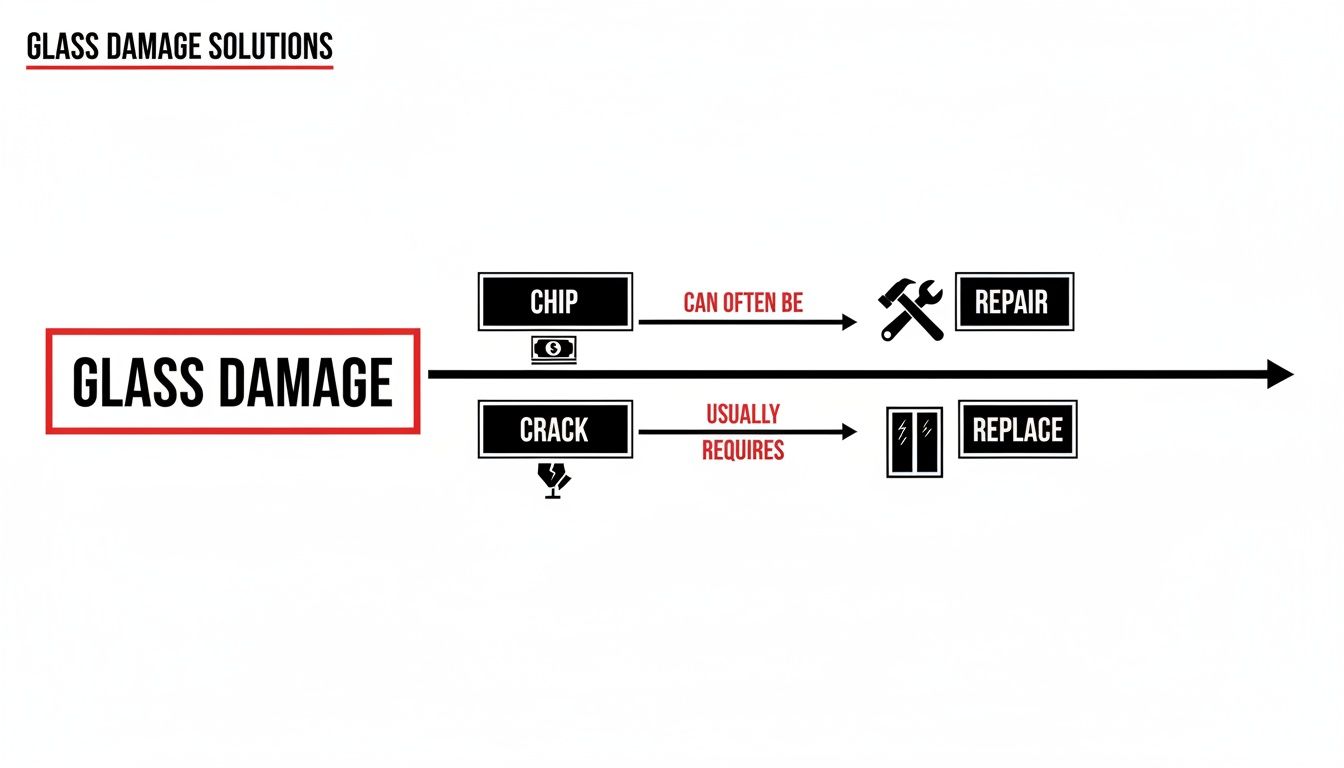
As you can see, small chips can often be repaired, but once a crack forms, a full replacement is almost always needed to restore the vehicle's structural integrity and safety.
Understanding Static and Dynamic Recalibration
The growing complexity of these systems is a huge reason the auto glass industry is changing so fast. In 2022 alone, 3.8 million windshield replacements in the US required calibration, creating a market worth over $959 million. You can dig into the numbers yourself by reviewing the full market analysis on researchandmarkets.com. That figure is only going to climb as more tech-heavy cars hit the road.
To get your systems dialed in perfectly, technicians perform two kinds of recalibration:
Static Recalibration: This is done while your car is parked. We set up special targets at precise distances and heights in front of the vehicle. The car's computer then uses these targets to reset the camera's view back to the original factory settings. It’s like an eye exam for your car.
Dynamic Recalibration: This part requires a road test. A technician drives the vehicle at a specific speed on clearly marked roads while a handheld device connected to the car's computer fine-tunes the cameras using real-world data like lane markings.
Some vehicles need one or the other, but many modern cars require both to fully restore their safety functions. At Auto Renu Auto Glass LLC, our mobile technicians come equipped to handle both types right on-site. We dive deeper into this in our article on ADAS calibration after windshield replacement. We don't leave until we're certain your car's safety features are working exactly as they should, so you can drive away with complete peace of mind.
Navigating Replacement Costs and Insurance Claims
When your car’s glass breaks, two questions pop into your head almost immediately: "How much is this going to set me back?" and "Will my insurance actually cover this?" There’s no simple, flat-rate answer. The final cost is a bit like a custom-tailored suit—it depends entirely on the specific measurements and materials involved.
The biggest piece of the cost puzzle is your vehicle itself—the make, model, and year. A side window for a 10-year-old Honda Civic is going to be a lot friendlier on your wallet than the high-tech, sensor-packed windshield on a brand new Tesla.
Key Factors Influencing Your Final Price
The type of glass your car needs is a huge factor in the final bill. You’ll generally have two choices, and each comes with its own price tag and performance considerations.
OEM (Original Equipment Manufacturer) Glass: This is the real deal—the exact same glass your car was built with at the factory. It’s the gold standard for a perfect fit and flawless communication with your car's safety cameras (ADAS), but it does come with a premium price.
OEE (Original Equipment Equivalent) Glass: Often called aftermarket glass, OEE is produced by third-party manufacturers who follow federal safety standards. It’s a more budget-friendly route, but the fit isn't always as precise as OEM. That's why we always push for OEM glass if your vehicle has any ADAS features.
On top of that, any advanced features baked into your windshield will add to the complexity and cost. Things like rain sensors, heating elements for de-icing, or a heads-up display all require more intricate glass and a much more delicate installation. For anyone managing a fleet of vehicles, these variables can really add up. To see how larger operations tackle these costs, you might find this a case study on automotive fleet expense management insightful.
Demystifying the Insurance Claim Process
Now for the good news. In many cases, your auto insurance policy will pick up most, if not all, of the tab. If you have comprehensive coverage, it's designed to handle damage from things outside of a collision—like a rock flying up on the highway, a tree branch falling during a storm, or vandalism.
Often, the only thing you'll have to pay is your deductible. Some policies even have a separate, much lower glass deductible or might waive it entirely for repairs. The best part? The whole claims process is surprisingly easy, especially when you have a pro handling it for you.
Let's be honest, nobody enjoys dealing with insurance paperwork. A good auto glass company will take that entire headache off your plate. They'll file the claim, talk to the adjuster, and handle the billing, making the whole thing feel effortless for you.
You might be surprised how common glass damage is. About 1 in 7 drivers gets a chip each year, and the number of insurance claims for glass damage is climbing by 15% annually. With modern cars, it's gotten more complicated, too—a staggering 3.8 million ADAS calibrations were needed after replacements in 2022 alone.
Your Step-by-Step Guide to Using Insurance
Filing a claim is much simpler than most people think. Here’s how we make it work:
Contact Us First: Before you even think about calling your insurance agent, give Auto Renu Auto Glass LLC a call. We’ve worked with every major insurance provider out there and know exactly how to navigate their systems.
Provide Your Policy Info: All we’ll need is your policy number and the date the damage happened. That’s it.
We Handle the Rest: From there, our team takes over. We contact your insurance company, confirm your coverage, and manage all the paperwork to get your claim approved fast.
This hands-off approach for you means no waiting on hold with adjusters or trying to figure out confusing forms. We handle the red tape so you can get on with your day. To see a full breakdown of what’s typically covered, check out our guide on whether insurance covers windshield replacement. Our mission is to make your glass replacement experience totally seamless.
The Convenience of Mobile Glass Replacement
Let's be honest, nobody has time to sit in a waiting room for hours. In the past, getting your automotive window glass replacement done was a major hassle. You'd have to book time off, drive to a shop, figure out a ride, and basically write off half your day. But that old, inconvenient model is a thing of the past. Mobile service flips the entire script, bringing dealership-level expertise right to your driveway or office parking lot.
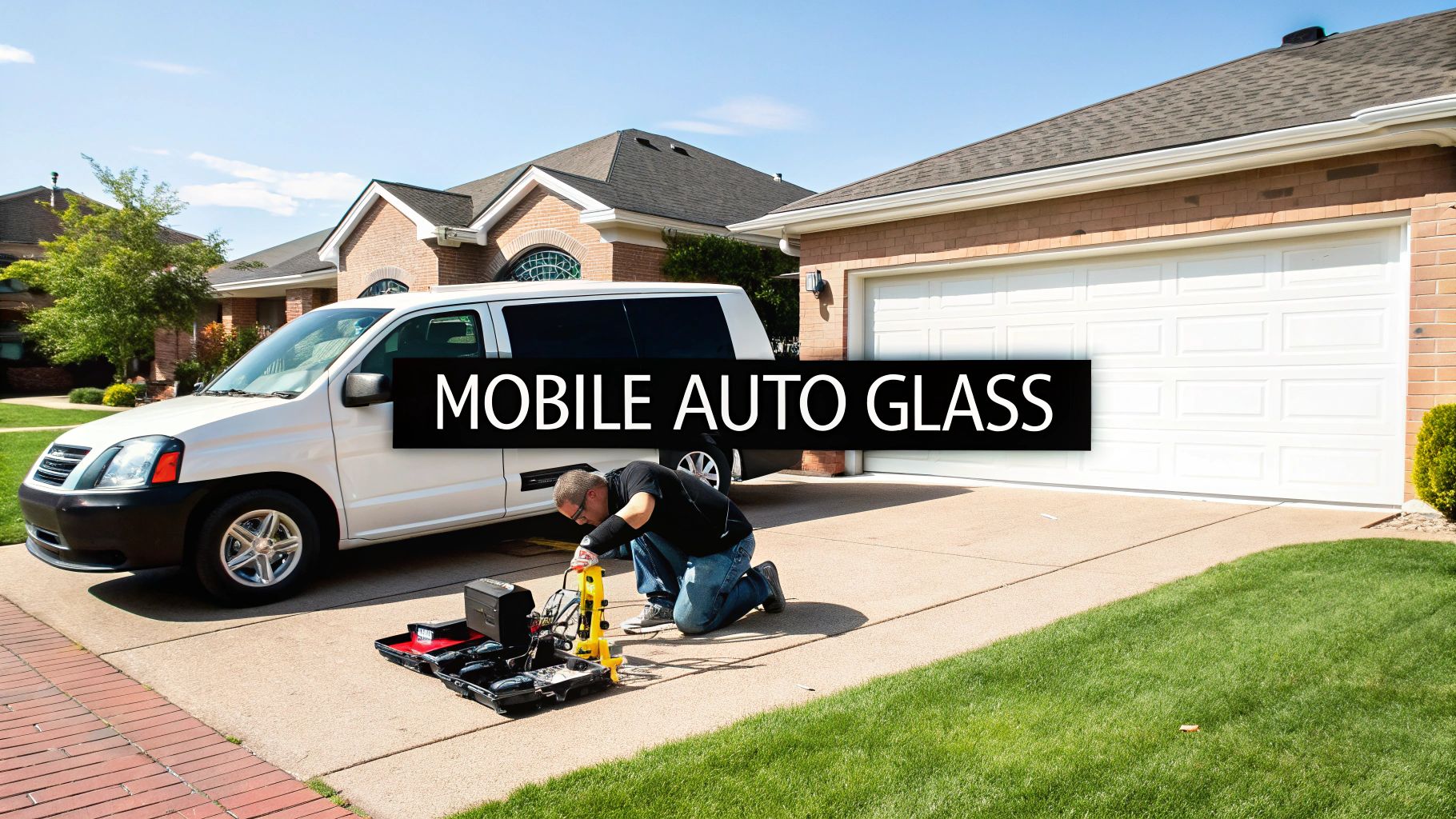
This whole approach is built around your life, not the other way around. Picture this: your windshield gets replaced while you're in a meeting at work, or while you're at home handling your daily to-do list. You don't have to miss a beat. We turn a major disruption into a simple background task that you barely have to think about.
Your Driveway Is the New Workshop
The biggest win with mobile auto glass replacement is simple: we work around your schedule. There's no need to burn a vacation day or give up a Saturday. A certified technician shows up in a fully loaded van with everything needed for a perfect installation—from the right OEM-equivalent glass to the specialized adhesives for a factory-grade seal.
This on-site service is a true game-changer for busy parents, professionals, and anyone who values their time.
At Home: We can swap out your glass while you're making lunch or getting chores done.
At the Office: Your car is fixed while you work. No lost productivity, no interruptions.
At a Job Site: For work trucks and fleet vehicles, we come directly to you to get your vehicles back on the road faster.
It’s all about making a critical safety repair fit seamlessly into your day.
The real value of a mobile service is getting your time back. Instead of losing hours to a shop visit, you can keep your day moving while an expert handles the entire replacement and safety check right where you are.
Mobile Auto Glass Service vs Traditional Shop Visit
When you put the two options head-to-head, the benefits of a modern mobile solution like Auto Renu Auto Glass LLC really stand out. It's more than just saving a trip; it’s a smarter, more efficient way to get things done.
Here’s a quick breakdown of how the two experiences compare.
Feature | Mobile Service (Auto Renu Auto Glass LLC) | Traditional Auto Glass Shop |
|---|---|---|
Location | We come to your home, office, or any convenient location. | You must drive your vehicle to their physical location. |
Time Investment | Minimal disruption. The work is done while you go about your day. | Requires drive time, wait time, and potentially return trips. |
Scheduling | Highly flexible, designed to fit within your existing schedule. | Limited to shop hours and their appointment availability. |
ADAS Recalibration | Full static and dynamic recalibration performed on-site after install. | May require leaving the vehicle longer or a separate appointment. |
Convenience | Maximum. No need to arrange for rides or alter your plans. | Minimal. Often requires coordinating with others for transport. |
Safety | Eliminates the risk of driving a vehicle with a compromised windshield. | Requires you to drive a potentially unsafe vehicle to the shop. |
Ultimately, the choice comes down to whether you want the service to revolve around your needs or the shop's.
No Compromise on Quality or Safety
One of the first questions people ask is, "Is a mobile repair as good as one done in a shop?" With a professional team like Auto Renu Auto Glass, the answer is an absolute yes. There's a common myth that mobile service is somehow a step down, but that couldn't be further from the truth.
Our technicians are highly trained experts who use the exact same premium glass and adhesives as a top-tier physical shop. We follow the same strict safety and installation standards—the only difference is the location.
Better yet, we bring the industry's most advanced technology to you, including full on-site ADAS recalibration. This is non-negotiable for modern vehicles. After a windshield is replaced, the cameras that control your safety systems must be recalibrated to function properly. We handle this critical step right on the spot, ensuring your lane-keeping assist and automatic braking systems are perfectly aligned with factory specs before we hand you back the keys.
Choosing a mobile automotive window glass replacement from Auto Renu Auto Glass gives you the best of both worlds: unbeatable convenience without ever cutting corners on the safety and quality your vehicle demands.
What to Expect During Your Mobile Service Appointment
Knowing what’s going to happen during an automotive window glass replacement can make the whole experience feel less stressful. At Auto Renu Auto Glass LLC, we believe in being completely upfront, so you feel confident and in the loop from the moment our van pulls up until the job is done. Think of our mobile service as a specialized workshop that comes right to your driveway or office, fully equipped for a perfect, factory-quality installation.
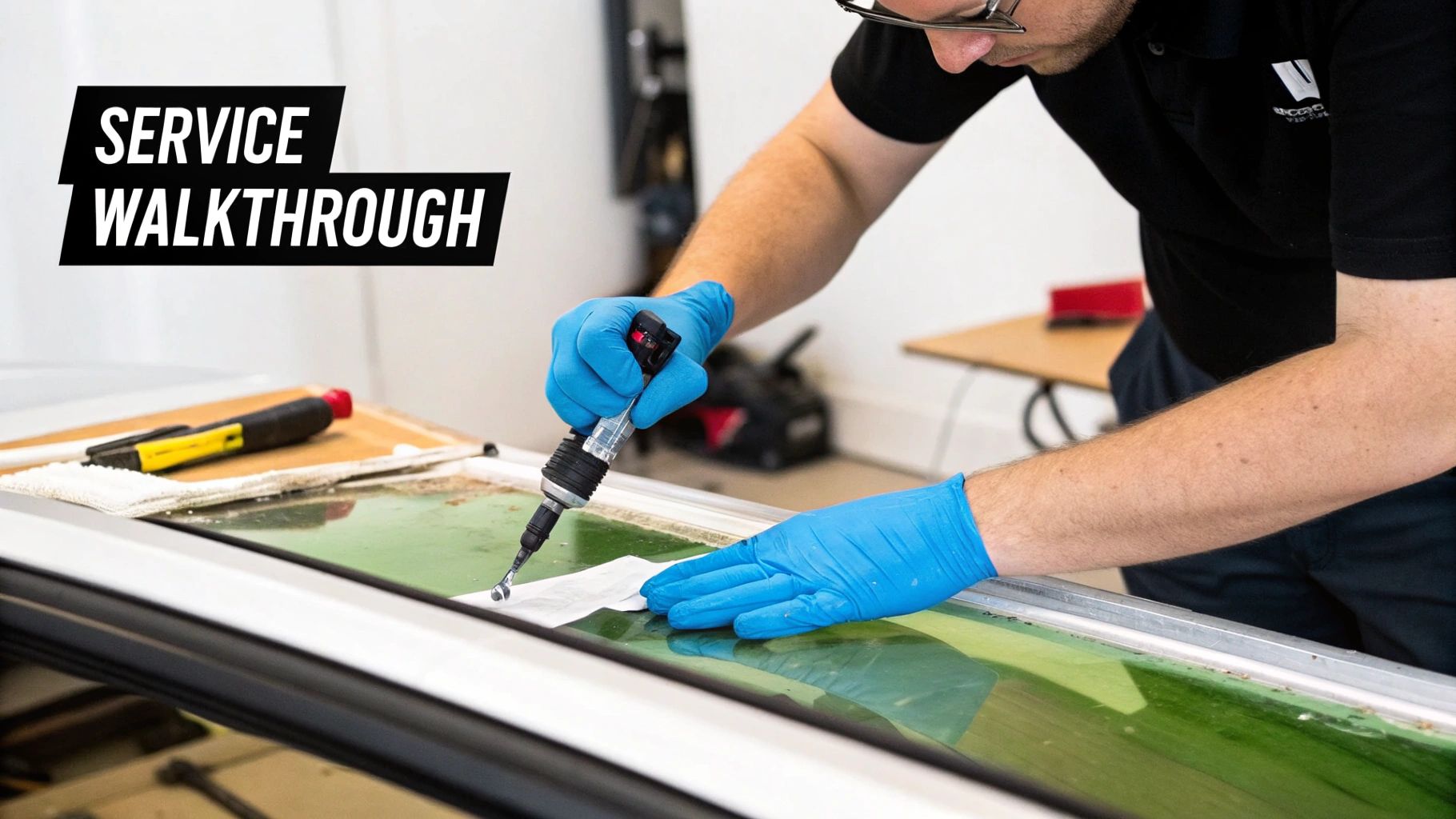
Our certified technician will start by saying hello, walking around your vehicle for a quick pre-inspection, and confirming the work order with you. This is the perfect time to ask any last-minute questions. This initial check ensures we're all on the same page before we get down to business.
The Replacement Process Step by Step
Once the pre-inspection is done, our technician gets to work. First things first, we lay down protective coverings around the glass to make sure your paint and interior stay pristine. The whole process is methodical and precise, designed to protect your car and deliver a flawless result.
Here's a breakdown of what we do:
Careful Removal of Old Glass: Using specialized tools, we’ll carefully cut through the old adhesive seal and lift out the damaged windshield or window. If we're dealing with shattered side or rear glass, we'll bring out the vacuums and meticulously clean every last shard of glass from your car's interior and door panels.
Frame Preparation: This is probably the most critical part of the entire job. We painstakingly remove every trace of the old urethane adhesive from the vehicle's frame, getting it down to the bare metal. Then, we clean the frame and apply a special primer. This primer is key—it prevents rust and helps the new adhesive form an unbreakable bond.
New Glass Installation: We prep the new, OEM-quality glass with an activator before applying a perfect bead of industry-leading urethane adhesive. Using professional-grade suction cups, we then carefully set the new glass into place, ensuring it fits perfectly and creates a watertight seal.
Final Checks and Aftercare Instructions
Just because the new glass is in doesn't mean we're finished. We run through a final quality inspection, cleaning the glass and making sure all the trim and moldings are reinstalled perfectly. If your vehicle has ADAS features, we perform the necessary on-site recalibration right then and there to guarantee your safety systems are working exactly as they should.
Finally, we'll walk you through some simple aftercare instructions. The most important rule to follow is the safe drive-away time.
The safe drive-away time is the minimum amount of time the adhesive needs to cure before it can meet federal safety standards. It’s usually about one hour, and it’s absolutely crucial for ensuring your windshield provides the structural support your car needs in a collision.
We’ll give you clear guidelines, like waiting a day or two before hitting a high-pressure car wash. For a more in-depth look at the timing, check out our guide on how long it takes to replace a windshield. From start to finish, our goal is to make the appointment seamless, professional, and completely stress-free for you.
Your Auto Glass Questions, Answered
A broken window on your car brings up a lot of questions, and that's a good thing. It means you're focused on getting a safe, quality automotive window glass replacement. We hear the same questions every day from customers just like you, so we've put together some clear, straightforward answers to help you know what to expect.
Think of this as your quick-reference guide. Knowing the answers helps you make a smart decision and feel confident when our mobile van pulls up.
How Long Does a Mobile Windshield Replacement Actually Take?
You might be surprised at how fast a professional mobile replacement can be. For a standard windshield, our technicians are usually in and out in about 60 to 90 minutes. They’re trained to be efficient without cutting a single corner on quality.
Now, if your car has modern safety features (ADAS), we'll need extra time for recalibration—plan on another 30 to 60 minutes. That's a safety step we absolutely can't rush. We’ll always give you a solid time estimate upfront so there are no surprises.
The most critical part of the process? The "safe drive-away time." You need to let the car sit for at least one hour after we're done. This gives the industrial-grade adhesive time to cure and form a solid bond. Driving off too early could ruin the seal and put you at risk.
What’s the Real Difference Between OEM and OEE Glass?
Knowing your glass options is crucial, especially with today’s tech-heavy cars. You’ll hear two terms thrown around: OEM and OEE.
OEM (Original Equipment Manufacturer): This is the exact same glass that was installed in your vehicle at the factory. It’s made by the same company, to the same specs. For any car with driver-assist cameras mounted to the windshield, OEM is the only way to guarantee a perfect fit and proper camera function.
OEE (Original Equipment Equivalent): This is aftermarket glass made by a different company. It’s designed to meet federal safety standards and can be a more budget-friendly option. However, for vehicles with advanced safety systems, we always recommend sticking with OEM glass to avoid any potential issues with your car's technology.
Can You Really Replace My Glass in Any Weather?
Our mobile service is built for convenience, so we're ready to work in most conditions—a little rain or a hot day won't stop us.
That said, the adhesive we use is the single most important part of the installation, and its ability to cure properly is affected by the weather. We have to draw the line at heavy rain, strong winds, or freezing temperatures. If the weather is just too severe to guarantee a perfect seal, we'll call you to reschedule for the next clear day. Your safety is our top priority.
For a safe, convenient, and professional automotive window glass replacement that comes directly to you, trust the experts at Auto Renu Auto Glass LLC. Schedule your mobile service today and experience the difference.