What Is the Real Cost to Tint Car Windows
Discover the true cost to tint car windows. Our complete guide breaks down pricing by film type, vehicle size, and other key factors to help you budget.
Dec 29, 2025
generated
cost to tint car windows, car window tinting cost, auto tint prices, ceramic tint cost, mobile tinting service
So, you're thinking about tinting your car windows and want to know what it'll cost. The short answer is you can expect to pay anywhere from $200 for a basic job on a small sedan to over $600 for a high-end ceramic tint on an SUV or truck.
The final price tag really boils down to a few key things: the size of your car, how many windows you’re tinting, and—most importantly—the quality of the film you choose.
A Quick Guide to Window Tinting Prices
Figuring out the cost of window tinting is a lot like buying tires. You have your budget-friendly options that do the basic job, and then you have your premium, high-performance versions that completely change the feel of your ride. Window film works the exact same way, with different tiers offering vastly different levels of heat rejection, UV protection, and overall durability.
It's an upgrade that more and more drivers are seeing the value in. The global automotive tinting film market was valued at a whopping $3.5 billion in 2020 and is on track to hit $5.76 billion by 2030. That kind of growth tells you people are realizing that a quality tint does more than just look cool—it protects your car's interior and makes every drive more comfortable. You can dive deeper into these market trends and statistics to see what's driving the demand.
Estimated Car Window Tinting Costs at a Glance
To give you a clearer picture, I've put together a table that breaks down the typical costs. Think of this as a starting point for budgeting your project, as prices can shift based on your specific vehicle and location.
Vehicle Type | Standard/Dyed Film | Carbon/Metallic Film | Premium Ceramic/IR Film |
|---|---|---|---|
Coupe/Sedan (2-4 Doors) | $180 - $250 | $250 - $400 | $400 - $650 |
Standard SUV/Truck | $200 - $300 | $300 - $450 | $450 - $700 |
Large SUV/Minivan | $250 - $350 | $350 - $500 | $500 - $800+ |
This table shows how the film you choose is the biggest factor in the final price. A basic dyed film is great for looks, but jumping up to a ceramic film is where you'll really feel the difference in heat rejection on a hot day.
Breaking Down the General Costs
While every shop has slightly different pricing, the costs generally fall into three main categories, each tied directly to the technology baked into the film itself.
Standard Dyed Film: This is your entry-level option. It's the most affordable way to get that classic tinted look and add some privacy.
Carbon or Metallic Film: A solid mid-range choice. These films step up the game with better heat rejection and are much more durable, so they won't fade to purple over time like some cheap dyed films can.
Ceramic or IR Film: This is the top of the line. You get maximum heat and UV-blocking power without any of the signal interference that metallic films can sometimes cause with your phone or GPS. It's the best of the best for comfort and protection.
At Auto Renu Auto Glass LLC, we bring all these options right to your doorstep. Our mobile service across the Bay Area means you get a flawless, professional installation at your home or office, saving you the trip to a shop.
This guide will walk you through all the details that shape your final quote, from the hidden costs to the long-term benefits. By the time you're done reading, you'll know exactly what to expect and why getting a professional tint is one of the smartest upgrades you can make for your vehicle.
The 7 Key Factors That Drive Your Tinting Price
Ever wondered why one quote for tinting your car comes in at $250, while another for a similar vehicle hits $700? It’s not random. The final price tag is a mix of specific choices you make and challenges your car presents, all of which affect the materials, labor, and skill needed for a perfect job.
Think of it like getting a custom paint job. The quality of the paint, the size of the car, and the intricacy of the design all play a part. Window tinting is no different. Once you understand these factors, you can look at any quote and know exactly where your money is going.
1. The Quality of the Tint Film
This is, by a long shot, the biggest piece of the pricing puzzle. The type of film you pick directly impacts how much heat it blocks, how well it protects you from UV rays, and how long it will last. Different films use different technologies, and that technology comes with a price.
Dyed Film: This is your entry-level option. It uses layers of dye to absorb heat and give you that dark, private look. It's great for aesthetics on a budget, but its heat-blocking power is minimal, and it’s known to fade and turn purple over years of sun exposure.
Carbon & Metallic Films: A solid step up. Carbon films are infused with tiny carbon particles that are fantastic at blocking infrared heat. Metallic films do the same with microscopic metal particles. They’re both far more durable than dyed films, but the metallic versions can sometimes mess with GPS, satellite radio, or cell signals.
Ceramic & IR Films: Welcome to the high-performance tier. These films use advanced nano-ceramic particles to reject a massive amount of heat and block up to 99% of harmful UV rays—all without needing to be super dark. They offer crystal-clear views, incredible durability, and won't interfere with any of your car's electronics.
Just choosing a quality ceramic film over a basic dyed one can easily double the material cost, which explains the huge swing in quotes you might see.
2. Vehicle Size and Type
It’s simple math: the more glass you have, the more it’s going to cost. A bigger vehicle doesn't just need more film; it also takes significantly more time to install it properly.
A little two-door coupe has a fraction of the glass found on a big SUV or a minivan with its army of side windows and a massive rear windshield. More glass means more materials and more labor hours, plain and simple.
Analogy Time: Tinting a coupe is like painting a small bedroom. Tinting a large SUV is like painting the entire living room and dining area. You're using the same techniques, but one job requires a lot more paint and a whole lot more time.
3. Number of Windows Being Tinted
You don't always have to tint the whole car. While a full package (all side windows plus the rear glass) is the most common route, the price can be adjusted based on exactly what you need.
Maybe you just want the two front windows tinted to match the factory privacy glass on the back of your SUV. Or maybe all you need is a simple sun strip across the top of your windshield to cut down on glare. Each choice has its own price.
Two Front Windows: Typically priced as a set.
Full Vehicle (Sides & Rear): The most popular and cost-effective package deal.
Windshield Visor Strip: A small, affordable add-on.
Full Windshield: A specialty job that requires a special, often clear, heat-rejecting film.
4. Complexity of the Windows
Let’s be clear: not all car windows are created equal. Some are nice and flat, making the installer's job pretty straightforward. Others, however, are a real headache, demanding extra time, patience, and a high level of skill—all of which gets factored into the labor cost.
So, what makes a window "complex"?
Extreme Curves: Think about the huge, sloping rear windshield on a Corvette or a Tesla. To make a flat piece of film conform to that curve without bubbles or creases, the installer has to carefully heat-shrink it into shape. It's an art form.
Numerous Small Windows: Some SUVs and vans have those extra little "quarter glass" windows that are incredibly tricky and time-consuming to get just right.
Frameless Doors: On cars with frameless doors, the installer has to be exceptionally precise to get the film right to the edge so it won’t peel over time.
To really get a feel for the craftsmanship involved in these tricky applications, check out our guide on how window tinting works.
5. Removal of Old Tint
If your car is already tinted but the film is old, bubbling, or peeling, it has to go. This isn't a quick peel-off job; it's a labor-intensive process that adds a separate charge to your bill, usually somewhere between $50 to $150 or more.
Removing old tint means steaming and scraping off not just the film itself, but also the stubborn, baked-on adhesive left behind. Slapping new film over old is a guaranteed way to get a bubbly, distorted mess. For a professional finish, you absolutely need a clean slate.
6. Local Labor Rates and Shop Reputation
Just like with any skilled trade, where you live matters. An experienced tint installer in a high-cost area is naturally going to charge more than one in a small town with a lower cost of living.
Beyond that, a shop's reputation is everything. The best installers—the ones who use computer-cut patterns for precision, work in spotless, dust-free bays, and have years of experience—command higher prices. You aren't just paying for a roll of film; you're investing in a flawless, bubble-free installation that will look great for years.
7. Mobile Service Convenience
Finally, opting for a mobile tinting service like Auto Renu Auto Glass LLC can also affect the price. You might pay a bit of a premium for the sheer convenience of having an expert come to you, but for many people, the trade-off is more than worth it.
You get back hours of your day. No driving to a shop, no waiting in a lobby, and no need to arrange for a ride home. The service works around your schedule, not the other way around. That premium covers the technician's travel, fuel, and the specialized gear required to deliver a top-quality job right in your driveway.
Dyed, Carbon, or Ceramic? Choosing Your Film
When you're figuring out the cost to tint your car windows, the biggest factor by far is the type of film you pick. This isn't just about how dark you want to go—it's about the technology behind the tint, how well it performs, and how long it will last.
Think of it like buying sunglasses. You could grab a basic, cheap pair, or you could invest in high-quality polarized lenses, or even go for a high-tech set with specialized coatings. Each one does the job differently, and the same goes for window film. Let’s break down the main options so you can find the perfect balance between your budget and what you want the tint to do for you.
Dyed Film: The Budget-Friendly Classic
Dyed window tint is the old-school, entry-level choice and the most affordable one you'll find. It’s made with layers of dye that absorb sunlight, which is what gives your car that classic, sleek tinted look. If your main goals are adding privacy and cutting down on glare without breaking the bank, dyed film is a solid starting point.
The catch? It manages heat by simply absorbing it. On a hot day, the glass itself gets hot and eventually radiates that heat right into your car. Plus, after a few years of baking in the sun, the dyes start to break down, which is why you sometimes see older cars with bubbly, purple-looking tint.
Pros: The most affordable option out there, great for privacy and reducing glare.
Cons: Doesn't reject much heat, can fade to purple over time, and is the least durable.
Best For: Drivers on a tight budget who care more about looks and privacy than high-performance heat blocking.
Carbon Film: The Durable Mid-Grade Performer
Take a step up, and you get to carbon window tint. This film doesn't use dye. Instead, it’s packed with tiny carbon particles that are fantastic at blocking infrared light—the specific type of light that makes you feel the heat. This technology gives it a serious performance advantage over a standard dyed film.
A huge plus for carbon film is its durability. Those carbon particles don't fade, so your tint stays a deep, true black for its entire life. It also has a nice, clean matte finish. And because it contains no metal, you never have to worry about it interfering with your cell phone, GPS, or radio signals.
Carbon film really hits the sweet spot. You get a real, noticeable difference in how cool your car stays, and you know the look will last, all without making the jump to the premium price of a ceramic film.
It's become the go-to for drivers who want a real upgrade in comfort and are willing to invest a little more for a tint that won't fade or fail.
The flowchart below gives you a quick way to see if a budget or performance film is the right fit for you.
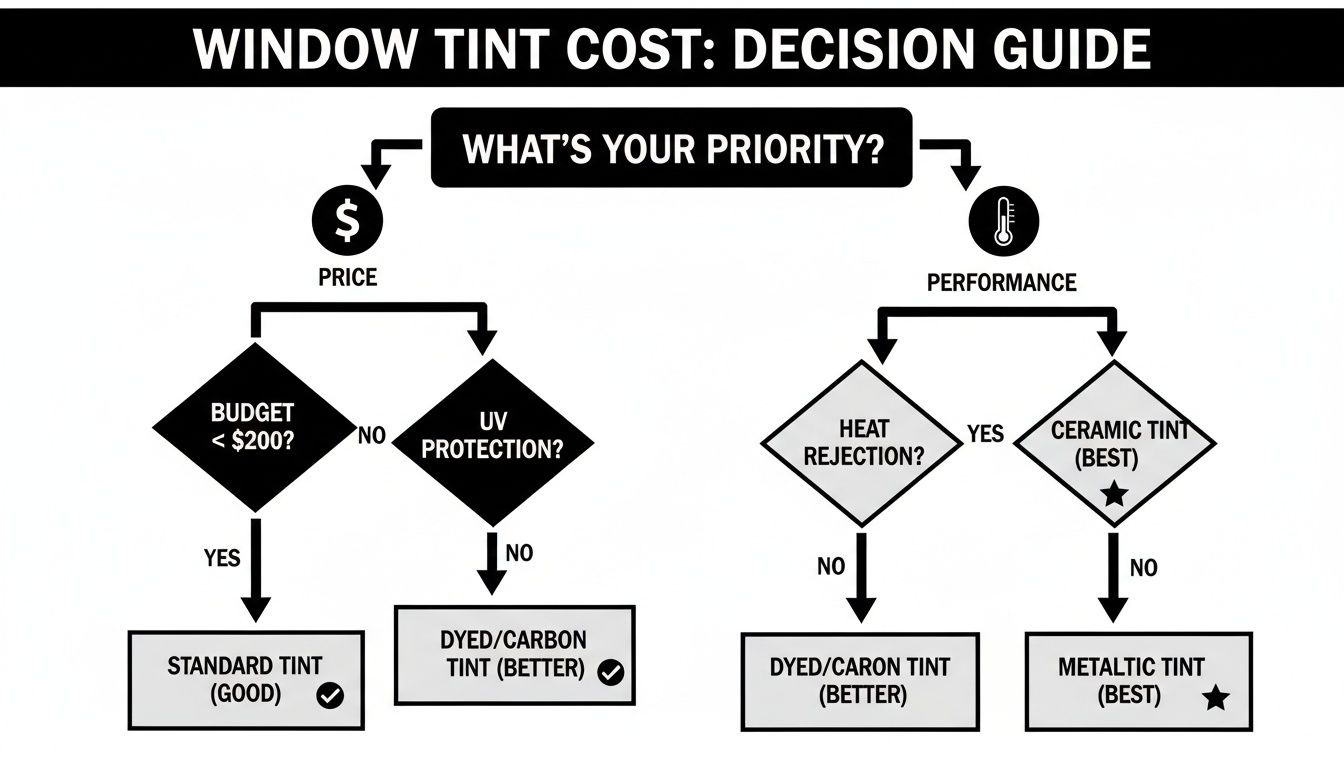
As you can see, if budget is your top priority, dyed film is the way to go. If performance is what you're after, you'll be looking at carbon or ceramic.
To make it even clearer, let's compare these films side-by-side.
Comparing Window Tint Film Types
Feature | Dyed Film (Standard) | Carbon/Metallic Film (Mid-Grade) | Ceramic/IR Film (Premium) |
|---|---|---|---|
Primary Technology | Absorbs solar energy with dye layers. | Reflects and blocks heat with carbon particles. | Blocks specific IR wavelengths with ceramic nanoparticles. |
Heat Rejection | Low to Moderate (absorbs heat) | Good to Very Good (blocks IR) | Excellent (targets and blocks IR) |
UV Protection | Good (around 99%) | Excellent (over 99%) | Superior (over 99.9%) |
Color Stability | Prone to fading and turning purple. | Excellent; will not fade over time. | Superior; maintains color and clarity indefinitely. |
Signal Interference | None | None | None |
Price Range | $100 - $300 | $250 - $500 | $400 - $850+ |
Best For | Aesthetics and privacy on a tight budget. | A balance of performance, durability, and value. | Maximum comfort, protection, and clarity. |
This table shows the clear trade-offs between cost and performance. While all films offer great UV protection, the real difference lies in heat rejection and long-term durability.
Ceramic Film: The Ultimate High-Tech Shield
At the very top, you have ceramic window tint—the best technology the industry has to offer. This film is infused with non-metallic, non-conductive ceramic nanoparticles that are engineered to act like a smart filter, aggressively blocking infrared and UV rays. The result is a level of heat rejection and sun protection that no other film can touch.
The most incredible thing about ceramic film is that it doesn't have to be dark to work. A very light, almost-clear ceramic film can block more heat than the darkest dyed film available. This means you can keep your car incredibly cool without sacrificing visibility. It stops up to 99% of damaging UV rays, which protects both you and your car's interior from fading, cracking, and sun damage.
This isn't just a luxury anymore; it's becoming a necessity. The global market for automotive window tinting is expected to hit $6.3 billion by 2025. A big part of that growth is from EV owners, who are finding that a premium ceramic tint can boost their cabin cooling efficiency by as much as 25%. That means less strain on the battery and more range, easily justifying the higher upfront cost.
Pros: The absolute best heat and UV rejection, crystal-clear visibility, will never fade, and has zero signal interference.
Cons: It's the most expensive option.
Best For: Anyone who wants the best comfort and protection possible, especially drivers in hot climates and EV owners.
Ultimately, the right film comes down to your priorities. Whether you go with the affordable style of dyed film or the elite performance of ceramic, getting it installed correctly is key. Our guide on mobile window tint services explains how we bring any of these options right to your doorstep for a perfect, convenient installation.
Why Mobile Tinting Is a Smart Investment
When you're looking at the cost to tint car windows, it’s easy to see a mobile service fee as just another add-on. But for anyone juggling a busy life in the Bay Area, it’s a whole lot more. Think of it as an investment in your most valuable resource: your time.
With a mobile service like Auto Renu Auto Glass LLC, a fully equipped, professional workshop rolls right up to your curb. This one simple shift completely erases the logistical nightmare of a typical shop appointment. No more fighting traffic, burning gas to drop off your car, and then trying to figure out how to get back to work or home without it.
The Value of Ultimate Convenience
Let’s be honest, the traditional way is a massive time-suck. You can easily burn an hour or more just getting to and from the shop. Then you’re stuck waiting in a lobby or scrambling to find a ride. With mobile tinting, that entire block of wasted time simply disappears.
Our technician arrives at your location—whether that's your driveway, office parking lot, or even a job site—and gets the job done while you carry on with your day. You can stay productive in a meeting, take care of things at home, or just kick back and relax without a single interruption.
The real cost isn't just the price on the invoice; it's the hours of your life you can't get back. Mobile service essentially buys that time back for you, turning a day-long hassle into a seamless background event.
This level of convenience transforms the entire process. What used to be a chore becomes a simple, incredibly efficient upgrade for your vehicle.
Achieving Shop-Quality Results Anywhere
A big question we hear is, "Can a mobile setup really match a professional shop?" The answer is an emphatic yes. Our mobile specialists bring everything needed to deliver a flawless, bubble-free installation, no matter where we are.
We are meticulous about preparing the work area and your vehicle. We create a controlled, clean space to ensure that dust, pollen, and other debris don’t get trapped under the film. This painstaking attention to detail means the final result is indistinguishable from work done in a high-end facility.
You get the same precision, the same durable bond, and the same stunning finish, all without ever leaving your property.
For Bay Area residents, choosing mobile tinting isn’t an extra expense—it's just a smarter way to get things done. You’re paying for an efficient, high-quality experience that respects your schedule and delivers exceptional results right to your doorstep. It’s the modern solution for a classic automotive upgrade.
The Long-Term Value of Professional Window Tinting
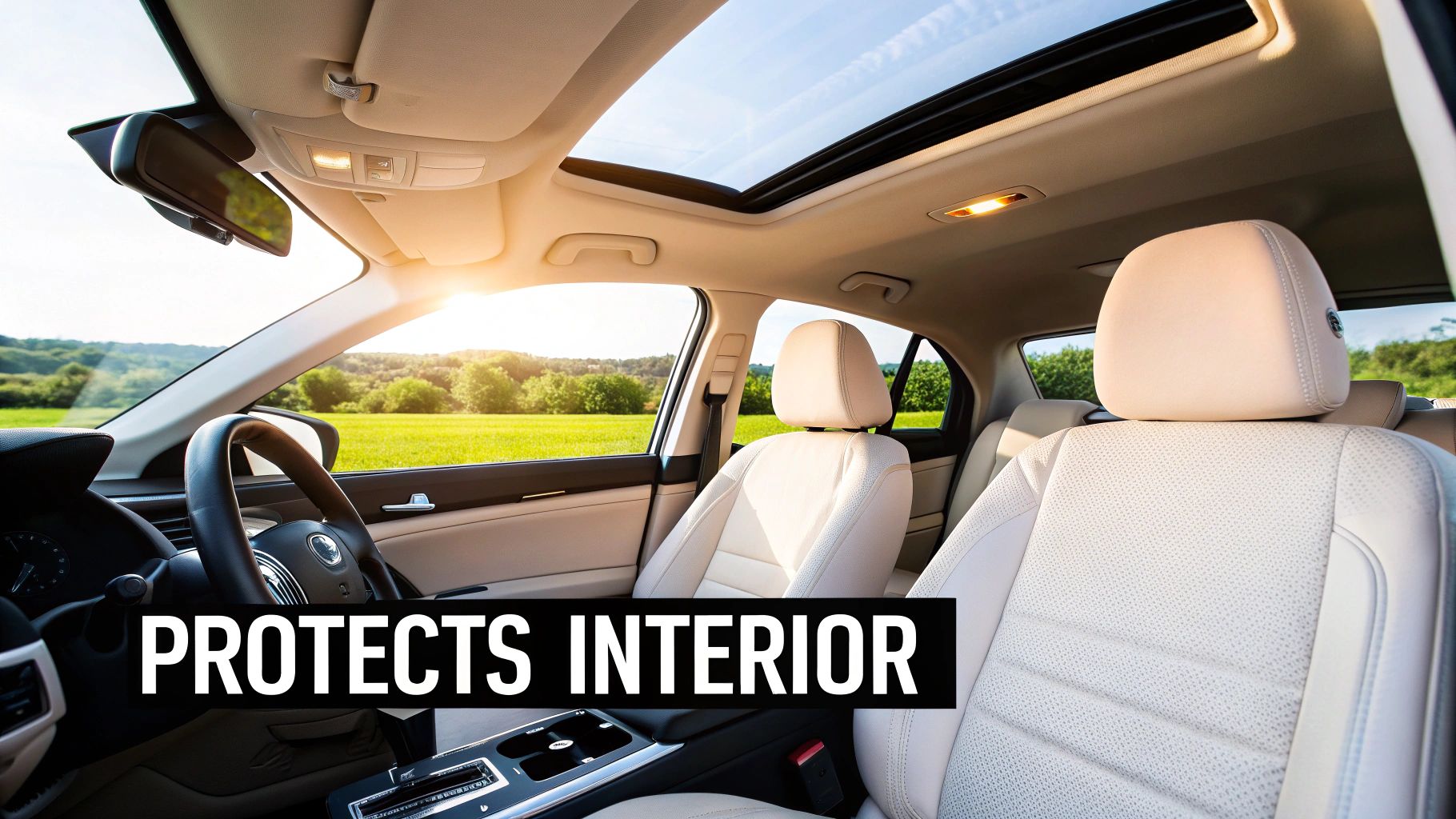
The initial cost to tint car windows is just the ticket price. The real payoff comes from the value it adds to your vehicle—and your daily drive—for years to come. Think of a quality tint job as a silent guardian for your car's interior.
Without it, your dashboard, seats, and trim are under constant assault from the sun. That relentless exposure is what causes fading, cracking, and a generally worn-out look. Professional window tinting throws up a powerful shield, keeping your interior looking fresh and directly protecting your car’s resale value.
More Than Just a Financial Return
Beyond protecting your investment, a professional tint is an upgrade for your own health and comfort. We often forget that we’re exposed to the sun even inside our cars, but high-quality films can block up to 99% of harmful UV rays—a major contributor to skin aging and skin cancer.
You’ll also feel the difference immediately. By reflecting a huge chunk of the sun's heat, tint keeps your cabin significantly cooler. That means your air conditioning doesn't have to fight a losing battle on hot days, which can improve your fuel efficiency and put less strain on the system.
A professional tint is one of those rare upgrades that pays you back in comfort, safety, and cold hard cash. It turns your car into a more protected, private, and comfortable space.
The secret is out, too. The global market for automotive tinting film is expected to hit $7.59 billion in 2024. Studies show a quality tint can boost resale values by 7-10%, and fleet operators have even reported fuel savings of 10-15% thanks to reduced A/C usage.
Safety, Security, and Longevity
Window tint also offers a couple of surprising benefits. In an accident, the film can help hold shattered glass together, reducing the risk of injury from flying shards. It also acts as a privacy screen, concealing valuables from view and making your car a less attractive target for thieves.
When you opt for a quality film and an expert installation, you're not just getting a cosmetic touch-up; you're buying a durable, long-lasting product. To see just how resilient it can be, you can learn more about how long window tint lasts in our detailed guide.
To round out the protection and keep your entire vehicle looking its best, pairing your tint with comprehensive car detailing services is a great way to maximize its long-term value.
Answering Your Top Window Tinting Questions
Alright, let's wrap this up by tackling the questions I hear all the time from drivers. Getting these details sorted out beforehand can make the whole process feel a lot less mysterious and help you make a confident decision.
How Long Does It Take to Tint Car Windows?
This is usually the first thing people ask. You want to know how long your car will be out of action, right? For a standard sedan, a professional can typically get the job done in about 1.5 to 3 hours. If you've got a bigger vehicle, like an SUV with those extra little quarter windows, you can expect it to take a bit longer.
But the work doesn't stop when the installer hands you back the keys. The tint needs time to "cure."
Think of the curing process like waiting for paint to dry. It's when the last bits of moisture between the film and the glass evaporate, letting the adhesive form a permanent bond. This can take anywhere from a few days to a couple of weeks, depending on the film and the weather.
You might see a little haziness or a few small water pockets during this time. Don't worry—that's completely normal. As the moisture evaporates, those spots will vanish, leaving you with a crystal-clear finish. Just remember to keep your windows rolled up for the first 48-72 hours to give the film a chance to set properly.
Is It Cheaper to Tint My Own Windows?
I get the appeal. You see a $50 DIY tint kit at the auto parts store and think, "How hard can it be?" But trust me, this is one of those jobs where trying to save a few bucks upfront can cost you a lot more down the road. Tinting windows is a real skill that takes precision, a ton of patience, and a spotless environment.
It’s incredibly easy for things to go wrong without the right tools and experience.
Bubbling and Peeling: This is the dead giveaway of a DIY attempt. Trapped air pockets look terrible and only get worse as time goes on.
Contamination: A single speck of dust or a stray pet hair trapped under the film can ruin the look of the entire window.
Creases and Cuts: Getting a flat sheet of film to lay perfectly on curved glass without creasing is an art. One wrong move, and that piece of film is toast.
In the end, most botched DIY jobs have to be professionally stripped off and redone. The cost of removing that old, gummy film plus the price of a new professional installation almost always adds up to more than what you would've paid to get it done right the first time. Going with a pro from the start saves you a massive headache and gets you a clean, warrantied result.
What Are the Legal Tint Limits in California?
This is a big one. You don't want to spend money on a beautiful tint job only to get slapped with a "fix-it" ticket. Tint darkness is measured in Visible Light Transmission (VLT)—basically, the percentage of light the window lets through.
Here in California, the laws are very specific:
Front Side Windows: The tint on your driver and front passenger windows must let more than 70% of light in. This means it has to be a very light shade.
Rear Side Windows & Back Windshield: On these windows, you can go as dark as you’d like.
Windshield: A non-reflective strip of tint is allowed, but only on the top 4 inches.
This is exactly why hiring a professional installer is your best bet. A reputable shop knows the local laws like the back of their hand. They’ll help you pick a film that gives you the look and heat rejection you want while making sure you’re 100% street legal.
Does Car Insurance Cover Window Tinting?
For the most part, your standard auto policy won't pay for you to add window tint as a cosmetic upgrade. It’s seen as an aftermarket modification, so the initial cost is on you.
However, the story changes if your tinted windows get damaged in an accident or from a break-in. If you have comprehensive coverage, your insurance should pay to return your car to its previous condition. That means they should cover the cost of replacing both the glass and the tint film that was on it.
It's always a good idea to let your insurance company know after you've had your windows professionally tinted. Having it on record makes for a much smoother claims process if you ever need it.
Ready to give your vehicle the comfort, privacy, and UV protection it deserves? At Auto Renu Auto Glass LLC, we bring top-tier service right to your driveway. For a flawless and convenient installation in the Bay Area, visit us online to get started.