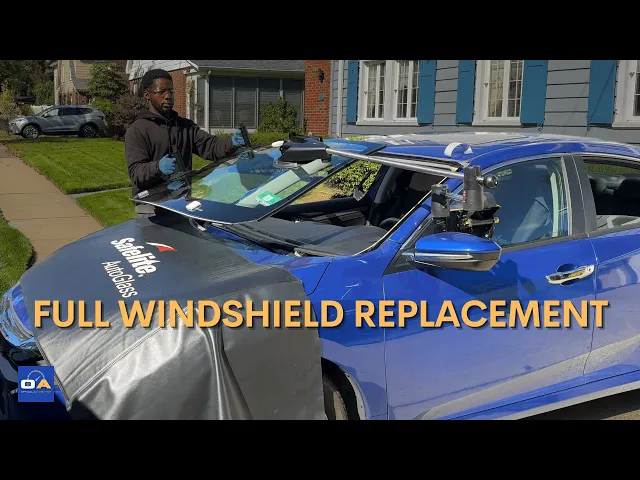
A Complete Guide to Replace the Windshield on Your Car
Learn when you need to replace the windshield with our expert guide. We cover safety, ADAS recalibration, costs, and choosing the right auto glass service.
Jan 2, 2026
generated
replace the windshield, windshield replacement, auto glass service, mobile auto glass, ADAS recalibration
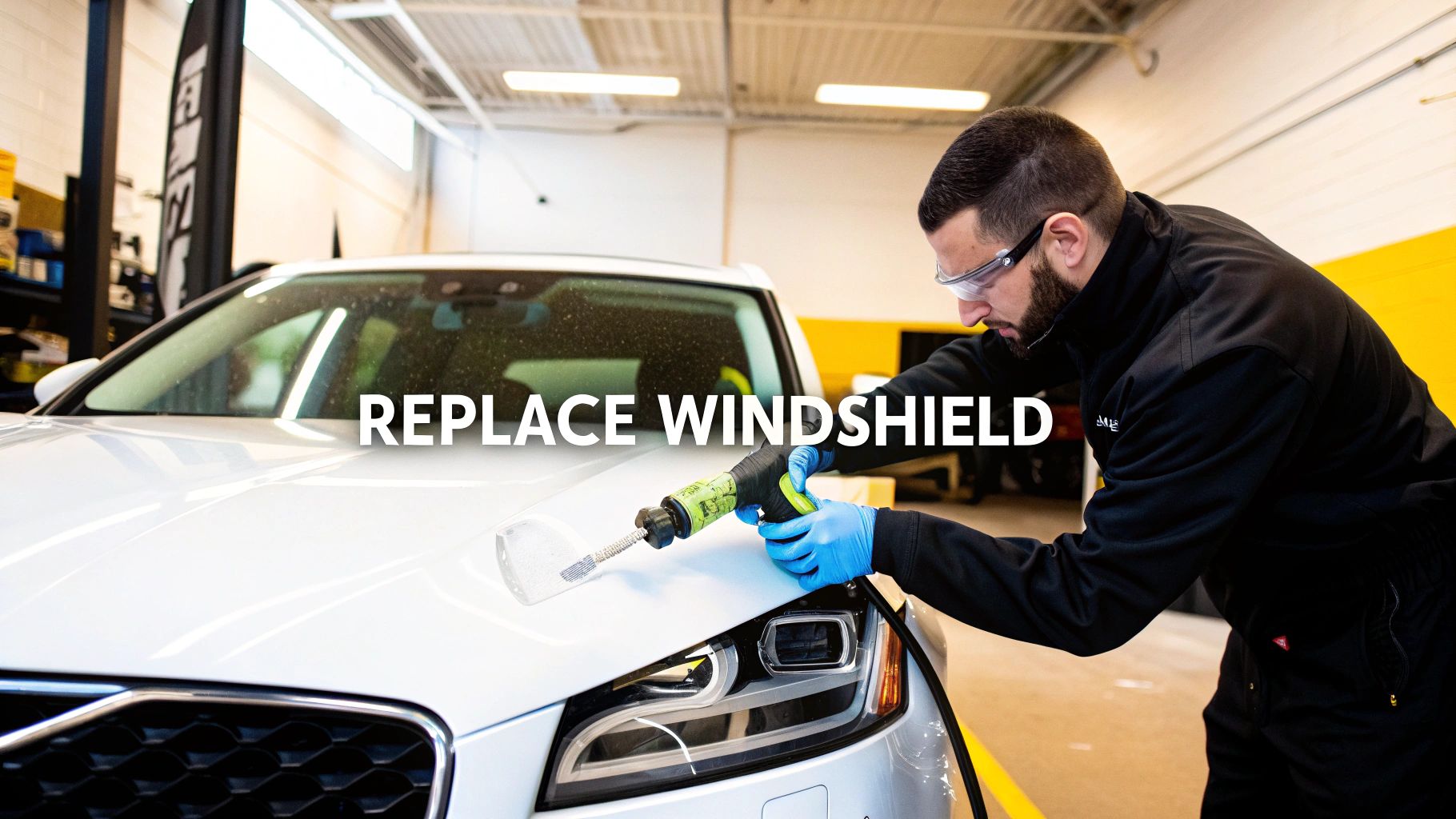
You've just heard that dreaded thwack against your glass. Now what? The big question on your mind is whether you're looking at a quick repair or a full-on windshield replacement.
There’s a common rule of thumb you've probably heard: if the chip is smaller than a quarter or the crack is shorter than a dollar bill, it’s fixable. That's not a bad starting point, but in the real world, the decision is a bit more involved. The location and severity of the damage are what truly matter.
Deciding When to Replace Your Windshield
That tiny chip from a piece of gravel on the highway might look innocent, but where it landed makes all the difference. A chip right in the driver's line of sight, for example, is almost always a deal-breaker for repair. Even the best repair can leave a slight distortion, and that's a dangerous distraction you just can't afford.
Damage near the edge of the windshield is another major red flag. Your windshield is a critical safety feature, providing up to 60% of your vehicle's cabin strength in a rollover. A crack that has crept to the edge has already weakened that structural support, making a replacement the only safe option.
The Anatomy of Windshield Damage
It’s not just about size; the type of damage is a huge factor. A clean "bull's-eye" or a small "star break" can often be filled and sealed successfully. But a long, running crack is a whole different beast.
Those long cracks tell you that the structural tension of the glass is shot. Drastic temperature shifts—blasting the defroster on a frosty morning or even just the sun beating down on a hot day—can make that crack spread in an instant. If you wait, what could have been a simple repair job quickly becomes a mandatory replacement.
Repair vs Replace Quick Decision Guide
Making a quick, informed decision is crucial. This table breaks down the most common scenarios to help you gauge whether you're likely looking at a repair or a full replacement.
Damage Characteristic | Repair Candidate | Replacement Necessary |
|---|---|---|
Size & Type | A chip smaller than a quarter, or a single crack under 6 inches. | A chip larger than a quarter, or a crack longer than 6 inches. |
Location | Anywhere outside the driver's direct line of sight. | Directly in the driver's line of sight. |
Edge Damage | Damage is several inches away from the edge of the glass. | Crack or chip is at or very near the edge of the windshield. |
Number of Impacts | One or two small, isolated chips. | Three or more chips, or complex/shattered damage. |
Depth | Damage has not penetrated both layers of the laminated glass. | The crack or chip goes through the outer and inner glass layers. |
ADAS Systems | The damage is not located over any camera or sensor areas. | Damage obstructs the view of any ADAS cameras or sensors. |
While this guide is a great starting point, remember that a professional inspection is the only way to be certain. An experienced technician can see things an untrained eye might miss.
Your windshield is more than just a window; it's a foundational safety feature. Postponing a necessary replacement not only risks a bigger repair bill later but also puts your safety on the line by weakening the vehicle's structural integrity and airbag support system.
The Growing Need for Quality Replacements
With more cars on the road than ever, windshield damage is a fact of life for drivers. The global automotive windshield market hit an incredible USD 29.74 billion in 2023 and is on track to reach USD 59.04 billion by 2032.
This isn't just a random statistic; it shows just how often drivers are faced with this exact decision. You can explore more about the automotive windshield market trends to see why finding a trustworthy, professional service is so important.
Ultimately, the best way to know for sure is to have an expert take a look. A qualified technician from a trusted service like Auto Renu Auto Glass LLC can properly assess the damage—its depth, location, and type—and give you a clear, safety-first recommendation.
A Look Inside the Professional Windshield Replacement Process
So, you've determined your windshield needs to be replaced. What's next? A professional replacement is so much more than just popping out the old glass and sticking in a new one. It’s a precision-based process that is absolutely critical to your vehicle's safety and structural integrity. Every certified technician follows a strict, methodical workflow to get that perfect, factory-quality fit.
Knowing what goes into a proper installation helps you understand why this is one job you really shouldn't DIY. It’s a combination of practiced skill, highly specialized tools, and a solid grasp of automotive engineering. Let’s pull back the curtain and see exactly what the pros at Auto Renu Auto Glass LLC do when they show up to replace your windshield.
Setting the Stage: Preparing the Vehicle for Surgery
The very first phase is all about protection. Before a single tool touches your car, a technician’s priority is to safeguard your vehicle from any potential damage during the job. This isn't just about being cautious; it’s a series of specific steps to protect your car inside and out.
Protecting the Interior: The technician will carefully lay down protective coverings over your dashboard, seats, and flooring. This keeps any glass fragments or urethane adhesive from making a mess or damaging your car's interior.
Guarding the Exterior: Fender covers and protective tape are applied around the windshield’s edge. This is a crucial step to shield your vehicle's paint and body from any accidental slips or scratches while the old glass is being removed.
These initial actions are a hallmark of professionalism and respect for your property. It’s a clear sign that the tech isn’t just there to replace the glass; they’re there to return your vehicle to you in pristine condition, just with a brand-new, securely fitted windshield.
The technician will also carefully detach any components mounted on the old windshield, like your rearview mirror, rain sensors, or any toll tags and stickers you want to save.
This diagram shows how a professional first assesses key damage factors—size, location, and type—to confirm a replacement is the right call.
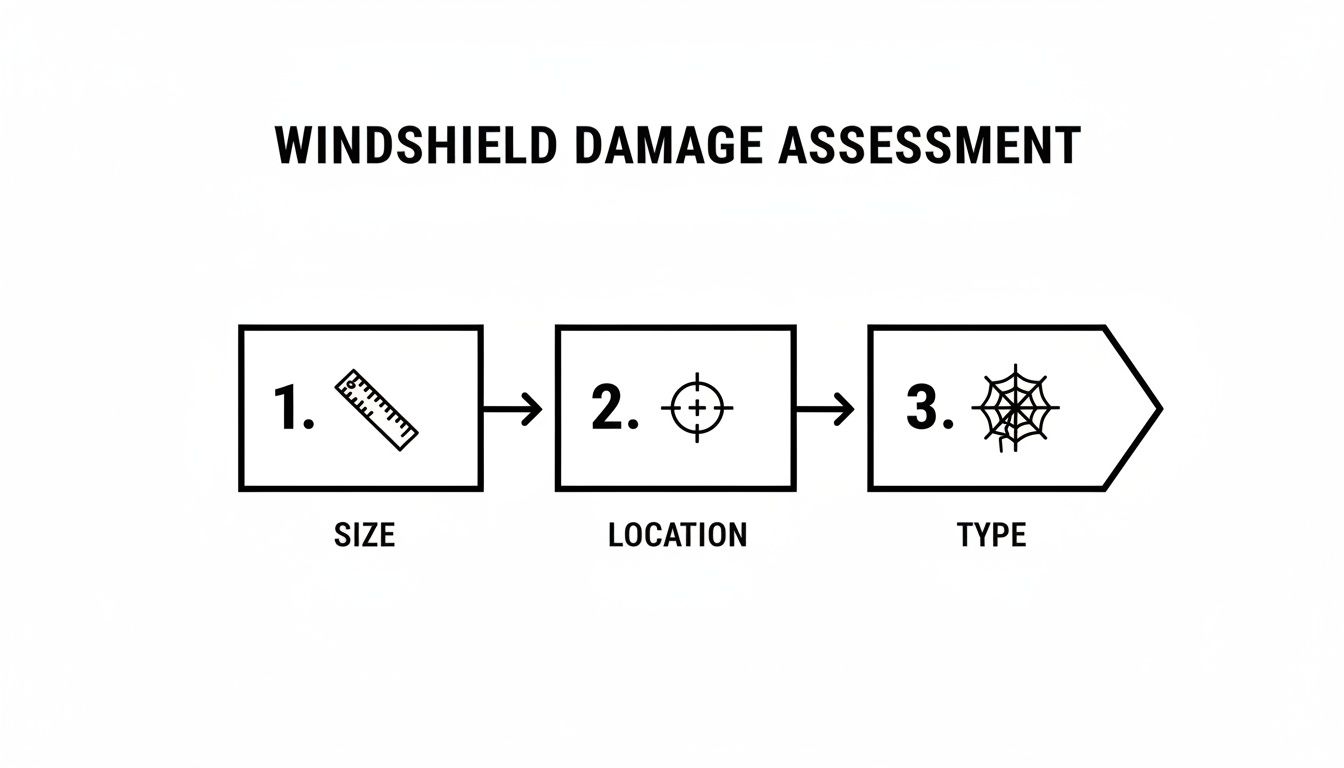
This quick visual check ensures that before any work begins, the correct service is being performed for your specific situation.
The Art of a Clean Windshield Extraction
With the vehicle prepped and protected, the delicate process of removing the damaged windshield can begin. This requires specialized tools designed to slice through the incredibly tough urethane adhesive holding the glass in place—all without harming the vehicle's frame, known as the pinch weld.
A pro might use a cold knife, a power cutting tool, or a wire-out system. The goal is the same: cut through the old adhesive cleanly and efficiently. An inexperienced hand can easily scratch the pinch weld here, and even a small scratch can lead to rust. Rust, in turn, will compromise the new adhesive's bond and eventually cause leaks or a complete seal failure.
The pinch weld is the metal channel where the windshield is seated. Keeping this surface clean, smooth, and rust-free is non-negotiable for a strong, watertight seal. A tiny scratch that isn't treated properly can doom the entire installation down the road.
Once the seal is broken, the old windshield is carefully lifted away using heavy-duty suction cups, and the most critical prep work begins.
Creating the Perfect Bonding Surface
Now that the old glass is out, the technician's focus shifts entirely to the pinch weld. The old urethane adhesive must be meticulously trimmed down, leaving a thin, flat base layer of about 1-2 millimeters. It might sound strange, but this small strip of old, cured adhesive actually helps the new urethane create a stronger bond than it would with bare, painted metal.
Next, the entire pinch weld area is cleaned to get rid of any dust, dirt, or moisture. From there, a special primer is applied to both the pinch weld and the black painted edge (the frit) of the new windshield. This primer is a game-changer and does two essential things:
It promotes adhesion, acting as a bonding agent to ensure the new urethane forms an unbreakable seal between the glass and the vehicle.
It inhibits rust by chemically treating any tiny, unavoidable scratches that may have happened during removal, protecting the frame’s long-term integrity.
This detailed surface preparation is the secret sauce that separates a professional, leak-proof job from a sloppy one that's bound to fail.
Precision Installation and Critical Cure Time
It's finally time to install the new windshield. Using a power caulking gun, the technician lays a consistent, even bead of high-quality urethane adhesive along the pinch weld. The height and width of this bead are critical—too little can lead to weak spots and leaks, while too much can squeeze out and make a mess.
With the adhesive ready, the technician uses suction cups to carefully lower the new windshield into place, aligning it perfectly within the frame. They apply gentle, steady pressure to seat the glass securely into the urethane, ensuring a complete, gap-free seal around the entire perimeter.
Finally, any moldings, trim pieces, and the rearview mirror are reinstalled. The technician will give the new glass a final cleaning and, most importantly, tell you the Safe Drive-Away Time (SDAT). This is the non-negotiable amount of time needed for the urethane to cure enough to meet federal safety standards. Rushing this is a serious mistake; an uncured windshield can fail to support the airbags or even fly out in a collision, compromising the roof's structural support.
Why ADAS Recalibration Is a Must After Replacement
Years ago, a windshield was just a piece of glass. Today, it’s the nerve center for your car's most important safety systems. Those features you rely on—like lane-keeping assist, adaptive cruise control, and automatic emergency braking—see the world through cameras and sensors mounted directly to your windshield.
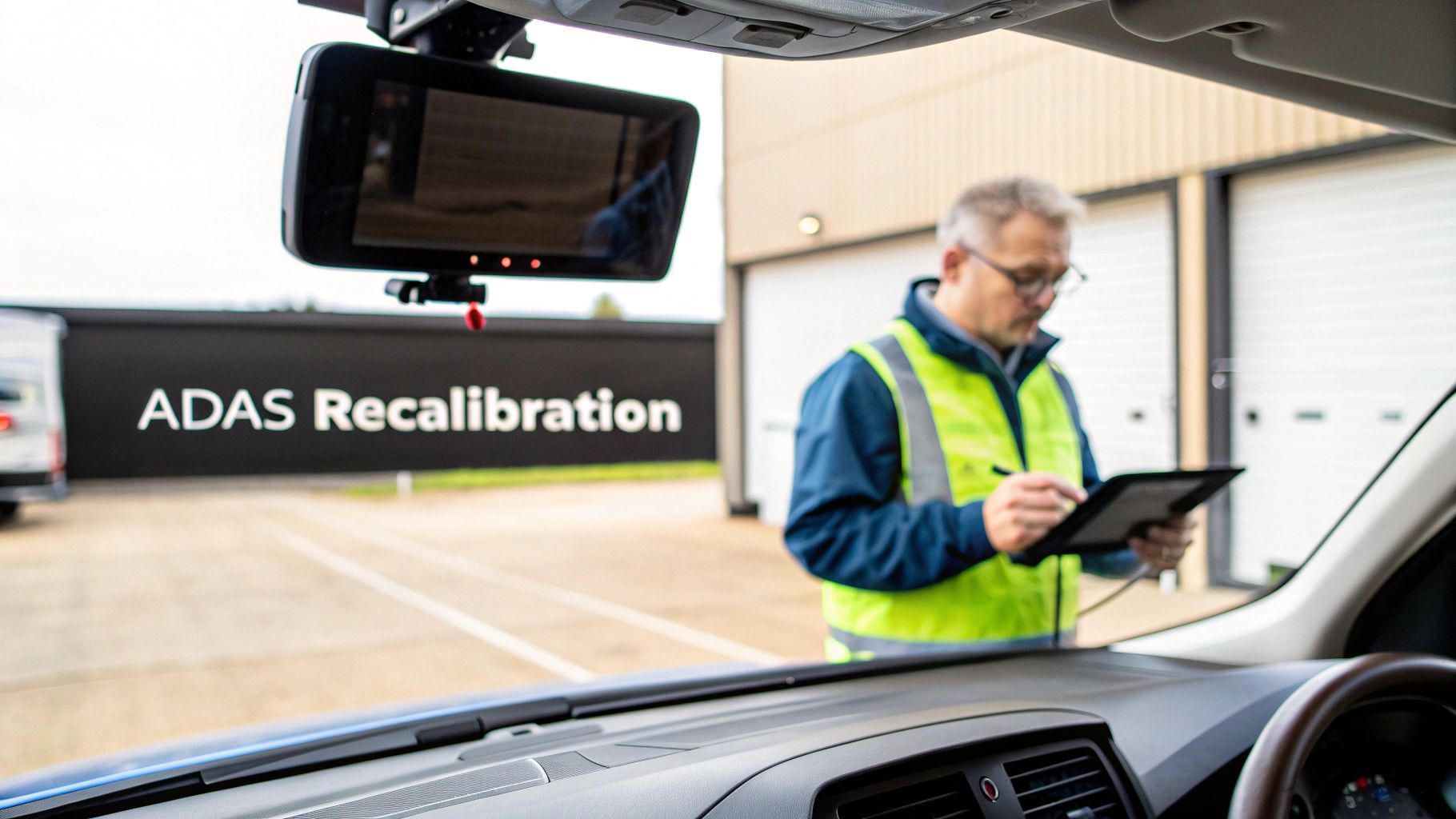
So, when that glass gets replaced, you're not just swapping out a window. You're temporarily displacing the eyes of your car's safety brain. That's why the job isn't finished until a proper ADAS (Advanced Driver-Assistance Systems) recalibration is performed.
Even with a perfect OEM windshield, tiny, microscopic variations exist. When the camera is put back on the new glass, its angle can be off by just a fraction of a degree. It sounds like nothing, but out on the road, that tiny shift can lead to huge problems.
The Real-World Danger of a Misaligned System
Let’s get practical. Imagine the camera for your lane-keeping assist is off by just one degree. At 100 yards down the highway, your car could be misjudging its position by several feet. This could mean the system fails to warn you when you drift, or worse, it could actively steer you into the shoulder or an adjacent lane.
Think about the automatic emergency braking system, too. It’s calibrated to calculate stopping distances with surgical precision. If that camera's view is skewed, it might not recognize a stopped car or a pedestrian until it's too late. These aren’t just theoretical what-ifs; they are the documented consequences of skipping a crucial safety procedure.
A new windshield without a proper ADAS recalibration is like getting a new pair of prescription glasses but keeping your old lenses. The frame looks great, but your view of the world is dangerously off. Your car's safety systems are trying to navigate with the wrong prescription.
How Recalibration Puts Things Right
Recalibration is the process of realigning your ADAS cameras and sensors so they function exactly as the manufacturer designed them to. It's not a suggestion; it's a requirement. Certified technicians use highly specialized tools and targets to reteach the car's computer how to see clearly through its new windshield.
There are two main ways this is done:
Static Recalibration: This happens in a controlled shop setting. A technician sets up a specific target board at a precise distance from the vehicle and uses diagnostic software to align the camera perfectly.
Dynamic Recalibration: This involves a road test where a technician drives the vehicle at certain speeds on clearly marked roads. The system uses the lane markings and other real-world data to recalibrate itself on the fly.
Many newer cars, especially from brands like Mercedes, Porsche, and Audi, need both static and dynamic methods to get the calibration just right. For a deeper dive, our guide on ADAS calibration after windshield replacement breaks down the entire process.
Expertise Is More Important Than Ever
The need for this specialized service is exploding. The global market for automotive glass replacement is expected to jump from USD 37.08 billion in 2024 to USD 40.55 billion in 2025—a 9.4% leap in just one year. This isn't just because more cars are on the road; it's because of the rapid integration of technologies like ADAS.
With electric vehicles projected to make up half of new U.S. sales by 2030, this trend is only accelerating. You can discover more insights about these automotive glass market trends to see why finding certified expertise is no longer optional.
For technologically advanced vehicles, like any Tesla with its complex Autopilot system, skipping recalibration is simply not an option. It’s a mandatory final step to ensure your car is as safe as the day it left the factory.
Breaking Down the Costs, Insurance, and Timeline
So, you've decided a replacement is the right move. The next big questions are usually about money and time. How much will this set me back? Will insurance cover it? How long until I can drive my car again?
Getting answers to these practical questions is just as important as the technical side of the job. The final price isn't a simple, flat rate—it really depends on your specific car and the kind of technology built into the glass.
The biggest factor, hands down, is your vehicle's make and model. A basic windshield for an older sedan is a completely different animal than the high-tech glass on a new luxury SUV.
Beyond the car itself, the features embedded in the glass make a huge difference. Many modern windshields come with advanced tech, such as:
Rain sensors that turn your wipers on automatically.
Heating elements that melt ice and frost in a flash.
Acoustic interlayers to keep the cabin quiet.
Heads-up display (HUD) projections, which require specially coated glass.
Each of these additions adds to the manufacturing complexity and, ultimately, the cost. For a deeper dive into pricing, our guide on the cost to replace a windshield lays out all the details.
Estimated Windshield Replacement Costs by Vehicle Type
To give you a clearer picture, here’s a general breakdown of what you might expect to pay for a replacement based on your vehicle type. Keep in mind that these are just estimates; your final quote will depend on the specific features your vehicle has.
Vehicle Category | Standard Windshield Est. Cost | Windshield with ADAS Features Est. Cost |
|---|---|---|
Sedans/Coupes | $300 - $500 | $700 - $1,100 |
SUVs/Crossovers | $400 - $600 | $800 - $1,400 |
Trucks | $350 - $550 | $750 - $1,300 |
Luxury Vehicles | $600 - $1,000 | $1,200 - $2,500+ |
As you can see, the presence of ADAS cameras and other sensors significantly impacts the price, not just because the glass is more expensive but also due to the required recalibration services after installation.
How Insurance Can Help with the Bill
Here’s the good news: your auto insurance policy will very likely cover a large chunk of the replacement cost, if not all of it. Windshield replacement almost always falls under your policy’s comprehensive coverage, which is designed for damage from things other than a collision, like a rock hitting your glass on the highway.
Before you schedule the work, you'll want to understand what is deductible in insurance and how it applies to your situation. This is the amount you’re responsible for paying before the insurance company steps in. Some policies even have a zero-deductible option for glass damage, which is a huge relief.
Filing a claim is typically a smooth process. Here at Auto Renu Auto Glass LLC, we work directly with all major insurance providers. We'll help you confirm your coverage and handle the claims paperwork, taking that stress right off your plate.
How Long Does It Really Take?
While a skilled technician can often get the old windshield out and the new one in within 60 to 90 minutes, the job isn’t finished yet. The most important part of the timeline comes after the glass is installed: the adhesive curing period.
We call this the Safe Drive-Away Time (SDAT), and it's non-negotiable. This is the minimum time needed for the powerful urethane adhesive to cure enough to meet federal safety standards.
A properly cured seal is what ensures your windshield will:
Provide critical support for the passenger-side airbag if it deploys.
Keep the roof from collapsing in a rollover accident.
Stay firmly in place during a collision.
Cutting this time short is a serious safety gamble. Depending on the type of adhesive used and the day's temperature and humidity, the SDAT can be anywhere from 30 minutes to a few hours. Your technician will give you a precise time, and it’s crucial to follow it.
Why Mobile Service and Certified Expertise Make All the Difference
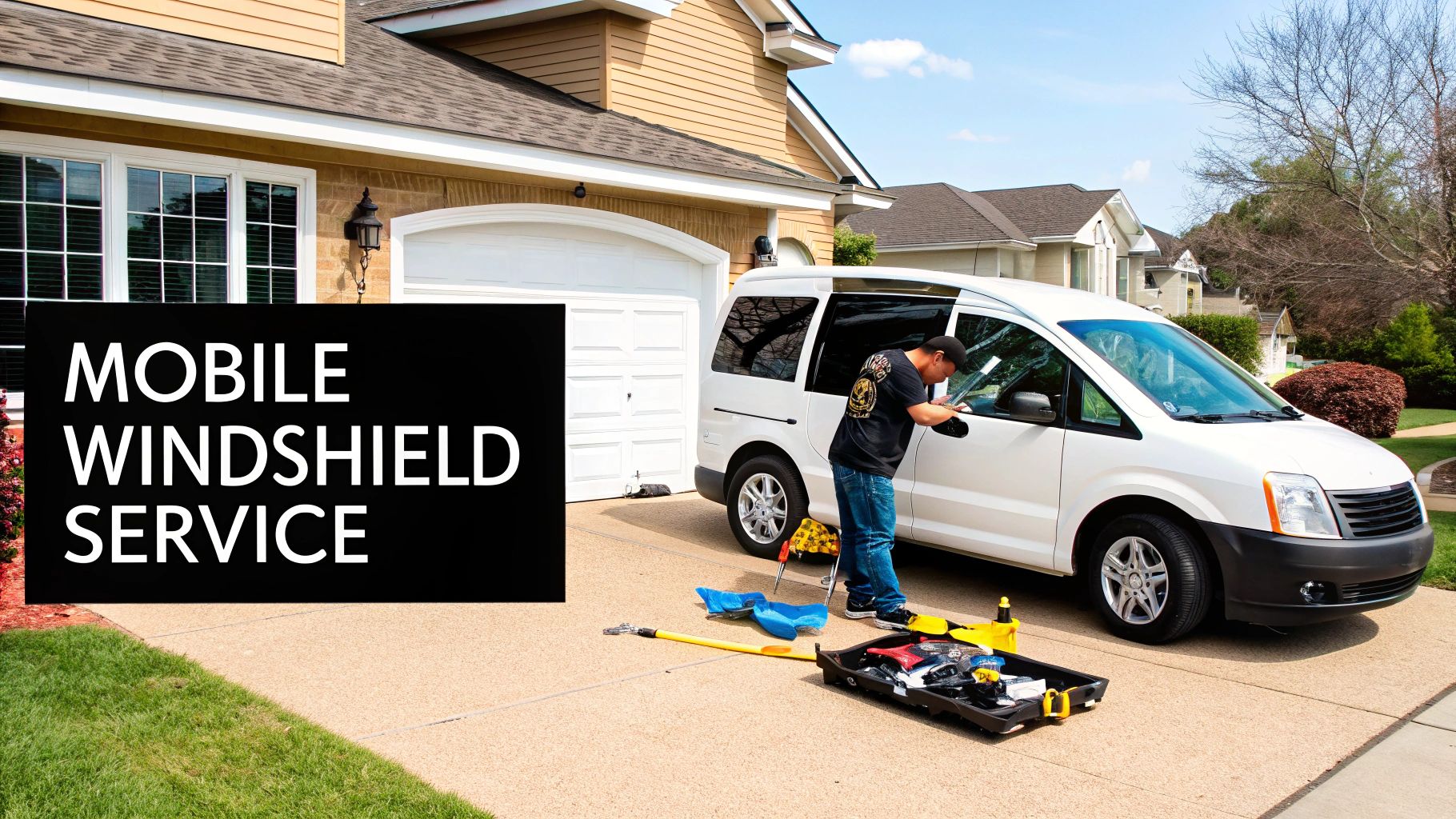
Life doesn’t stop for a cracked windshield. Between work, family, and everything else on your plate, spending half your day in a repair shop waiting room is the last thing you need. Dropping your car off for a windshield replacement can throw your entire schedule into chaos. This is exactly why mobile auto glass service has become such a lifesaver.
Choosing a mobile specialist isn't just about convenience, though. It's about getting top-tier, certified expertise delivered right to your doorstep—whether that's your office, your home, or even a job site where your company's fleet is parked.
Unmatched Convenience for Your Hectic Life
For busy professionals, time is money. A mobile service like Auto Renu Auto Glass LLC gives you back those hours you’d otherwise lose driving to a shop, waiting around, and then heading back. Your windshield replacement happens in the background while you get on with your life.
Picture this: you spot a massive crack spreading across your windshield on the way to work. Instead of panicking, you just schedule a mobile appointment. A technician meets you in your office parking lot that afternoon, replaces the glass while you’re finishing a report, and your car is safe and ready to go by 5 p.m. You experience zero interruption to your day.
This is what turns a major headache into a minor inconvenience. Our deep dive into mobile windshield replacement service shows just how perfectly this on-demand model works for today's world.
Keeping Your Business on the Road
If you manage a fleet of vehicles, downtime isn't just an annoyance—it's a direct hit to your revenue. Every hour a service truck or delivery van is off the road for a repair, it’s not making you money. This is a huge pain point for any business that relies on its fleet.
Mobile service is the perfect answer. Rather than taking multiple vehicles out of commission and sending them to a shop, we bring the shop to you.
Work Done On-Site: Our technicians can service several vehicles in one visit, right in your company lot.
Less Wasted Time: We can work on vehicles during their natural downtime, keeping your fleet ready to roll when you need it.
Simple Logistics: Forget about coordinating drivers to drop off and pick up vehicles. We handle it all right there.
This kind of rapid, on-location service keeps your business moving and protects your bottom line.
Choosing a mobile service with certified expertise means you're not trading quality for convenience. You're getting both—a professional, dealership-quality installation wherever you are, without the logistical nightmare.
The Guarantee of Safety and Certified Skill
At the end of the day, what matters most is knowing the job was done right. A certified mobile technician from a trusted company like Auto Renu Auto Glass LLC has the training to perform installations that meet—and often exceed—federal safety standards. We use the same high-quality glass and adhesives you'd find in the best brick-and-mortar shops.
This is a non-negotiable for insurance claims and anyone concerned about vehicle safety. A certified installation ensures:
The correct OEM or OEE glass is used for a flawless fit.
High-grade urethane adhesives are applied correctly for a bond as strong as the original factory seal.
ADAS systems are recalibrated whenever needed, ensuring your vehicle's safety features function perfectly.
Opting for a mobile expert isn't just a time-saver. It's about ensuring the structural integrity of your vehicle and the safety of everyone inside are fully restored by a qualified professional, right on your own turf.
A Few More Questions We Hear All the Time
Even after walking through the whole process, you probably still have a couple of questions. That’s completely normal. When it comes to your vehicle’s safety, you should feel 100% confident. We've put together some of the most common questions our customers ask us every day to give you fast, straight-up answers.
This is where we clear up any final worries you might have. We’ll cover everything from how long you'll actually be without your car to how insurance claims and our warranty work. You deserve to have all the facts.
How Long Does a Windshield Replacement Really Take?
There are two parts to this answer, and they're both important. The hands-on work—a certified technician carefully removing your old windshield and fitting the new one—usually takes about 60 to 90 minutes. For an experienced pro, it’s a very precise and efficient job.
But the work isn't over when the tools go back in the truck. The most critical part of the whole process is waiting for the adhesive to cure. We call this the Safe Drive-Away Time (SDAT). This is how long it takes for the powerful urethane sealant to harden enough to meet federal safety standards. Depending on the adhesive we use and the weather that day, this can be anywhere from 30 minutes to a few hours. We always opt for premium, fast-curing adhesives to get you back on the road sooner, and our technician will give you an exact time when your car is safe to drive.
Will My Insurance Rates Go Up if I File a Windshield Claim?
This is a huge worry for a lot of people, but the good news is that in nearly every case, the answer is no. Filing a windshield claim under your comprehensive coverage is almost always considered a "no-fault" incident. A rock flying up from the highway is completely out of your control, so insurers don't typically penalize you for it.
In fact, many auto insurance policies even have a low or zero-deductible for glass replacement, which makes it even easier. At Auto Renu Auto Glass LLC, we work directly with all major insurance providers. We can help you navigate the claims process and confirm your exact coverage before we even start the work.
Our Experience Shows: A windshield claim under your comprehensive policy is highly unlikely to affect your insurance premiums. This coverage is specifically designed for damage from road hazards and other things you can't control.
Is Aftermarket Glass Just as Good as the Original (OEM)?
That's an excellent question, and one we get all the time. Let’s quickly break down the lingo:
OEM (Original Equipment Manufacturer): This is the exact same glass your car had when it rolled off the assembly line. It’s made by the company that supplies the parts to your car’s manufacturer.
OEE (Original Equipment Equivalent): This is top-quality aftermarket glass made by other reputable manufacturers. The crucial thing to know is that OEE glass must meet the very same strict federal safety standards for strength, clarity, and fit as OEM glass.
For most installations, we use premium OEE glass because it provides a perfect fit and safe, reliable performance at a great value. However, some newer vehicles with highly sensitive ADAS cameras can be finicky. In those specific cases, we might recommend OEM glass to ensure the systems recalibrate and perform flawlessly.
What Kind of Warranty Do You Offer?
We're confident in our materials and the expertise of our technicians, so we stand behind our work completely. Auto Renu Auto Glass LLC provides a lifetime warranty on every single windshield installation for as long as you own the vehicle.
This warranty covers any defects in the materials or our workmanship. If you ever notice a water leak, hear wind noise, or see a problem with the molding that stems from our installation, just give us a call and we'll make it right. Our goal is for you to drive away with total peace of mind, knowing the job was done correctly and is guaranteed to last.
Ready for a professional windshield replacement that comes right to your door? Trust the certified experts at Auto Renu Auto Glass LLC to get you back on the road safely and quickly. Schedule your mobile service today by visiting us at https://www.autorenu911.com.